100% FREE ACCESS
9th Standard CBSE Syllabus & Materials
9th Standard CBSE
CBSE 9th Science Is matter around us pure? - New Model Questions Papers Study Material - QB365 Set A
NEW9th Standard CBSE
CBSE 9th Science Matter in our surroundings - New Model Questions Papers Study Material - QB365 Set A
NEW9th Standard CBSE
CBSE 9th Mathematics Heron's Formula Sample Question Papers Study Material - QB365 Set A
NEW9th Standard CBSE
CBSE 9th Mathematics Circles Sample Question Papers Study Material - QB365 Set A
NEW9th Standard CBSE
CBSE 9th Mathematics Quadrilaterals Sample Question Papers Study Material - QB365 Set A
NEW9th Standard CBSE
CBSE 9th Mathematics Triangles Sample Question Papers Study Material - QB365 Set A

Published on: 29/10/2025
Download CBSE Class 9th Standard CBSE Mathematics question papers, sample papers, important questions, and previous year solved papers in PDF format. Get free study materials, NCERT solutions, and exam preparation resources for Class 9th Standard CBSE Mathematics
Questions + Answers key
Take MCQ Mathematics Test
1.
Show that of all line segments drawn from a given point not on it, the perpendicular line segment is the shortest.
2.
A field is in the shape of a trapezium whose parallel sides are 25 m and 10 m. The non-parallel sides are 14 m and 13 m. Find the area of the field.
3.
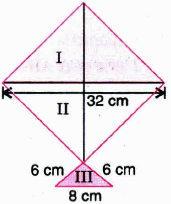
A kite in the shape of a square with a diagonal 32 cm and an isosceles triangle of base 8 cm and side 6cm each is to be made of three different shades as shown in figure. How much paper of each shade has been used in it?
4.
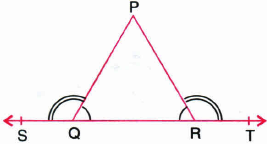
In figure \(\angle \)PQR =\(\angle \)PRQ then prove that \(\angle \) PQS =\(\angle \)PRT
5.
In an isosceles triangle ABC, with AB = AC, the bisectors of LB and LC intersect each other at O. Join A to O. Show that:
(i) OB = OC
(ii) AO bisects ∠A
6.
If two lines intersect each other, then the vertically opposite angles are equal. prove it
7.
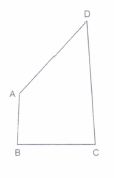
AB and CD are respectively the smallest and longest sides of a quadrilateral ABCD (see figure). Show that ∠A > ∠C and ∠B > ∠D.
8.
Line segment AB is parallel to another line segment CD. 0 is the mid-point of AD. Show that
(i) ΔAOB ≅ ΔDOC
(ii) O is also the mid-point of BC
9.
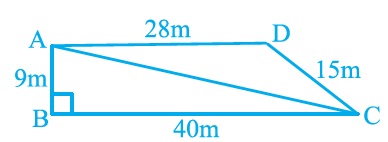
Students of a school staged a rally for cleanliness campaigp. They walked through the lanes in two groups. One group walked through the lanes AB, BC and CA; while the other through AC, CD and DA. Then they cleaned the area enclosed within their lanes. If AB = 9 m, BC = 40 m, CD = 15 m, DA = 28 m and \(\angle B=90°\) , which group cleaned more area and by how much? Find the total area cleaned by the students.
10.
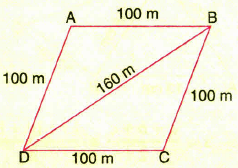
Sanya has a piece of land which is in the shape of a rhombus. She wants her one daughter and one son to work on the land and produce different crops to suffice the needs of their family. She divided the land in two equal parts. If the perimeter of the land is 400 m and one of the diagonals is 160 m, how much area each of them will get?
11.
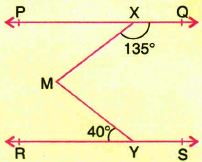
In the figure if PQ || RS, \(\angle MXQ=135^{ 0 }\) and \(\angle MYR=40^{ 0 }\) find \(\angle \) XMY
12.
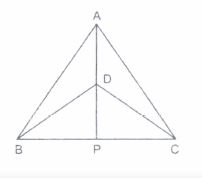
ΔABC and ΔDBC are two isosceles triangles on the same base BC and vertices A and D are on the same side of BC (see figure}.If is extended to intersect BC at P. show that
(i ) ΔABD ≅ ΔACD
(ii) ΔABP ≅ ΔACP
iii) AP bisects ∠A as well as ∠D
(iv) AP is the perpendicular bisector of BC.
13.
In the adjoining figure, POQ is a line. Ray OR is perpendicular to line PQ. OS is another ray lying between rays OP and OR. Prove that ∠ROS = \(\frac{1}{2}\) (∠QOS - ∠POS).
14.
A triangle and a parallelogram have the same base and the same area. If the sides of the triangle are 26 cm, 28 cm and 30 cm and the parallelogram stands on the base 28 cm, find the height of the parallelogram.
15.
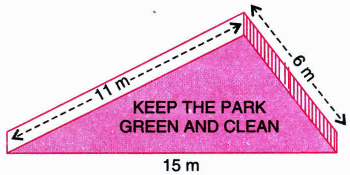
There is a slide in a park. One of its side walls has been painted in some colour with a message 'KEEP THE PARK GREEN AND CLEAN'. If the sides of the wall are 15 m, 11 m and 6 m, then find the area painted in colour.
1.
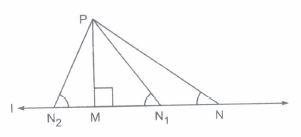
Let us consider the ΔPMN such that ∠M = 90о
Since, ∠M + ∠N + ∠P = 180о
[Sum of angles of a triangle]
∵ ∠M = 90о [∵ PM ⊥ ℓ ]
⇒ ∠N< ∠M
⇒ PM < PN ... (1)
Similarly, PM < PN1 ,.. (2)
PM < PN2 ...(3)
From (1), (2) and (3). we have PM is the smallest line segment drawn from P on the line l . Thus, the perpendicular segment is the shortest line segment drawn on a line from a point not on it.
2.
Let the given field be in the shape of a trapezium ABCD in which AB=25 m, CD= 10 m, BC = 13 m and AD = 14 m.
From D, draw DE 11 BC meeting AB at E. Also, draw DF \(\bot \) AB.
\(\therefore \) DE = BC =13 m
AE = AB - EB = AB - DC
= 25 - 10 = 15 m
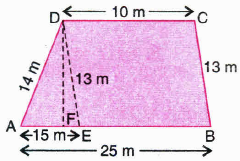
For AED
a = 14 m, b = 13 m, c= 15 m
\(\therefore s=\frac { a+b+c }{ 2 } =\frac { 14+13+15 }{ 2 } =\frac { 42 }{ 2 } =21\) m
\(\therefore \) Area of the \(\Delta \)AED \(=\sqrt { s(s-a)(s-b)(s-c) } \)
\(=\sqrt { 21(21-14)(21-13)(21-15) }\)
\( \\ =\sqrt { 21(7)(8)(6) } =\sqrt { \left( 7\times 3 \right) (7)\left( 4\times 2 \right) \left( 2\times 3 \right) } \)
\(=7\times 3\times 2\times 2=84\) m2
\(\Rightarrow \frac { 1 }{ 2 } \times \)AE\(\times \)DE = 84
\(\Rightarrow \ \frac { 1 }{ 2 } \times \)15\(\times \)DF = 84
\(\Rightarrow \) DF = \(\frac { 84\times 2 }{ 15 } \)
\(\Rightarrow \) DF= \(\frac { 56 }{ 5 } \) m = 11.2 m
\(\Rightarrow\) Height of the trapezium is 11.2 m.
\(\therefore \) Area of parallelogram EBCD = Base \(\times \) Height
= EB\(\times \) DF = 10 \(\times \)\(\frac { 56 }{ 5 } \) = 112 m2
\(\therefore \) Area of the field = Area of AED + Area of parallelogram EBCD = 84 m2 + 112 m2 = 196 m2.
3.
Area of paper of shade I \(2\times \left( \frac { 1 }{ 2 } \times 16\times 16 \right) =256\)cm2
Similarly, Area of paper of shade II = 256 cm2
For area of paper of shade III
a = 8 cm, b = 6 cm, c = 6cm
\(\therefore s=\frac { a+b+c }{ 2 } =\frac { 8+6+6 }{ 2 } =10\) cm
\(\therefore \) Area of paper of shade III = \(\sqrt { s(s-a)(s-b)(s-c) } \)
\(=\sqrt { 10(10-8)(10-6)(10-6) } \)
\(=\sqrt { (10)(2)(4)(4) } =8\sqrt { 5 } \)
= 17.89 cm2
4.
\(\therefore \)Ray QP stands on line ST
\(\therefore \) \(\angle \)PQS +\(\angle \)PQR = \(180^{ 0 }\)
|Linear Pair Axiom
Ray RP stands on line ST
\(\therefore \) \(\angle \)PRQ +\(\angle \)PRT= \(180^{ 0 }\)
| Linear Pair Axiom
From (1) and (2) we obtain
\(\angle \)PQS+\(\angle \)PQR =\(\angle \)PRQ +\(\angle \)PRT
\(\Rightarrow \)\(\angle \) PQS =\(\angle \)PRT
\(\therefore \) \(\angle \)PQR=\(\angle \)PRQ(Given)
5.
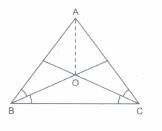
(i) In ABC, we have
AB = AC [Given]
∴ ∠C = ∠B
[Angle opposite to equal sides are equal]
⇒ \(\frac{1}{2}\)∠C = \(\frac{1}{2}\)∠B
or ∠OCB = ∠OBC
⇒ OB = OC
[Sides opposite to equal angles are equal]
(ii) In ΔABO and ΔACO, we have
AB =AC [Given]
OB = OC [Proved
∠OBA = ∠OCA [∵ \(\frac{1}{2}\)∠B-\(\frac{1}{2}\)∠C]
∴ Using SAS criteria,
ΔABO =ΔACO
⇒ ∠OAB = ∠OAC [c.p.c.t.]
⇒ AO bisects LA.
6.
Let AB and CD two lines intersecting at O
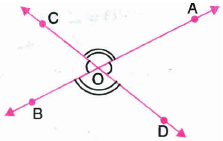
This leads to two pairs of vertically opposite angles,namely
(i) \(\angle \)AOC and \(\angle \)BOD
(II) \(\angle \)AOD and \(\angle \)BOC
We are to prove that
(i) \(\angle \)AOC and \(\angle \)BOD
(II) \(\angle \)AOD and \(\angle \)BOC
\(\therefore \) Ray OA stands on line CD
Therefore (i) \(\angle \)AOC and \(\angle \)AOD=\(180^{ 0 }\)
|Linear Pair Axiom
From (1) and (2)
\(\angle \)AOC and \(\angle \)AOD= \(\angle \)AOD and \(\angle \)BOD \(\angle \)AOC and \(\angle \)BOD
\(\Rightarrow \) Similarly we can prove that
\(\angle \)AOD and \(\angle \)BOC
7.
.JPG)
Let us join AC.
Now, in ΔABC AB < BC
[∵ AB the smallest side of quadrilateral ABCD]
BC >AB
[Angle opposite to BC] < [Angle opposite to AB]
∠BAC > ∠BCA ... (1)
Again in ΔACD,
CD > AD
[∵ CD is the longest side ofthe quadrilateral ABCD]
∴ [Angle opposite to CD] > [Angle opposite to AD]
⇒ ∠CAD > ∠ACD ...(2)
Adding (1) and (2), we get
[∠BAC + CAD] > [∠BCA + ∠ACD]
⇒ ∠A > ∠C
Similarly, by joining BD, we have
∠B > ∠D
8.
Given AB॥CD and O is the mid-point of AD.
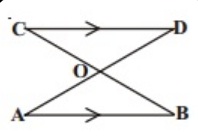
∴ AO = OD
To prove (i) ΔAOB ≅ ΔDOC
(ii) O is also the mid-point of BC, ie OB = OC
Proof (i) In ΔAOB and ΔDOC,
ㄥABO =ㄥDCO [alternate angles as AB ‖ CD and BC is a transversal line]
ㄥAOB = ㄥDOC [vertically opposite angles]
and OA = OD [from Eq. (i)]
∴ ㄥAOB ≅ ΔDOC [by AAS congruence rule]
(ii) Bty using corresponding part of congruent triangles, we get
OB = OC
Hence, O is also the mid-point of BC.
9.
Since AB = 9 m and BC = 40 m, Ð B = 90°, we have
\( \mathrm{AC} =\sqrt{9^{2}+40^{2}} \mathrm{~m} \)
\(=\sqrt{81+1600} \mathrm{~m} \)
\(=\sqrt{1681} \mathrm{~m}=41 \mathrm{~m} \)
Therefore, the first group has to clean the area of triangle ABC, which is right angled.
\(Area of \Delta \mathrm{ABC}=\frac{1}{2} \times base \times height \)
\(=\frac{1}{2} \times 40 \times 9 \mathrm{~m}^{2}=180 \mathrm{~m}^{2} \)
The second group has to clean the area of triangle ACD, which is scalene having sides 41 m, 15 m and 28 m.
Here, \(s=\frac{41+15+28}{2} \mathrm{~m}=42 \mathrm{~m}\)
Therefore, area of \(\Delta \mathrm{ACD}=\sqrt{s(s-a)(s-b)(s-c)}\)
\(=\sqrt{42(42-41)(42-15)(42-28)} \mathrm{m}^{2} \)
\( =\sqrt{42 \times 1 \times 27 \times 14} \mathrm{~m}^{2}=126 \mathrm{~m}^{2} \)
So first group cleaned 180 m2 which is (180 – 126) m2, i.e., 54 m2 more than the area cleaned by the second group.
Total area cleaned by all the students = (180 + 126) m2 = 306 m2.
10.
Let ABCD be the field.
Perimeter = 400 m
So, each side = 400 m ÷ 4 = 100 m.
i.e. AB = AD = 100 m.
Let diagonal BD = 160 m.
Then semi-perimeter s of D ABD is given by
\(s=\frac{100+100+160}{2} \mathrm{~m}=180 \mathrm{~m}\)
Therefore, area of \(\Delta \mathrm{ABD}=\sqrt{180(180-100)(180-100)(180-160)}\)
\(=\sqrt{180 \times 80 \times 80 \times 20} \mathrm{~m}^{2}=4800 \mathrm{~m}^{2}\)
Therefore, each of them will get an area of 4800 m2.
11.
Here, we need to draw a line AB parallel to line PQ, through point M as shown in Fig. Now, AB || PQ and PQ || RS.
Therefore, AB || RS
Now, \(\angle\) QXM + \(\angle\) XMB = 180°
(AB || PQ, Interior angles on the same side of the transversal XM)
But \(\angle\) QXM = 135°
So, 135° + \(\angle\) XMB = 180°
Therefore, \(\angle\) XMB = 45° (1)
Now, \(\angle\) BMY = \(\angle\) MYR (AB || RS, Alternate angles)
Therefore, \(\angle\) BMY = 40° (2)
Adding (1) and (2), you get
\(\angle\) XMB + \(\angle\) BMY = 45° + 40°
That is, \(\angle\) XMY = 85°
12.
(i) In ΔABD and ΔACD. we have
AB = AC [Given]
AD = AD [Common]
BD = CD [Given]
∴ ΔABD ≅ ΔACD [SSS Criteria]
(ii) In ΔABP and ΔACP, we have
AB = AC [Given]
∴ AB = AC⇒ ∠B = ∠C
[∵ Angle opposite to equal sides are equal]
AP = AP [Common]
∴ ΔABP ≅ ACP [SAS Criteria]
(iii) Since, ΔABP ≅ ΔACP
∴ Their corresponding parts are congruent.
⇒ ∠BAP = ∠CAP
∴ AP is the bisector of ∠A ...(1)
Again, in ΔBDP and ΔCDP, we have
BD = CD [Given]
∠DBP = ∠CDP [Angles opposite to equal sides]
DP = DP [Common]
⇒ ∠BDP = ∠CDP
∴ ∠BDP = ∠CDP [c.p.c.t.]
⇒ DP (or AP) is the bisector of ∠D. ...(2)
From (1) and (2) AP is the bisector of ∠A as well as ∠D.
(ii) ∴ ΔABP ≅ ΔACP
∴ Their corresponding parts are equal.
⇒ ∠APB = ∠APC
But ∠APB + ∠APC = 180० [Linear pair]
∴ ∠APB = ∠APC = 90०
⇒ AP ⊥ BC
⇒ AP is the perpendicular bisector of BC
13.
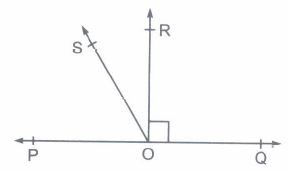
∵ POQ is a straight line. [Given]
∴ ∠POS + ∠ROS + ∠ROQ = 180о
But OR ⊥ PQ
∴ ∠ROQ = 90о
∴ ∠POS + ∠ROS + 90о = 180o
⇒ ∠POS + ∠ROS = 90о
Now, we have ∠ROS + ∠ROQ = ∠QOS ...(1)
⇒ ∠ROS + 90о = ∠QOS ...(2)
From (1) and (2), we have
∠ROS + [∠POS + ∠ROS] = ∠QOS
⇒ 2∠ROS + ∠POS = ∠QOS
⇒ 2∠ROS = [∠QOS - ∠POS]
∴ ∠ROS = \(\frac{1}{2}\)[∠QOS - ∠POS]
14.
Let the sides of triangle be a = 26 cm, b = 28 cm and c = 30 cm. Let s be the semi-perimeter of the triangle
Then,
\(s=\frac{a+b+c}{2}=\frac{26+28+30}{2}=\frac{84}{2}=42cm\)
and area of triangle \(=\sqrt{s(s-a)(s-b)(s-c)}\)
\(=\sqrt{42\times(42-26)(42-28)(42-30)}\)
\(=\sqrt{42\times16\times14\times12}\)
\(=\sqrt{7\times6\times16\times7\times2\times6\times2}=336cm^2\)
Let h be the height of the parallelogram.
Then, area of parallelogram = base x height = 28 x b
∵ area of parallelogram =Area of triangle
ஃ \(28\times b=336\Rightarrow b=\frac{336}{28}\Rightarrow b=12cm\)
Hence, the height of the parallelogram is 12 cm.
15.
Let given sides of the wall be a = 15m, b = 11m and c = 6 m.
ஃ Semi-perimeter, \(s=\frac{a+b+c}{2}=\frac{15+11+6}{2}=\frac{32}{2}=16m\)
Now, area of the wall= \(=\sqrt{s(s-a)(s-b)(s-c)}\)
\(=\sqrt{16(16-15)(16-11)(16-6)}\)
\(=\sqrt{16\times1\times5\times10}=\sqrt{4\times4\times5\times5\times2}=5\times4\sqrt2\)
\(=20\sqrt{2}m^2\)
Hence, the area painted in colour is \(=20\sqrt{2}m^2\)

9th Standard CBSE Syllabus & Materials
9th Standard CBSE
CBSE 9th Mathematics Lines and Angles Sample Question Papers Study Material - QB365 Set A
NEW9th Standard CBSE
CBSE 9th Mathematics Introduction to Euclid's Geometry Sample Question Papers Study Material - QB365 Set A
NEW9th Standard CBSE
CBSE 9th Mathematics Linear Equations in Two Variables Sample Question Papers Study Material - QB365 Set A
NEW9th Standard CBSE
CBSE 9th Mathematics Coordinate Geometry Sample Question Papers Study Material - QB365 Set A



NCERT Books

Syllabus

Exam Pattern

Sample Question Papers

Previous year Question Papers

Important Notes

MCQ Practice test

NCERT Exemplers

Case study Questions

Image Based Questions

Passage based Questions

HOT Questions

Value Based Questions

Model Questions Papers
NCERT ( Book Back ) Questions

Assertion and Reason
Important Questions And Answers

CBSE 9th Standard CBSE Subjects
CBSE Standards