100% FREE ACCESS
9th Standard CBSE Syllabus & Materials
9th Standard CBSE
CBSE 9th Science Is matter around us pure? - New Model Questions Papers Study Material - QB365 Set A
NEW9th Standard CBSE
CBSE 9th Science Matter in our surroundings - New Model Questions Papers Study Material - QB365 Set A
NEW9th Standard CBSE
CBSE 9th Mathematics Heron's Formula Sample Question Papers Study Material - QB365 Set A
NEW9th Standard CBSE
CBSE 9th Mathematics Circles Sample Question Papers Study Material - QB365 Set A
NEW9th Standard CBSE
CBSE 9th Mathematics Quadrilaterals Sample Question Papers Study Material - QB365 Set A
NEW9th Standard CBSE
CBSE 9th Mathematics Triangles Sample Question Papers Study Material - QB365 Set A

Published on: 29/10/2025
Download CBSE Class 9th Standard CBSE Mathematics question papers, sample papers, important questions, and previous year solved papers in PDF format. Get free study materials, NCERT solutions, and exam preparation resources for Class 9th Standard CBSE Mathematics
Questions + Answers key
Take MCQ Mathematics Test
1.
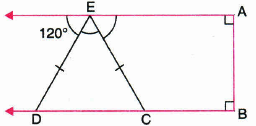
In figure, AB 丄 AE, BC 丄 AB, CE =DE and ㄥAED = 120°. Find
(a) ㄥ EDC
(b) ㄥDEC
(c) Hence prove that EDC is an equilateral triangle.
2.
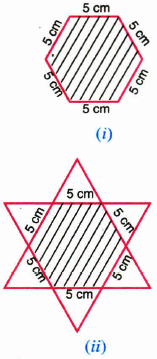
Complete the hexagonal and star shaped Rangolies [see figures (i) and (ii)] by filling them with as many equilateral triangles of side 1em as you can.Count the number of triangles in each case.Which has more triangles?
3.
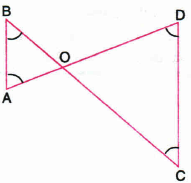
In figure, ㄥB < ㄥA and ㄥC < ㄥD. Show that AD < BC.
4.
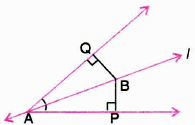
Line l is the bisector of an angle\(\angle A\) and \(\angle B\) is any point on I.BP and BQ are perpendiculars from B to the arms of \(\angle A\) (see figure). Show that:
(i) \(\triangle APB\cong \triangle AQB\)
(ii) BP = BQ or B is equidistant from the arms of \(\angle A\)
5.
In an isosceles triangle ABC, with AB = AC, the bisectors of LB and LC intersect each other at O. Join A to O. Show that:
(i) OB = OC
(ii) AO bisects ∠A
6.
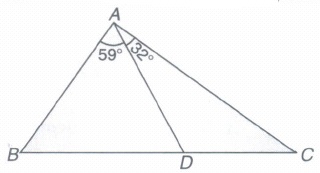
In the given figure, AD = BD. Prove that BD < AC.
7.
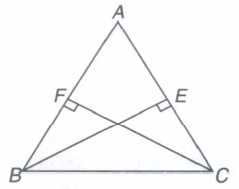
In figure, ABC is a triangle in which altitudes BE and CF to sides AC and AB respectively are equal.
Show that:
(i) \(\triangle ABE\cong \triangle ACF\)
(ii) AB = AC.
8.
Two friends Rahim and Meera constructed their houses in the same colony. Rahim wanted to make a bamboo stair to go on the roof of his house. He called a carpenter for taking a measurement of the stair to be constructed. He took the measurement and constructed. Now, Rahim's friend Meera desires to have a stair for her roof. She measures the heights of the two buildings and finds that they are the same. What criterion of congruence can use to make her bamboo stair without taking measurement of the bamboo stair equal. Show that the length of the stairs are equal. What value is depicted by this question?
9.
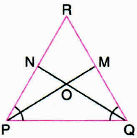
In figure, \(\angle QPR=\angle PQR\) and M and N are respectively points on sides QR and PR of \(\triangle PQR\) , such that QM = PN. Prove that OP = OQ, where O is the point of intersecting of PM and QN.
10.
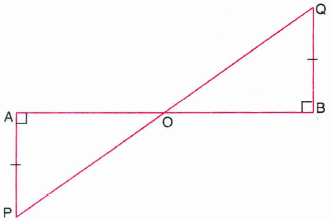
In figure, AP and BQ are perpendiculars to the line-segment AB and AP = BQ. Prove that O is the mid-point of line segments AB and PQ.
11.
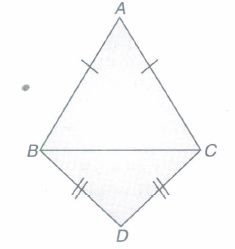
In the figure, \(\triangle\)ABC and \(\triangle\)DBC are two isosceles triangles on the same base BC Prove that \(\angle\) ABD = \(\angle\)ACD.
12.
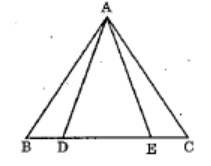
In the given figure, AD = AE and BD = EC. Prove that AB = AC.
13.
In ΔABC, if ㄥA = 50° and ㄥB = 60°, determine the shortest and the longest side of the triangle.
14.
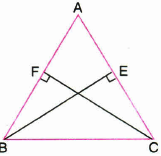
ABC is an isosceles triangle in which altitudes BE and CF are drawn to equal sides AC and AB respectively (see figure). Show that these altitudes are equal.
15.
In triangles ABC and PQR, AB = AC, ㄥC = ㄥPand ㄥB = ㄥQ. The two triangles are:
isosceles but not congruent
isosceles and congruent
congruent but not isosceles
neither isosceles nor congruent
16.
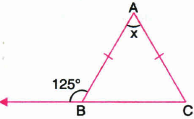
In figure, if AB = AC find x.
550
550
500
700
17.
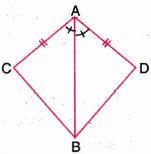
Which congruence rule is used to show ΔACB ≅ ADB?
ASA
SSS
AAS
SAS
18.
Two triangles are congruent, if two angles and the included side of one triangle are equal to two angles and the included side of other triangle. This rule is known as
SAS congruence rule
ASA congruence rule
SSS congruence rule
AAS congruence rule.
19.
ΔABC ≅ ΔPQR.If AB = 5cm, ㄥB = 400and ㄥA = 800, then which of the following is true?
QP = 5cm, ㄥP = 600
QP = 5cm, ㄥR = 600
QR = 5cm, ㄥR = 600
QR = 5cm, ㄥQ = 400
1.
(a) 600
(b) 600
2.
(i) Number of triangles = 25 x 6
= 25 + 25 + 25 + 25 + 25 + 25 = 150
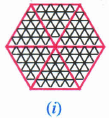
(ii) Number of triangles = 25 x 6 + 25 x 6
= 150 + 150
= 300
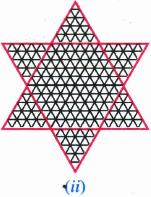
Figure (ii) has more triangles.
3.
Given: In figure,
ㄥB < ㄥA and ㄥC < ㄥD.
To Prove: AD < BC
Proof: ㄥB < ㄥA
ㄥA > ㄥB
OB> OA ...(1)
ㄥC < ㄥD
ㄥD > ㄥC
OC > OD ..(2)
| Side opposite to greater angle is longer
From (1) and 2), we get
OB+OC > OA+OD
⇒ BC> AD
⇒ AD < Be.
4.
Given: Line l is the bisector of an angle\(\angle A\) and \(\angle B\) is any point on I.BP and BQ are perpendiculars from B to the arms of \(\angle A\)
To Prove: (i) \(\triangle APB\cong \triangle AQB\)
(ii) BP = BQ or B is equidistant from the arms of \(\angle A\)
Proof: (i) In \(\triangle APB\) and \(\triangle AQB\)
\(\angle BAP=\angle BAQ \) | l is the bisector of \(\angle A\)
AB = AB | Common
\(\angle BAP=\angle BAQ \) | Each = 900
BP = BQ or B is equidistant from the arms of \(\angle A\)
\(\triangle APB\cong \triangle AQB\) | SAS Rule
(ii) \(\triangle APB\cong \triangle AQB\) | Proved in (i) above
BP = BQ | C.P.C.T
5.
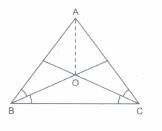
(i) In ABC, we have
AB = AC [Given]
∴ ∠C = ∠B
[Angle opposite to equal sides are equal]
⇒ \(\frac{1}{2}\)∠C = \(\frac{1}{2}\)∠B
or ∠OCB = ∠OBC
⇒ OB = OC
[Sides opposite to equal angles are equal]
(ii) In ΔABO and ΔACO, we have
AB =AC [Given]
OB = OC [Proved
∠OBA = ∠OCA [∵ \(\frac{1}{2}\)∠B-\(\frac{1}{2}\)∠C]
∴ Using SAS criteria,
ΔABO =ΔACO
⇒ ∠OAB = ∠OAC [c.p.c.t.]
⇒ AO bisects LA.
6.
AD = BD
\(\Rightarrow\) \(\angle\)ABD = \(\angle\)DAB = 590
(Angles opp. to equal sides are equal)
In \(\triangle\)ABD,
590 + 590 + \(\angle\)ADB = 1800
\(\Rightarrow\) \(\angle\)ADB = 1800- 1180 = 620
and \(\angle\)ACD = 620- 320 = 300
(Exterior angle is equal to the sum of interior opposite angles)
In \(\triangle\)ABD,
(Side opp. to greatest angle is the longest) 1
Also in \(\triangle\)ABC, AB < AC
BD < AC
7.
Let, BE\(\bot \)AC and CF\(\bot \)AB
In \(\triangle\)s ABE and ACF, we have
\(\angle\)AEB = \(\angle\)AFC (.: Each = 90°)
\(\angle\)A = \(\angle\)A (Common)
and BE = CF (Given)
\(\therefore\) By AAS criterion at congruence, we have
\(\triangle ABE\cong \triangle ACF\)
\(\Rightarrow\) AB = AC.
(\(\therefore\) Corresponding parts of congruent triangles are equal)
8.
Let AB be the height of Rahim's building. The length of his bamboo stair is AC. The carpenter places the foot of the stair at C at a distance of BC from the wall.
Then, MBC is a right angled triangle.
Also, let height of Me era's building be PQ, which is equal to AB, if she may keep the foot R of her stair at a same distance, i.e. at QR = BC
Also \(\angle ABC=\angle PQR=90^{ 0 }\)
AB = PQ
\(\triangle ABC\equiv \triangle PQR\)
[by SAS congruence rule]
Hence, she use SAS congruence rule to make her bamboo stair without taking measurement of the bamboo stair
Since \(\triangle ABC\equiv \triangle PQR\)
AC = PR [by CPCT]
Thus, length of the stairs are equal. Here, values depicted are friendly and cooperative nature between two friends ignoring their religion.
9.
Given: \(\angle QPR=\angle PQR\) and M and N are respectively points on sides QR and PR of \(\triangle PQR\) , such that QM = PN.
To prove: OP = OQ, where O is the point of intersecting of PM and QN.
Proof: In \(\triangle PNQ\) and \(\triangle QMP\)
PN = QM
PQ = QP
\(\angle QPN=\angle PQM\)
\(\triangle PNQ=\triangle QMP\) | SAS congruence rule
\(\angle PNQ=\angle QMB\) | C.P.C.T
Again, in \(\triangle PNO\) and \(\triangle QMO\)
PN = QM
\(\angle PON=\angle QOM\)
\(\angle PNO=\angle QMO\) | proved above
\(\triangle PNO\cong \triangle QMO\) | AAS congruence rule
OP = OQ | C.P.C.T
10.
In \(\triangle OAP\) and \(\triangle OBQ\)
AP = BQ
\(\angle OAP=\angle OBQ\)
\(\angle AOB=\angle BOQ\) | Vertically opposite angles
\(\triangle OAP\cong \triangle OBQ\) | AAS Rule
OA = OB | C.P.C.T
OP = OQ | C.P.C.T
O is the mid-point of line segments AB and PQ.
11.
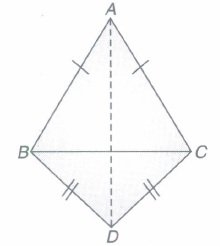
Join AD.
In \(\triangle\)ABC and \(\triangle\)ACD,
AB = AC (Given)
BD = CD (Given)
AD = AD (Common)
By using SSS Congruency Rule,
\(\triangle ABD\cong \triangle ACD\)
\(\therefore \angle ABD=\angle ACD (By c.p.c.t)\)
12.
Since, AD = AE
∴ ㄥADE=ㄥAD
[ ∵ angles opposite to equal sides of a triangle are equal]
Now, 1800 - ㄥADE = 1800-ㄥAED
⇒ ㄥADB =ㄥAEC ..(i)
Now, prove that ΔADB\(\cong \)ΔAEC with the help of Eq. (i) by SAS congruence rule, then show that AB = AC by CPCT.
13.
BC, AB
14.
Given: ABC is an isosceles triangle in which altitudes BE and CF are drawn to equal sides AC and AB respectively.
To Prove: BE = CF
Proof: ABC is an isosceles triangle
AB = AC
\(\angle ABC=\angle ACB\) | Angles opposite to equal sides of a triangle are equal
In \(\triangle BEC\) and \(\triangle CFB\)
\(\angle BEC=\angle CFB\) | Each = 900
BC = CB
\(\angle ECB=\angle FBC\)
\(\triangle BEC\cong \triangle CFB\) | By AAS Rule
BE = CF | C.P.C.T
15.
(a)
isosceles but not congruent
16.
(d)
700
17.
(d)
SAS
18.
Theorem
19.
(b)
QP = 5cm, ㄥR = 600

9th Standard CBSE Syllabus & Materials
9th Standard CBSE
CBSE 9th Mathematics Lines and Angles Sample Question Papers Study Material - QB365 Set A
NEW9th Standard CBSE
CBSE 9th Mathematics Introduction to Euclid's Geometry Sample Question Papers Study Material - QB365 Set A
NEW9th Standard CBSE
CBSE 9th Mathematics Linear Equations in Two Variables Sample Question Papers Study Material - QB365 Set A
NEW9th Standard CBSE
CBSE 9th Mathematics Coordinate Geometry Sample Question Papers Study Material - QB365 Set A



NCERT Books

Syllabus

Exam Pattern

Sample Question Papers

Previous year Question Papers

Important Notes

MCQ Practice test

NCERT Exemplers

Case study Questions

Image Based Questions

Passage based Questions

HOT Questions

Value Based Questions

Model Questions Papers
NCERT ( Book Back ) Questions

Assertion and Reason
Important Questions And Answers

CBSE 9th Standard CBSE Subjects
CBSE Standards