100% FREE ACCESS
9th Standard CBSE Syllabus & Materials
9th Standard CBSE
CBSE 9th Science Is matter around us pure? - New Model Questions Papers Study Material - QB365 Set A
NEW9th Standard CBSE
CBSE 9th Science Matter in our surroundings - New Model Questions Papers Study Material - QB365 Set A
NEW9th Standard CBSE
CBSE 9th Mathematics Heron's Formula Sample Question Papers Study Material - QB365 Set A
NEW9th Standard CBSE
CBSE 9th Mathematics Circles Sample Question Papers Study Material - QB365 Set A
NEW9th Standard CBSE
CBSE 9th Mathematics Quadrilaterals Sample Question Papers Study Material - QB365 Set A
NEW9th Standard CBSE
CBSE 9th Mathematics Triangles Sample Question Papers Study Material - QB365 Set A

Published on: 29/10/2025
Download CBSE Class 9th Standard CBSE Mathematics question papers, sample papers, important questions, and previous year solved papers in PDF format. Get free study materials, NCERT solutions, and exam preparation resources for Class 9th Standard CBSE Mathematics
Questions + Answers key
Take MCQ Mathematics Test
1.
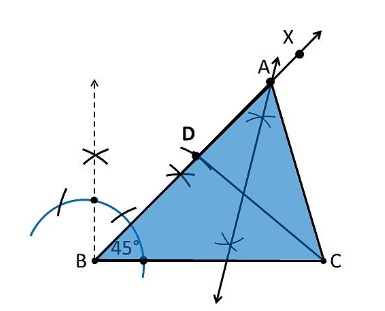
Construct a triangle ABC in which BC = 8 cm,ㄥB = 45o and AB - AC = 3.5 cm
2.
The length of 40 leaves of a plant are measured a correct one millimeter, and the obtained data is represented in the following table:
| Length (in mm) | Number of leaves |
| 118-126 | 3 |
| 127-135 | 5 |
| 136-144 | 9 |
| 145-153 | 12 |
| 154-162 | 5 |
| 163-171 | 4 |
| 172-180 | 2 |
(i) Draw a histogram to represent the given data.
(ii) Is there any suitable graphical representation for the same data?
(iii) Is it correct to conclude that the maximum number of leaves are 153 mm long? Why?
3.
Given below are the seats won by different political parties in the polling outcome of a state assembly elections:
| Political Party | A | B | C | D | E | F |
| Seat won | 75 | 55 | 37 | 29 | 10 | 37 |
(i) Draw a bar graph to represent the polling results.
(ii) Which political party won the maximum number of seats?
4.
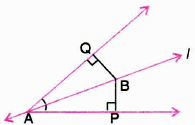
Line l is the bisector of an angle\(\angle A\) and \(\angle B\) is any point on I.BP and BQ are perpendiculars from B to the arms of \(\angle A\) (see figure). Show that:
(i) \(\triangle APB\cong \triangle AQB\)
(ii) BP = BQ or B is equidistant from the arms of \(\angle A\)
5.
The median of the data 19 25 59 48 35 31 30 32 51 is
32
31
30
25
6.
If the mean of 3,5,0,9 x,7 and 13 is 7, the value of x is:
10
11
12
8
7.
Mean of first five prime numbers is:
5.6
7.8
5.2
1.4
8.
Mode of the following score is:
14,25,14,28,18,17,18,14,23,22,14,18
18
28
14
25
9.
The marks of some students are given below. Find the mode of marks.
| Marks | Number of students |
|---|---|
| 10 | 2 |
| 20 | 8 |
| 30 | 16 |
| 40 | 26 |
| 50 | 20 |
| 60 | 16 |
| 70 | 7 |
| 80 | 4 |
60
50
30
40.
10.
In the following frequency distribution, the number of students of age less than 25 years is
| Age (in years) | Number of students |
|---|---|
| 5-10 | 3 |
| 10-15 | 6 |
| 15-20 | 8 |
| 20-25 | 8 |
| 25-30 | 2 |
8
6
17
25.
11.
The range of the following frequency distribution is
2.7,2.7,2.8,2.1,2.4,3.2,2.1,3.1,2.8,3.2.
2.1
1.6
5.3
1.1
12.
In the following frequency distribution, the lower limit of the sixth class is
| Marks | Numbeo of Students |
|---|---|
| 0-5 | 3 |
| 5-10 | 5 |
| 10-15 | 8 |
| 15-20 | 12 |
| 20-25 | 7 |
| 25-30 | 3 |
20
25
30
0.
13.
'Heights of 20 students of your class' from
Primary data
Secondary data
Useless data
Fictitious data
14.
Statistics is branch of
Mathematics
Physics
Chemistry
Psychology
15.
Two sides of a triangle are 13 cm, and 14 cm and its semi-perimeter is 18 cm.Then third side of the triangle is
12 cm
11 cm
10 cm
9 cm
16.
The semiperimeter of a triangle having the length of its sides as 20 cm, 15 cm, and 9 cm is
44 cm
21 cm
22 cm
None
17.
Area of a triangle is 60 cm2.Its base is 15 cm.Its altitude is
30 cm
4 cm
8 cm
10 cm
18.
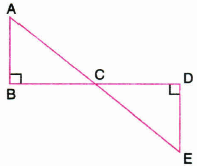
In the following figure, ㄥB = ㄥD = 90° and BC = CD.Then, the relation between AB and DE is
AB = DE
AB > DE
AB < DE
none of these.
19.
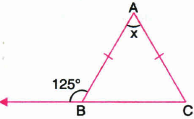
In figure, if AB = AC find x.
550
550
500
700
20.
The measure of each angle of an equilateral triangle is
300
450
600
900
21.
Among the following which is not a criteria for congruence of two triangles?
SAS
ASA
SSA
SSS
22.
Two triangles are congruent, if two sides and the included angle of one triangle are equal to two sides and the included angle of the other triangle. This rule is known as
SAS congruence rule
ASA congruence rule
SSS congruence rule
RHS congruence rule.
23.
The symbol for congruence is
=
~
0
≅
24.
A closed figure formed by three intersecting lines is called
circle
square
triangle
rhombus
25.
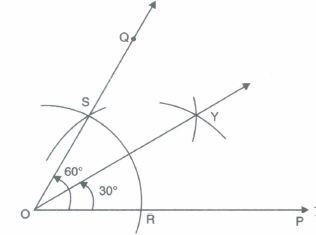
Construct ∠POY=30 o. using compass and ruler.
26.
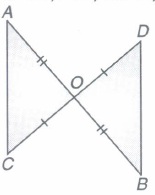
In the figure below, O is the mid-point of AB and CD, Prove that AC = BD.
27.
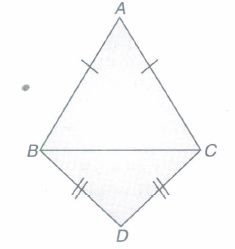
In the figure, \(\triangle\)ABC and \(\triangle\)DBC are two isosceles triangles on the same base BC Prove that \(\angle\) ABD = \(\angle\)ACD.
28.
In a city, the following weekly observations were made in a study on the cost of living index.
| Cost of living index | Number of weeks |
|---|---|
| 140-150 | 5 |
| 150-160 | 10 |
| 460-170 | 20 |
| 170-180 | 9 |
| 180-190 | 6 |
| 190-200 | 2 |
| Total | 52 |
Draw a frequency polygon for the data above (without constructing a histogram).
29.
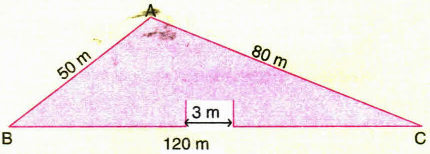
A triangular park ABC has sides 120 m, 80 m and 50 m. A gardener Dhania has to put a fence all around it and also plant grass inside. How much area does she need to plant? Find the cost of fencing it with barbed wire at the rate of Rs. 20 per metre leaving a space 3 m wide for a gate on one side.
30.
Find the area of the triangle whose two sides are of measure 13 cm and 14 cm and perimeter is 42 cm.
31.
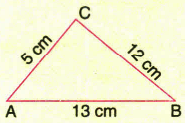
The sides of a right triangle ABC are 5 cm, 12 cm and 13 cm. Find the area of the triangle.
32.
The runs scored by two teams A and B on the first 42 balls in a cricket match are given below. Draw the frequency polygon on the same graph paper.
| Number of balls | Team A | Team B |
|---|---|---|
| 0-6 | 2 | 5 |
| 6-12 | 1 | 6 |
| 12-18 | 8 | 2 |
| 18-24 | 9 | 10 |
| 24-30 | 4 | 5 |
| 30-36 | 5 | 6 |
| 36-42 | 6 | 3 |
33.
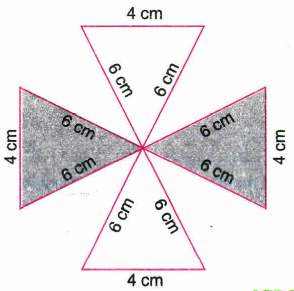
Black and white coloured triangular sheets are used to make a toy as shown in figure. Find the total area of black and white colour sheets used for making the toy.
1.
Steps of construction:
i) Draw the line segment BC = 8 cm and at point B construct an angle of 45o .i.e XBC = 45o and AB - AC = 3.5 cm
ii) Cut the line segment BD = 3.5 cm(equal to AB-AC)on ray BX
iii) Join DC and draw the perpendicular bisector PQ of DC
iv) The perpendicular bisector intersects BXat point A.Join AC MBC is the required triangle.
2.
Modified Continues Distribution
| Length (in mm) | Number of leaves |
| 117.5-126.5 | 3 |
| 126.5-135.5 | 5 |
| 135.5-144.5 | 9 |
| 144.5-153.5 | 12 |
| 153.5-162.5 | 5 |
| 162.5-171.5 | 4 |
| 171.5-180.5 | 2 |
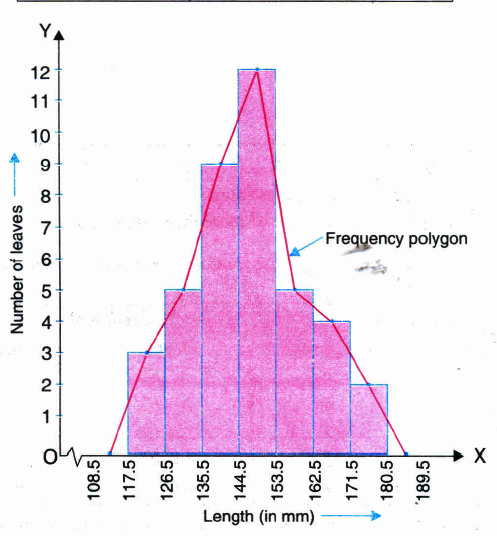
(ii) Frequency Polygon.
(iii) No, because the maximum number of leaves have their lengths lying in the original interval 145-153 (or modified interval 144.5-153.5).
3.
(i)
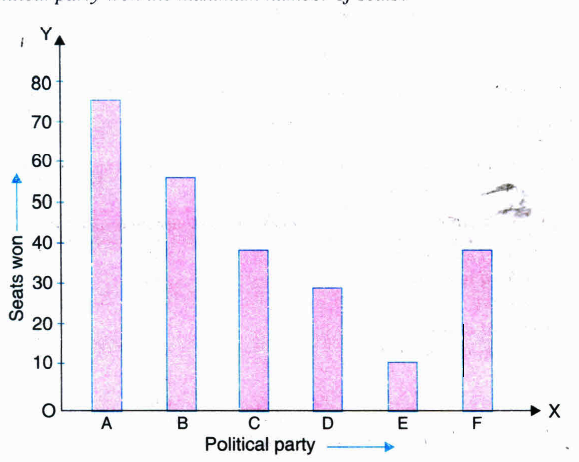
(ii) Political party A won the maximum number of seats.
4.
Given: Line l is the bisector of an angle\(\angle A\) and \(\angle B\) is any point on I.BP and BQ are perpendiculars from B to the arms of \(\angle A\)
To Prove: (i) \(\triangle APB\cong \triangle AQB\)
(ii) BP = BQ or B is equidistant from the arms of \(\angle A\)
Proof: (i) In \(\triangle APB\) and \(\triangle AQB\)
\(\angle BAP=\angle BAQ \) | l is the bisector of \(\angle A\)
AB = AB | Common
\(\angle BAP=\angle BAQ \) | Each = 900
BP = BQ or B is equidistant from the arms of \(\angle A\)
\(\triangle APB\cong \triangle AQB\) | SAS Rule
(ii) \(\triangle APB\cong \triangle AQB\) | Proved in (i) above
BP = BQ | C.P.C.T
5.
19 25 59 48 35 31 30 32 51
n = 9
n+1/2 = 5
Median = 32
6.
\(\frac{3+5+0+9+x+7x+13}{7}=7\)
7.
Mean \(\frac {2+3+5+7+11}{5}=5.6\)
8.
14 occurs most frequently (4 times).
9.
Maximum number of students (26) have 40 marks.
10.
Required number = 3 + 6 + 8 + 8 = 25.
11.
Highest item value = 3.2
Lowest item value = 2.1
\(\therefore\) Range = 3.2 -2.1 = 1.1.
12.
(b)
25
13.
(a)
Primary data
14.
(a)
Mathematics
15.
(d)
9 cm
16.
s=\(\frac { 20+15+9 }{ 2 } \)=22 cm
17.
(c)
8 cm
18.
ㄥCBA=ㄥCDE=900
ㄥACB=ㄥECD
BC=CD
∴ ΔCBA≅ΔCDE
∴ AB=DE
19.
(d)
700
20.
(c)
600
21.
(c)
SSA
22.
Theorem
23.
≌ represents congruence.
24.
(c)
triangle
25.
Steps of Construction:
i) Draw any line OP.
ii) With O as centre and any suitable radius, draw an arc to meet OP at R.
iii) With R as centre and same radius (as in step 2).draw an arc to meet the previous arc at S.
iv) Join OS and Produce it to Q,then ㄥPOQ=60o
v) With R as centre and any suitable radius (not necessarily) equal to radius of step 1 (but > \(\frac { 1 }{ 2 } \)RS),draw an arc. Also, with 5 as centre and radius draw another arc to meet the previous arc at Y.
vi) Join OY and produced it, the OY is the required bisector of ㄥPOQ (i.e ㄥPOY=30o)
26.
OA = OB (O is the mid-point of AB)
\(\angle\)AOC = \(\angle\)BOD (Vertically opposite angles)
OC = OD (O is the mid-point of CD)
\(\triangle AOC\cong \triangle BOD\)
\(\Rightarrow\) AC = BD. (By c.p.c.t) Proved.
27.
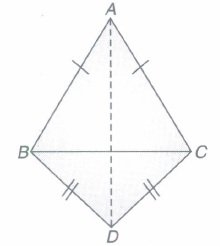
Join AD.
In \(\triangle\)ABC and \(\triangle\)ACD,
AB = AC (Given)
BD = CD (Given)
AD = AD (Common)
By using SSS Congruency Rule,
\(\triangle ABD\cong \triangle ACD\)
\(\therefore \angle ABD=\angle ACD (By c.p.c.t)\)
28.
Since we want to draw a frequency polygon without a histogram, let us find the class-marks of the classes given above, that is of 140 - 150, 150 - 160,....
For 140 - 150, the upper limit = 150, and the lower limit = 140
So, the class-mark = \(\frac{150+140}{2}=\frac{290}{2}=145\)
| Classes | Class Marks | Frequency |
|---|---|---|
| 140-150 | 145 | 5 |
| 150-160 | 155 | 10 |
| 160-170 | 165 | 20 |
| 170-180 | 175 | 9 |
| 180-190 | 185 | 6 |
| 190-200 | 195 | 2 |
| Total | 52 |
We can now draw a frequency polygon by plotting the class-marks along the horizontal axis, the frequencies along the vertical-axis, and then plotting and joining the points B(145, 5), C(155, 10), D(165, 20), E(175, 9), F(185, 6) and G(195, 2) by line segments. We should not forget to plot the point corresponding to the class-mark of the class 130 - 140 (just before the lowest class 140 - 150) with zero frequency, that is, A(135, 0), and the point H (205, 0) occurs immediately after G(195, 2). So, the resultant frequency polygon will be ABCDEFGH.

29.
For finding area of the park, we have
2s = 50 m + 80 m + 120 m = 250 m.
i.e., s = 125 m
Now, s – a = (125 – 120) m = 5 m,
s – b = (125 – 80) m = 45 m,
s – c = (125 – 50) m = 75 m.
Therefore, area of the park = \(\sqrt{s(s-a)(s-b)(s-c)}\)
\(=\sqrt{125 \times 5 \times 45 \times 75} \mathrm{~m}^{2}\)
\(=375 \sqrt{15} \mathrm{~m}^{2}\)
Also, perimeter of the park = AB + BC + CA = 250 m
Therefore, length of the wire needed for fencing = 250 m – 3 m (to be left for gate)
= 247 m
And so the cost of fencing = Rs.20 x 247 = RS. 4940
30.
84 cm2
31.
30 cm2.
32.
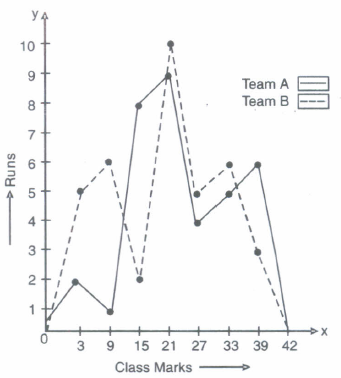
33.
For one black colour sheet a= 4 cm, b = 6 cm
\(\therefore \) Area \(=\frac { a }{ 4 } \sqrt { 4{ b }^{ 2 }-{ a }^{ 2 } } \) | Sheet is an isosceles triangle
\(=\frac { 4 }{ 4 } \sqrt { 4{ (6) }^{ 2 }-4^{ 2 } } \) \(=\sqrt { 128 } =8\sqrt { 2 } \) cm2
\(\therefore \) Area of 2 black colour sheets = 2\(\times 8\sqrt { 2 } \) = \( 16\sqrt { 2 } \) cm2
Similarly, area of 2 white colour sheets = \( 16\sqrt { 2 } \) cm2
\(\therefore \) Total area of black and white colour sheets = \( 16\sqrt { 2 } \) + \( 16\sqrt { 2 } \) = \( 32\sqrt { 2 } \) cm2

9th Standard CBSE Syllabus & Materials
9th Standard CBSE
CBSE 9th Mathematics Lines and Angles Sample Question Papers Study Material - QB365 Set A
NEW9th Standard CBSE
CBSE 9th Mathematics Introduction to Euclid's Geometry Sample Question Papers Study Material - QB365 Set A
NEW9th Standard CBSE
CBSE 9th Mathematics Linear Equations in Two Variables Sample Question Papers Study Material - QB365 Set A
NEW9th Standard CBSE
CBSE 9th Mathematics Coordinate Geometry Sample Question Papers Study Material - QB365 Set A



NCERT Books

Syllabus

Exam Pattern

Sample Question Papers

Previous year Question Papers

Important Notes

MCQ Practice test

NCERT Exemplers

Case study Questions

Image Based Questions

Passage based Questions

HOT Questions

Value Based Questions

Model Questions Papers
NCERT ( Book Back ) Questions

Assertion and Reason
Important Questions And Answers

CBSE 9th Standard CBSE Subjects
CBSE Standards