100% FREE ACCESS
9th Standard CBSE Syllabus & Materials
9th Standard CBSE
CBSE 9th Science Is matter around us pure? - New Model Questions Papers Study Material - QB365 Set A
NEW9th Standard CBSE
CBSE 9th Science Matter in our surroundings - New Model Questions Papers Study Material - QB365 Set A
NEW9th Standard CBSE
CBSE 9th Mathematics Heron's Formula Sample Question Papers Study Material - QB365 Set A
NEW9th Standard CBSE
CBSE 9th Mathematics Circles Sample Question Papers Study Material - QB365 Set A
NEW9th Standard CBSE
CBSE 9th Mathematics Quadrilaterals Sample Question Papers Study Material - QB365 Set A
NEW9th Standard CBSE
CBSE 9th Mathematics Triangles Sample Question Papers Study Material - QB365 Set A

Published on: 29/10/2025
Download CBSE Class 9th Standard CBSE Mathematics question papers, sample papers, important questions, and previous year solved papers in PDF format. Get free study materials, NCERT solutions, and exam preparation resources for Class 9th Standard CBSE Mathematics
Questions + Answers key
Take MCQ Mathematics Test
1.
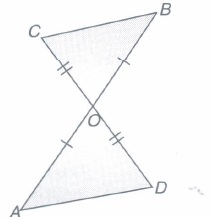
In the figure, OA = OB and OD = OC Show that:
(i) \(\triangle AOD\cong \triangle BOC\),
(ii) AD II BC.
2.
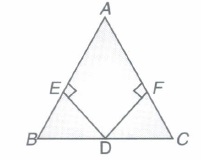
In the given figure, D is the mid-point of base BC DE and DF are perpendiculars to AB and AC respectively such that DE = DF. Prove that \(\angle\)B = \(\angle\)C.
3.
A military tent is in the form of a circular cone of vertical height 6 m, the diameter of the base being 7 m. If 12 soldiers can sleep in it, find the average cubic metre of air space required per soldier.
4.
The surface area of a cuboid is 1372 cm2.If its dimensions are in the ratio 4: 2: 1, find its length.
5.
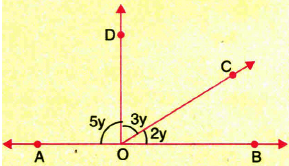
In the given figure if AOB is a line then find the measure of \(\angle \)BOC \(\angle \)COD and \(\angle \)DOA
6.
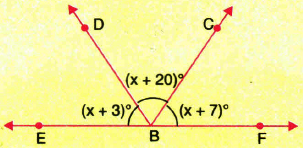
In figure find the value of x.
7.
Two cylindrical cans have bases of the same size. The diameter of each is 14 cm. One of the cans is 10 cm high and the other is 20 cm high. Find the ratio of their volumes.
8.
Twenty cylindrical pillars of a building are to be cleaned. If the diameter of a pillar is 0.5 m and height is 4 m, what will be the cost of cleaning them at the rate of Rs 3 per m2. \(\left( Take\pi =3.14 \right) \)
9.
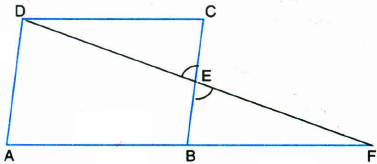
In the figure ABCD is a parallelogram and E is the midpoint of side BC DE and AB on producing meet at F. Prove that AF = 2AB.
10.
Prove that the medians of an equilateral triangle are equal.
11.
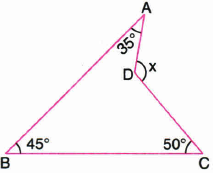
In figure Find the value of x
12.
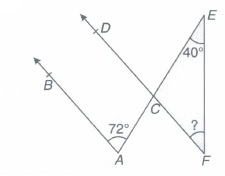
In the given figure, AB||CD, \(\angle BAC=72^o\) and \(\angle CEF=40^o\). Find \(\angle CFE.\)
13.
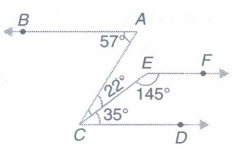
In the figure, prove that AB||EF
14.
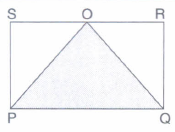
In a parallelogram PQRS of the given figure, the bisectors of ㄥP and ㄥQ meet SR at O. Show that ㄥPOQ=90°
15.
Curved surface area of a cone is 308 cm2 and its slant height is 14 cm. Find (i) radius of the base and (ii) total surface area of the cone.
16.
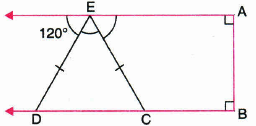
In figure, AB 丄 AE, BC 丄 AB, CE =DE and ㄥAED = 120°. Find
(a) ㄥ EDC
(b) ㄥDEC
(c) Hence prove that EDC is an equilateral triangle.
17.
Two solid spheres made of the same metal have masses 5920 g of and 740 g respectively. Determine the radius of the larger sphere, if the diameter of the smaller sphere is 5 cm.
18.
I and m are two parallel equal lines intersected by another pair of parallel lines p and q (see figure) :
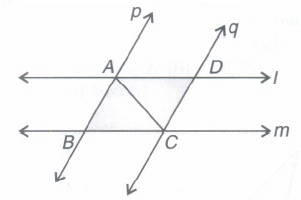
(i) Show that \(\triangle ABC\cong \triangle CDA\)
(ii) Which mathematical concept is used in this problem?
(iii) What is its value?
19.
For spreading the message "Save Girl Child Save Future" a rally was organized by some students of a school. They were given triangular cardboard piece PQR which they divided in to two parts by drawing the angle bisectors QO and RO of base angles Q and R and wrote a slogan. Prove that \(\angle\)QOR = 90° + \(\frac{1}{2}\)\(\angle\)P. What is the benefit of these types of rallies?
20.
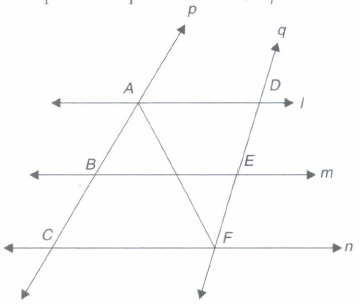
l, m and n are three parallel lines intersected by transversals p and q such that l, m and n cut off equal intercepts AB and BC on p (see Fig.). Show that l, m and n cut off equal intercepts DE and EF on q also.
1.
(i) In \(\triangle\) AOD and \(\triangle\)BOC,
OA =OB (Given)
OD = OC (Given)
\(\angle\)AOD = \(\angle\)BOC
(Vertically opposite angles)
So, by SAS criteria,
\(\triangle AOD\cong \triangle BOC\)
(ii) \(\angle\)CBA = \(\angle\)DAB (By c.p.c.t.)
AD and BC are two lines intersected by AB such that \(\angle\)CBA = \(\angle\)DAB and they form a pair of alternate angles.
Hence, AD II BC
2.
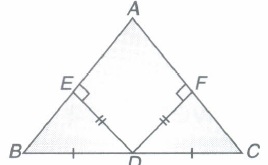
In \(\triangle\)BED and \(\triangle\)CFD,
\(\angle\)DEB = \(\angle\)DFC = 90°
BD = DC (D is the mid-point)
ED = FD (Given)
\(\therefore \triangle BED\cong \triangle CFD\) (By RHS)
\(\Rightarrow\) \(\angle\)B = \(\angle\)C (By c.p.c.t.) Proved.
3.
\(\frac { 77 }{ 12 } { m }^{ 3 }\)
4.
28 cm
5.
\(36^{ 0 },54^{ 0 },90^{ 0 }\)
6.
50
7.
\(\frac{V_1}{V_2}=\frac{\pi (\frac{14}{2})^210}{\pi (\frac{14}{2})^220}=\frac{1}{2}=1:2\)
8.
For a pillar
Radius (r) = \(\frac { 0.5 }{ 2 } m=0.25m\)
Height (h) = 4 m
\(\therefore \) Curved surface area = \(2\pi rh\)
= 2 \(\times\) 3.14 \(\times\) 0.25 \(\times\) 4
= 6.28 m2
\(\therefore \) Curved surface area of 20 pillars
= 6.28 \(\times\) 20 m2 = 125.6 m2
\(\therefore \) Cost of cleaning them at Rs 3 per m2
= 125.6 \(\times\) 3 = Rs 376.80
9.
Given: ABCD is a parallelogram and E is the mid-point of side BC. DE and AB on producing meet at F.
To Prove: AF = 2AB
Proof: In \(\Delta \)FAD,
\(\therefore\) E is the mid-point of BC I Given
and EB II DA | Opposite sides of a parallelogram are parallel
\(\therefore\) B is the mid-point of AF I By converse of mid-point theorem
AB = BF = \(1\over2\) AF ⇒ AF = 2AB
10.
Given: ABC is an equilateral triangle whose medians are AD, BE and CF.
To prove: AD = BE = CF
Proof: In \(\triangle ADC\) and \(\triangle BEC\)
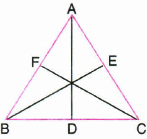
AC = BC
\(\angle ACD=\angle BCE\)
AD is a median DC = DB = 1/2 BC
BE is a median EA = EC = 1/2 AC
AC = BC
DC = EC
\(\triangle ADC\cong \triangle BEC\) | SAS congruence rule
AD = BE | C.P.C.T
Similarly, we can prove that
BF = CF ... (2)
CF = AD ....(3)
From (1), (2) and (3)
AD = BE = CF
11.
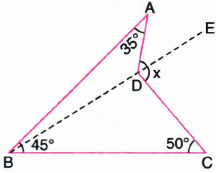
Construction Join BD and extend upto E
\(x=\angle ADC\)
=\(x=\angle ADE+\angle CDE\)
=\(x=\angle DAB+\angle ABD+(\angle DBC+\angle DCB\)
|Exterior Angle Theoram
\(=30^{ 0 }+\angle ABD)+\angle DBC+50^{ 0 }\)
=\(35^{ 0 }+\angle ABD)+\angle DBC+50^{ 0 }\)
= \(35^{ 0 }+45^{ 0 }+50^{ 0 }=130^{ 0 }\)
12.
Since AB||CD
\(\angle BAC=\angle DCE=72^o\) (Corresponding angles)
\(\angle ACE=\angle CEF+\angle CFE\) (Exterior angle)
\(\Rightarrow 72^o=40^o+\angle CFE\)
\(\therefore \angle CFE=32^o\)
13.
\(\angle A=57^o\)
and \(\angle ACD=22^o+35^o=57^o\)
\(\angle A=\angle ACD\)
But these are alternate angles
AB||CD
Again \(\angle FEC+\angle ECD=145^o+35^o=180^o\)
EF||CD
Now AB||CD and EF||CD
AB||EF
14.
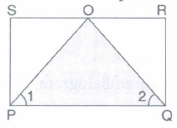
A parallelogram PQRS in which the bisectors of LP and LQ meet SR at O.
To Prove: ㄥPOQ=90°
Now, since PQRS is a parallelogram. Therefore,
PSIIQR
Now, PS II QR and transversal PQ intersects them.
ㄥP+ㄥQ=180°
(∵ Sum of consecutive interior angles is 180°)
\(\frac{1}{2}\)ㄥP+\(\frac{1}{2}\)ㄥQ=90°
⇒ ㄥ1+ㄥ2=90° ( OP is bisector of ㄥP...(i) and OQ is bisector of ㄥQ.
ㄥ1=\(\frac{1}{2}\) ㄥP and ㄥ2=\(\frac{1}{2}\) ㄥQ)
Now, in ΔPOQ
ㄥ1+ㄥPOQ+ㄥ2=180°
⇒ 90°+ㄥPOQ=180°
⇒ ㄥPOQ=90°
15.
(i) Slant height (l) = 14 cm
Curved surface area = 308 cm2
\(\Rightarrow \pi rl=308\)
\(\\ \Rightarrow \frac { 22 }{ 7 } \times r\times 14=308\)
\(\\ \Rightarrow r=\frac { 308\times 7 }{ 22\times 14 } \)
\(\\ \Rightarrow r=7cm\)
Hence, the radius of the base is 7 cm.
(ii) Total surface area of the cone = \(\pi r\left( l+r \right) \)
\(=\frac { 22 }{ 7 } \times 7\times \left( 14+7 \right)\)
\( \\ =\frac { 22 }{ 7 } \times 7\times 21=462{ cm }^{ 2 }\)
Hence, the total surface area of the cone is 462 cm2.
16.
(a) 600
(b) 600
17.
Let r and R be the radii of the smaller and larger spheres respectively, we have
\(r=\frac { 5 }{ 2 } cm\)
Volume of the smaller sphere \(=\frac { 4 }{ 3 } \pi { r }^{ 3 }=\frac { 4 }{ 3 } \pi { \left( \frac { 5 }{ 2 } \right) }^{ 3 }\)
\(=\frac { 4 }{ 3 } \times \pi \times \frac { 125 }{ 8 } { cm }^{ 3 }\)
Density of metal\(=\frac { mass }{ Valume } \)
\(=\frac { 740 }{ \frac { 4 }{ 3 } \pi \times \frac { 125 }{ 8 } } g\quad { cm }^{ 3 }\) ...........(i)
Volume of larger sphere = \(\frac { 4 }{ 3 } \pi { R }^{ 3 }\)
Density of metal=\(\frac { mass }{ Volume } =\frac { 5920 }{ \frac { 4 }{ 3 } \pi { R }^{ 3 } } \) ......(ii)
From (i) and (ii), we have
\(\frac { 740 }{ \frac { 4 }{ 3 } \pi \times \frac { 125 }{ 8 } } =\frac { 5920 }{ \frac { 4 }{ 3 } \pi { R }^{ 3 } } \)
\(\Rightarrow \quad { R }^{ 3 }=\frac { 5920\times 125 }{ 740\times 8 } \)
= 125
\(\Rightarrow\) R = 5 cm.
18.
(i) I and m are two parallel lines intersected byanother pair of parallel lines p and q.
AD II BC
and AB II CD.
\(\Rightarrow\) ABCD is a parallelogram.
i.e., AB = CD
and BC = AD
Now in \(\triangle\)ABC and \(\triangle\)CDA,we have
AB = CD (Prop. of IIgm)
BC =AD
and AC = AC (Common)
\(\therefore\) \(\triangle ABC\cong \triangle CDA\)
(By SSS criterion of congruence)
(ii) Congruency of triangles.
(iii) Equality is the sign of democracy.
19.
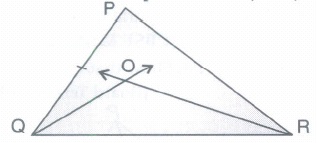
Proof: QO is bisector of \(\angle\)PQR
\(\angle\)OQR = \(\frac{1}{2}\)\(\angle\)PQR = \(\frac{1}{2}\) =\(\angle\)Q
RO is bisector \(\angle\)ORQ
\(\therefore\) \(\angle\)ORQ =\(\frac{1}{2}\) \(\angle\)PRQ = \(\frac{1}{2}\) \(\angle\)R
In \(\angle\)OQR
\(\angle\)QOR + \(\angle\)OQR + \(\angle\)ORQ = 180°
(Angle sum property)
\(\angle\)QOR + \(\frac{1}{2}\) \(\angle\)Q + \(\frac{1}{2}\) \(\angle\)R = 180°
\(\angle\)QOR = 180°- \(\frac{1}{2}\)(\(\angle\)Q + \(\angle\)R)
But in \(\angle\)PQR
\(\angle\)P + \(\angle\)Q + \(\angle\)R = 180°
\(\angle\)Q + \(\angle\)R = 180°- \(\angle\)P
\(\angle\)QOR = 180°- \(\frac{1}{2}\) (180°- \(\angle\)P)
= 180°-90° + \(\frac{1}{2}\)\(\angle\)P
= 90° + \(\angle\)P Hence Proved.
These type of rallies spread awareness among people for not to kill girl child and helping in equalising sex ratio.
20.
We are given that AB = BC and have to prove that
DE = EF.
Let us join A to E intersecting m at G.
Let trapezium ACFD is divided into two triangles, namely ΔACF and ΔAFD.
In ΔACF, it is given that B is the mid-point of AC(AB = BC) and BG II CF (Since m || n)
So, G is the mid-point of AF (By the converse of midpoint theorem)
Now in ΔAFD, we can apply the sam argument as G is the mid-point of AF, GE IIAD so E is the mid-point of DF
i.e., DE = EF
In otherwords l, m and n cut off equal intercepts on q also.

9th Standard CBSE Syllabus & Materials
9th Standard CBSE
CBSE 9th Mathematics Lines and Angles Sample Question Papers Study Material - QB365 Set A
NEW9th Standard CBSE
CBSE 9th Mathematics Introduction to Euclid's Geometry Sample Question Papers Study Material - QB365 Set A
NEW9th Standard CBSE
CBSE 9th Mathematics Linear Equations in Two Variables Sample Question Papers Study Material - QB365 Set A
NEW9th Standard CBSE
CBSE 9th Mathematics Coordinate Geometry Sample Question Papers Study Material - QB365 Set A



NCERT Books

Syllabus

Exam Pattern

Sample Question Papers

Previous year Question Papers

Important Notes

MCQ Practice test

NCERT Exemplers

Case study Questions

Image Based Questions

Passage based Questions

HOT Questions

Value Based Questions

Model Questions Papers
NCERT ( Book Back ) Questions

Assertion and Reason
Important Questions And Answers

CBSE 9th Standard CBSE Subjects
CBSE Standards