100% FREE ACCESS
9th Standard CBSE Syllabus & Materials
9th Standard CBSE
CBSE 9th Science Is matter around us pure? - New Model Questions Papers Study Material - QB365 Set A
NEW9th Standard CBSE
CBSE 9th Science Matter in our surroundings - New Model Questions Papers Study Material - QB365 Set A
NEW9th Standard CBSE
CBSE 9th Mathematics Heron's Formula Sample Question Papers Study Material - QB365 Set A
NEW9th Standard CBSE
CBSE 9th Mathematics Circles Sample Question Papers Study Material - QB365 Set A
NEW9th Standard CBSE
CBSE 9th Mathematics Quadrilaterals Sample Question Papers Study Material - QB365 Set A
NEW9th Standard CBSE
CBSE 9th Mathematics Triangles Sample Question Papers Study Material - QB365 Set A

Published on: 09/10/2019
Areas of Parallelograms and Triangles
Download CBSE Class 9th Standard CBSE Mathematics question papers, sample papers, important questions, and previous year solved papers in PDF format. Get free study materials, NCERT solutions, and exam preparation resources for Class 9th Standard CBSE Mathematics
Questions + Answers key
Take MCQ Mathematics Test
1.
Two brothers have a triangular plot. They decide to distribute it equally amongst themselves but also want to give away a triangular part of it for charity to a school which is attached on the base side of 120 m of the triaangular plot.
Answer the following questions:
(i) what is the area of the triangular plot if its height is 90 m?
(ii) Explain with the help of figure how could this be possible and what type of parts do the brothers get?
(iii) What value of the two brothers is depicted here?
2.
In \(\Delta\)ABC, E is the mid-point of median AD. show that ar(\(\Delta\)BED) = \(\frac { 1 }{ 4 } ar(\Delta ABC)\)
3.
PQRS is a parallelogram and O is a point in the interior of the parallelogram. Show that ar(POS) + ar(QOR)=\(\frac { 1 }{ 2 } ar(PQRS)\).
4.
BD is one of the diagonals of a quadrilateral AB CD. AM and CN are the perpendiculars from A and C respectively on BD. Show that
\(ar(ABCD)=\frac { 1 }{ 2 } BD.(AM+CN)\).
5.
Given two points A and B and a positive real number k. Find the locus of a point P such that ar(\(\Delta \) PAB) = k.
6.
Prove that the area of a rhombus is equal to half the rectangle contained by its diagonals.
7.
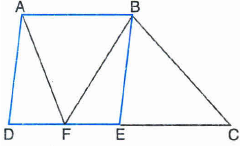
In the given figure, ABED is a parallelogram in which DE = EC. Show that: area (ABF) = area (BEC).
8.
Areas of triangles on the same bases and between the same parallels are equal in. Prove it.
9.
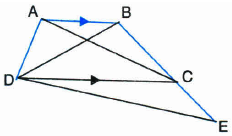
In the given figure, AB 11DC. Show that ar(BDE) = ar(ACED).
10.
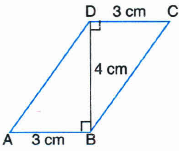
ABCD is a quadrilateral and BD is one of its diagonals as shown in figure. Show that ABCD is a parallelogram and find its area.
1.
(i) Area of triangular plot \(=\frac { 1 }{ 2 } \times b\times h\)
\(=\frac { 1 }{ 2 } \times 120\times 90\)
= 5400 m2
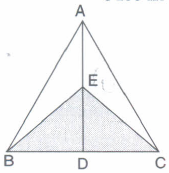
(ii) In \(\Delta\)ABC they draw median AD on base BC and divide it into two equal areas ABD and ACD. Take any point E on AD and join BE and CE.
The brothers get areas
ar(\(\Delta\)ABE) and ar(\(\Delta\)ACE)
ar(\(\Delta\)BCE) is donated to school.
(iii) Any positive value is accepable. Both brothers know the impotance of education, love their community.
2.
In figure, AD is the median of \(\Delta\)ABC.
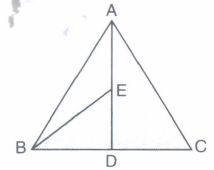
\(\therefore \ ar(\triangle ABD)=\frac { 1 }{ 2 } ar(\triangle ABC)\) ...........(i)
Now, BE is the median of \(\Delta\)ABD
\(\therefore \ ar(\triangle BED)=\frac { 1 }{ 2 } ar(\Delta ABD)\) ..............(ii)
From (i) and (ii), we get
ar(\(\Delta\)BED) = \(\frac { 1 }{ 2 } ar(\triangle ABC)\)
3.
Through O, draw AB || PS
Also PA || BS
PABS is a parallelogram.
ar(POS) =\(\frac { 1 }{ 2 } ar(PABS)\)
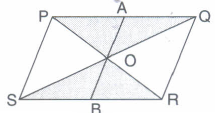
(Triangle and a parallelogram are on the same base and between the same parallels)
Similarly, ar(QOR )= \(\frac { 1 }{ 2 } \)ar(QABR)
\(\therefore \ ar(POS)+ar(QOR)=\frac { 1 }{ 2 } [ar(PABS)+ar(QABR)]\)
\(=\frac { 1 }{ 2 } ar(PQRS)\)
4.
Given: BD is one of the diagonals of a quadrilateral ABCD. AM and CN are perpendiculars from A and C respectively on BD.
To Prove: ar(quad. ABCD)
\(\frac { 1 }{ 2 } BD.(AM+CN)\)
Proof: ar(quad. ABCD)
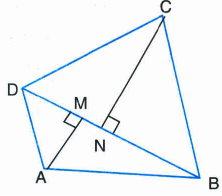
\(ar(\Delta ABD)+ar(\Delta BCD)\)
\(\\ =\frac { BD.AM }{ 2 } +\frac { BD.CN }{ 2 } \)
Area of a triangle = \(\frac { 1 }{ 2 } \times Base\times Corresponding\ altitude\)
\(\frac { 1 }{ 2 } BD(AM+CN)\)
5.
Given: Two points A and B and a positive real number k.
To find: The locus of a point P such that ar(\(\Delta \) PAB) = k.
Construction: Draw \(PM\bot AB\)
Determination: Let PM = h
ar(\(\Delta \)PAB) = k |Given
\(\Rightarrow \frac { 1 }{ 2 } (AB)(PM)=k\)
\(\\ \Rightarrow \frac { 1 }{ 2 } (AB)(h)=k\)
\(\\ h=\frac { 2k }{ AB } \)
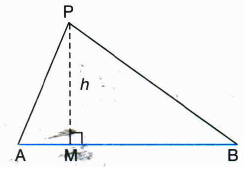
Points A and B are given. AB is fixed.
Also, k being a positive real number k is fixed.
h is a fixed positive real number.
The locus of P is a line parallel to the line
AB at a fixed distance of \(h=\frac { 2k }{ AB } \) on either side of it.
6.
Let ABCD be a rhombus whose diagonals are AC and BD. I
Then,
Area of rhombus ABCD
= Area of \(\Delta \)ABO + Area of \(\Delta \)CBD
\(=\frac { (BD)(AO) }{ 2 } +\frac { (BD)(OC) }{ 2 } \)
|Diagonals of a rhombus are perpendicular to each other
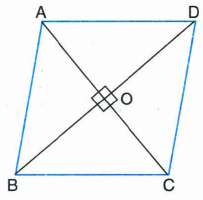
\(\frac { (BD) }{ 2 } (AO+OC)=\frac { (BD)(AC) }{ 2 } \)
\(\frac { 1 }{ 2 } \) Product of the lengths of its diagonals.
7.
Given: ABCD is a parallelogram in which DE=EC
To Prove: area (ABF) = area (BEC)
Proof: AB = DE .....(1)
I Opposite sides of a parallelogram
DE = EC I Given ...(2)
AB = EC I From (1) and (2)
Also, AB || DE
I Opposite sides of a parallelogram
\(\Rightarrow \) AB || DC
Now, \(\Delta ABF\) and \(\Delta BEC\)are on equal bases AB and EC and between the same parallels AB and DC
\(\therefore \ ar(\Delta ABF)=ar(\Delta BEC)\)
8.
Let ABC and A'BC be two triangles on the same base BC and between the same parallels PQ and RS.
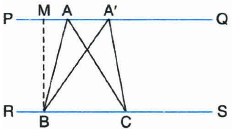
Draw \(BM\bot PQ\),then,
\(ar(\Delta ABC)\)
\( =\frac { 1 }{ 2 } \times Base\times Corresponding\ altitude\)
\(\\ =\frac { 1 }{ 2 } \times BC\times BM\quad \quad \quad \quad .....(i)\)
\(\\ ar(\Delta A'BC)\)
\(\\ =\frac { 1 }{ 2 } \times Base\times Corresponding\ altitude\)
\(\\ =\frac { 1 }{ 2 } \times BC\times BM\quad\quad \quad \quad \quad .....(ii)\)
Form (i) and (ii),we get
\(ar(\Delta ABC)=ar(\Delta ABC)\)
Hence, \(\Delta ABC\) and \(\Delta A'BC\) are equal in area.
9.
Given: AB || DC in the given figure.
To Prove: ar(BDE) = ar(ACED)
Proof:\(\Delta \) ADC and \(\Delta \) BDC are on the same base DC and between the same parallels AB and DC
ar(\(\Delta \) ADC) = ar(\(\Delta \) BDC)
\(\Rightarrow ar(\Delta \ ADC)+ar(\Delta \ DCE)\)
\( =ar(\Delta \ BDC)+ar(\Delta \ DCE)\)
|Adding ar(\(\Delta \quad DCE\)) to both sides
\(\Rightarrow \ ar(ACED)=ar(BDE)\)
\(\\ \Rightarrow \ ar(BDE)\ =ar(ACED)\)
10.
Given: ABCD is a quadrilateral and BD is one of its diagonals.
To Prove: ABCD is a parallelogram and to determine its area.
Proof:\(\angle ABD=\angle BDC(=90°)\) |Given
But these angles form a pair of equal alternate.interior angles for lines AB, DC and a transversal BD
AB || DC
Also, AD = DC (= 3 cm) I Given
Hence, quadrilateral ABCD is a parallelogram.
I A quadrilateral is a parallelogram if its one pair of opposite sides are parallel and equal
Now,
\(ar(||gm\ ABCD)=base\times Corresponding\ altitude\)
\(\\ =3\times 4\)
\(\\ =12{ cm }^{ 2 }\)

9th Standard CBSE Syllabus & Materials
9th Standard CBSE
CBSE 9th Mathematics Lines and Angles Sample Question Papers Study Material - QB365 Set A
NEW9th Standard CBSE
CBSE 9th Mathematics Introduction to Euclid's Geometry Sample Question Papers Study Material - QB365 Set A
NEW9th Standard CBSE
CBSE 9th Mathematics Linear Equations in Two Variables Sample Question Papers Study Material - QB365 Set A
NEW9th Standard CBSE
CBSE 9th Mathematics Coordinate Geometry Sample Question Papers Study Material - QB365 Set A



CBSE 9th Standard CBSE Subjects
CBSE Standards