100% FREE ACCESS
9th Standard CBSE Syllabus & Materials
9th Standard CBSE
CBSE 9th Science Is matter around us pure? - New Model Questions Papers Study Material - QB365 Set A
NEW9th Standard CBSE
CBSE 9th Science Matter in our surroundings - New Model Questions Papers Study Material - QB365 Set A
NEW9th Standard CBSE
CBSE 9th Mathematics Heron's Formula Sample Question Papers Study Material - QB365 Set A
NEW9th Standard CBSE
CBSE 9th Mathematics Circles Sample Question Papers Study Material - QB365 Set A
NEW9th Standard CBSE
CBSE 9th Mathematics Quadrilaterals Sample Question Papers Study Material - QB365 Set A
NEW9th Standard CBSE
CBSE 9th Mathematics Triangles Sample Question Papers Study Material - QB365 Set A

Published on: 09/12/2019
Areas of Parallelograms and Triangles
Download CBSE Class 9th Standard CBSE Mathematics question papers, sample papers, important questions, and previous year solved papers in PDF format. Get free study materials, NCERT solutions, and exam preparation resources for Class 9th Standard CBSE Mathematics
Questions + Answers key
Take MCQ Mathematics Test
1.
ABCD is a' trapezium with AB || DC A line parallel to AC intersects AB at X and BC at Y. Prove that ar(\(\Delta \) ADX) = ar(\(\Delta \) ACY)
2.
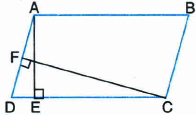
In figure, ABCD is a parallelogram, \(AE\bot DC\)and \(CF\bot AD\). If AB = 16cm, AE = 8 cm and CF = 10 cm, find AD.
3.
Which of the following figures lie on the same and between the same parallels.In such a case, write the common base and the two parallels.
.png)
.png)
4.
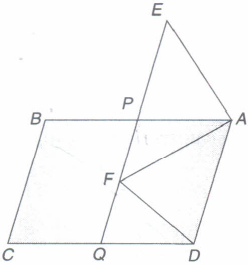
In the given figure ABCD and AEFD are two parallelograms. Prove that ar(\(\Delta\)PEA)=ar(\(\Delta\)QFD).
5.
PQRS is a parallelogram and O is a point in the interior of the parallelogram. Show that ar(POS) + ar(QOR)=\(\frac { 1 }{ 2 } ar(PQRS)\).
6.
ABCD is a parallelogram whose diagonals intersect at o. If P is any point on BO, prove that
(i) ar(\(\Delta \)ADO) = ar(\(\Delta \) CDO)
(ii) ar(\(\Delta \)ABP) = ar(\(\Delta \) CBP)
7.
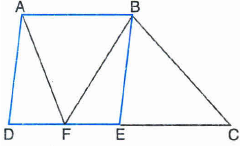
In the given figure, ABED is a parallelogram in which DE = EC. Show that: area (ABF) = area (BEC).
8.
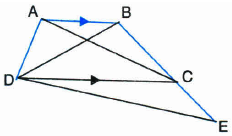
In the given figure, AB 11DC. Show that ar(BDE) = ar(ACED).
9.
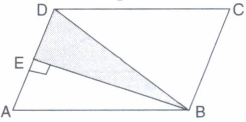
In given figure, ABCD is a parallelogram and BE\(\bot \)AD. If BE=14 cm and AD=8 cm, find the area of \(\Delta \)DBC.
10.
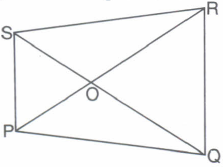
In the figure, PS||QR, Show that ar(\(\Delta \)ROS) = ar(\(\Delta \)POQ).
11.
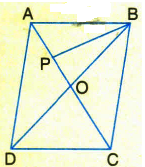
ABCD is a parallelogram with area 80 sq. cm. The diagonals AC and BD intersect at O. P is the midpoint of OA. Calculate ar(\(\Delta\) BOP)
12.
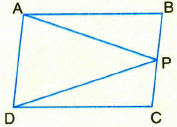
If the area of parallelogram (shown in figure) is 80 cm2 , then find area of \(\Delta \) ADP.
13.
In a parallelogram ABCD, AB = 8 cm. The altitudes corresponding to sides AB and AD are respectively 4 cm and 5 cm. Find measure of AD.
14.
If a rectangle and a square stand on the same base and between the same parallels, then the ratio of their areas is
1:2
1:4
1:1
2:1
15.
Two parallelograms are on equal bases and between the same parallels. The ratio of their areas is
1:2
1:1
2:1
3:1
16.
In the following figure, find the area of quad. ABCD.
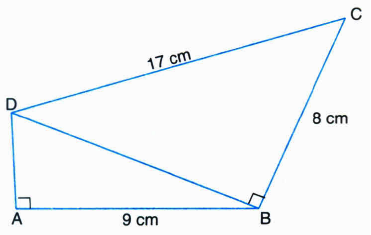
114 cm2
56cm2
28cm2
14 cm2
17.
In the figure, the area of parallelogram PQRS is:
\(PQ\times QB\)
\(QR\times QC\)
\(SR\times QC\)
\(PS\times SA\)
18.
The areas of a parallelogram and a triangle are equal and they lie on the same base. If the altitude of the parallelogram is 2 cm, then the altitude of triangle is
4cm
1cm
2 cm
3 cm
1.
Given: AB CD is a trapezium with AB || DC. A line parallel to AC intersects AB at X and BC at Y.
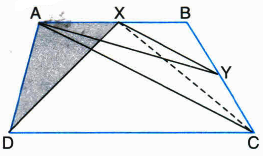
To Prove: ar(\(\Delta \)ADX) = ar(\(\Delta \)ACY).
Construction: Join CX.
Proof: \(\Delta \)ADX and \(\Delta \)ACX are on the same base AX and between the same parallels AB and DC.
ar(\(\Delta \)ADX) = ar(\(\Delta \)ACX) ...(1)
|Two triangles on the same base (or equal bases) and between the same parallels are equal in area
\(\Delta \)ACX and \(\Delta \)ACY are on the same base AC and between the same parallels AC and XY.
ar(\(\Delta \)ACX) = ar(\(\Delta \)ACY) ...(2)
|Two triangles on the same base (or equal bases) and between the same parallels are equal in area
From (1) and (2), we get
ar(\(\Delta \)ADX) = ar(\(\Delta \)ACY).
2.
ar(parallelogram ABCD) = AB x AE
= 16 x 8 cm2
= 128 cm2 ...(1)
ar(parallelogram ABCD) = AD x CF
= AD x 10 cm2 .......(2)
From (1) and (2), we get
AD x 10 = 128
AD = \(\frac { 128 }{ 10 } \)
AD = 12.8 cm.
3.
(i) \(\Delta \)PDC and quadrilateral ABCD lie on the same base DC and between the same parallels DC and AB.
(ii) \(\Delta \) TRQ and parallelogram SRQP lie on the same base RQ and between the same parallels RQ and SP.
(iii) Quadrilaterals APCD and ABQD lie on the same base AD and between the same parallels AD and BQ.
4.
In triangles PEA and QFD, we have
\(\angle \)APE = \(\angle \)DQF
(Corresponding angles)
AE = DF
(Oppoosite sides of 8 ||gm AEFD)
\(\angle \)AEP=\(\angle \)DFQ
(Corresponding angles)
\(\therefore\) \(\Delta\)PEA\(\cong \)\(\Delta\)QFD (by AAS)
As congruent triangles have equal area.
\(\therefore\) ar(\(\Delta\)PEA)=ar(\(\Delta\)QFD)
5.
Through O, draw AB || PS
Also PA || BS
PABS is a parallelogram.
ar(POS) =\(\frac { 1 }{ 2 } ar(PABS)\)
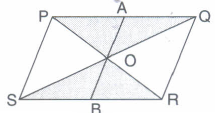
(Triangle and a parallelogram are on the same base and between the same parallels)
Similarly, ar(QOR )= \(\frac { 1 }{ 2 } \)ar(QABR)
\(\therefore \ ar(POS)+ar(QOR)=\frac { 1 }{ 2 } [ar(PABS)+ar(QABR)]\)
\(=\frac { 1 }{ 2 } ar(PQRS)\)
6.
Given: ABCD is a parallelogram whose diagonals intersect at O. P is any point on BO.
To prove:
(i) ar(\(\Delta \)ADO) = ar(\(\Delta \) CDO)
(ii) ar(\(\Delta \)ABP) = ar(\(\Delta \) CBP)
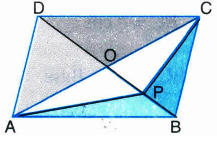
Proof:
i) Diagonals of a parallelogram bisect each other
AO = OC
O is the midpoint of AC
DO is a median of \(\Delta \)DAC
ar(\(\Delta \) ADO) = ar(\(\Delta \) CDO)
|A median of a triangle divides it into two triangles of equal areas
(ii) BO is a median of \(\Delta \)BAC
ar(\(\Delta \) BOA) = ar(\(\Delta \) BOC) ..........(1)
|A median of a triangle divides it into two triangles of equal areas
PO is a median of \(\Delta \)PAC
ar(\(\Delta \) POA) = ar(\(\Delta \) POC) .........(2)
|A median of a triangle divides it into two triangles of equal areas
Subtracting (2) from (1), we get
ar(\(\Delta \) BOA) - ar(\(\Delta \) POA) = ar(\(\Delta \) BOC) - ar(\(\Delta \) POC)
ar(\(\Delta \) ABP) = ar(\(\Delta \) CBP)
7.
Given: ABCD is a parallelogram in which DE=EC
To Prove: area (ABF) = area (BEC)
Proof: AB = DE .....(1)
I Opposite sides of a parallelogram
DE = EC I Given ...(2)
AB = EC I From (1) and (2)
Also, AB || DE
I Opposite sides of a parallelogram
\(\Rightarrow \) AB || DC
Now, \(\Delta ABF\) and \(\Delta BEC\)are on equal bases AB and EC and between the same parallels AB and DC
\(\therefore \ ar(\Delta ABF)=ar(\Delta BEC)\)
8.
Given: AB || DC in the given figure.
To Prove: ar(BDE) = ar(ACED)
Proof:\(\Delta \) ADC and \(\Delta \) BDC are on the same base DC and between the same parallels AB and DC
ar(\(\Delta \) ADC) = ar(\(\Delta \) BDC)
\(\Rightarrow ar(\Delta \ ADC)+ar(\Delta \ DCE)\)
\( =ar(\Delta \ BDC)+ar(\Delta \ DCE)\)
|Adding ar(\(\Delta \quad DCE\)) to both sides
\(\Rightarrow \ ar(ACED)=ar(BDE)\)
\(\\ \Rightarrow \ ar(BDE)\ =ar(ACED)\)
9.
Given: BE = 14 cm, AD = 8 cm
\(\therefore \ Area(\triangle ADB)=\frac { 1 }{ 2 } \times 8\times 14\)
= 56 cm2
\(\because\) ABCD is a parallelogram.
\(\therefore\) ar(\(\Delta \)DBC) = ar(\(\Delta \)ADB) = 56 cm2.
10.
\(\Delta \)PSR and \(\Delta \)PSQ are on the same base PS and between the same parallels PS and QR.
ar(\(\Delta \)PSR) = ar(\(\Delta \)PSQ)
ar(\(\Delta \)PSR) - ar(\(\Delta \)PSO) = ar(\(\Delta \)PSQ) - ar(\(\Delta \)PSO)
ar(\(\Delta \)ROS) = ar(\(\Delta \)POQ).
11.
10 cm2
12.
40 cm2
13.
6.4cm
14.
A rectangle is essentially a parallelogram. A square is essentially a parallelogram. Parallelograms on the same base and between the same parallels are equal in area
15.
Parallelograms on the same base and between the same parallels are equal in area
16.
(a)
114 cm2
17.
Area of parallelelogram=\(Base\times Corresponding\quad altitude\)
18.
(a)
4cm

9th Standard CBSE Syllabus & Materials
9th Standard CBSE
CBSE 9th Mathematics Lines and Angles Sample Question Papers Study Material - QB365 Set A
NEW9th Standard CBSE
CBSE 9th Mathematics Introduction to Euclid's Geometry Sample Question Papers Study Material - QB365 Set A
NEW9th Standard CBSE
CBSE 9th Mathematics Linear Equations in Two Variables Sample Question Papers Study Material - QB365 Set A
NEW9th Standard CBSE
CBSE 9th Mathematics Coordinate Geometry Sample Question Papers Study Material - QB365 Set A



CBSE 9th Standard CBSE Subjects
CBSE Standards