100% FREE ACCESS
9th Standard CBSE Syllabus & Materials
9th Standard CBSE
CBSE 9th Science Is matter around us pure? - New Model Questions Papers Study Material - QB365 Set A
NEW9th Standard CBSE
CBSE 9th Science Matter in our surroundings - New Model Questions Papers Study Material - QB365 Set A
NEW9th Standard CBSE
CBSE 9th Mathematics Heron's Formula Sample Question Papers Study Material - QB365 Set A
NEW9th Standard CBSE
CBSE 9th Mathematics Circles Sample Question Papers Study Material - QB365 Set A
NEW9th Standard CBSE
CBSE 9th Mathematics Quadrilaterals Sample Question Papers Study Material - QB365 Set A
NEW9th Standard CBSE
CBSE 9th Mathematics Triangles Sample Question Papers Study Material - QB365 Set A

Published on: 16/09/2019
Areas of Parallelograms and Triangles
Download CBSE Class 9th Standard CBSE Mathematics question papers, sample papers, important questions, and previous year solved papers in PDF format. Get free study materials, NCERT solutions, and exam preparation resources for Class 9th Standard CBSE Mathematics
Questions + Answers key
Take MCQ Mathematics Test
1.
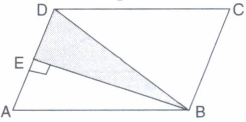
In given figure, ABCD is a parallelogram and BE\(\bot \)AD. If BE=14 cm and AD=8 cm, find the area of \(\Delta \)DBC.
2.
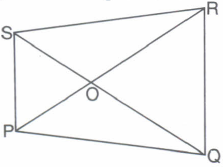
In the figure, PS||QR, Show that ar(\(\Delta \)ROS) = ar(\(\Delta \)POQ).
3.
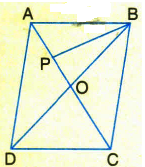
ABCD is a parallelogram with area 80 sq. cm. The diagonals AC and BD intersect at O. P is the mid-point of OA. Calculator ar (\(\Delta\)BOP).
4.
ABCD is a quadrilateral and BD is one of its diagonals as shown in figure. Show that ABCD is a parallelogram and find its area.
5.
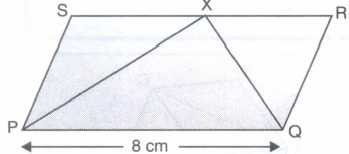
In the figure, PQRS is parallelogram with PQ=8 cm and ar(\(\Delta \)PXQ)=32 cm2. Find the altitude of PQRS and hence its area.
6.
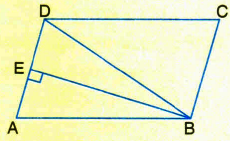
In the given figure, ABCD is a \(BE\bot AD\)parallelogram. If BE = 14 cm and AD = 8 cm, find the area of \(\Delta\)DBC.
7.
ABCD is a parallelogram with area 80 sq. cm. The diagonals AC and BD intersect at O. P is the midpoint of OA. Calculate ar(\(\Delta\) BOP)
8.
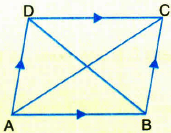
In the given figure:
(a) name the two triangles on the same base AB and between the same parallels.
(b) name a triangle and a parallelogram on the same base BC and between the same parallels.
9.
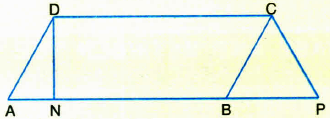
In the figure, ABCD is a parallelogram. P is a point on AB produced and \(DN\bot AB\) . If AB = 8 cm and DN = 3 cm. Find the area of \(\Delta \) CPD.
10.
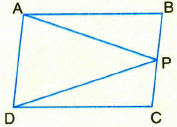
If the area of parallelogram (shown in figure) is 80 cm2 , then find area of \(\Delta \) ADP.
11.
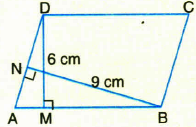
In the figure, ABCD is a parallelogram. AB = 12 cm, DM = 6 cm and BN = 9 cm. Find the length of AD.
12.
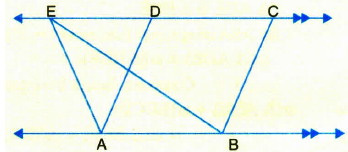
In the figure, ar( \(\Delta\)ABE) = 50 cm2. Find the area of the parallelogram ABCD. Give reasons.
13.
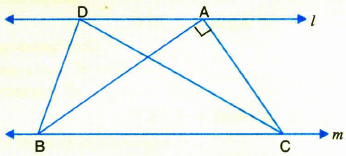
In the given figure, ABC and DBC are triangles on the same base and between parallel lines I and m. If AB = 3 cm, BC = 5 cm, \(\angle A=90°\), find area of \(\Delta \) DBC.
14.
In a parallelogram ABCD, AB = 8 cm. The altitudes corresponding to sides AB and AD are respectively 4 cm and 5 cm. Find measure of AD.
15.
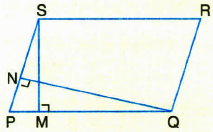
In the figure, PQRS is a parallelogram with PQ = 12 cm, altitudes corresponding to PQ and SP are respectively 8 cm and 10 cm. Find SP.
1.
Given: BE = 14 cm, AD = 8 cm
\(\therefore \ Area(\triangle ADB)=\frac { 1 }{ 2 } \times 8\times 14\)
= 56 cm2
\(\because\) ABCD is a parallelogram.
\(\therefore\) ar(\(\Delta \)DBC) = ar(\(\Delta \)ADB) = 56 cm2.
2.
\(\Delta \)PSR and \(\Delta \)PSQ are on the same base PS and between the same parallels PS and QR.
ar(\(\Delta \)PSR) = ar(\(\Delta \)PSQ)
ar(\(\Delta \)PSR) - ar(\(\Delta \)PSO) = ar(\(\Delta \)PSQ) - ar(\(\Delta \)PSO)
ar(\(\Delta \)ROS) = ar(\(\Delta \)POQ).
3.
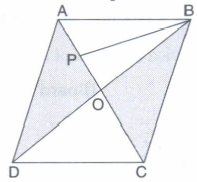
Area of a parallelogram is divided into four equal parts by the diagonals.
\(\Rightarrow \ ar(AOB)=\frac { 1 }{ 4 } ar(ABCD)\)
\(ar(\Delta BOP)=\frac { 1 }{ 2 } ar(AOB)=\frac { 1 }{ 8 } ar\ (ABCD)\)
\(=\frac { 1 }{ 8 } \times 80=10\quad { cm }^{ 2 }\)
4.
In the figure,
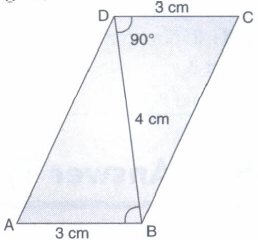
\(\angle CDB=\angle ABD=90°\)
But they are alternate angles.
\(\therefore\) AB || DC
Also DC = AB = 3 cm.
A quadrilateral with a pair of equal and parallel sides is a parallelogram.
\(\therefore\) Area = b\(\times\)h
=(3\(\times\)4) cm2
= 12 cm2
5.
Area of \((\Delta PXO)=\frac { 1 }{ 2 } \times b\times h\)
(b=base, h=height)
\(\Rightarrow \ 32=\frac { 1 }{ 2 } \times PQ\times h\)
\(\Rightarrow \ 32=\frac { 1 }{ 2 } \times 8\times h\)
\(\Rightarrow \ h=\frac { 32\times 2 }{ 8 } \)
\(\Rightarrow\) h = 8 cm
now, area of ||gm PQRS = b\(\times\)h
= 8 \(\times\) 8
= 64 cm2
Hence altitude of PQRS = 8 cm
and area of PQRS = 64 cm2
6.
56 cm2
7.
10 cm2
8.
\((a)\Delta DAB,DCAB\)
\(\\ (b)\Delta DAB,||gm\ ABCD\)
9.
12 cm2
10.
40 cm2
11.
8 cm
12.
100 cm2
13.
7.5 cm2
14.
6.4cm
15.
9.6 cm

9th Standard CBSE Syllabus & Materials
9th Standard CBSE
CBSE 9th Mathematics Lines and Angles Sample Question Papers Study Material - QB365 Set A
NEW9th Standard CBSE
CBSE 9th Mathematics Introduction to Euclid's Geometry Sample Question Papers Study Material - QB365 Set A
NEW9th Standard CBSE
CBSE 9th Mathematics Linear Equations in Two Variables Sample Question Papers Study Material - QB365 Set A
NEW9th Standard CBSE
CBSE 9th Mathematics Coordinate Geometry Sample Question Papers Study Material - QB365 Set A



CBSE 9th Standard CBSE Subjects
CBSE Standards