100% FREE ACCESS
9th Standard CBSE Syllabus & Materials
9th Standard CBSE
CBSE 9th Science Is matter around us pure? - New Model Questions Papers Study Material - QB365 Set A
NEW9th Standard CBSE
CBSE 9th Science Matter in our surroundings - New Model Questions Papers Study Material - QB365 Set A
NEW9th Standard CBSE
CBSE 9th Mathematics Heron's Formula Sample Question Papers Study Material - QB365 Set A
NEW9th Standard CBSE
CBSE 9th Mathematics Circles Sample Question Papers Study Material - QB365 Set A
NEW9th Standard CBSE
CBSE 9th Mathematics Quadrilaterals Sample Question Papers Study Material - QB365 Set A
NEW9th Standard CBSE
CBSE 9th Mathematics Triangles Sample Question Papers Study Material - QB365 Set A

Published on: 09/12/2019
Constructions
Download CBSE Class 9th Standard CBSE Mathematics question papers, sample papers, important questions, and previous year solved papers in PDF format. Get free study materials, NCERT solutions, and exam preparation resources for Class 9th Standard CBSE Mathematics
Questions + Answers key
Take MCQ Mathematics Test
1.
Construct an equilateral triangle if its altitude is 6 cm
2.
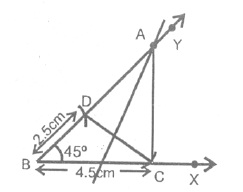
Construct a ΔABC in which BC = 4.7 cm,ㄥB = 45o and AB - AC = 2cm
3.
(i) Construct a \(\triangle ABC\) in which BC = 5.7cm, ㄥB = 30° and AC-AB = 3 cm.
(ii) Measure AC
(iii) Measure AB.
(iv) Verify that AC - AB = 3 cm.
(v) Apala ponders that \(\triangle BAC=\angle{30^\circ}\).Is she correct? Find by measurement.Which value is depicted by her ponderation?
4.
Draw an angle of 40° with a protractor and then construct an angle 80° using ruler and compass.
5.
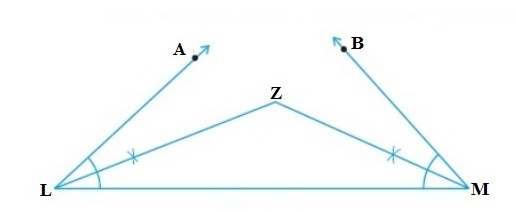
Construct an equilateral triangle LMN, one of whose sides is 5 cm. Bisect \(\angle M\) of the triangle.
6.
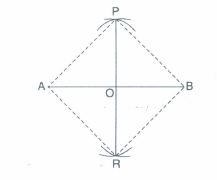
In the figure below,PR is the perpendicular bisectors of a line segment AB=16 cm.Is PA=PB true?
7.
If a 60o angle is bisected twice,what will be measure of each that is constructed?
8.
Bisector of an angle divides it in to_______equal parts
9.
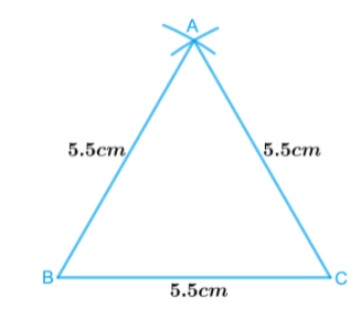
Construct an equilateral triangle PQR,When PQ = 5.5 cm
10.
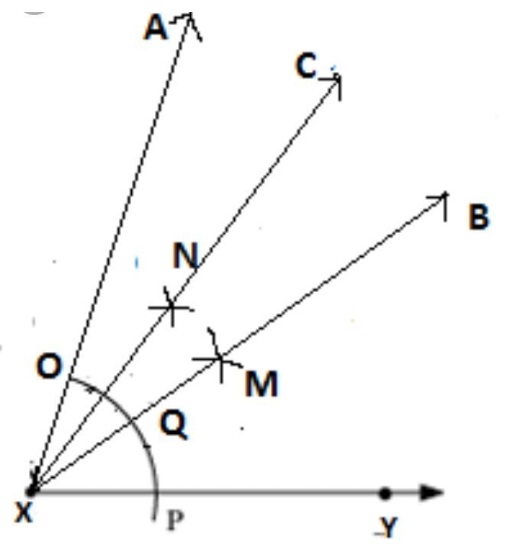
Draw ㄥDEF = 72o ,Construct \(\frac { 3 }{ 4 } \)ㄥDEF using a compass
11.
Draw any exterior angle of a triangle using compass, bisect it.
12.
Draw an angle of an equilateral triangle,using protrator. Bisect it using compass
13.
Construct an angle of 15o
14.
Construct ∠POY=30 o. using compass and ruler.
15.
Construct a triangle having its perimeter 12.5 cm and the ratio of the angles 3:4:5
16.
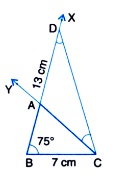
Construct a triangle ABC in which BC = 7 cm,∠B = 75o and AB + AC = 13 cm
17.
Construct a right triangle whose base is 4 cm and sum of its hypotenuse and other side is 8 cm.
1.
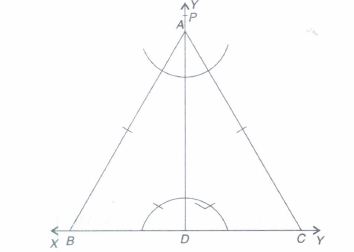
i) Draw a line XY
ii) Construct perpendicular PD at any point D on the line XY
iii) From point D, cut OH line segment AD = 6 cm.
iv) Construct ㄥBAD =ㄥCAD = 30o Then ABC is required triangle
Justification of Construction:
As A = ㄥBAD +ㄥCAD = 30o + 30o = 60o and AD⊥ BC.Therefore ΔABC is an equilateral triangle with altitude AD = 6 cm.
2.
Steps of construction:
i) Draw a line segment BC = 4.7 cm. and at point B construct an angle of 45o i.e ㄥXBC=45o
ii) Cut the line segment BD = 2 cm (equal to AB-AC)on ray BX
iii) Join DC and draw the perpendicular bisector PQ of DC
iv) The perpendicular bisector intersects BXat point A. Jon AC ΔABC is the required triangle.
3.
(i) Steps of Construction
1. Draw the base BC = 5 "7
2. At point B make XBC = 30°.
3. Cut the line segment =3 cm iron the line BX extended II opposite side of line segment Be.
4. Join DC and draw the perpendicular bisector, say PQ of De.
5. Let PQ intersect BX at A. Join AC.Then, ABC is the required triangle.
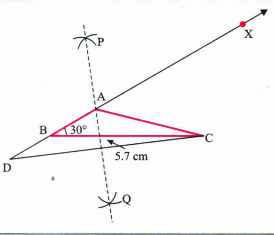
(ii) By measurement, AC = 4.5cm
(iii) By measurement, AB = 1.5cm
(iv) AC - AB =4.5 -1.5 = 3 cm
(v) The value 'ponderance' is depicted by her ponderation.
4.
Steps of Construction
1. Draw an angle AOB = 40° with a protractor.
2. Taking O as centre and some radius, draw an arc of a circle, which intersects OA at P and OB at Q.
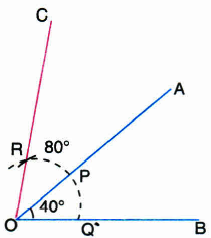
3. Taking P as centre and radius QP, draw an arc of a circle, which intersects the arc drawn in step 2, say at a point R.
4. Join OR and produce to form a ray Oc. Then, \(\angle COB=80°\)
5.
Steps of Construction
1. Draw a line segment MN = 5 cm.
2. With M as centre and 5 cm as radius, draw an arc on one side of MN.
3. With N as centre and 5 cm as radius, draw another arc on the same side of MN to intersect the former arc at L.
4. Join LM and LN. Then, \(\Delta \) LMN is the required equilateral triangle.
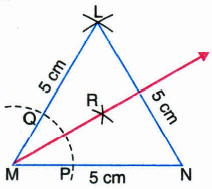
5. Taking M as centre and any radius, draw an arc to intersect the line segments MN and ML at P and Q respectively.
6. Next, taking P and Q as centres and with 1 the radius more than \(\frac { 1 }{ 2 } \) PQ, draw arcs to intersect each other, say at R.
7. Draw the ray MR. This ray MR is the required bisector of the \(\angle M\).
6.
()
AO = BO
= \(\frac { 1 }{ 2 } \) AB = 8 ..(i)
[PR is bisector of AB,given]
∠POA = ∠POB [Each 90o given]...(ii)
In △POA and △POB
AO = BO [From Given (i)]
∠POA = ∠POB
PO = PO[Common]
△POA =△POB [by SAS]
PA = PB [by c.p.c.t]
7.
()
Since bisector of an angle divides it in two equal parts,so,when it is bisected twice,measure of each angle is 15o
8.
()
Two
9.
Steps of Construction:
i) Draw any line segment PQ = 5.5. cm
ii) With P as centre and radius 5.5 cm draw an arc
iii) With Q as centre and radius 5.5 cm draw an arc to cut the previous arc at R
iv) Join PR and QR, then PQR is the required triangle.
10.
Steps of construction:
i) Draw ㄥDEF=72o ,using protractor
ii) Bisect it. Let the bisected angle be ㄥDEK
iii) Again bisect ㄥDEK
iv) Now ㄥGEF = \(\frac { 3 }{ 4 } \)ㄥDEF
11.
Steps of construction:
i) Construct a triangle ABC.
ii) Mark an exterior angle outside the triangle ABC,and name the point as E.
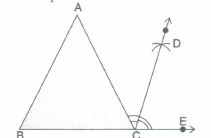
iii) Now, ACE is the exterior angle.
iv) Draw a bisecter of ㄥACE
12.
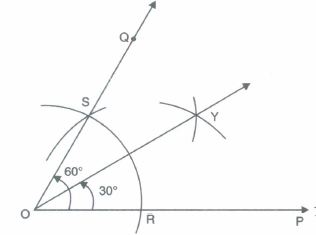
We know that each angle of equilateral triangle is 60o,So have to draw an angle 60oand bisect it.
Construction:
i) Draw any line OP.
ii) With 0 as centre and any suitable radius, draw an arc to meet OP at R.
iii) With R as centre and same radius draw an arc to meet the previous arc at S.
iv) Join OS and Produce it to Q, then ㄥPOQ=60o
v) With R as centre and any suitable radius (not necessarily)equal to radius of step 1 (but >\(\frac { 1 }{ 2 } \)RS),draw an arc. Also, with 5 as centre and radius draw another arc to meet the previous arc at Y
vi) Join OY and produced it, the OY is the required bisector of ㄥPOQ(i.e,ㄥPOY=30o)
13.
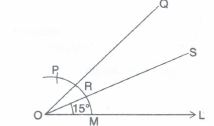
Steps of construction:
i) Draw a line OL using a ruler.
ii) Keeping O as center, with any radius draw an arc cutting the ray at point M using compass.
iii)T aking M as centre, draw arc to meet at previous arc at P.
iv) With P and M as centres and equal radius draw arcs intersecting at R. Join OR and extend to Q.
v) ㄥLOQ=30o
vi) With Rand M as centre, draw arcs with same radius or more than half of RM, meeting at point S
vii)J oin OS, which makes an angle, ㄥLOS = 15o
14.
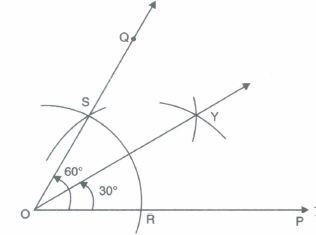
Steps of Construction:
i) Draw any line OP.
ii) With O as centre and any suitable radius, draw an arc to meet OP at R.
iii) With R as centre and same radius (as in step 2).draw an arc to meet the previous arc at S.
iv) Join OS and Produce it to Q,then ㄥPOQ=60o
v) With R as centre and any suitable radius (not necessarily) equal to radius of step 1 (but > \(\frac { 1 }{ 2 } \)RS),draw an arc. Also, with 5 as centre and radius draw another arc to meet the previous arc at Y.
vi) Join OY and produced it, the OY is the required bisector of ㄥPOQ (i.e ㄥPOY=30o)
15.
aㄥA= \(\frac { 3 }{ 12 } \times { 180 }^{ o }\)=45o
ㄥB=\(\frac { 4 }{ 12 } \times { 180 }^{ o }\) =60o
ㄥC= \(\frac { 5 }{ 12 } \times { 180 }^{ o }\) =75o
Steps of construction:
i) Draw a line PQ = 12.5 cm.
ii) At P, construct ㄥSPQ=60o and at Q , construct ㄥRQP=75o
iii) Draw the bisectors of ㄥSPQ and ㄥRQP ,intersecting at A.
iv) Draw the perpendicular bisectors of AP and AQ intersecting PQ at Band C respectively.
v) Join A to B and A to C.
ABC is the required triangle.
16.
Steps of construction:
i) Draw a line segment BC = 7 cm. At point B draw ㄥXBC= 75o
ii) Cut a line segment BD = 13 cm (i.e., equal to AB + AC) from BX
iii) Join DC and make an angle DCY equal to ㄥBDC
iv) Line CY intersects BX at A. ΔABC is the required triangle.
17.
Steps of construction:
i) Draw a ray BX and cut off line segment BC = 4cm
ii) Construct ㄥXBY = 90o
iii) From BY cut off line segment BD = 8 cm,
iv) Join CD.
v) Draw the ⊥ bisector of CD, intersecting BD at A
vi) Join AC, ABC is the required triangle

9th Standard CBSE Syllabus & Materials
9th Standard CBSE
CBSE 9th Mathematics Lines and Angles Sample Question Papers Study Material - QB365 Set A
NEW9th Standard CBSE
CBSE 9th Mathematics Introduction to Euclid's Geometry Sample Question Papers Study Material - QB365 Set A
NEW9th Standard CBSE
CBSE 9th Mathematics Linear Equations in Two Variables Sample Question Papers Study Material - QB365 Set A
NEW9th Standard CBSE
CBSE 9th Mathematics Coordinate Geometry Sample Question Papers Study Material - QB365 Set A



CBSE 9th Standard CBSE Subjects
CBSE Standards