100% FREE ACCESS
9th Standard CBSE Syllabus & Materials
9th Standard CBSE
CBSE 9th Science Is matter around us pure? - New Model Questions Papers Study Material - QB365 Set A
NEW9th Standard CBSE
CBSE 9th Science Matter in our surroundings - New Model Questions Papers Study Material - QB365 Set A
NEW9th Standard CBSE
CBSE 9th Mathematics Heron's Formula Sample Question Papers Study Material - QB365 Set A
NEW9th Standard CBSE
CBSE 9th Mathematics Circles Sample Question Papers Study Material - QB365 Set A
NEW9th Standard CBSE
CBSE 9th Mathematics Quadrilaterals Sample Question Papers Study Material - QB365 Set A
NEW9th Standard CBSE
CBSE 9th Mathematics Triangles Sample Question Papers Study Material - QB365 Set A

Published on: 31/10/2019
Download CBSE Class 9th Standard CBSE Mathematics question papers, sample papers, important questions, and previous year solved papers in PDF format. Get free study materials, NCERT solutions, and exam preparation resources for Class 9th Standard CBSE Mathematics
Questions + Answers key
Take MCQ Mathematics Test
1.
Three students Priyanka, Sania and David are protesting against killing innocent animals for commercial purposes in a circular park of radius 20 m. They are standing at equal distance on its boundary by holding banners in their hands.
(i) Find the distance between each of them?
(ii) Which mathematical concept is used in it?
(iii) How does an act like this reflects their attitude towards society?
2.
Raja, Renu and Reena are three friends. They decided to sweep a circular park near their homes. They divided the park into three parts by two equal chords AB and AC for convenience.
(i) Prove that the centre of the park lies on the angle bisector of \(\angle\)BAC
(ii) Which mathematical concept is used in the above problem?
(iii) By deciding sweeping, which value is depicted by the three friends?
3.
AD and BC are equal perpendiculars to a line segment AB (see figure).
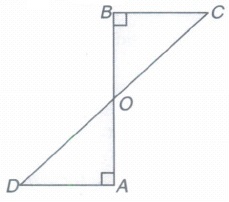
(i) Show that CD bisects AB.
(ii) Which mathematical concept is used in this problem?
(iii) What is its value?
4.
In \(\triangle\)ABC, if AB is the greatest side, then prove that LC > 60°.
5.
The % of marks obtained by students in the annual examination of a class in mathematics are given below:
| Percentage of marks | No. of students |
|---|---|
| 0-10 | 8 |
| 10-30 | 32 |
| 30-45 | 18 |
| 45-50 | 10 |
(i) How many students get less than 30% of marks?
(ii) Represent the data by histogram.
(iii) Which value is depicted by a student Ram obtaining the highest marks in the interval 45-50?
6.
Survey on the playing children of various age group is:
| Age(in yrs) | No. of Children |
| 1-2 | 5 |
| 2-3 | 3 |
| 3-5 | 6 |
| 5-7 | 12 |
| 7-10 | 9 |
| 10-15 | 10 |
| 15-17 | 4 |
Draw the histogram of above data
7.
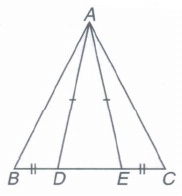
In the figure, AD = AE, BD = EC. Prove that \(\triangle\)ABC is an isosceles triangle.
8.
There was four plants in Suraj's fields. Suraj named their bases of P, Q, R, S. He joined PQ, QR, RS and SP. His teacher told him that the quadrilateral PQRS was a parallelogram. He asked him to find the measure of all the angles of the parallelogram,
provided that the measure of anyone interior angle of PQRS. To obtain a technique and hence to solve the problem, he worked hard and spent much time.
(i) Obtain all the angles of the paralellogram PQRS if ㄥR=80°.
(ii) Which mathematical concept is used in the above problem?
(iii) Which value was depicted by Suraj on such a problem
9.
Geetha told her classmate Radha that "\(\sqrt { \frac { \left( \sqrt { 2 } -1 \right) }{ \left( \sqrt { 2 } +1 \right) } } \) is an irrational number." Radha replied that "you are wrong" and further claimed that "If there is a number 'x' such that x3 is an irrational number, then x5 is also irrational". Geetha said, "No Radha, you are wrong". Radha took some time and after verification accepted her mistakes and thanked Geetha for pointing out these mistakes.
(i) Justify both the statements.
(ii) What value is depicted from this question?
10.
Prove that: \({ \left( \frac { { x }^{ { a }^{ 2 } } }{ { x }^{ { b }^{ 2 } } } \right) }^{ \frac { 1 }{ a+b } }.{ \left( \frac { { x }^{ { b }^{ 2 } } }{ { x }^{ { c }^{ 2 } } } \right) }^{ \frac { 1 }{ b+c } }.{ \left( \frac { { x }^{ { c }^{ 2 } } }{ { x }^{ { a }^{ 2 } } } \right) }^{ \frac { 1 }{ c+a } }=1\)
1.
(i) Let us assume that A, Band C are the position of Priyanka, Sania and David respectively on the boundary of circular park with centre O.
Draw AD\(\bot\) BC
Since the centre of the circle coincides with the centroid of the equilateral \(\triangle\) ABC
\(\therefore\) Radius of circumscribed circle = \(\frac{2}{3}\) AD
\(\Rightarrow 20=\frac { 2 }{ 3 } AD\)
\(\Rightarrow AD=20\times \frac { 2 }{ 3 } \)
\(\Rightarrow AD=30m\)
Now, AD\(\bot\)BC, and let AB=BC=CA=x
\(\Rightarrow BD=CD=\frac { 1 }{ 2 } BC=\frac { x }{ 2 } \)
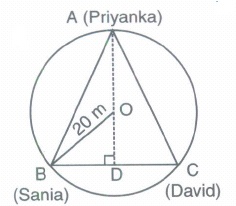
In rt. \(\triangle\)BDA, D=900
By Pythagoras Theorem, we have
AB2=BD2+AD2
\(\Rightarrow { x }^{ 2 }={ \left( \frac { x }{ 2 } \right) }^{ 2 }+{ (30) }^{ 2 }\)
\(\Rightarrow{ x }^{ 2 }-{ \frac { { x }^{ 2 } }{ 4 } }=90\)
\(\Rightarrow \frac { 3 }{ 4 } { x }^{ 2 }=90\)
\(\Rightarrow { x }^{ 2 }=900\times \frac { 4 }{ 3 } \)
\(\Rightarrow { x }^{ 2 }=1200\)
\(\therefore x=\sqrt { 1200 } =20\sqrt { 3 } \)
Hence, the distance between each of them is \(20\sqrt { 3 } .\)
(ii) Properties of the circle, equilateral triangle and Pythagoras theorem.
(iii) Live and let live.
2.
(i) Given: A circle C(O, r) and chord AB = chord AC. AD is bisector of \(\angle\)CAB.
To Prove: Centre O lies on the bisector of \(\angle\)BAC
Construction Join Be, meeting bisector AD of \(\angle\)BAC, at M.
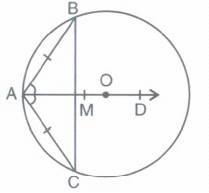
Proof: In triangles BAM and CAM,
AB=AC (given)
\(\angle\)BAM= \(\angle\)CAM (given)
AM=AM (Common)
\(\triangle BAM\cong \triangle CAM\) (SAS)
\(\Rightarrow\) BM=CM
and \(\angle\)BMA = \(\angle\)CMA
As \(\angle\)BMA + \(\angle\)CMA = 1800 (linear pair)
\(\Rightarrow\) \(\angle\)BMA = \(\angle\)CMA = 900
\(\Rightarrow\) AM is the perpendicular bisector of the chord BC
\(\Rightarrow\) AM passes through the centre O.
[\(\because\) Perpendicular bisector of chord of a circle passes through the centre of the circle]
Hence, the centre of the park lies on the angle bisector of \(\angle\)BAC
(ii) Congruency of triangles by SAS axiom (Geometry)
(iii) Cleanliness and respect for labour.
3.
(i) AB and CD intersect atO0
\(\therefore\) \(\angle\)AOD = \(\angle\)BOC
(Vertically opp. angles) ...(i)
In \(\triangle\)AOD and \(\triangle\)BOC, we have
\(\angle\)AOD = \(\angle\)BOC ...(ii)
\(\angle\)DAO = \(\angle\)CBO = 90° (Given)
and AD = BC (Given)
\(\triangle AOD\cong \triangle BOC\)
(By AAS congruence criterion)
\(\Rightarrow\) OA = OB (By c.p.c.t.)
i.e., O is the mid-point of AB
Hence, CD bisects AB.
(ii) Congruency of triangles.
(iii) Equality is the sign of democracy.
4.
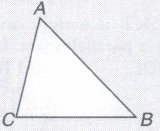
In \(\triangle\)ABC, as AB is the greatest side
\(\Rightarrow\) AB > BC \(\Rightarrow\) \(\angle\)C > \(\angle\)A
AB > AC \(\Rightarrow\) \(\angle\)C > \(\angle\)B
On adding (1) and (2), we get
2\(\angle\)C > \(\angle\)A + \(\angle\)B
\(\Rightarrow\) 2\(\angle\)C + \(\angle\)C > \(\angle\)A + \(\angle\)B + \(\angle\)C
\(\Rightarrow\) 3\(\angle\)C > 180°
\(\therefore\) \(\angle\)C > 60°.
5.
(i) Required number of students = 8 + 32 = 40
(ii) Here, We notice that classes are continuous but class-size is not the same for all the classes. We notice minimum class-size is of class 45-50, i.e., 5. We will first find proportionate length of rectangle (adjusted frequency) for each class.
Length of rectangle (adjusted frequency) =\(\frac { Frequency\ of\ Class }{ Width\ of\ class } \times Minimum\ class-size\)
| Marks (C.I.) |
Number of students(f) | Width of class (Clss-size) |
Length of rectangle |
|---|---|---|---|
| 0-10 | 8 | 10 | \(\frac{8}{10}\)x 5 = 4 |
| 10-30 | 32 | 20 | \(\frac{32}{20}\) x 5 = 8 |
| 30-45 | 18 | 15 | \(\frac{18}{15}\) x 5 = 6 |
| 45-50 | 10 | 5 | \(\frac{10}{5}\) x 5 = 10 |
Now, we construct rectangles with respective class-intervals as widths and adjusted frequencies as heights.
Histogram representing marks obtained by students in unit test of Mathematics.
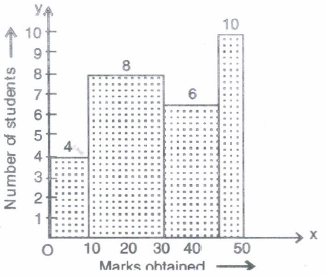
(iii) Hardwork and Dilligence.
6.
| Age(in years) | No. of children | Width of class | Length of rectangle |
|---|---|---|---|
| 1-2 | 5 | 1 | \(\frac{5}{1}\)x1=5 |
| 2-3 | 3 | 1 | \(\frac{3}{1}\)x1=3 |
| 3-5 | 6 | 2 | \(\frac{6}{2}\)x1=3 |
| 5-7 | 12 | 2 | \(\frac{12}{2}\)x1=6 |
| 7-10 | 9 | 3 | \(\frac{9}{3}\)x1=3 |
| 10-15 | 10 | 5 | \(\frac{10}{5}\)x1=2 |
| 15-17 | 4 | 2 | \(\frac{4}{2}\)x1=2 |
Required histogram is as follows:
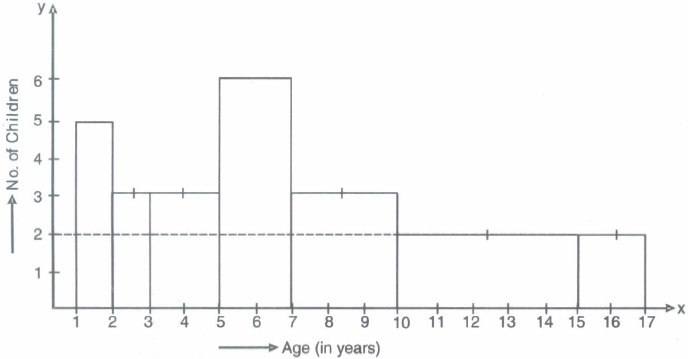
7.
Proof: In \(\triangle\)ADE, we have
AD = AE
\(\angle\)ADE = \(\angle\)AED
180°- \(\angle\)ADE = 180°- \(\angle\)AED
\(\Rightarrow\) \(\angle\)ADB = \(\angle\)AEC
Consider \(\triangle\)ABD and \(\triangle\)ACE
AD =AE
\(\angle\)ADB = \(\angle\)AEC
BD = EC
By SAS congruence,
\(\triangle ADB\cong \triangle AEC\)
By c.p.c.t., AB = AC
\(\therefore\) \(\triangle\)ABC is an isosceles triangle.
8.
ㄥR=80° (Given)
SR II PQ and RQ is a transversal
ஃ ㄥR+ㄥQ=180°
ㄥQ=180°-80°
= 100°
Similarly, ㄥQ+ㄥP=180°
⇒ ㄥP=180°-100°=80°
and ㄥS+ㄥR=180°
⇒ ㄥS=180°-80°=100°
Hence, ㄥP=80°, ㄥQ=100°, ㄥR=80°, ㄥS=100°
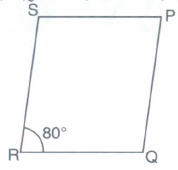
(ii) Property of co-interior angles when a pair of straight lines intersected by another straight line (Geometry)
(iii) Diligence i.e., dedication, determination, and hard work.
9.
\(\sqrt { \frac { \left( \sqrt { 2 } -1 \right) }{ \left( \sqrt { 2 } +1 \right) } } \)is an irrational number.
\(\sqrt { \frac { \left( \sqrt { 2 } -1 \right) }{ \left( \sqrt { 2 } +1 \right) } } =\sqrt { \frac { \left( \sqrt { 2 } -1 \right) }{ \left( \sqrt { 2 } +1 \right) } \times \frac { \left( \sqrt { 2 } -1 \right) }{ \left( \sqrt { 2 } -1 \right) } } \)
\(=\sqrt { \frac { { \left( \sqrt { 2 } -1 \right) }^{ 2 } }{ 2-1 } } \)
\(=\sqrt { \frac { { \left( \sqrt { 2 } -1 \right) }^{ 2 } }{ 1 } } =\sqrt { 2 } -1\)
which is an irrational number.
Let, there is a number x such that x3 is an irrational number but x5 is a rational number.
Let, x =\(\sqrt[5]{7}\) be the number.
⇒ x3 = (5√7)3 = (7)3/5
is an irrational number.
But x5 = (\(\sqrt[5]{7}\))5=(7)5/5 = 7
=7 is a rational number.
(ii) Accepting own mistakes gracefully, co-operative learning among the classmates.
10.
\(={ \left( { x }^{ { a }^{ 2 }-{ b }^{ 2 } } \right) }^{ \frac { 1 }{ a+b } }.{ \left( { x }^{ { b }^{ 2 }-{ c }^{ 2 } } \right) }^{ \frac { 1 }{ b+c } }.{ \left( { x }^{ { c }^{ 2 }-{ a }^{ 2 } } \right) }^{ \frac { 1 }{ c+a } }\)
\(={ x }^{ \frac { { a }^{ 2 }-{ b }^{ 2 } }{ a+b } }.{ x }^{ \frac { { b }^{ 2 }-{ c }^{ 2 } }{ a+b } }.{ x }^{ \frac { { c }^{ 2 }-{ a }^{ 2 } }{ c+a } }\)
\(={ x }^{ a-b }.{ x }^{ b-c }.{ x }^{ c-a }\)
\(={ x }^{ 0 }\)

9th Standard CBSE Syllabus & Materials
9th Standard CBSE
CBSE 9th Mathematics Lines and Angles Sample Question Papers Study Material - QB365 Set A
NEW9th Standard CBSE
CBSE 9th Mathematics Introduction to Euclid's Geometry Sample Question Papers Study Material - QB365 Set A
NEW9th Standard CBSE
CBSE 9th Mathematics Linear Equations in Two Variables Sample Question Papers Study Material - QB365 Set A
NEW9th Standard CBSE
CBSE 9th Mathematics Coordinate Geometry Sample Question Papers Study Material - QB365 Set A



CBSE 9th Standard CBSE Subjects
CBSE Standards