100% FREE ACCESS
9th Standard CBSE Syllabus & Materials
9th Standard CBSE
CBSE 9th Science Is matter around us pure? - New Model Questions Papers Study Material - QB365 Set A
NEW9th Standard CBSE
CBSE 9th Science Matter in our surroundings - New Model Questions Papers Study Material - QB365 Set A
NEW9th Standard CBSE
CBSE 9th Mathematics Heron's Formula Sample Question Papers Study Material - QB365 Set A
NEW9th Standard CBSE
CBSE 9th Mathematics Circles Sample Question Papers Study Material - QB365 Set A
NEW9th Standard CBSE
CBSE 9th Mathematics Quadrilaterals Sample Question Papers Study Material - QB365 Set A
NEW9th Standard CBSE
CBSE 9th Mathematics Triangles Sample Question Papers Study Material - QB365 Set A

Published on: 31/10/2019
Download CBSE Class 9th Standard CBSE Mathematics question papers, sample papers, important questions, and previous year solved papers in PDF format. Get free study materials, NCERT solutions, and exam preparation resources for Class 9th Standard CBSE Mathematics
Questions + Answers key
Take MCQ Mathematics Test
1.
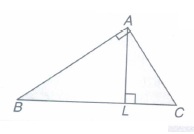
In figure, triangle ABC is right angles at A, AL is drawn perpendicular ro BC. Prove that \(\angle BAL=\angle ACB.\)
2.
Simplify: \(\left( \sqrt { 3 } +1 \right) \left( 1-\sqrt { 12 } \right) +\frac { 9 }{ \left( \sqrt { 3 } +\sqrt { 12 } \right) } \)
3.
Simplify: \((\sqrt{x})^{-\frac{2}{3}}\sqrt{y^{4}}\div\sqrt{(xy)^{-\frac{1}{2}}}\)
4.
Write three solutions of the equation 3x=y+3. Draw its graph and find the points where the graph intersects the axes.
5.
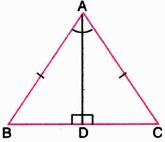
AD is an altitude of an isosceles triangle ABC in which AB = AC Show that
(i) AD bisects BC (ii) AD bisects \(\angle A\)
6.
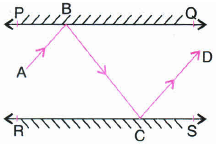
In Figure ,PQ and RS are two mirrors placed parallel to each other An incident ray AB strikes the mirror PQ at B the reflected ray moves along the path BC and strikes the mirror RS at C and again reflects back along CD.Prove that AB|| CD
7.
Express the following linear equation in the form ax+by+c=0 and indicate the values of a, b and c in each case:
-2x+3y=6
8.
In which quadrant do the given points lie?(9,6)
9.
Verify whether the following are zeroes of the polynomial, indicated against them.
\(p(x)=3x+1,x=-\frac { 1 }{ 3 } \)
10.
Classify the following as linear, quadratic and cubic polynomials:
y + y2 + 4
11.
Write the coefficients of x2 in the following:
2 - x2 + x3
12.
Express \(2.\overline { 93 } \) in the form of \(\frac { p }{ q } \), where p and q are integers, \(q\neq 0\)
13.
Write the following in decimal form and say what kind of decimal expansion each has:
\(\frac { 3 }{ 13 } \)
14.
Find six rational numbers between 3 and 4.
1.
In \(\triangle ABC,\angle A+\angle B+\angle C=180^o\)(Angle sum property)
\(\Rightarrow 90^o+\angle B+\angle C=180^o(\angle A=90^o)\)
\(\Rightarrow \angle B+\angle C=90^o\)
\(\therefore \angle C=\angle ACB=90^o-\angle B...(i)\)
Also in \(\triangle ALB,\)
\(\angle ALB+\angle BAL+\angle B=180^o\) (Angle sum property)
\(\Rightarrow 90^o+\angle BAL+\angle B=180^o\)
\(\angle BAL=90^o-\angle B....(ii)\)
Hence, from (i) and (ii), we get
\(\angle BAL=\angle ACB\)
2.
\(\left( \sqrt { 3 } +1 \right) \left( 1-\sqrt { 12 } \right) +\frac { 9 }{ \left( \sqrt { 3 } +\sqrt { 12 } \right) } \)
\(=\left( \sqrt { 3 } -6+1-\sqrt { 12 } \right) +\frac { 9 }{ \left( \sqrt { 12 } +\sqrt { 3 } \right) } \times \frac { \left( \sqrt { 12 } -\sqrt { 3 } \right) }{ \left( \sqrt { 12 } -\sqrt { 3 } \right) } \)
\(=\left( \sqrt { 3 } -6+1-\sqrt { 12 } \right) +\frac { 9\left( \sqrt { 12 } -\sqrt { 3 } \right) }{ 12-3 } \)
\(=\sqrt { 3 } -5-\sqrt { 12 } +\sqrt { 12 } -\sqrt { 3 } \)
= -5
3.
\(\frac { { \left( { x }^{ \frac { 1 }{ 2 } } \right) }^{ \frac { -2 }{ 3 } }{ \left( { y }^{ 4 } \right) }^{ \frac { 1 }{ 2 } } }{ { x }^{ \frac { -1 }{ 4 } }{ y }^{ \frac { -1 }{ 4 } } } ={ x }^{ \frac { -1 }{ 3 } }.{ y }^{ 2 }.{ x }^{ \frac { 1 }{ 4 } }.{ y }^{ \frac { 1 }{ 4 } }\)
\({ x }^{ \frac { -1 }{ 12 } }.{ y }^{ \frac { 9 }{ 4 } }=\frac { { y }^{ \frac { 9 }{ 4 } } }{ { x }^{ \frac { 1 }{ 12 } } } \)
4.
3x=y+3; three solutions are x=1, y=0; x=2, y=3 and x=0, y=-3
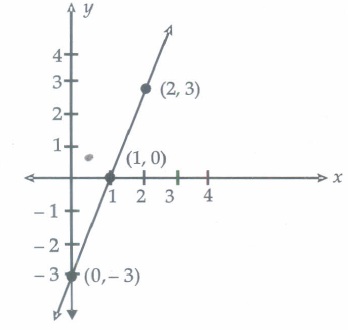
From graph it is clear that line meets x-axis at(1,0) and y-axis at (0,-3)
5.
Given: AD is an altitude of an isosceles triangle ABC in which AB = AC.
To prove: (i) AD bisects BC (ii) AD bisects \(\angle A\)
Proof: (i) In right \(\triangle ADB\) and right \(\triangle ADC\)
Hyp.AB = Hyp. AC
Side AD = Side AD
\(\triangle ADB\cong \triangle ADC\) | RHS rule
BD = CD | C.P.C.T
AD bisects BC
(ii) \(\triangle ADB\cong \triangle ADC\)
\(\angle BAD=\angle CAD\)
AD bisects \(\angle A\)
6.
Construction: Draw ray BL \(\bot \) PQ and ray CM \(\bot \) RS.
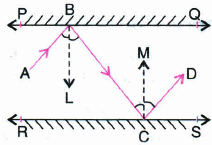
BL \(\bot \) PQ,CM \(\bot \) RS and PQ || RS BL||CM
\(\angle \) LBC=\(\angle \) MCB
|Alternate Interior Angles
\(\angle\)ABL=\(\angle\)LBC
Angle of incidence= Angle of reflection
\(\angle \)MCB=\(\angle \)MCD
Angle of incidence= Angle of reflection
From (1),(2) and (3) we get
\(\angle \)ABL =\(\angle \)MCD
Adding (1) and (4) , we get
\(\angle \) LBC+\(\angle \)ABL =\(\angle \)MCB+\(\angle \)MCD
\(\Rightarrow \) \(\angle \)ABC=\(\angle \)BCD
But these form a pair of equal alternate interior angles
So AB || CD.
7.
-2x+3y=6
Comparing with ax+by+c=0, we get
a=2, b=3, c=-6
8.
I
9.
\(p\left( -\frac { 1 }{ 3 } \right) =3\left( -\frac { 1 }{ 3 } \right) +1=-1+1=0\)
\(\therefore -\frac { 1 }{ 3 } \) is a zero of p(x)
10.
quadratic
11.
Coefficient of x2 = -1
12.
\(\frac { 291 }{ 99 } \)
13.
\(\frac { 3 }{ 13 } \)= 0.230769230769...=\(0.\overline { 230769 } \)
14.
There can be infinitely many rational numbers between 3 and 4.
\(\frac { 3+4 }{ 2 } =\frac { 7 }{ 2 } \)
\(\\ \frac { 3+\frac { 7 }{ 2 } }{ 2 } =\frac { 13 }{ 4 } \)
\(\\ \frac { 3+\frac { 13 }{ 4 } }{ 2 } =\frac { 25 }{ 8 }\)
\( \\ \frac { 3+\frac { 25 }{ 8 } }{ 2 } =\frac { 49 }{ 16 } =\frac { 3+\frac { 49 }{ 16 } }{ 2 } =\frac { 97 }{ 32 } =\frac { 3+\frac { 97 }{ 32 } }{ 2 } =\frac { 193 }{ 64 } \)
Thus, six rational numbers between 3 and 4
\(\frac { 193 }{ 64 } ,\frac { 97 }{ 32 } ,\frac { 49 }{ 16 } ,\frac { 25 }{ 8 } ,\frac { 13 }{ 4 } \)and \(\frac { 7 }{ 2 } \)
Aliter
\(3=\frac { 3 }{ 1 } =\frac { 3\times 7 }{ 1\times 7 } =\frac { 21 }{ 7 } \)
\(\\ 4=\frac { 4 }{ 1 } =\frac { 4\times 7 }{ 1\times 7 } =\frac { 28 }{ 7 } \)
6 + 1 = 7
the six rational numbers between 3 and 4 can be taken as
\(\frac { 22 }{ 7 } ,\frac { 23 }{ 7 } ,\frac { 24 }{ 7 } ,\frac { 25 }{ 7 } ,\frac { 26 }{ 7 } \) and \(\frac { 27 }{ 7 } \)

9th Standard CBSE Syllabus & Materials
9th Standard CBSE
CBSE 9th Mathematics Lines and Angles Sample Question Papers Study Material - QB365 Set A
NEW9th Standard CBSE
CBSE 9th Mathematics Introduction to Euclid's Geometry Sample Question Papers Study Material - QB365 Set A
NEW9th Standard CBSE
CBSE 9th Mathematics Linear Equations in Two Variables Sample Question Papers Study Material - QB365 Set A
NEW9th Standard CBSE
CBSE 9th Mathematics Coordinate Geometry Sample Question Papers Study Material - QB365 Set A



CBSE 9th Standard CBSE Subjects
CBSE Standards