100% FREE ACCESS
9th Standard CBSE Syllabus & Materials
9th Standard CBSE
CBSE 9th Science Is matter around us pure? - New Model Questions Papers Study Material - QB365 Set A
NEW9th Standard CBSE
CBSE 9th Science Matter in our surroundings - New Model Questions Papers Study Material - QB365 Set A
NEW9th Standard CBSE
CBSE 9th Mathematics Heron's Formula Sample Question Papers Study Material - QB365 Set A
NEW9th Standard CBSE
CBSE 9th Mathematics Circles Sample Question Papers Study Material - QB365 Set A
NEW9th Standard CBSE
CBSE 9th Mathematics Quadrilaterals Sample Question Papers Study Material - QB365 Set A
NEW9th Standard CBSE
CBSE 9th Mathematics Triangles Sample Question Papers Study Material - QB365 Set A

Published on: 04/11/2019
Download CBSE Class 9th Standard CBSE Mathematics question papers, sample papers, important questions, and previous year solved papers in PDF format. Get free study materials, NCERT solutions, and exam preparation resources for Class 9th Standard CBSE Mathematics
Questions + Answers key
Take MCQ Mathematics Test
1.
In a medical examination of students of a class, the following blood groups are recorded:
| Blood group | No.of students |
| A | 10 |
| AB | 13 |
| B | 12 |
| O | 5 |
A student is selected at random from the class. The probability that a student has blood group 'B' is:
\(\frac { 1 }{ 4 } \)
\(\frac { 13 }{ 40 } \)
\(\frac { 3 }{ 10 } \)
\(\frac { 1 }{ 8 } \)
2.
Three coins were tossed 30 times simultaneously. Each time the number of heads occurring was noted down as follows:
0 1 2 2 1 2
3 1 3 0 1 3
1 1 2 2 0 1
2 1 3 0 0 1
1 2 3 2 2 0
Find the probability of getting 3 heads is
\(\frac { 1 }{ 2 } \)
\(\frac { 1 }{ 3 } \)
\(\frac { 1 }{ 4 } \)
\(\frac { 1 }{ 6 } \)
3.
Three coins one tossed simultaneously 600 times with the following frequencies of different outcomes:
| Outcome | Frequency |
| 3 heads | 150 |
| 2 heads | 200 |
| 1 head | 100 |
| no head | 150 |
The probability of getting 1 head is
\(\frac { 1 }{ 6 } \)
\(\frac { 1 }{ 4 } \)
\(\frac { 1 }{ 3 } \)
\(\frac { 1 }{ 2 } \)
4.
Three coins one tossed simultaneously 600 times with the following frequencies of different outcomes:
| Outcome | Frequency |
| 3 heads | 150 |
| 2 heads | 200 |
| 1 head | 100 |
| no head | 150 |
The probability of getting 3 heads is
\(\frac { 1 }{ 2 } \)
\(\frac { 1 }{ 3 } \)
\(\frac { 1 }{ 4 } \)
\(\frac { 1 }{ 5 } \)
5.
In a survey of 350 women, 132 were found to be working. If a woman is selected at random, the probability that she is not working is:
\(\frac { 66 }{ 175 } \)
\(\frac { 109 }{ 175 } \)
\(\frac { 43 }{ 175 } \)
1
6.
In 1000 lottery tickets there are 5 prize winning tickets. Then the probability of winning a prize if a person buys one ticket will be:
\(\frac { 1 }{ 200 } \)
\(\frac { 1 }{ 500 } \)
\(\frac { 1 }{ 1000 } \)
\(\frac { 1 }{ 20 } \)
7.
In an experiment, a coin is tossed 500 times.If a head up 280 times, then the probability of getting a tail is:
\(\frac { 14 }{ 25 } \)
\(\frac { 11 }{ 25 } \)
\(\frac { 13 }{ 25 } \)
\(\frac { 19 }{ 25 } \)
8.
The probability P(E) of an event E is:
P(E)=0
P(E)=1
\(0\ge p(E)>1\)
\(0\le p(E)\le 1\)
9.
The sum of probabilities of an event A and event, not A is equal to:
0
1
-1
2
10.
What is the number of outcomes when a coin is tossed?
1
2
4
6
11.
The mean of 3,4,5,6,7 is
7
6
5
4
12.
If the mode of the given data 16,18,17,16,18,x,19,17,14 is 18, then the value of x will be:
16
17
18
19
13.
The marks of some students are given below. Find the mode of marks.
| Marks | Number of students |
|---|---|
| 10 | 2 |
| 20 | 8 |
| 30 | 16 |
| 40 | 26 |
| 50 | 20 |
| 60 | 16 |
| 70 | 7 |
| 80 | 4 |
60
50
30
40.
14.
Two consecutive class marks of a distribution are 52 and 57. Then the class size is:
2.5
5
54.5
109
15.
'Heights of 20 students of your class' from
Primary data
Secondary data
Useless data
Fictitious data
16.
The area of the four walls of a room is 80 cm2 and its height is 4 m. Then, the perimeter of the floor of the room is
16 m
5 m
20 m
10 m
17.
The area of the four walls of a room is 300 m2. Its length and height are 15 m and 6 m respectively. Find its breadth.
10 m
5 m
20 m
15 m
18.
The dimensions of a box are 1 m, 80 cm and 50 cm. The area of its four walls is
6000 cm2
12000 cm2
18000 cm2
24000 cm2
19.
A brick measures 25 cm \(\times\) 12 cm \(\times\) 10 cm. Its surface area is
670 cm2
1340 cm2
3000 cm2
1500 cm2
20.
The lateral surface area of a cuboid of length l, breadth b and height h is
2(lb + bh + hl)
2(l + b)h
lbh
none of these.
21.
If the edges of a cuboid are l, b and h respectively, then the total surface area of the cuboid is
2(lb + bh + hl)
lbh
2(l + b)h
none of these.
22.
The lateral surface area of a cube of side a is
4a2
6a2
3a2
2a2.
23.
The number of edges of a cube are
6
8
12
16.
24.
Identify the wrong statement of the following:
A square can be drawn on our notebook.
A circle can be drawn on the blackboard.
A rectangle can be drawn on a piece of paper.
A triangle cannot be drawn on a wall.
25.
Which of the following is a plane figure?
Cone
Square
Cylinder
Cube.
26.
If the area of a square is 625 ares, then its perimeter is
250 m
500 m
1000 m
25 m
27.
1 hectare =
10 m2
100 m2
1000 m2
10000 m2
28.
The sides of a triangular field are in the ratio 3:4:5.The perimeter of the triangular field is 144 m.Find the longest side of the field.
15 m
30 m
60 m
90 m
29.
Find the perimeter of the triangle whose sides are 17 cm, 33 cm, and 20 cm.
70 cm
50 cm
53 cm
37 cm
30.
Find the area of a quadrilateral whose one diagonal is 8 cm and the sum of perpendiculars from vertices is 10 cm.
20 cm2
40 cm2
80 cm2
160 cm2
31.
The sides of a triangle are 7 cm, 24 cm, and 25 cm.Its area is
168 cm2
84 cm2
87.5 cm2
300 cm2
32.
Side of an equilateral triangle is 4 cm. Its area is
\(4\sqrt { 3 } \) cm2
\(\frac { \sqrt { 3 } }{ 4 } \) cm2
\(\sqrt { 3 } \) cm2
\(2\sqrt { 3 } \) cm2
33.
Area of a triangle is 60 cm2.Its base is 15 cm.Its altitude is
30 cm
4 cm
8 cm
10 cm
34.
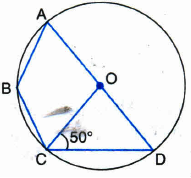
In the following figure, ABCD is a cyclic quadrilateral whose side AD is a diameter of the circle and the point O is the centre of the circle. If \(\angle OCD=50°\) , then the measure of \(\angle ABC\) is
100°
120°
110°
130°
35.
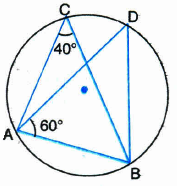
In the given figure, A, B, C and D are points on the circle such that \(\angle ACB=40°\) and \(\angle DAB=60°\),the measure of \(\angle DBA\) is
70°
80°
60°
100°
36.
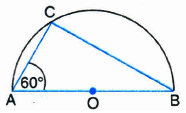
In the figure, AOB is a diameter of the semicircle. If \(\angle A=60°\) , then \(\angle B\) is equal
60°
30°
50°
40°
37.
In the adjacent figure, what is the relation between AB and CD?
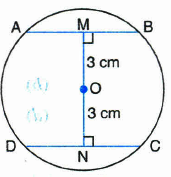
AB > CD
AB < CD
AB = CD
AB = 2CD
38.
To determine a unique circle, the number of points required is:
1
2
3 non collinear points
3 collinear points
39.
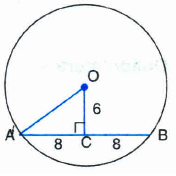
The length of a chord of a circle is 16 cm and its distance from the centre is 6 cm. The measure of the radius of the circle is
6 cm
8 cm
10 cm
12 cm.
40.
In the given figure, O is the centre of the circle. \(\Delta AOB\) is equilateral. CD = AB, then \(\angle COD=\)
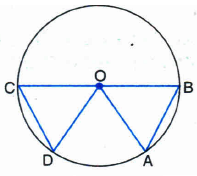
30°
45°
60°
90°
41.
In the given figure, O is the centre of the circle. \(\angle AOB=\angle COD=50°\) and CD = 5 cm then AB is equal to:
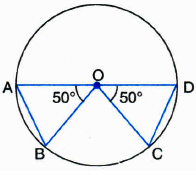
2.5 cm
10cm
\(\frac { 10 }{ 3 } \) cm
5 cm
42.
In the figure, ABCD is a parallelogram in which DC = 6 cm and \(AE\bot DC\), AE = 4 cm. The area of (\(\Delta\)DCF) is equal to:
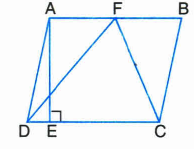
24 cm2
10 cm2
12 cm2
20 cm2
43.
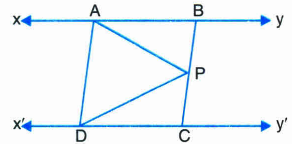
Parallelogram ABCD and \(\Delta\)APD are on the same base AD and between the same parallels AD and BC. If the area of \(\Delta\)APD is 12 cm2 , then the area of || gm ABCD (in cm2) is:
6
12
18
24
44.
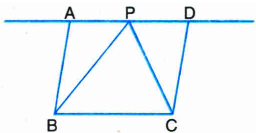
In the figure, parallelogram ABCD and \(\Delta\)BCP are on the same base BC and between the same parallels. If ar(BCP) = 15 cm2. Then ar(ABCD) equals:
7.5 cm2
30 cm2
15 cm2
60 cm2
45.
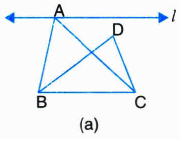
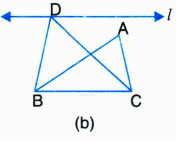
In which of the following figures, \(\Delta\)ABC and \(\Delta\)DBC lie on the same base and between the same parallels?
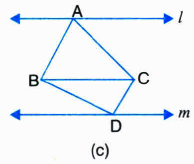
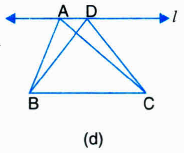
46.
In the given figure, ABCD is a parallelogram. F and E are midpoints of CD and AB respectively. If area (BEC) = a sq. units, then the area (ABCD) (in sq. units) is equal to:
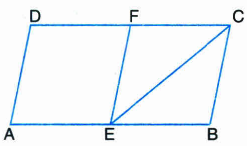
2a
a
3a
4a
47.
ABCD is a quadrilateral whose diagonal AC divides it into two parts equal in area, then ABCD is
a rhombus
a parallelogram
a kite
a trapezium
48.
Two parallelograms are on equal bases and between the same parallels. The ratio of their areas is
1:2
1:1
2:1
3:1
49.
In the figure, ABCD is a parallelogram of area 128 cm2 . If CF = 16 cm, the length of AD is
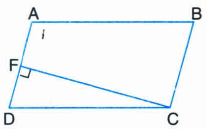
8 cm
4 cm
16 cm
10 cm
50.
The quadrilateral formed by joining the mid-point of the sides of a rectangle taken in order is a
rectangle
square
rhombus
kite
51.
The quadrilateral formed by joining the mid-point of a quadrilateral taken in order is a
kite
parallelogram
rectangle
square
52.
A rhombus is
a rectangle
a square
a kite
not a square.
53.
Which of the following is false?
A square is a rectangle
A square is a rhombus
A parallelogram is a trapezium
A kite is a parallelogram.
54.
Each angle of a square is
300
600
900
450
55.
In ΔABC, ㄥA=1000, ㄥB=300 and ㄥC=500, then:
AB > AC
BC < AC
AB < AC
none of these
56.
In ΔABC, if AB > BC then:
ㄥC < ㄥA
ㄥC=ㄥA
ㄥC > ㄥA
ㄥA=ㄥB
57.
In any triangle ABC, ㄥA > ㄥB and ㄥB > ㄥC, then the smallest side is:
AB
BC
CA
none of these
58.
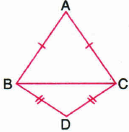
In figure, if AB = AC and BD = DC, ΔABD and ΔACD are congruent by which criterion.
SSS
ASA
SAS
RHS
59.
If three sides C1fone triangle are equal to three sides of another triangle, then the two triangles are congruent.
SAS congruence rule
ASA congruence rule
AAS congruence rule
SSS congruence rule.
60.
In triangles ABC and PQR, AB = AC, ㄥC = ㄥPand ㄥB = ㄥQ. The two triangles are:
isosceles but not congruent
isosceles and congruent
congruent but not isosceles
neither isosceles nor congruent
61.
ΔABC is an isosceles right angled triangle in which ㄥA = 900, then ㄥB =
600
900
450
300
62.
In two triangles ABC and DEF, ㄥA = ㄥD, ㄥB = ㄥE and AB = EF, then are the two triangles congruent? If yes, by which congruency rule?
yes, by AA
NO
yes, by ASA
Yes, by RHS
63.
Two equilateral triangles are congruent when:
their angles ar equal
their sides are equal
their sides are proportional
their areas are proportional
64.
In a regular polygon of an sides the measure of each interior angle is
\(\frac { 360^{ 0 } }{ n } \)
\(\frac { 2n-4 }{ n } \)
n right angles
2n right angles
65.
The measure of each of regular angles octagon is
\(120^{ 0 }\)
\(60^{ 0 }\)
\(135^{ 0 }\)
\(108^{ 0 }\)
66.
Two lines are respectively perpendicular to two perpendicular lines then the these two lines to each other are
parallel
perpendicular
inclined at some acute angle
intersecting at \(110^{ 0 }\)
67.
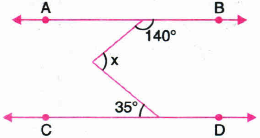
In figure ,AB || CD the value of x is:
\(35^{ 0 }\)
\(40^{ 0 }\)
\(60^{ 0 }\)
\(75^{ 0 }\)
68.
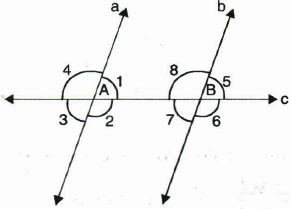
In the following figure a transversal c intersects two parallel lines a and b The angles formed at A and B have been marked.Tell which pair of angles need not be equal?
\(\angle 1,\angle 2\)
\(\angle 1,\angle 3\)
\(\angle 1,\angle 5\)
\(\angle 2,\angle 8\)
69.
The things which coincide with one another are:
equal to one another
un equal
double of same thing
triple of same thing
70.
The number of lines that can pass through a given point is:
two
none
only one
infinite many
71.
Pythagoras was a student of
Thales
Euclid
both (a) and (b)
Archimedes
72.
Euclid belonged to the country
Babylonia
Egypt
Greek
india
73.
In ancient India, alters with combination of shapes like rectangles, triangles and trapeziums were used for
public workship
household rituals
both (a) and (b)
none of the above
74.
In ancient India, the shapes of altars used for household rituals were
squares and circles
triangles and rectangles
trapeziums and phyramids
rectangles and squares
75.
In Indus Valley Civilisation (about 300 b.C), The brick used for construction work were having dimension in the ration
1 : 3 : 4
4 : 2 : 1
4 : 4 : 1
4 : 3 : 2
76.
A solution of the linear equation \(2\sqrt{2}x-3y+4=0\) corresponding to y=2 is:
2-2\(\sqrt{2}\)
\(2\sqrt{2}-2\)
\(1\over \sqrt{2}\)
\(-\sqrt{2}\)
77.
Solve the equation \({y\over 4}+1={y\over 2}\)
1
4
3
2
78.
x=2 and y=-1 in the solution of the equation:
x-y=3
2x+y=-3
x-2y=0
x+y=3
79.
The equation in 3x+4y=12 has
a unique solution
no solution
two solution
infinitely may solution
80.
The equation 2x=3 in two variables is of the form:
2.x+3.y=0
2.x+0.y=3
\({2\over3}.x+0.y=3\)
1.x+\(2\over3\).y=1
81.
The distance of the point (1,0) from O is:
0
1
2
None of these
82.
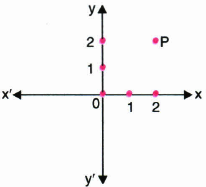
Write the coordinates of P
(2,2)
(-1,-2)
(1,-2)
(-1,2)
83.
If (x+2,4)=(5,y-2), then the coordinates (x,y) are:
(7,12)
(6,3)
(3,6)
(2,1)
84.
If the points A(2,0), B(- 6,0) and C(3,a-3) lie on the x-axis, then the value of a is:
0
2
3
-6
85.
The number of parts, the coordinates axes divide the plane are:
two parts
four parts
six parts
eight parts
86.
The co-ordinates of point Q are:
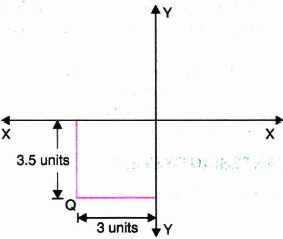
(3,3.5)
(3.5,3)
(-3,3.5)
(-3,-3.5)
87.
Which of the following points lies on the negative side of x - axis?
(-4,0)
(3,2)
(0,-4)
(5,-7)
88.
Rene Descartes belonged to
15th Century
16th Century
17th Century
18th Century
89.
The expanded form of \((x+2y+z)^2\) is:
\(x^2+4y^2+z^2+4xy+4yz+2zx\)
\(x^2+4y^2+z^2+2xy+2yz+zx\)
\(x^2+4y^2+z^2+4xy+2yz+4zx\)
\(x^2+4y^2+z^2+4xy+4yz+4zx\)
90.
The expanded form of \((x+\frac{1}{3})^3\) is:
\(x^3+\frac{1}{27}+\frac{x}{3}+x^2\)
\(x^3+\frac{1}{9}+\frac{x}{3}+x^3\)
\(x^3+\frac{1}{27}+\frac{x^2}{3}+x\)
\(x^3+\frac{1}{27}+3x+3x^2\)
91.
If \(a+b=1\) then the value of \(a^3+b^3+3ab\) is
1
-1
2
-2
92.
The zeros of the polynomial \(x^2+2 x+3\) are
real
not real
irrational
rational
93.
A linear polynomial
has one and only one zero
may have no zero
may have one zero
may have more than one zero
94.
\(\sqrt [ 3 ]{ \frac { 54 }{ 250 } } \) equals:
\(\frac { 9 }{ 25 } \)
\(\frac { 3 }{ 5 } \)
\(\frac { 27 }{ 125 } \)
\(\frac { \sqrt [ 3 ]{ 2 } }{ 5 } \)
95.
The value of \(\sqrt [ 4 ]{ { \left( 64 \right) }^{ -2 } } \) is
1/8
1/2
8
1/64
96.
The decimal expansion of \(\sqrt { 2 } \) is
finite decimal
1.4121
non-terminating recurring
non-terminating non-recurring
97.
Two rational numbers between \(\frac { 2 }{ 3 } \) and \(\frac { 5 }{ 3 } \)are:
1/6 and 2/6
1/2 and 2/7
5/6 and 7/6
2/3 and 4/3
98.
The rational number between -1/5 and -2/5 is
0
-1/4
-3/10
-7/25
1.
Required probability=\(\frac { 12 }{ 10+13+12+5 } \)
2.
Required probability=\(\frac { 5(Number\ of\ Threes) }{ 30 } =\frac { 1 }{ 6 } \)
3.
Required probability=\(\frac { 100 }{ 600 } =\frac { 1 }{ 6 } \)
4.
Required probability=\(\frac { 150 }{ 600 } =\frac { 1 }{ 4 } \)
5.
Required probability= \(1-\frac { 132 }{ 350 } \)
6.
Required probability=\(\frac { 5 }{ 1000 } \)
7.
Required probability=\(1-\frac { 280 }{ 500 } \)
8.
\(0\le P(E)\le 1\)
9.
P(A)+P(not A)=1
10.
H,T
11.
\(\overset{-}{x}=\frac {3+4+5+6+7}{5}=5.\)
12.
Frequency of 16 = 2
Frequency of 17 = 2
Frequency of 18 = 2
Forr mode to be 18, x = 18 so that 18 has the maximum frequency.
13.
Maximum number of students (26) have 40 marks.
14.
Class size = 57 - 52 = 5
15.
(a)
Primary data
16.
Required number \(=\frac { 60\times 30\times 30 }{ 15\times 6\times 4 } =150\)
17.
Number of cubes = \(\frac { { \left( 20 \right) }^{ 3 } }{ { \left( 5 \right) }^{ 3 } } =64\)
18.
(c)
18000 cm2
19.
\(\frac { 2 }{ 3 } \times \left( 6\times 5\times 4 \right) 80{ m }^{ 3 }\)
20.
Volume = 15 \(\times\) 10 \(\times\) 8 = 1200 cm3
21.
Length of the rod \(=\sqrt { { \left( 10 \right) }^{ 2 }+{ \left( 10 \right) }^{ 2 }+{ \left( 5 \right) }^{ 2 } } \)
22.
(a)
4a2
23.
(c)
12
24.
(d)
A triangle cannot be drawn on a wall.
25.
(b)
Square
26.
(c)
1000 m
27.
Formula
28.
Longest side = \(\frac { 5 }{ 3+4+5 } \times 144\)=60 m.
29.
Perimeter = 17+33+20 = 70 cm
30.
\(\frac { 1 }{ 2 } \times 8\times 10=40\)cm2
31.
\(\because \) 72+242=252
\(\therefore \) Triangle is right angled with hypotenuse 25 cm.
\(\therefore \) Area =\(\frac { 7\times 24 }{ 2 } \)= 84 cm2
32.
Area \(=\frac { \sqrt { 3 } }{ 4 } { a }^{ 2 }=\frac { \sqrt { 3 } }{ 4 } { \left( 4 \right) }^{ 2 }=4\sqrt { 3 } \) cm2
33.
(c)
8 cm
34.
\(\therefore \angle OCD=\angle ODC=50°\)
\(\angle ABC+\angle ADC=180°\)
\(\Rightarrow \angle ABC+50°=180°\)
\(\Rightarrow \angle ABC=130°\)
35.
\(\angle ADB=\angle ACB=40°\)
36.
\(\angle ACB=90°\)
37.
If two chords of a circle are equidistant from the centre, then they are equal.
38.
Theorem
39.
\(AC=CB=\frac { 1 }{ 2 } AB=\frac { 1 }{ 2 } \times 16=8\quad cm\)
\(OA=\sqrt { OC^{ 2 }+AC^{ 2 } }\)
\(=\sqrt { 6^{ 2 }+8^{ 2 } } =10\quad cm\)
40.
Each angle of an equilateral triangle is 60°. Equal chords subtend equal angles at the centre.
41.
∵ \(\angle AOB=\angle COD\)
∴ AB=CD=5 cm
42.
Area of a triangle =\(\frac { 1 }{ 2 } \) x Base x Corresponding altitude
43.
If a parallelogram and a triangle are on the same base and between the same parallels, then area of the triangle is half the area of the parallelogram.
44.
If a parallelogram and a triangle are on the same base and between the same parallels Then area of the triangle is half the area of the parallelogram.
45.
In Figure (d), \(\Delta\)ABC and \(\Delta\)DBC lie on the same base BC and between the same parallels AD and Be.
46.
AEFD and EBCF are equal parallelograms. A diagonal of a parallelogram divides it into two congruent triangles. Two congruent figures have equal areas.
47.
A diagonal of a parallelogram divides it into two congruent triangles. Two congruent triangles have equal area.
48.
Parallelograms on the same base and between the same parallels are equal in area
49.
(a)
8 cm
50.
(c)
rhombus
51.
PQ II DB, SR II DB
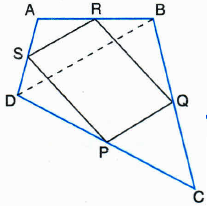
\(\therefore\) PQ II SR
Similarly, PS IIQR
\(\therefore\) PQRS is a parallelogram.
52.
no of angle of a rhombus is 900
53.
opposite sides are not equal in a kite
54.
(a)
300
55.
<C > <B
AB > AC
56.
AB > BC
ㄥC > ㄥA
57.
ㄥA > ㄥB
BC > CA
ㄥB > ㄥC
CA > AB
BC > CA > AB
AB is the smallest side
58.
AB=AC
BD=CD
AD=AD
ΔABD ≅ ΔACD
59.
Theorem
60.
(a)
isosceles but not congruent
61.
(c)
450
62.
(c)
yes, by ASA
63.
Obviously(b)
64.
formula
65.
n=8
\(\frac { 2n-4 }{ n } \)
66.
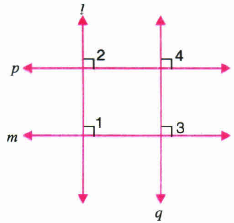
Let \(l\bot m\)
Then \(\angle 1=90^{ 0 }\)
\(P\bot 1\)
Then \(\angle 2=90^{ 0 }\)
67.
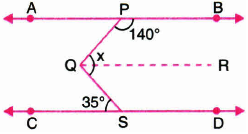
\(x=\angle PQS=\angle PQR+\angle SQR\)
\(=(180^{ 0 }-\angle QPR)+\angle CSQ\)
68.
\(\angle 1\) and \(\angle 2\) are simply adjacent angles
69.
(a)
equal to one another
70.
(d)
infinite many
71.
(a)
Thales
72.
(c)
Greek
73.
(a)
public workship
74.
(a)
squares and circles
75.
(b)
4 : 2 : 1
76.
\(2\sqrt{2}x-3(2)+4=0 \ \Rightarrow\ \ x={1\over\sqrt{2}}\)
77.
\({y\over 2}-{y\over 4}=1\)
\(\Rightarrow\ \ {y\over4}=1\)
\(\Rightarrow\ \ \ y=4\)
78.
x=2, y=-1 satisfy x-y=3
79.
(d)
infinitely may solution
80.
Evident
81.
(b)
1
82.
(a)
(2,2)
83.
(c)
(3,6)
84.
(c)
3
85.
(b)
four parts
86.
(d)
(-3,-3.5)
87.
(a)
(-4,0)
88.
(c)
17th Century
89.
\((x+2y+z)^2=(x)^2+(2y)^2+(z)^2+2(x)(2y)+2(2y)(z)+2(z)(x)\)
90.
\((x+\frac{1}{3})^3=x^3+(\frac{1}{3})^3+3x.\frac{1}{3}(x+\frac{1}{3})\)
91.
\(a^3+b^3+3ab\)
\(=a^3+b^3+3ab(a+b) \ \because \ a+b=0\)
\(=(a+b)^2=1^3=1\)
92.
\(x^2+2 x+3=0\)
\(\Rightarrow\quad x=\frac{-2\pm\sqrt{4-12}}{2}=\frac{-2\pm2\sqrt{2}i}{2}\)
\(=-1\pm\sqrt{2}i\)
93.
A characteristic of a linear polynomial
94.
(b)
\(\frac { 3 }{ 5 } \)
95.
(a)
1/8
96.
(d)
non-terminating non-recurring
97.
(c)
5/6 and 7/6
98.
(c)
-3/10

9th Standard CBSE Syllabus & Materials
9th Standard CBSE
CBSE 9th Mathematics Lines and Angles Sample Question Papers Study Material - QB365 Set A
NEW9th Standard CBSE
CBSE 9th Mathematics Introduction to Euclid's Geometry Sample Question Papers Study Material - QB365 Set A
NEW9th Standard CBSE
CBSE 9th Mathematics Linear Equations in Two Variables Sample Question Papers Study Material - QB365 Set A
NEW9th Standard CBSE
CBSE 9th Mathematics Coordinate Geometry Sample Question Papers Study Material - QB365 Set A



CBSE 9th Standard CBSE Subjects
CBSE Standards