100% FREE ACCESS
9th Standard CBSE Syllabus & Materials
9th Standard CBSE
CBSE 9th Science Is matter around us pure? - New Model Questions Papers Study Material - QB365 Set A
NEW9th Standard CBSE
CBSE 9th Science Matter in our surroundings - New Model Questions Papers Study Material - QB365 Set A
NEW9th Standard CBSE
CBSE 9th Mathematics Heron's Formula Sample Question Papers Study Material - QB365 Set A
NEW9th Standard CBSE
CBSE 9th Mathematics Circles Sample Question Papers Study Material - QB365 Set A
NEW9th Standard CBSE
CBSE 9th Mathematics Quadrilaterals Sample Question Papers Study Material - QB365 Set A
NEW9th Standard CBSE
CBSE 9th Mathematics Triangles Sample Question Papers Study Material - QB365 Set A

Published on: 26/09/2019
Heron's Formula
Download CBSE Class 9th Standard CBSE Mathematics question papers, sample papers, important questions, and previous year solved papers in PDF format. Get free study materials, NCERT solutions, and exam preparation resources for Class 9th Standard CBSE Mathematics
Questions + Answers key
Take MCQ Mathematics Test
1.
Find the area of a quadrilateral ABCD in which AB = 3 cm, BC = 4 cm, CD = 4 cm, DA = 5 cm and AC = 5 cm.
2.
A rhombus-shaped field has green grass for18cows to graze. If each side of the rhombus is 30 m and its longer diagonal is 48 m, how much area of grass field will each cow be getting?
3.
A field is in the shape of a trapezium whose parallel sides are 25 m and 10 m. The non-parallel sides are 14 m and 13 m. Find the area of the field.
4.
A floral design on a floor is made up of 16 tiles which are triangular, the sides of the triangle being 9 cm, 28 cm, and 35 cm. Find the cost of polishing the tiles at the rate of 50 p per cm2 .
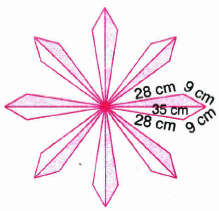
5.
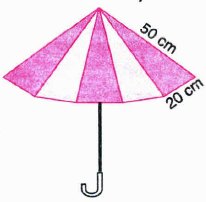
An umbrella is made by stitching 10 triangular pieces of cloth of two different colours (see figure). each piece measuring 20 cm, 50 cm, and 50 cm. How much cloth of each colour is required for the umbrella?
6.
An isosceles triangle has perimeter 30 cm and each of the equal sides is 12 cm. Find the area of the triangle.
7.
The perimeter of a triangle of a rhombus is 52 cm. One of the diagonals is 24 cm, find the area of the rhombus.
8.
Sides of a triangle in the ratio 5:12:13 and its perimeter is 120 cm. Find its area.
9.
The lengths of the sides of a triangle are in the ratio 3: 4: 5 and its perimeter is 144 cm. Find the area of the triangle.
10.
The sides of a triangle are in the ratio of 25: 17: 12 and its perimeter is 1080 cm. Find its area.
11.
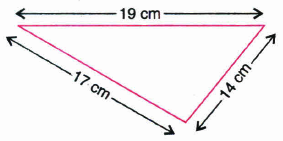
(a) Find the area of the triangle.
(b) Find the area of a triangle whose sides are 16 cm, 14 cm, nd 10 cm.
(c) The sides of a triangle are 7 cm, 12 cm, and 13 cm. Find its area.
d) Find the area of a triangle whose sides are 11 m, 60 m and 61 m.
12.
Find the area of an equilateral triangle whose perimeter is 60 cm. (Using Heron's formula).
1.
For \(\Delta \)ABC
a = 4 cm, b = 5 cm, c = 3 cm
\(\because \) a2 + c2 = b2
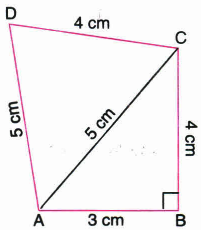
\(\therefore \) \(\Delta \)ABC is right angled with \(\angle B=90°\).
\(\therefore \) Area of right triangle ABC = \(\frac { 1 }{ 2 } \times \)Base \(\times \) Height
\(=\frac { 1 }{ 2 } \times 3\times 4=6\) cm2
For \(\Delta \)ACD
a = 4 cm, b = 5 cm, c = 5 cm
\(\therefore s=\frac { a+b+c }{ 2 } =\frac { 4+5+5 }{ 2 } =\frac { 14 }{ 2 } =7\) cm
\(\therefore \) Area of the ACD \(=\sqrt { s(s-a)(s-b)(s-c) } \)
\(=\sqrt { 7(7-4)(7-5)(7-5) }\)
\( \\ =\sqrt { 7(3)(2)(22) }\)
\(=\ 2\sqrt { 21 } \) cm2
= 2\(\times \) 4.6 cm2 (approx.) =9.2 cm2 (approx.)
\(\therefore \) Area of the equilateral ABCD = Area of \(\Delta \) ABC+Area of \(\Delta \)ACD
= 6 cm2 + 9.2 cm2 = 15.2 cm2 (approx.)
2.
For \(\Delta \)ABC a = 30 m, b = 48 m, c = 30 m
\(\therefore s=\frac { a+b+c }{ 2 } =\frac { 30+48+30 }{ 2 } =\frac { 108 }{ 2 } =54\) m
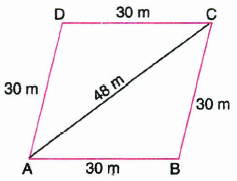
\(\therefore \) Area of \(\Delta \)ABC = \(\sqrt { s(s-a)(s-b)(s-c) } \)
\(=\sqrt { 54(54-30)(54-48)(54-30) } \)
\(\\ =\sqrt { 54(24)(6)(24) } \)
\(\\ =\sqrt { \left( 9\times 6 \right) (24)\left( 6 \right) \left( 24 \right) } \)
\(=3\times 6\times 24=432\) m2
\(\therefore \) Area of the rhombus = 2 area of \(\Delta \)ABC
\(=2\times 432=864\) m2.
Area of grass for 18 crows = 864 m2.
Area of grass for 1 cow = \(\frac { 864 }{ 18 } \) m2 = 48 m2.
3.
Let the given field be in the shape of a trapezium ABCD in which AB=25 m, CD= 10 m, BC = 13 m and AD = 14 m.
From D, draw DE 11 BC meeting AB at E. Also, draw DF \(\bot \) AB.
\(\therefore \) DE = BC =13 m
AE = AB - EB = AB - DC
= 25 - 10 = 15 m
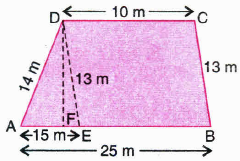
For AED
a = 14 m, b = 13 m, c= 15 m
\(\therefore s=\frac { a+b+c }{ 2 } =\frac { 14+13+15 }{ 2 } =\frac { 42 }{ 2 } =21\) m
\(\therefore \) Area of the \(\Delta \)AED \(=\sqrt { s(s-a)(s-b)(s-c) } \)
\(=\sqrt { 21(21-14)(21-13)(21-15) }\)
\( \\ =\sqrt { 21(7)(8)(6) } =\sqrt { \left( 7\times 3 \right) (7)\left( 4\times 2 \right) \left( 2\times 3 \right) } \)
\(=7\times 3\times 2\times 2=84\) m2
\(\Rightarrow \frac { 1 }{ 2 } \times \)AE\(\times \)DE = 84
\(\Rightarrow \ \frac { 1 }{ 2 } \times \)15\(\times \)DF = 84
\(\Rightarrow \) DF = \(\frac { 84\times 2 }{ 15 } \)
\(\Rightarrow \) DF= \(\frac { 56 }{ 5 } \) m = 11.2 m
\(\Rightarrow\) Height of the trapezium is 11.2 m.
\(\therefore \) Area of parallelogram EBCD = Base \(\times \) Height
= EB\(\times \) DF = 10 \(\times \)\(\frac { 56 }{ 5 } \) = 112 m2
\(\therefore \) Area of the field = Area of AED + Area of parallelogram EBCD = 84 m2 + 112 m2 = 196 m2.
4.
For one tile a = 9 cm, b = 28 cm, c = 35 cm
\(\therefore s=\frac { a+b+c }{ 2 } =\frac { 9+28+35 }{ 2 } =36\) cm
\(\therefore \) Area of one tile \(=\sqrt { s(s-a)(s-b)(s-c) } \)
\(=\sqrt { 36(36-9)(36-28)(36-35) } \)
\(\\ =\sqrt { 36(27)(8)(1) } =\sqrt { 36\left( 9\times 3 \right) \left( 4\times 2 \right) } \)
\(=6\times 3\times 2\sqrt { 6 } =36\sqrt { 6 } \) cm2
\(\therefore \) Area of 16 tiles \(=36\sqrt { 6 } \times 16=576\sqrt { 6 } \)cm2
\(\therefore \) Cost of polishing the tiles at the rate of 50 p per cm2.
\(=576\sqrt { 6 } \times 50\) p = Rs. \(\frac { 576\sqrt { 6 } \times 50 }{ 100 } \)
= Rs. \(288\sqrt { 6 } \) = Rs. 705.60
5.
For one triangular piece = 20 cm, b = 50 cm, c = 50 cm
\(\therefore s=\frac { a+b+c }{ 2 } =\frac { 20+50+50 }{ 2 } =\frac { 120 }{ 2 } =60\) cm
\(\therefore \) Area of one triangle \(=\sqrt { s(s-a)(s-b)(s-c) } \)
\(=\sqrt { 60(60-20)(60-50)(60-50) } \)
\(=\sqrt { (60)(40)(10)(10) } =200\sqrt { 6 } \) cm2
\(\therefore \) Area of 5 triangles of one colour \(=5(200\sqrt { 6 } )\) cm2 = 1000\(\sqrt { 6 } \) cm2
Hence, 1000\(\sqrt { 6 } \) cm2 cloth of each colour is required for the umbrella.
6.
a = 12 cm, b = 12 cm Perimeter = 30 cm
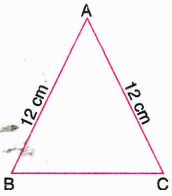
\(\Rightarrow \) a + b + c = 30
\(\Rightarrow \) 12 + 12 + c = 30
\(\Rightarrow \) 24 + c = 30
\(\Rightarrow \) c = 30 - 24
\(\Rightarrow \) c = 6 cm
\(s=\frac { 30 }{ 2 } \) cm = 15 cm
\(\therefore \) Area of the triangle \(=\sqrt { s(s-a)(s-b)(s-c) } \)
\(=\sqrt { 15(15-12)(15-12)(15-6) } \)
\(=\sqrt { 15(3)(3)(9) } =9\sqrt { 15 } \) cm2.
7.
120 cm2
8.
480 cm2
9.
864 cm2
10.
36000 cm2
11.
(a) 114.89 cm2
(b) \(40\sqrt { 3 } \)cm2
(c) \(24\sqrt { 3 } \)cm2
(d) 330 m2
12.
\(100\sqrt { 3 } \) cm2

9th Standard CBSE Syllabus & Materials
9th Standard CBSE
CBSE 9th Mathematics Lines and Angles Sample Question Papers Study Material - QB365 Set A
NEW9th Standard CBSE
CBSE 9th Mathematics Introduction to Euclid's Geometry Sample Question Papers Study Material - QB365 Set A
NEW9th Standard CBSE
CBSE 9th Mathematics Linear Equations in Two Variables Sample Question Papers Study Material - QB365 Set A
NEW9th Standard CBSE
CBSE 9th Mathematics Coordinate Geometry Sample Question Papers Study Material - QB365 Set A



CBSE 9th Standard CBSE Subjects
CBSE Standards