100% FREE ACCESS
9th Standard CBSE Syllabus & Materials
9th Standard CBSE
CBSE 9th Science Is matter around us pure? - New Model Questions Papers Study Material - QB365 Set A
NEW9th Standard CBSE
CBSE 9th Science Matter in our surroundings - New Model Questions Papers Study Material - QB365 Set A
NEW9th Standard CBSE
CBSE 9th Mathematics Heron's Formula Sample Question Papers Study Material - QB365 Set A
NEW9th Standard CBSE
CBSE 9th Mathematics Circles Sample Question Papers Study Material - QB365 Set A
NEW9th Standard CBSE
CBSE 9th Mathematics Quadrilaterals Sample Question Papers Study Material - QB365 Set A
NEW9th Standard CBSE
CBSE 9th Mathematics Triangles Sample Question Papers Study Material - QB365 Set A

Published on: 18/09/2019
Heron's Formula
Download CBSE Class 9th Standard CBSE Mathematics question papers, sample papers, important questions, and previous year solved papers in PDF format. Get free study materials, NCERT solutions, and exam preparation resources for Class 9th Standard CBSE Mathematics
Questions + Answers key
Take MCQ Mathematics Test
1.
Students of a school staged a rally for cleanliness campaigp. They walked through the lanes in two groups. One group walked through the lanes AB, BC and CA; while the other through AC, CD and DA. Then they cleaned the area enclosed within their lanes. If AB = 9 m, BC = 40 m, CD = 15 m, DA = 28 m and \(\angle B=90°\) , which group cleaned more area and by how much? Find the total area cleaned by the students.
2.
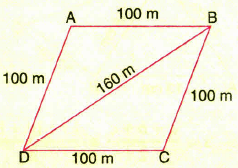
Sanya has a piece of land which is in the shape of a rhombus. She wants her one daughter and one son to work on the land and produce different crops to suffice the needs of their family. She divided the land in two equal parts. If the perimeter of the land is 400 m and one of the diagonals is 160 m, how much area each of them will get?
3.
Manisha has a garden in the shape of a rhombus.The-perimeter of the garden is 40 m and its diagofial is 16 m. She wants to divide it into two equal parts and use these parts in rotation. Find the area of each part of the garden.
4.
A triangle and a parallelogram have the same base and the same area. If the sides of the triangle are 26 cm, 28 cm and 30 cm, and the parallelogram stands on the base 30 cm, find the height of the parallelogram.
5.
Find the area of the quadrilateral ABCD where AB = 7 cm, BC = 6 cm, CD = 12 cm, DA = 15 cm and AC = 9 cm.
6.
Find the area of a parallelogram whose sides are 13 cm and 14 cm and diagonal is 15 cm.
7.
The lengths of the sides of a triangle are 10 cm, 24 cm, and 26 cm respectively. Find the length of the perpendicular drawn from its opposite vertex to the side whose length is 24 cm.
8.
Find the area of a triangle, whose sides are 26 cm, 28 cm, and 30 cm respectively. Find the height corresponding to the longest side.
9.
Find the area of the triangle whose two sides are of measure 13 cm and 14 cm and perimeter is 42 cm.
10.
Find the area of a triangle, two sides of which are 60 cm and 100 cm and the perimeter is 300 cm.
11.
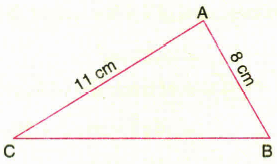
Find the area of a triangle two sides of which are 8 cm and 11 cm and the perimeter is 32 cm.
12.
Find the area of a triangle whose sides are 6.5 cm. 7 cm and 7.5 cm.
13.
The unequal side of an isosceles triangle is 6 cm and its perimeter is 24 cm. Find its area.
14.
Find the area of an isosceles triangle, whose equal sides are of length 15 cm each and third side is 12 cm.
15.
Find the area of an equilateral triangle of side 10 cm.
1.
Since AB = 9 m and BC = 40 m, Ð B = 90°, we have
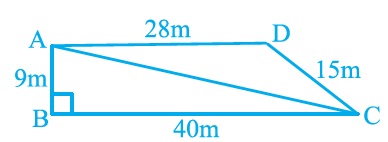
\( \mathrm{AC} =\sqrt{9^{2}+40^{2}} \mathrm{~m} \)
\(=\sqrt{81+1600} \mathrm{~m} \)
\(=\sqrt{1681} \mathrm{~m}=41 \mathrm{~m} \)
Therefore, the first group has to clean the area of triangle ABC, which is right angled.
\(Area of \Delta \mathrm{ABC}=\frac{1}{2} \times base \times height \)
\(=\frac{1}{2} \times 40 \times 9 \mathrm{~m}^{2}=180 \mathrm{~m}^{2} \)
The second group has to clean the area of triangle ACD, which is scalene having sides 41 m, 15 m and 28 m.
Here, \(s=\frac{41+15+28}{2} \mathrm{~m}=42 \mathrm{~m}\)
Therefore, area of \(\Delta \mathrm{ACD}=\sqrt{s(s-a)(s-b)(s-c)}\)
\(=\sqrt{42(42-41)(42-15)(42-28)} \mathrm{m}^{2} \)
\( =\sqrt{42 \times 1 \times 27 \times 14} \mathrm{~m}^{2}=126 \mathrm{~m}^{2} \)
So first group cleaned 180 m2 which is (180 – 126) m2, i.e., 54 m2 more than the area cleaned by the second group.
Total area cleaned by all the students = (180 + 126) m2 = 306 m2.
2.
Let ABCD be the field.
Perimeter = 400 m
So, each side = 400 m ÷ 4 = 100 m.
i.e. AB = AD = 100 m.
Let diagonal BD = 160 m.
Then semi-perimeter s of D ABD is given by
\(s=\frac{100+100+160}{2} \mathrm{~m}=180 \mathrm{~m}\)
Therefore, area of \(\Delta \mathrm{ABD}=\sqrt{180(180-100)(180-100)(180-160)}\)
\(=\sqrt{180 \times 80 \times 80 \times 20} \mathrm{~m}^{2}=4800 \mathrm{~m}^{2}\)
Therefore, each of them will get an area of 4800 m2.
3.
48 m2
4.
11.2 cm
5.
74.97 cm2
6.
168 cm2
7.
10 cm
8.
336 cm2 , 22.4 cm
9.
84 cm2
10.
\(1500\sqrt { 3 } \) cm2
11.
Here we have perimeter of the triangle = 32 cm, a = 8 cm and b = 11 cm.
Third side c = 32 cm – (8 + 11) cm = 13 cm
So, 2s = 32, i.e., s = 16 cm,
s – a = (16 – 8) cm = 8 cm,
s – b = (16 – 11) cm = 5 cm,
s – c = (16 – 13) cm = 3 cm.
Therefore, area of the triangle = \(\sqrt{s(s-a)(s-b)(s-c)}\)
\(=\sqrt{16 \times 8 \times 5 \times 3} \mathrm{~cm}^{2}=8 \sqrt{30} \mathrm{~cm}^{2}\)
12.
21 cm2
13.
\(18\sqrt { 2 } \)cm2
14.
\(18\sqrt { 21 } \) cm2
15.
\(25\sqrt { 3 } \) cm2

9th Standard CBSE Syllabus & Materials
9th Standard CBSE
CBSE 9th Mathematics Lines and Angles Sample Question Papers Study Material - QB365 Set A
NEW9th Standard CBSE
CBSE 9th Mathematics Introduction to Euclid's Geometry Sample Question Papers Study Material - QB365 Set A
NEW9th Standard CBSE
CBSE 9th Mathematics Linear Equations in Two Variables Sample Question Papers Study Material - QB365 Set A
NEW9th Standard CBSE
CBSE 9th Mathematics Coordinate Geometry Sample Question Papers Study Material - QB365 Set A



CBSE 9th Standard CBSE Subjects
CBSE Standards