100% FREE ACCESS
9th Standard CBSE Syllabus & Materials
9th Standard CBSE
CBSE 9th Science Is matter around us pure? - New Model Questions Papers Study Material - QB365 Set A
NEW9th Standard CBSE
CBSE 9th Science Matter in our surroundings - New Model Questions Papers Study Material - QB365 Set A
NEW9th Standard CBSE
CBSE 9th Mathematics Heron's Formula Sample Question Papers Study Material - QB365 Set A
NEW9th Standard CBSE
CBSE 9th Mathematics Circles Sample Question Papers Study Material - QB365 Set A
NEW9th Standard CBSE
CBSE 9th Mathematics Quadrilaterals Sample Question Papers Study Material - QB365 Set A
NEW9th Standard CBSE
CBSE 9th Mathematics Triangles Sample Question Papers Study Material - QB365 Set A

Published on: 09/12/2019
Probability
Download CBSE Class 9th Standard CBSE Mathematics question papers, sample papers, important questions, and previous year solved papers in PDF format. Get free study materials, NCERT solutions, and exam preparation resources for Class 9th Standard CBSE Mathematics
Questions + Answers key
Take MCQ Mathematics Test
1.
In a mathematics test, 90 students obtained (out of 100)the marks given in the following table:
| Marks | No.of students |
| 1-20 | 8 |
| 21-40 | 12 |
| 41-50 | 15 |
| 51-60 | 20 |
| 61-70 | 13 |
| 71-80 | 17 |
| 81-90 | 05 |
Find the probability: Answers
(i) a student obtained less than 41,
(ii) a student obtained more than 50,
(iii) a student obtained between 41 and 80
2.
A die is thrown 400 times and outcomes are recorded as follows:
| Outcome | Frequency |
| 1 | 70 |
| 2 | 65 |
| 3 | 60 |
| 4 | 75 |
| 5 | 63 |
| 6 | 67 |
Find the probability of getting an odd number.
3.
Two coins are tossed simultaneously 300 times.The frequency of appearing:
(i) both heads: 75
(ii) one head: 160
(iii) No head: 65
Find the probability of occurrence of each of these events.
4.
To know the opinion of the students about the subject statistics, a survey of 200 students was conducted. The data is recorded in the following table:
| Opinion | Number of students |
| like | 135 |
| dislike | 65 |
Find the probability that a student chosen at random
(i) likes statistics,
(ii) does not like it
5.
In a particular section of Class IX, 40 students were asked about the months of their birth, the following graph was prepared for the data so obtained. Find the probability that a student of the class was born in August.
6.
When a coin is tossed 500 times, the following outcomes were recorded:
Head: 235 times, Tail: 265 times
If now a coin is tossed once again, the probability of getting a Tail is
0.50
0.47
0.45
0.53
7.
A coin is tossed 200 times.The head appears 79 times.The probability of a tail is:
\(\frac { 79 }{2004 } \)
\(\frac { 121 }{ 200 } \)
1
0
8.
Probability of impossible event is:
0
1
\(\frac { 1 }{ 2 } \)
\(\frac { 2 }{ 3 } \)
9.
What is the number of outcomes when a cubical dice is thrown?
2
4
6
3
10.
What is the number of outcomes when a coin is tossed?
1
2
4
6
11.
In class IX of 50 students second language opted by the studnets is as follows:
Sanskrit-14
Japanese- 08
French-12
Urdu-06
Rest of then opted for German.
A student is selected at random. Find the probability that the student.
(a) opts for French
(b) does not opts for Japanese
(c) Either opts for Sanskrit or for German.
12.
An insurance company selected 1600 drivers at random in a particular city to find a relationship between age and number of accidents. The data obtained are given in the following table:
| Age of drivers (in years) |
No.of accidents(in one year) | ||||
| 0 | 1 | 2 | 3 | More than 3 | |
| 18-25 | 320 | 125 | 75 | 45 | 30 |
| 25-40 | 400 | 45 | 50 | 15 | 10 |
| 40-55 | 150 | 85 | 13 | 8 | 10 |
| Above 55 | 150 | 25 | 17 | 20 | 7 |
Find the number of drivers
(a) in the age of 25-40 years and has more than 2 accidents in the year.
(b) in the age above 40 years and has accidents more than 1 but less than 3.
13.
The percentages of marks obtained by a student in examination are given below:
| Examination subjects |
% marks |
| I | 58 |
| II | 64 |
| III | 76 |
| IV | 62 |
| V | 85 |
Find the probability that the student gets
(i) a first class i.e. at least 60% marks
(ii) a distinction i.e. 75% or above
(iii) marks between 70% and 80%
14.
On a particular day, the number of vehicles through a crossing is given below:
| Vehicle | Frequency |
| Two-wheeler | 57 |
| Three-wheeler | 33 |
| Four-wheeler | 30 |
A particular vehicle is chosen at random. What is the probability that it is not a four-wheeler?
15.
1500 families with 2 children were released randomly and the following data was recorded:
| No.of girls | No.of.families |
| 0 | 211 |
| 1 | 814 |
| 2 | 475 |
If a family is chosen at random, find the probability that it has
(i) at most one girl
(ii) at least one girl
16.
In a box, there are 9 red, 8 white, and 3 black balls. One ball is taken out of the bag. Find the probability that it is
(i) white
(ii) red or black
(iii) not red.
17.
Two coins are tossed simultaneously 500 times, and we get
| Result | 2 heads | 1 head | No head |
| Frequency | 105 | 275 | 120 |
Find the probability of occurrence of
(i) two heads
(ii) all tails.
18.
The percentage of marks obtained by a student in monthly unit tests are given below:
| Unit test | I | II | III | IV | V |
| Percentage of marks obtained |
69 | 71 | 73 | 68 | 74 |
Based on this data, find the probability that the student gets more than 70% marks in a unit test.
19.
Two coins are tossed simultaneously 500 times, and we get
Two heads: 105 times
One head: 275 times
No head: 120 times
Find the probability of occurrence of each of these events.
20.
A die is thrown. Find the probability of getting an odd number.
1.
(i) Pob. of less than 41
\(=\frac{8+12}{90}=\frac{20}{90}=\frac{2}{9}\)
(ii) Prob.of more than 50 \(=\frac{20+13+17+5}{90}=\frac{55}{90}=\frac{11}{18}\)
(iii)Prob. of marks between 41 and 80
\(=\frac{15+20+13+17}{90}=\frac{65}{90}=\frac{13}{18}\)
2.
\(\frac { 193 }{ 400 } \)
3.
\((i)\frac { 1 }{ 4 }\)
\((ii)\frac { 8 }{ 15 }\)
\((iii)\frac { 13 }{ 60 } \)
4.
Total number of students = 200
(i) Number of students who like statistics = 135
Probability that a student chosen at random likes statistics=\(\frac { 135 }{ 200 } =\frac { 27 }{ 40 } \)
(ii) Number of students who do not like statistics=65
Probability that a student chosen at random does not like it= \(\frac { 65 }{ 200 } =\frac { 13 }{ 40 } \)
Aliter:
Probability that a student chosen at random does not like statistics
= 1 - probability that a student chosen at random likes statistics
=\(1-\frac { 27 }{ 40 } =\frac { 13 }{ 40 } \)
5.
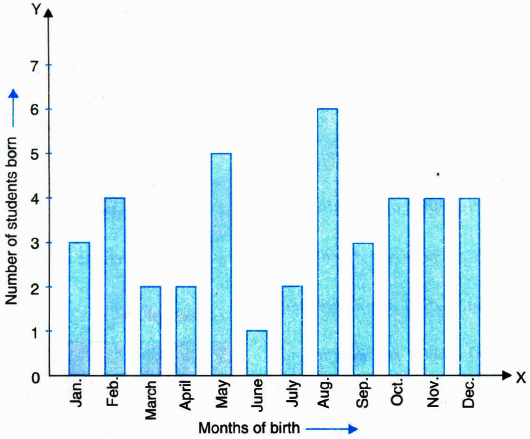
Total number of students born in the year
= 3 + 4 + 2 + 2 + 5 + 1 + 2 + 6 + 3 + 4 + 4 + 4 = 40
Number of students born in August = 6
. Probability that a student of the class was born in August =\(\frac { 6 }{ 40 } =\frac { 3 }{ 20 } \)
6.
Required probability=\(\frac { 265 }{ 500 } =0.53\)
7.
Required probability=\(1-\frac { 79 }{ 200 } \)
8.
Required probability=0
9.
1,2,3,4,5,6
10.
H,T
11.
(a) Probability that a student selected is opts French language = \(\frac{12}{50}=\frac{6}{25}\)
(b) Probability that a student selected does not opt for Japanese = 1-selected student opts Japnese
(c) Probability that selected either opts for Sanskrit or for German = Prob. of student opts Sanskrti+ Prob. of students opts German
\(\therefore \)No of student who opted German
= 5 - (14 + 08 + 12 + 6)
= 50-40
= 10
\(\therefore \)Prob. that selected student either opt for Sanskrit or for German
\(=\frac{14}{50}+\frac{10}{50}\)
\(=\frac{24}{50}=\frac{12}{25}\)
12.
(a) The number of drivers in the age of 25-40 years and has more than 2 accidents in the year
= 15 + 10 = 25
(b) The number of drivers the age of whose is above 40 years and has accidents more than 1 but less than 3
= 13 + 17 = 30.
13.
Total number of subjects = 5
(i) Number of subjects in which the student gets a first class = 4
Probability that the students gets a first class \(=\frac { 4 }{ 5 } \)
(ii) Number of subjects in which the student gets a distinction = 2
Probability that the student gets a distinction \(=\frac { 2 }{ 5 } \)
(iii) Number of subjects in which the student gets marks between 70% and 80% = 1
Probability that the students gets marks between 70% and 80% \(=\frac { 1 }{ 5 } \)
14.
Number of two wheelers = 57
Number of three wheelers = 33
Number of four wheelers = 30
Total number of vehicles = 57 + 33 + 30 = 120
Number of vehicles that is not a four-wheeler = 57 + 33 = 90
Probability that the vehicle chosen at random is not a four-wheeler
\(\frac { 90 }{ 120 } =\frac { 3 }{ 4 } \)
15.
Total number of families = 1500
(i) at most one girl means 0 girl or 1 girl.
Number of families which have at most one girl
= Number of families which have 0 girl + Number of families which have 1 girl.
= 211 + 814 = 1015
Probability that it has at most one girl=\(\frac { 1015 }{ 1500 } =\frac { 203 }{ 300 } \)
(ii) at least one girl means 1 girls or 2 girls.
Number of families which have at least one girl
= Number of families which have I girl + Number of families which have 2 girls.
= 814 + 475 = 1289
Probability that it has at least one girl=\(\frac { 1289 }{ 1500 } \)
16.
\((i)\frac { 2 }{ 5 }\)
\((ii)\frac { 3 }{ 5 } \)
\((iii)\frac { 11 }{ 20 } \)
17.
\((i)\frac { 21 }{ 100 }\)
\((ii)\frac { 6 }{ 25 } \)
18.
The total number of unit tests held is 5.
The number of unit tests in which the student obtained more than 70% marks is 3.
So, P(scoring more than 70% marks) \(=\frac{3}{5}=0.6\)
19.
Let us denote the events of getting two heads, one head and no head by E1, E2 and E3, respectively. So,
\(
P\left(E_{1}\right)=\frac{105}{500}=0.21
\)
\(P\left(E_{2}\right)=\frac{275}{500}=0.55
\)
\(P\left(E_{3}\right)=\frac{120}{500}=0.24
\)
20.
\(\frac { 1 }{ 2 } \)

9th Standard CBSE Syllabus & Materials
9th Standard CBSE
CBSE 9th Mathematics Lines and Angles Sample Question Papers Study Material - QB365 Set A
NEW9th Standard CBSE
CBSE 9th Mathematics Introduction to Euclid's Geometry Sample Question Papers Study Material - QB365 Set A
NEW9th Standard CBSE
CBSE 9th Mathematics Linear Equations in Two Variables Sample Question Papers Study Material - QB365 Set A
NEW9th Standard CBSE
CBSE 9th Mathematics Coordinate Geometry Sample Question Papers Study Material - QB365 Set A



CBSE 9th Standard CBSE Subjects
CBSE Standards