100% FREE ACCESS
9th Standard CBSE Syllabus & Materials
9th Standard CBSE
CBSE 9th Science Is matter around us pure? - New Model Questions Papers Study Material - QB365 Set A
NEW9th Standard CBSE
CBSE 9th Science Matter in our surroundings - New Model Questions Papers Study Material - QB365 Set A
NEW9th Standard CBSE
CBSE 9th Mathematics Heron's Formula Sample Question Papers Study Material - QB365 Set A
NEW9th Standard CBSE
CBSE 9th Mathematics Circles Sample Question Papers Study Material - QB365 Set A
NEW9th Standard CBSE
CBSE 9th Mathematics Quadrilaterals Sample Question Papers Study Material - QB365 Set A
NEW9th Standard CBSE
CBSE 9th Mathematics Triangles Sample Question Papers Study Material - QB365 Set A

Published on: 24/09/2019
Triangles
Download CBSE Class 9th Standard CBSE Mathematics question papers, sample papers, important questions, and previous year solved papers in PDF format. Get free study materials, NCERT solutions, and exam preparation resources for Class 9th Standard CBSE Mathematics
Questions + Answers key
Take MCQ Mathematics Test
1.
In the given figure \(\angle\)B > \(\angle\)A and \(\angle\)C > \(\angle\)D. Show that AD > BC.
.jpg)
2.
PQR is a triangle in which PQ = PR. 5 is any point on the side PQ. Through 5, a line is drawn parallel to QR intersecting PR at T. Prove that PS = PT.
3.
Prove that each angle of an equilateral triangle is 60°.
4.
In a triangle ABC, X and Yare the points on AB and BC respectively. If BX=\(\frac{1}{2}\) AB and and AB = BC Show that BX = BY.
5.
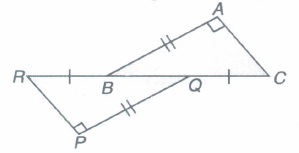
In the given figure, BA\(\bot \) CA, RP\(\bot \)QP, AB = PQ and BR = CQ. Prove that AC = PR.
6.
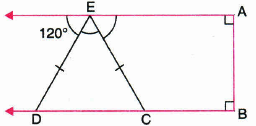
In figure, AB 丄 AE, BC 丄 AB, CE =DE and ㄥAED = 120°. Find
(a) ㄥ EDC
(b) ㄥDEC
(c) Hence prove that EDC is an equilateral triangle.
7.
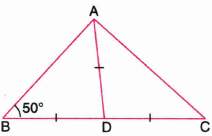
In the given figure, D is the mid-point of the side BC of a ΔABC and ㄥABD = 50°. If AD = BD = CD, then find the measure of ㄥACD.
8.
In a huge park, people are concentrated at three points (see figure):
A) where there are different slides and swings for children,
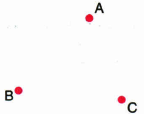
B) near which a man-made lake is situated,
C) which is near to a large parking and exit.
where should an icecream parlour be set up so that maximum number of persons can approach it?
9.
Show that in a right angled triangle, the hypotenuse is the longest side.
10.
Show that the angles of an equilateral triangle are 60° each.
11.
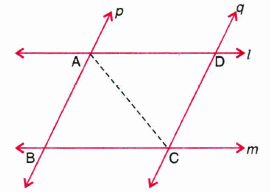
l and m are two parallel lines intersected by another pair of parallel lines p and q (see figure). Show that \(\triangle ABC\cong \triangle CDA\)
1.
Proof: In \(\triangle\)AOB,
\(\angle\)B >\(\angle\)A
\(\angle\)A <\(\angle\)B
OB
\(\angle\)C >\(\angle\)D
\(\angle\)D < \(\angle\)C
OC < OD ....(2)
Adding (1) + (2),
OB + OC < OA + OD
BC
2.
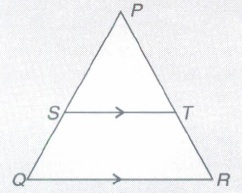
PQ = PR \(\Rightarrow\) \(\angle\)PQR = \(\angle\)PRQ
(Angles opp. to equal sides)
ST II QR \(\Rightarrow\) \(\angle\)PST = \(\angle\)PQR
(Corresponding angles)
\(\Rightarrow\) PTS = \(\Rightarrow\)PRQ
(Corresponding angles)
\(\therefore\) PST = PTS
\(\Rightarrow\) PS = PT.
(Sides opp. to equal angles)
3.
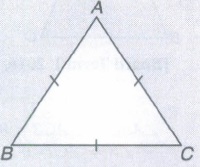
AB =AC
\(\therefore\) \(\angle\)B = \(\angle\)C = x
BA =BC
\(\therefore\) \(\angle\)A = \(\angle\)C = x
AC =BC
\(\angle\)A = \(\angle\)B = x
But, \(\angle\)A + \(\angle\)B + \(\angle\)C = 180°
Also,
3x = 1800
\(\angle\)A = \(\angle\)B = \(\angle\)C = 60°.
Alternative Method:
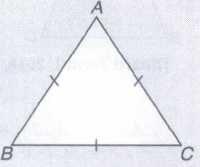
Let \(\triangle\)ABC be an equilateral triangle, so that AB = AC = BC
Now, AB = AC
\(\Rightarrow\) \(\angle\)B = \(\angle\)C ....(1)
(\(\because\)Angles opp. to equal sides are equal)
CB = CA
\(\Rightarrow\) \(\angle\)A = \(\angle\)B ....(2)
(\(\because\) Angles opp. to equal sides are equal)
From (1) and (2), we have
\(\angle\)A = \(\angle\)B = \(\angle\)C
Also, \(\angle\)A +\(\angle\).B +\(\angle\)C = 180°,(Angle sum property)
\(\therefore\) \(\angle\)A + \(\angle\)A + \(\angle\)A = 180°
\(\Rightarrow\) 3\(\angle\)A = 180° \(\Rightarrow\) \(\angle\)A = 60°.
\(\therefore\) \(\angle\)A = \(\angle\)B = \(\angle\)C = 60°.
Thus, each angle of an equilateral triangle is 60°.
4.
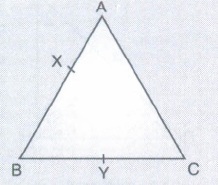
AB = BC
\(\Rightarrow\) \(\frac{1}{2}\)AB = \(\frac{1}{2}\) BC
But \(\frac{1}{2}\) AB = BX
\(\frac{1}{2}\) BC = BX
But
\(\frac{1}{2}\) BC = BY
From (i) and (ii), BX = BY
5.
BR + BQ = CQ + BQ \(\Rightarrow\) QR = BC
\(\triangle ABC\cong \triangle PQR\) by RHS\(\cong\)condn
\(\therefore\) AC = PR (By c.p.c.t.)
6.
(a) 600
(b) 600
7.
400
8.
Draw the perpendicular bisectors of AB and AC. Their point of intersection is the required point.
9.
Let ABC be a right angled triangle in which ㄥB = 90°.
Then, ㄥA +ㄥC = 90°
|Sum of all the angles of a triangle is 180°
ㄥB=ㄥA+ㄥC
ㄥB>ㄥA and ㄥB>ㄥC
AC>BC
| Side opposite to greater angle is longer
and AC> AB
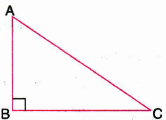
AC is the longest side, i.e., hypotenuse is the longest side.
10.
Given: An equilateral triangle ABC
To prove: \(\angle A+\angle B+\angle C={ 60 }^{ 0 }\)
Proof: ABC is an equilateral triangle
AB = BC = CA ....... (1) |
AB = BC
\(\angle A=\angle C\) .......... (2) | Angles opposite to equal sides of a triangle are equal
BC = CA
\(\angle A=\angle B\) ......... (3) | Angles opposite to equal sides of a triangle are equal
From (2) and (3), we obtain
\(\angle A=\angle B=\angle C\) ........ (4)
In \(\triangle ABC\)
\(\angle A+\angle B+\angle C={ 180 }^{ 0 }\) ...... (5) | Sum of all the angles of a triangle is 180°
Let \(\angle A={ x }^{ 0 }\) then, \(\angle B=\angle C={ x }^{ 0 }\)
From (5)
\({ x }^{ 0 }+{ x }^{ 0 }+{ x }^{ 0 }={ 180 }^{ 0 }\)
\(3{ x }^{ 0 }={ 180 }^{ 0 }\)
\({ x }^{ 0 }={ 60 }^{ 0 }\)
\(\angle A=\angle B=\angle C={ 60 }^{ 0 }\)
11.
Given: l and m are two parallel lines intersected by another pair of parallel lines p and q
To Prove: \(\triangle ABC\cong \triangle CDA\)
Proof: \(AB\parallel DC\) and \(AD\parallel BC\)
Quadrilateral ABCD is a parallelogram.
| A quadrilateral is a parallelogram if both the pairs of opposite sides are parallel
BC = AD ........... (1) | Opposite sides of a \(\parallel \) gm are equal
AB = CD .............(2) | Opposite sides of a \(\parallel \) gm are equal
\( \angle ABC=\angle CDA\)......(3) | Opposite angles of a \(\parallel \) gm are equal
In \(\triangle ABC\) and \(\triangle CDA\),
AB = CD | From (2)
BC = DA | From (1)
\( \angle ABC=\angle CDA\) | From (3)
\(\triangle ABC\cong \triangle CDA\) | SAS Rule

9th Standard CBSE Syllabus & Materials
9th Standard CBSE
CBSE 9th Mathematics Lines and Angles Sample Question Papers Study Material - QB365 Set A
NEW9th Standard CBSE
CBSE 9th Mathematics Introduction to Euclid's Geometry Sample Question Papers Study Material - QB365 Set A
NEW9th Standard CBSE
CBSE 9th Mathematics Linear Equations in Two Variables Sample Question Papers Study Material - QB365 Set A
NEW9th Standard CBSE
CBSE 9th Mathematics Coordinate Geometry Sample Question Papers Study Material - QB365 Set A



CBSE 9th Standard CBSE Subjects
CBSE Standards