100% FREE ACCESS
9th Standard CBSE Syllabus & Materials
9th Standard CBSE
CBSE 9th Science Is matter around us pure? - New Model Questions Papers Study Material - QB365 Set A
NEW9th Standard CBSE
CBSE 9th Science Matter in our surroundings - New Model Questions Papers Study Material - QB365 Set A
NEW9th Standard CBSE
CBSE 9th Mathematics Heron's Formula Sample Question Papers Study Material - QB365 Set A
NEW9th Standard CBSE
CBSE 9th Mathematics Circles Sample Question Papers Study Material - QB365 Set A
NEW9th Standard CBSE
CBSE 9th Mathematics Quadrilaterals Sample Question Papers Study Material - QB365 Set A
NEW9th Standard CBSE
CBSE 9th Mathematics Triangles Sample Question Papers Study Material - QB365 Set A

Published on: 16/09/2019
Triangles
Download CBSE Class 9th Standard CBSE Mathematics question papers, sample papers, important questions, and previous year solved papers in PDF format. Get free study materials, NCERT solutions, and exam preparation resources for Class 9th Standard CBSE Mathematics
Questions + Answers key
Take MCQ Mathematics Test
1.
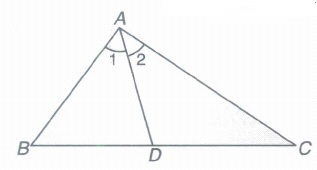
In the figure, given AC > AB and AD is the bisector of \(\angle\)A. Show that \(\angle\)ADC > \(\angle\)ADB.
2.
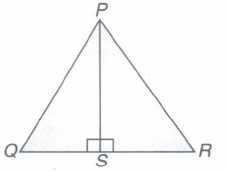
PS is an altitude of an isosceles triangle PQR in which PQ = PR. Show that PS bisects \(\angle\)P.
3.
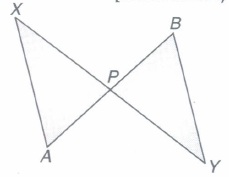
In figure, AX = BY and AX II BY, prove that \(\triangle APX\cong \triangle BPY.\)
4.
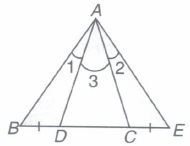
In figure \(\angle\)B = \(\angle\)E, BD = CE and \(\angle\)1 =\(\angle\)2. Show \(\triangle ABC\cong \triangle AED.\)
5.
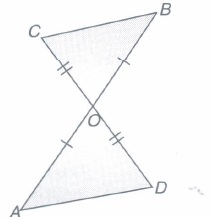
In the figure, OA = OB and OD = OC Show that:
(i) \(\triangle AOD\cong \triangle BOC\),
(ii) AD II BC.
6.
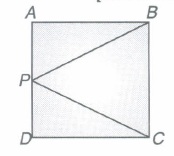
In the figure below, ABCD is a square and P is the mid-point of AD. BP and CP are joined. Prove that \(\angle\)PCB = \(\angle\)PBC.
7.
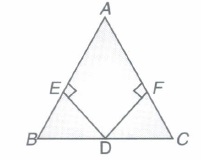
In the given figure, D is the mid-point of base BC DE and DF are perpendiculars to AB and AC respectively such that DE = DF. Prove that \(\angle\)B = \(\angle\)C.
8.
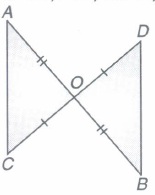
In the figure below, O is the mid-point of AB and CD, Prove that AC = BD.
9.
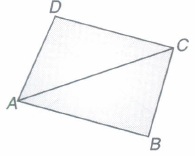
In the figure below, the diagonal AC of quadrilateral ABCD bisects \(\angle\)BAD and \(\angle\)BCD.Prove that BC = CD.
10.
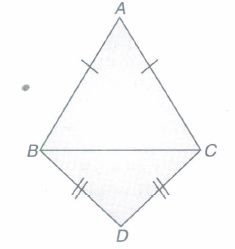
In the figure, \(\triangle\)ABC and \(\triangle\)DBC are two isosceles triangles on the same base BC Prove that \(\angle\) ABD = \(\angle\)ACD.
11.
In ΔPQR, ㄥP = 100° and ㄥR = 60°, which side of the triangle is the longest. Give reasons for your answer.
12.
In ΔABC, ㄥA = 60°, ㄥB = 40°, which side of this triangle is the smallest? Give reasons for your answer.
13.
In a ΔDEF, if ㄥD = 30°, ㄥE = 60° then which side of the triangle is longest and which side is shortest?
14.
In ΔABC, if ㄥA = 50° and ㄥB = 60°, determine the shortest and the longest side of the triangle.
15.
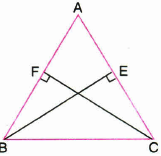
ABC is an isosceles triangle in which altitudes BE and CF are drawn to equal sides AC and AB respectively (see figure). Show that these altitudes are equal.
1.
In \(\triangle\)ABC, AC >AB
\(\therefore\) \(\angle\) ABC > \(\angle\)ACB
(Angles opposite to larger side is greater)
\(\therefore\) \(\angle\)ABC + \(\angle\)1 > \(\angle\)ACB + \(\angle\)1
(Adding \(\angle 1\)on both sides) Y.
\(\therefore\) \(\angle\)ABC + \(\angle\)1 > \(\angle\)ACB + \(\angle\)2
(AD bisects \(\angle\)A, \(\angle\)1 = \(\angle\)2)
\(\therefore\) \(\angle\)ADC > \(\angle\)ADB.
(Exterior angle property of triangle)
2.
In \(\triangle\)PQS and \(\triangle\)PRS,
PQ = PR (Given)
PS = PS (Common)
\(\angle\)PSQ = \(\angle\)PSR = 90°
(PS is altitude)
By R.H.S. rule,
\(\triangle PQS\cong \triangle PRS\)
\(\angle\)QPS = \(\angle\)RPS (By c.p.c.t.)
Hence, PS bisects \(\angle\)P.
3.
Given, AX II BY
\(\angle\)BAX = \(\angle\)ABY (Alternate angles) ...(i)
\(\angle\)AXY = \(\angle\)BYX (Alternate angles) ... (ii)
In \(\triangle\)APX and \(\triangle\)BPY,
AX = BY (Given) ...(iii)
From (1), (2) and (3), we get
\(\triangle APX\cong \triangle BPY\)
(By ASA) Proved
4.
Let, \(\angle\)DAC be \(\angle\)3
\(\angle\)1= \(\angle\)2
\(\angle\)1 + \(\angle\)3 = \(\angle\)2 + \(\angle\)3
\(\angle\)BAC = \(\angle\)EAD ...(i)
Given that, BD = CE
BD + DC = CE + DC
\(\Rightarrow\) BC = DE ....(ii)
\(\angle\)B = \(\angle\)E (Given)....(iii)
From (i), (ii) and (iii), we get
\(\triangle ABC\cong \triangle AED\) (By AAS rule).
5.
(i) In \(\triangle\) AOD and \(\triangle\)BOC,
OA =OB (Given)
OD = OC (Given)
\(\angle\)AOD = \(\angle\)BOC
(Vertically opposite angles)
So, by SAS criteria,
\(\triangle AOD\cong \triangle BOC\)
(ii) \(\angle\)CBA = \(\angle\)DAB (By c.p.c.t.)
AD and BC are two lines intersected by AB such that \(\angle\)CBA = \(\angle\)DAB and they form a pair of alternate angles.
Hence, AD II BC
6.
In \(\triangle\)PAB and \(\triangle\)PDC,
PA = PD (Given)
(P is the mid-point of AD)
AB = CD (Side of a square)
\(\angle\)PAB = \(\angle\)PDC = 90°
By R.H.S., \(\triangle PAB\cong \triangle PDC\)
\(\therefore\) PB = PC (By c.p.c.t.)
(Angles opp. to equal sides are equal)
\(\Rightarrow\) \(\angle\)PCB = \(\angle\)PBC. Proved.
7.
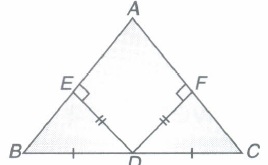
In \(\triangle\)BED and \(\triangle\)CFD,
\(\angle\)DEB = \(\angle\)DFC = 90°
BD = DC (D is the mid-point)
ED = FD (Given)
\(\therefore \triangle BED\cong \triangle CFD\) (By RHS)
\(\Rightarrow\) \(\angle\)B = \(\angle\)C (By c.p.c.t.) Proved.
8.
OA = OB (O is the mid-point of AB)
\(\angle\)AOC = \(\angle\)BOD (Vertically opposite angles)
OC = OD (O is the mid-point of CD)
\(\triangle AOC\cong \triangle BOD\)
\(\Rightarrow\) AC = BD. (By c.p.c.t) Proved.
9.
In \(\triangle\)ADC and \(\triangle\)ABC,
AC is Common
\(\angle DAC=\angle BAC\)
\(\angle DCA=\angle BCA\)(Given)
Hence, \(\triangle ADC\cong \triangle ABC\) (By AAS rule)
\(\Rightarrow\) CD = BC (By c.p.ct) Proved
10.
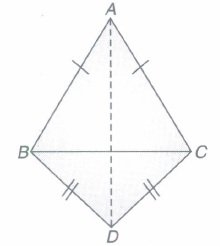
Join AD.
In \(\triangle\)ABC and \(\triangle\)ACD,
AB = AC (Given)
BD = CD (Given)
AD = AD (Common)
By using SSS Congruency Rule,
\(\triangle ABD\cong \triangle ACD\)
\(\therefore \angle ABD=\angle ACD (By c.p.c.t)\)
11.
QR as ㄥP is the greatest
12.
AC as ㄥB is the smallest.
13.
DE, EF
14.
BC, AB
15.
Given: ABC is an isosceles triangle in which altitudes BE and CF are drawn to equal sides AC and AB respectively.
To Prove: BE = CF
Proof: ABC is an isosceles triangle
AB = AC
\(\angle ABC=\angle ACB\) | Angles opposite to equal sides of a triangle are equal
In \(\triangle BEC\) and \(\triangle CFB\)
\(\angle BEC=\angle CFB\) | Each = 900
BC = CB
\(\angle ECB=\angle FBC\)
\(\triangle BEC\cong \triangle CFB\) | By AAS Rule
BE = CF | C.P.C.T

9th Standard CBSE Syllabus & Materials
9th Standard CBSE
CBSE 9th Mathematics Lines and Angles Sample Question Papers Study Material - QB365 Set A
NEW9th Standard CBSE
CBSE 9th Mathematics Introduction to Euclid's Geometry Sample Question Papers Study Material - QB365 Set A
NEW9th Standard CBSE
CBSE 9th Mathematics Linear Equations in Two Variables Sample Question Papers Study Material - QB365 Set A
NEW9th Standard CBSE
CBSE 9th Mathematics Coordinate Geometry Sample Question Papers Study Material - QB365 Set A



CBSE 9th Standard CBSE Subjects
CBSE Standards