100% FREE ACCESS
9th Standard CBSE Syllabus & Materials
9th Standard CBSE
CBSE 9th Science Is matter around us pure? - New Model Questions Papers Study Material - QB365 Set A
NEW9th Standard CBSE
CBSE 9th Science Matter in our surroundings - New Model Questions Papers Study Material - QB365 Set A
NEW9th Standard CBSE
CBSE 9th Mathematics Heron's Formula Sample Question Papers Study Material - QB365 Set A
NEW9th Standard CBSE
CBSE 9th Mathematics Circles Sample Question Papers Study Material - QB365 Set A
NEW9th Standard CBSE
CBSE 9th Mathematics Quadrilaterals Sample Question Papers Study Material - QB365 Set A
NEW9th Standard CBSE
CBSE 9th Mathematics Triangles Sample Question Papers Study Material - QB365 Set A

Published on: 07/09/2019
Probability
Download CBSE Class 9th Standard CBSE Mathematics question papers, sample papers, important questions, and previous year solved papers in PDF format. Get free study materials, NCERT solutions, and exam preparation resources for Class 9th Standard CBSE Mathematics
Questions + Answers key
Take MCQ Mathematics Test
1.
In a survey of 200 men, it was found that 65 men take only coffee, 35 take only tea, 25 do not take either and the rest take both coffee and tea. Find the probability that a man selected at random:
(a) takes coffee
(b) takes only tea
2.
The percentage of marks obtained by a student in the monthly unit tests are given below:
| Unit test | No.of marks obtained |
| I | 76 |
| II | 52 |
| III | 60 |
| IV | 95 |
| V | 43 |
Based on this data, find the probabi lity that the
(a) student gets less than 60% marks in a unit test
(b) student gets at least 60% marks in a unit test
3.
In a cricket match, a batsman hits a boundary 6 times out of 30 balls she plays.Find the probability that she did not hit a boundary.
4.
To know the opinion of the students about the subject statistics, a survey of 200 students was conducted. The data is recorded in the following table:
| Opinion | Number of students |
| like | 135 |
| dislike | 65 |
Find the probability that a student chosen at random
(i) likes statistics,
(ii) does not like it
5.
In a particular section of Class IX, 40 students were asked about the months of their birth, the following graph was prepared for the data so obtained. Find the probability that a student of the class was born in August.
6.
Which of the following cannot be the experiment probability of an event?
\(\frac { 15 }{ 100 } \)
\(\frac { 3 }{ 2 } \)
0.17
\(\frac { 6 }{ 17 } \)
7.
An experiment has two outcomes E and F P(E)+P(F) is equal to:
1
0
2
\(\frac { 1 }{ 2 } \)
8.
What is the number of outcomes when a cubical dice is thrown?
2
4
6
3
9.
What is the number of outcomes when a coin is tossed?
1
2
4
6
10.
The minimum probability of an event is
0
1
\(\frac { 1 }{ 2 } \)
-1
11.
Two dice are thrown simultaneously 500 times. Each time the sum of two numbers appearing on their tops is noted and recorded as given in the following table:
| Sum of numbers | Frequency |
| 2 | 19 |
| 3 | 30 |
| 4 | 22 |
| 5 | 55 |
| 6 | 52 |
| 7 | 75 |
| 8 | 70 |
| 9 | 53 |
| 10 | 26 |
| 11 | 28 |
| 12 | 70 |
| Total | 500 |
If the dice are thrown once more, find the probability of getting a sum
(i) of 7
(ii) more than 11
(iii) less than or equal to 6
(iv) between 5 and 10
12.
The heights of the students of a class is measured and recorded as given below:
| Height (in cm) | No. of Students |
| 120-125 | 7 |
| 125-130 | 7 |
| 130-135 | 11 |
| 135-140 | 3 |
| 140-145 | 5 |
| 145-150 | 9 |
| 150-155 | 8 |
A student is selected at random. Find the probability that height of the students is :
(i) more than 135 cm
(ii) at least 145 cm
(iiii) less than 130 cm
(iv) 125 cm or more but less than 140 cm
13.
A die is rolled 25 times and outcomes are recorded as under:
| Outcomes | Frequency |
| 1 | 9 |
| 2 | 4 |
| 3 | 5 |
| 4 | 6 |
| 5 | 1 |
| 6 | 0 |
It is thrown one more time. Find the probability of getting
(a) an even number
(b) a multiple of 3
(c) a prime number.
14.
Out of the past 250 consecutive days, its weather forecasts were correct 175 times.
(i) What is the probability that on a given day it was correct?
(ii) What is the probability that it was not correct on a given day?
15.
A and B are the only two outcomes of an event. Probability P(A) = 0.72 then what will be the probability P(B) and why?
16.
Two coins are tossed simultaneously 1000 times with the following frequencies of different outcomes
| Outcome | Frequency |
| 2 heads | 350 |
| 1 head | 310 |
| No head | 340 |
If these two coins are tossed again, find the probability of getting
(i) at least 1 head
(il) at most 1 head
17.
The record of a weather station shows that out of the past 250 consecutive days, its weather forecasts were correct 175 times:
(i) What is the probability that on a given day it was correct?
(ii) What is the probability that it was not correct on a given day?
18.
A dice is thrown WOOtimes with the following frequencies for the outcomes 1,2,3,4, 5 and 6 given in the following table:
| Outcome | 1 | 2 | 3 | 4 | 5 | 6 |
| Frequency | 179 | 150 | 157 | 149 | 175 | 190 |
Find the probability of the happening of each outcome.
19.
A die is thrown. Find the probability of getting an odd number.
20.
In a group of 70 persons, there are 15 boys, 20 girls, 30 men and rest women. Find the probability that a selected person is a woman.
1.
\((a)\frac { 7 }{ 10 }\)
\((b)\frac { 7 }{ 40 } \)
2.
\((a)\frac { 2 }{ 5 } \)
\((b)\frac { 3 }{ 5 } \)
3.
Let E be the event of hitting the boundary.
Then,
\(P(E)=\frac { Number\ of\ times\ the\ batswoman\ hits\ the\ boundary }{ Total\ number\ of\ balls\ she\ plays } \)
\(=\frac { 6 }{ 30 } =\frac { 1 }{ 5 } =0.2\)
Probability of not hitting the boundary
= 1- Probability of hitting the boundary
= 1- P(E) = 1 - 0.2 = 0.8
4.
Total number of students = 200
(i) Number of students who like statistics = 135
Probability that a student chosen at random likes statistics=\(\frac { 135 }{ 200 } =\frac { 27 }{ 40 } \)
(ii) Number of students who do not like statistics=65
Probability that a student chosen at random does not like it= \(\frac { 65 }{ 200 } =\frac { 13 }{ 40 } \)
Aliter:
Probability that a student chosen at random does not like statistics
= 1 - probability that a student chosen at random likes statistics
=\(1-\frac { 27 }{ 40 } =\frac { 13 }{ 40 } \)
5.
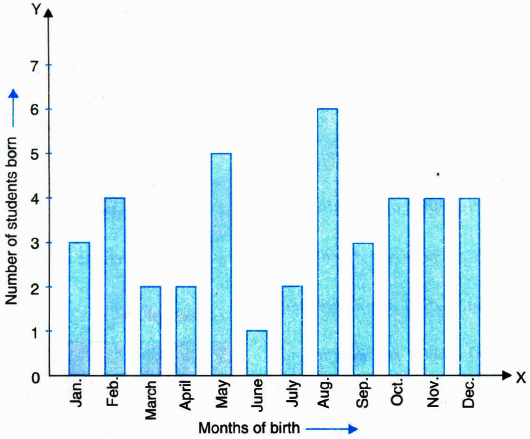
Total number of students born in the year
= 3 + 4 + 2 + 2 + 5 + 1 + 2 + 6 + 3 + 4 + 4 + 4 = 40
Number of students born in August = 6
. Probability that a student of the class was born in August =\(\frac { 6 }{ 40 } =\frac { 3 }{ 20 } \)
6.
\(\frac { 3 }{ 2 } >1\) so, \(\frac { 3 }{ 2 } \) cannot be the experimental probability of an event.
7.
P(E)+P(F)=1
8.
1,2,3,4,5,6
9.
H,T
10.
\(0\le P(E)\le 1\)
11.
(i) P(sum is 7)\(=\frac{75}{500}=\frac{3}{20}\)
(ii) P(sum is more than 11)\(=\frac{70}{500}=\frac{7}{50}\)
(iii) P(sum is less than or equal to 6)\(=\frac{19+30+22+52+55}{500}\)
\(=\frac{178}{500}=\frac{89}{250}\)
(iv) P(sum is between 5 and 10)\(=\frac{52+75+70+53}{50}\)
\(=\frac{250}{500}=\frac{1}{2}\)
12.
Total student = 7 + 7 + 11 + 3 + 5 + 9 + 8 = 50
(i) P(height of student is more that 135 cm)\(=\frac{25}{50}=\frac{1}{2}\)
(ii)P(height of student is at least 145 cm)\(=\frac{17}{50}\)
(iii) p(height of student is less than 130 cm)\(=\frac{14}{50}=\frac{7}{25}\)
(iv) P(height of student is 125 or more but less than 140)\(=\frac{21}{50}\)
13.
Total number of times a die is rolled = 25
Even numbers are 2, 4, 6.
Probability of getting an even number
\(=\frac { 4+6+0 }{ 25 } =\frac { 10 }{ 25 } =\frac { 2 }{ 5 } \)
(b) Multiples of 3 are 3, 6.
Probability of getting a multiple of 3
\(=\frac { 5+0 }{ 25 } =\frac { 5 }{ 25 } =\frac { 1 }{ 5 } \)
(c) 2, 3, 5 are prime numbers.
Probability of getting a prime number
\(=\frac { 4+5+1 }{ 25 } =\frac { 10 }{ 25 } =\frac { 2 }{ 5 } \)
14.
Total number of days = 250
(i) Number of days on which the weather forecasts were correct = 175
Probability that on a given day it was correct = \(\frac { 175 }{ 250 } =\frac { 7 }{ 10 } \)
(ii) Probability that it was not correct on a given day=\(1-\frac { 7 }{ 10 } =\frac { 3 }{ 10 } \)
15.
P(A)+P(B)=1
\(\because \) Sum of the probabilities of all the outcomes of an event is 1
\(\Rightarrow \ 0.72+P(B)=1\)
\(\\ \Rightarrow \ P(B)=1-0.72=0.28\)
16.
\((i)\frac { 33 }{ 50 } \)
\((ii)\frac { 13 }{ 20 } \)
17.
The total number of days for which the record is available = 250
(i) P(the forecast was correct on a given day)
\(
=\frac{\text { Number of days when the forecast was correct }}{\text { Total number of days for which the record is available }}
\)
\(=\frac{175}{250}=0.7\)
(ii) The number of days when the forecast was not correct = 250 - 175 = 75
So, P(the forecast was not correct on a given day) \(=\frac{75}{250}=0.3\)
18.
0.179, 0.15, 0.157, 0.149, 0.175, 0.19
19.
\(\frac { 1 }{ 2 } \)
20.
No of women = 70 - 15(+20 + 30)
= 5
P(women) = \(\frac{5}{70}=\frac{1}{14}\)

9th Standard CBSE Syllabus & Materials
9th Standard CBSE
CBSE 9th Mathematics Lines and Angles Sample Question Papers Study Material - QB365 Set A
NEW9th Standard CBSE
CBSE 9th Mathematics Introduction to Euclid's Geometry Sample Question Papers Study Material - QB365 Set A
NEW9th Standard CBSE
CBSE 9th Mathematics Linear Equations in Two Variables Sample Question Papers Study Material - QB365 Set A
NEW9th Standard CBSE
CBSE 9th Mathematics Coordinate Geometry Sample Question Papers Study Material - QB365 Set A



CBSE 9th Standard CBSE Subjects
CBSE Standards