100% FREE ACCESS
9th Standard CBSE Syllabus & Materials
9th Standard CBSE
CBSE 9th Science Is matter around us pure? - New Model Questions Papers Study Material - QB365 Set A
NEW9th Standard CBSE
CBSE 9th Science Matter in our surroundings - New Model Questions Papers Study Material - QB365 Set A
NEW9th Standard CBSE
CBSE 9th Mathematics Heron's Formula Sample Question Papers Study Material - QB365 Set A
NEW9th Standard CBSE
CBSE 9th Mathematics Circles Sample Question Papers Study Material - QB365 Set A
NEW9th Standard CBSE
CBSE 9th Mathematics Quadrilaterals Sample Question Papers Study Material - QB365 Set A
NEW9th Standard CBSE
CBSE 9th Mathematics Triangles Sample Question Papers Study Material - QB365 Set A

Published on: 24/09/2019
Gravitation
Download CBSE Class 9th Standard CBSE Science question papers, sample papers, important questions, and previous year solved papers in PDF format. Get free study materials, NCERT solutions, and exam preparation resources for Class 9th Standard CBSE Science
Questions + Answers key
Take MCQ Science Test
1.
Shruti and Kriti were performing the experiment to find the pressure exerted by a cuboid kept on sand with its different faces. Shruti shared her thoughts with Kriti and told her that, since the teacher had explained about pressure and area, therefore she could guess the results.
(i) How can you relate pressure applied by an object with its area?
(ii) What would be the observation of Shruti and Kriti?
(iii) Which qualities about Shruti do you observe from here?
2.
Mohit throws a ball horizontally while Shobhit throws a ball vertically downwards from a tower. Both of them do so in an attempt to see who hits the stone on ground first. After that, they try to reason their findings.
Read the above passage and answer the following questions:
(i) Which ball reaches the ground first?
(ii) What are the values shown by Mohit and Shobhit?
(iii) What is the relation of g with G?
3.
(i) State the SI units of thrust and pressure.
(ii) In which situation, we exert more pressure on ground when we stand on one foot or on the both feet? Justify your answer.
4.
A particle weighs 120 N on the surface of the earth. At what height above the earth's surface will its weight be 30 N? Radius of the earth = 6400 km.
5.
A ball is dropped from the edge of a roof. It takes 0.1 s to cross a window of height 2.0 m. Find the height of the roof above the top of the window.
6.
A ball is thrown with some speed u mls. Show that under the free fall, it will fall on the ground with same speed.
7.
Prove that, if a body is thrown vertically upwards, then the time of ascent is equal to the time of descent.
8.
Calculate the acceleration due to gravity on the surface of satellite having mass 7.4 x 10²² kg and radius 1.74 x 106 cm. (Take,G = 6.7 X 10⁻¹¹ N-m/kg2)
9.
Two solid objects of masses 1 kg and 2 kg are dropped from a helicopter at the same time. Which one will reach the ground earlier? Justify your answer with suitable reason
10.
If the distance between two masses beincreased by a factor of 6, by what factor would the mass of one of them have to be altered to maintain the same gravitational force? Would this be an increase or decrease in mass?
11.
Two different bodies are completely immersed in water and undergo the same loss in weight. Is it necessary that their weights in air should also be the same? Justify your answer.
12.
A cubical tub of side 2 m is full of water. Calculate the total thrust and pressure at the bottom of tank due to water. (Take, density of water = 1000 kg m-3 and g = 10 ms-2)
13.
The earth is not a perfect sphere. As the radius of the radius of the earth increases from the poles to the equator, the value of g becomes greater at the poles than at the equator. As one goes above the earth's surface, the value of g decreases. If one goes deep inside the earth, then also the value of g decreases. In fact, the value of g becomes zero at the centre of the earth. Moreover, due to the rotation of the earth, the weight of a body is maximum at the poles and minimum at the equator.
(i) Name the factors on which the value of 'g' depends.
(ii) What is the effect of altitude on acceleration due to gravity?
(iii) What is the effect of rotation of the earth on the acceleration due to gravity?
14.
If a fresh egg is put into a beaker filled with water, it sinks. On dissolving a lot of salt in the water, the egg begins to rise and floats. Why?
15.
State Archimedes' principle? Write two applications of Archimedes' principle.
1.
(I) We know that, pressure =\(\cfrac { force }{ area } \)
The pressute acting on the surface is inversely proportional to the area of the surface on which force is applied, i.e
Pressure \(\left( p \right) \propto \cfrac { 1 }{ Area\left( A \right) } \)
(ii) Shruti and Kriti observed that pressure is more, if the area of cuboid in contact with the sand is less.
On the other hand, pressure is less, if the area of contact is large, as pressure\(\left( p \right) \propto \cfrac { 1 }{ Area\left( A \right) } \)
(iii) Shruti is intelligent, scientific and enthusiastic.
2.
(I) Both balls reach the ground simultaneously. Because both of them have been dropped from the same height.
(ii) Mohit and Shobhit are inquisitive, logical, experimental and competitive.
(iii) \(g=\cfrac { GM }{ { R }^{ 2 } } \)
3.
(i) The SI unit of thrust is newton (N). The SI unit of pressure is N m-2or pascal (Pa).
(ii) We exert more pressure on ground when we stand on one foot than the both feet, as the area of one foot is half than that of two feet and \(p\propto \cfrac { 1 }{ A } \)
4.
Let the weight of the particle on the surface of the earth,
\(w=120=\cfrac { GMm }{ { R }^{ 2 } } \)
where, R = 6400 km = 6.4 X 10⁶ m
Hence, 120=\(\cfrac { GMm }{ \left( 6.4\times { 10 }^{ 6 } \right) ^{ 2 } } \)
Let the height h above the earth's surface, where its weight will be 30 N.
Hence,\(30=\cfrac { GMm }{ \left( h+R \right) ^{ 2 } } \)
\(30=\cfrac { GMm }{ \left( h+6.4\times 10^{ 6 } \right) ^{ 2 } } \) ...(ii)
On dividing Eq. (i) by Eq. (ii), we get
\(\cfrac { 120 }{ 30 } =\cfrac { GMm }{ \left( 6.4\times 10^{ 6 } \right) } \times \cfrac { \left( h+6.4\times { 10 }^{ 6 } \right) ^{ 2 } }{ GMm } \)
\(\cfrac { 4 }{ 1 } =\cfrac { \left( h+R \right) ^{ 2 } }{ { R }^{ 2 } } \Rightarrow 2=\cfrac { h+R }{ R } \)
\(\Rightarrow\) 2R = h + R
\(\Rightarrow\) h = 2R - R = R = 6400 km
= 6.4 x 10⁶m
5.
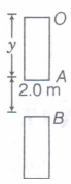
Let AB be the window and suppose the roof is at a height y above A.Also, suppose it takes a time t1, for the ball to reach A. The velocity of the ball at A is
v1= 0 + gt1 = 9.8t1
Now, consider the motion of the ball from A to B.
Here, the initial velocity is v1 the distance covered is 2 m and the time taken is 0.1 s .
From secon d eeqcuuaattiion 0f moontion, s = ut + \(\cfrac { 1 }{ 2 } \)gt
\(\Rightarrow\) 2.0 =v1 (0.1) +\(\cfrac { 1 }{ 2 } \) - X 9.8 X (0.1)2 = 9.8t1 (0.1)+0.049
\(\Rightarrow\) t1=199\(\approx \)2s
The height y is \(y=\cfrac { 1 }{ 2 } g{ t }_{ 1 }^{ 2 }\)
= \(\cfrac { 1 }{ 2 } \) x 9.8 X (2)2 =19.6m
The roof is at a height 19.6 m above the top of the window.
6.
When the ball is thrown upwards, then it will reach certain height h and starts falling. At maximum height h, the final velocity will be v = 0.
Maximum height reached by the ball,
v2- u2 = 2gh [using equation]
0- u2 = - 2gh [\(\therefore\) acceleration = - g]
\(\Rightarrow\) \(h=\cfrac { { u }^{ 2 } }{ 2g } \)
In second case, when the ball starts to fall, then the initial velocity u = 0. It will accelerate due to gravity, i.e. a = g and reach ground with speed (sayv2).
Using equation,
\({ v }_{ 2 }^{ 2 }-{ u }^{ 2 }=2gh\)
\(\Rightarrow\) \({ v }_{ 2 }^{ 2 }-0=2gh\)
\({ v }_{ 2 }^{ 2 }=2g\left( \cfrac { { u }^{ 2 } }{ 2g } \right) ={ u }^{ 2 }\) [from Eq. (i)]
\(\Rightarrow\) v2=u
Thus, the ball reach on the ground with same speed
7.
For the upward motion
v =u - gt1 > 0 = u - gt1, \({ t }_{ 1 }=\cfrac { u }{ g } \) and the downward motion,
v = u + gt2, v = 0 + gt2
The body falls back to the earth with the same speed as it was thrown vertically upwards.
\(\therefore\) v=u, u=0+gt2\(\Rightarrow \) \({ t }_{ 2 }=\cfrac { u }{ g } \)
From Eqs. (i) and (ii), we get
tl = t2 => Time of ascent = Time of descent
8.
As we know, acceleration due to gravity,\(g=\cfrac { GM }{ R^{ 2 } } \)
For the satelite,R = 1.74 X1 06 cm = \(\cfrac { 1.74\times { 10 }^{ 6 } }{ 100 } \)
=1.74 X 10⁴m
M = 7.4 X10²² kg
\(\therefore\) g= \(\cfrac { 6.67\times 10^{ -11 }\times 7.4\times 10^{ 22 } }{ 1.74\times 10^{ 4 }\times 1.74\times { 10 }^{ 4 } } \)
= \(\cfrac { 6.67\times 7.4 }{ 1.74\times 1.74 } \times 10^{ 3 }\) g=16.30 X10³m/s2
9.
Both will reach the ground at the same time as we know that an object experiences acceleration during free fall. This acceleration experienced by an object is independent of its mass because \(g=\cfrac { GM }{ R^{ 2 } } \)
As they are dropped at the same time, they will reach the ground at the same time.
10.
As we know,\(F=\cfrac { G{ m }_{ 1 }{ m }_{ 2 } }{ { 4r }^{ 2 } } \)
According to question, r' = 6r
So, \(F=\cfrac { G{ m }_{ 1 }{ m }_{ 2 } }{ \left( 6r \right) ^{ 2 } } =\cfrac { G{ m }_{ 1 }{ m }_{ 2 } }{ 36r^{ 2 } } =\cfrac { F }{ 6 } \)
To maintain same force one of the mass is to be increased by 36 times.
11.
No, it is not necessary that their weights in air should also be the same. This is because the two bodies have undergone the same loss in weight on completely immersing in water due to their equal volumes, not due to their equal weights. So, they may have different weights in air.
12.
\(\therefore\) Volume of cubical tub = Length x Breadth X Height
Here, length = breadth = height = 2 m
\(\therefore\) Volume=2 x 2 x 2 =8 m3
Mass of water = Volume x Density of water
= 8 x 1000 = 8000 kg
\(\therefore\) Weight of water = Mass x Acceleration due to
gravity = 8000 x 10 = 8 x 10⁴ N
\(\therefore\) Total thrust = Weight of water = 8 x 10⁴ N
Area of bottom = Area of square shape of tub
= 2 x 2 = 4m2
\(\therefore\) Pressure of water at the bottom = \(\frac{Force}{Area}=\frac{Weight}{Area}\)
= \(\frac{8\times 10^4}{4}\) = 2 x 10⁴ Pa
13.
(i) The value of g depends on
(a) shape of the earth,
(b) rotation of the earth,
(c) altitude, and
(d) depth.
(ii) Acceleration due to gravity decreases.
(iii) The value of g decreases due to rotation of the earth.
14.
The average density of a fresh egg is more than of pure water but less than that of water in which salt is, dissolved. So a fresh egg sinks in pure water while it floats in salty water.
15.
Archimedes' principle. This principle states that when a body is immersed fully or partially in a fluid, it experiences an upward thrust equal to the weight of the fluid displaced by it.
Applications of Archimedes' principle
(i) Archimedes' principle is used in designing ships and submarines.
(ii) Lactometers based on Archimedes' principle are used to measure purity of a sample of milk.
(iii) Hydrometers used to measure density off liquids are based on Archimedes' principle.

9th Standard CBSE Syllabus & Materials
9th Standard CBSE
CBSE 9th Mathematics Lines and Angles Sample Question Papers Study Material - QB365 Set A
NEW9th Standard CBSE
CBSE 9th Mathematics Introduction to Euclid's Geometry Sample Question Papers Study Material - QB365 Set A
NEW9th Standard CBSE
CBSE 9th Mathematics Linear Equations in Two Variables Sample Question Papers Study Material - QB365 Set A
NEW9th Standard CBSE
CBSE 9th Mathematics Coordinate Geometry Sample Question Papers Study Material - QB365 Set A



CBSE 9th Standard CBSE Subjects
CBSE Standards