100% FREE ACCESS
9th Standard CBSE Syllabus & Materials
9th Standard CBSE
CBSE 9th Science Is matter around us pure? - New Model Questions Papers Study Material - QB365 Set A
NEW9th Standard CBSE
CBSE 9th Science Matter in our surroundings - New Model Questions Papers Study Material - QB365 Set A
NEW9th Standard CBSE
CBSE 9th Mathematics Heron's Formula Sample Question Papers Study Material - QB365 Set A
NEW9th Standard CBSE
CBSE 9th Mathematics Circles Sample Question Papers Study Material - QB365 Set A
NEW9th Standard CBSE
CBSE 9th Mathematics Quadrilaterals Sample Question Papers Study Material - QB365 Set A
NEW9th Standard CBSE
CBSE 9th Mathematics Triangles Sample Question Papers Study Material - QB365 Set A

Published on: 31/12/2018
Class 9 Model Question
Download CBSE Class 9th Standard CBSE Mathematics question papers, sample papers, important questions, and previous year solved papers in PDF format. Get free study materials, NCERT solutions, and exam preparation resources for Class 9th Standard CBSE Mathematics
Questions + Answers key
Take MCQ Mathematics Test
1.
the length, breadth and height of a room are 6 m, 4 m and 3 m respectively. Find the cost of white washing the four walls of the room at the rate of Rs 12 per m2. The room has an entrance door mearuring 2.5 m \(\times\) 1 m which is not to be white washed.
2.
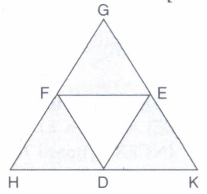
In \(\Delta\)GHK; D, E and F are the mid-point of sides HK, KG and GH respectively. show that EFHK is trapezium and ar(EFHK) = \(\frac { 3 }{ 4 } ar(\Delta GHK)\)
3.
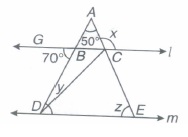
In the figure, \(\angle BAC=50^o, \angle GBD=70^o\) and l and m are parallel lines. Find x,y, and z.
4.
If \(x=\frac { \sqrt { 3 } +\sqrt { 2 } }{ \sqrt { 3 } -\sqrt { 2 } } \quad and\quad y=\frac { \sqrt { 3 } -\sqrt { 2 } }{ \sqrt { 3 } +\sqrt { 2 } } \) find the value of x2-y2+xy, if \(\sqrt { 6 } \)=2.4.
5.
If the point (-1,-5) lies on the graph of 3x=ay+7, then find the value of 'a'.
6.
The following data on the number of girls (to the nearest ten) per thousand boys in different sections of the Indian society is given below:
| Section | Number of girls per thousand boys |
| Scheduled Caste (SC) | 940 |
| Scheduled Tribe (ST) | 970 |
| Non SC/ST | 920 |
| Backward districts | 950 |
| Non-backward districts | 920 |
| Rural | 930 |
| Urban | 910 |
(i) Represent the information above by a bar graph.
(ii) In the classroom discuss what conclusion can be arrived at from the graph.
7.
Prove that an isosceles trapezium is cyclic
8.
Classify the following numbers as rational or irrational: 0.3796
9.
In a particular section of Class IX, 40 students were asked about the month of their birth, the following was prepared for the data so obtained.
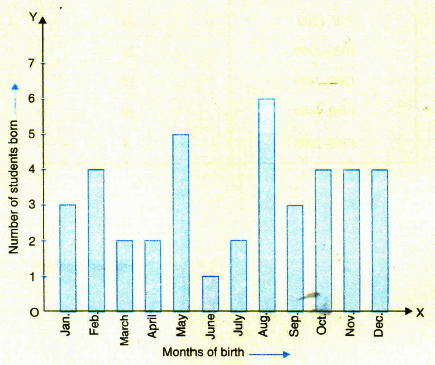
Observe the bar graph given above and answer the following question:
(i) How many students were born in the month of November?
(ii) In which month were the maximum number of students born?
10.
The radius and height of a right circular cone are in the ratio 4 : 3. If the area of the base of the cone is 154 cm2, find the area of its curved surface. \(\left[ Use\ \pi =\frac { 22 }{ 7 } \right] \)
11.
Find the area of an equilateral triangle of side 10 cm.
12.
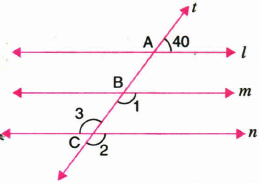
l,m and n are parallel lines intersected by transversal 't' at A, B, and C respectively. Find the measure of \(\angle 1,\angle 2and\angle 3\) Give reasons
13.
Draw a graph of the line x - 2y = 3. From the graph, find the coordinates of the point when
(i) x =-5
(ii) y = 0.
14.
In which quadrant do the given point lie? (2,-1)
15.
Factorise: \(16x^3-2y^3\)
16.
If \(a=\frac { \sqrt { 3 } +1 }{ \sqrt { 3 } -1 } \) and \(b=\frac { 1 }{ a } \) , find the value of \({ a }^{ 2 }+ab+{ b }^{ 2 }\)
17.
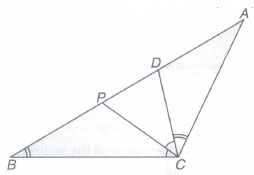
In the given figure, \(\angle ACD=\angle ABC\) CP bisects \(\angle BCD.\) Prove that \(\angle APC=\angle ACP.\)
18.
Find the length of the longest rod that can be placed in a room 12 m \(\times\) 9 m \(\times\) 8 m.
19.
Find the angle marked as x in each of following figures where O is the centre of the circle:
(i)
.png)
(ii)
.png)
(iii)
.png)
(iv)
.png)
(v)
.png)
20.
Show that each angle of a rectangle is a right angle.
21.
Find the value of the polynomial \(p(z)={ 3z }^{ 2 }=4z+\sqrt { 17 } \) when z=3.
22.
Evaluate:\(\frac { 40 }{ 2\sqrt { 10 } +\sqrt { 20 } +\sqrt { 40 } -2\sqrt { 5 } } \) when it is given that \(\sqrt { 10 } =3.162\)
23.
The class-mark of the class 130-150 is
24.
Find the amount of water displaced by a solid spherical ball of diameter 4.2 cm, when it is completely immersed in water.
25.
Bisector of an angle divides it in to_______equal parts
26.
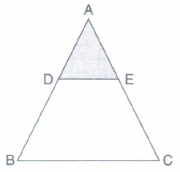
In an equilateral triangle ABC, D and E are the mid-points of sides AB and AC respectively, then length of DE is....
27.
In \(\triangle ABC,\angle A=\angle B/2=\angle C/6,\) then what will be the measurement of \(\angle A?\)
28.
Write ASA congruence rule for two triangles.
29.
Write the number of dimension(s) of a surface.
30.
If f(x) be a polynomial such that \(f\left( -\frac { 1 }{ 3 } \right) \)=0, then calculate one factor of f(x).
31.
The graph of the linear equation 4x - 3y = 12 cuts y-axis at _____
32.
Write the sum of \(0.\bar{3}\) and \(0.\bar{4}\)
33.
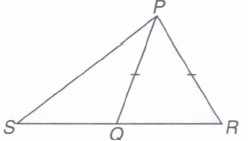
In figure, PQ = PR. Show that PS > PQ.
34.
Geetha told her classmate Radha that "\(\sqrt { \frac { \left( \sqrt { 2 } -1 \right) }{ \left( \sqrt { 2 } +1 \right) } } \) is an irrational number." Radha replied that "you are wrong" and further claimed that "If there is a number 'x' such that x3 is an irrational number, then x5 is also irrational". Geetha said, "No Radha, you are wrong". Radha took some time and after verification accepted her mistakes and thanked Geetha for pointing out these mistakes.
(i) Justify both the statements.
(ii) What value is depicted from this question?
1.
l = 6 m, b = 4 m, h = 3 m.
Area of 4 walls = 2(l + b)h
= 2(6 + 4)3
= 60 m2
Area of door = 2.5\(\times\)1
= 2.5 m2
Net area to be white washed=Area of four walls-Area of door.
= 60-2.5
= 57.5 m2
Cost of white washing = 57.5 \(\times\)12
= Rs 690
2.
In \(\Delta\)GHK; F and E are the mid-points of HG and GK respectively.
\(\therefore\) By mid-point theorem,
\(FE=\frac { 1 }{ 2 } KH\quad and\quad FE||KH\) ...........(i)
In quadrilateral EFHK,
EF || HK (by (i))
\(\therefore\) EFHK is a trapezium.
Also,
ar(EFHK) = ar(FHD) + ar(DEF) + ar(DEK) .............(ii)
We have, FE || HD and FE = HD
\(\therefore\) FEDH is a ||gm,
So, ar(FHD) = ar(DEF) ..........(iii)
Similarly, DFGE is a ||gm,
\(\therefore\) ar(DEF) = ar(GEF) ...........(iv)
Also, DFEK is a ||gm,
\(\therefore\) ar(DEF) = ar(DEK) ...........(v)
Using (iii), (iv) & (v) we get,
ar(GEF) = ar(FHD)
= ar(DEK) = ar(DEF)
\(=\frac { 1 }{ 4 } \) ar(GHK) ...........(vi)
Using (vi) and (ii), we get
ar(EFHK) = \(\frac { 3 }{ 4 } ar(GHK)\)
Hence proved
3.
\(\angle ABC=\angle GBD=70^o\) (Vertically opp. angle)
\(x=\angle ABC+\angle CAB\) (Exterior angle)
=50o+70o=120o
\(y=\angle GBD=70^o\) (Alternate angles)
\(z=180^o-\angle EAD-y\) (Angle sum property)
=180o-50o-70o
=60o
4.
\({ x }^{ 2 }-{ y }^{ 2 }={ \left( \frac { \sqrt { 3 } +\sqrt { 2 } }{ \sqrt { 3 } -\sqrt { 2 } } \right) }^{ 2 }-{ \left( \frac { \sqrt { 3 } -\sqrt { 2 } }{ \sqrt { 3 } +\sqrt { 2 } } \right) }^{ 2 }+\left( \frac { \sqrt { 3 } +\sqrt { 2 } }{ \sqrt { 3 } -\sqrt { 2 } } \right) \times \left( \frac { \sqrt { 3 } -\sqrt { 2 } }{ \sqrt { 3 } +\sqrt { 2 } } \right) \)
\(=\frac { 5+2\sqrt { 6 } }{ 5-2\sqrt { 6 } } -\frac { 5-2\sqrt { 6 } }{ 5+2\sqrt { 6 } } +1\)
\(=\frac { { (5+2\sqrt { 6 } ) }^{ 2 }-({ 5-2\sqrt { 6 } ) }^{ 2 } }{ (5-2\sqrt { 6 } )(5+2\sqrt { 6 } ) } +1\)
\(=\frac { 25+24+20\sqrt { 6 } -25-24+20\sqrt { 6 } }{ 25-24 } +1\)
\(=40\sqrt { 6 } +1\)
\(=40\times 2.4+1=96+1=97\)
5.
(-1,-5) lies on the graph of
3x=ay+7
3(-1)=aX(-5)+7
\(\Rightarrow\)-3=-5a+7\(\Rightarrow\) 5a=10
\(\Rightarrow\)a=2
6.
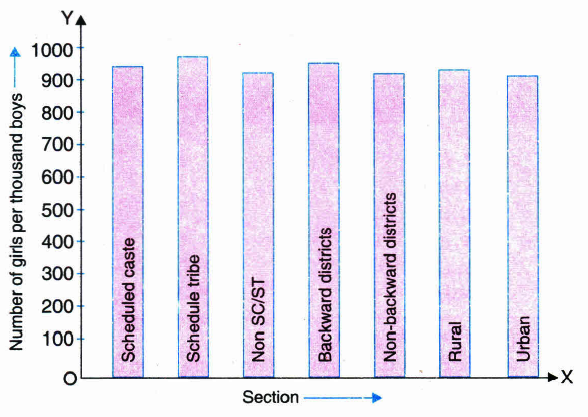
(ii) The two conclusions we can arrive at from the graph are as follows:
(a) The numbers of girls to the nearest ten per thousand boys is maximum in Scheduled Tribe section of the society and minimum in Urban section of the society.
(b) The number of girls to the nearest ten per thousand boys is the same for 'Non Sc/ST' and 'Non-backward Districts' sections of the society.
7.
Given: ABCD is a trapezium whose nonparallel sides AD and BC are equal.
To Prove: Trapezium ABCD is cyclic.
Construction: Draw BE 11 AD.
Proof: ∵ AB || DE I Given
and AD || BE I By construction
∴ Quadrilateral ABCD is a parallelogram.
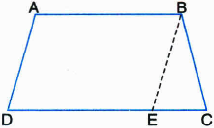
∴ \(\angle BAD=\angle BED\) ....(1)
| Opp.\(\angle \) s of a || gm are equal
and AD = BE ...(2)
Opp. sides of a || gm are equal
But AD = BC .......(3) I Given
From (2) and (3),
BE=BC
∴ \(\angle BEC=\angle BCE\) ....(4)
| Angles opposite to equal sides of a triangle are equal
\(\angle BEC+\angle BED=180°\)| Linear Pair Axiom
⇒ \(\angle BCE+\angle BAD=180°\) I From (4) and (1)
⇒ Trapezium ABCD is cyclic.
∵ If the sum of a pair of opposite angles of a quadrilateral is 180°, then the quadrilateral is cyclic.
8.
The decimal expansion is terminating.
0.3796 is a rational number.
9.
(i) 4 students were born in the month of November.
(ii) Maximum number of students were born in the month of August.
10.
192.5 cm2
11.
\(25\sqrt { 3 } \) cm2
12.
\(140^{ 0 },140^{ 0 },140^{ 0 }\)
13.
(i)(-5,-4)
(ii)(3,0)
14.
IV
15.
\(2(2x-y)(4x^2+2xy+y^2)\)
16.
15
17.
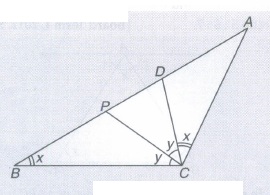
\(\angle ACD=\angle ABC=x\)
\(\angle BCP=\angle DCP=y\)
Ext \(\angle APC=x+y\)
\(\angle ACP=x+y\)
\(\angle ACP=\angle APC\)
18.
For room
l = 12 m,
b = 9 m,
h = 8 m
\(\therefore\) Length of the longest rod that can be placed in the room
= Length of the diagonal
\(=\sqrt { { l }^{ 2 }+{ b }^{ 2 }+{ h }^{ 2 } } \)
\(\\ =\sqrt { { \left( 12 \right) }^{ 2 }+{ \left( 9 \right) }^{ 2 }+{ \left( 8 \right) }^{ 2 } } \)
\(\\ =\sqrt { 144+81+64 } \)
\(\\ =\sqrt { 289 } \)
\(\\ =17m.\)
19.
(i) x = 2 x 35° = 70°
I ∵ Angle subtended by an arc of a circle at the centre is double the angle subtended by it at any point of the remaining part of the circle
(ii) \(x=\frac { 1 }{ 2 } \times 110°=55°\)
| ∵ Angle subtended by an arc of a circle at the centre is double the angle subtended by it at any point of the remaining part of the circle
(iii) \(x=\frac { 1 }{ 2 } \times 70°=35°\)
I ∵ Angle subtended by an arc of a circle at the centre is double the angle subtended by it at any point of the remaining part of the circle
(iv) x = 180° - (90° + 55°) I ∵ Angle in a semi-circle is 90°
= 180° - 145° = 35°
(v) \(x=\frac { 1 }{ 2 } \times \left( 180°-120° \right) \)
| ∵ Angle subtended by an arc of a circle at the centre is double the angle subtended by it at any point of the remaining part of the circle \(=\frac { 1 }{ 2 } \left( 60° \right) =30°\).
20.
Let us recall what a rectangle is.
A rectangle is a parallelogram in which one angle is a right angle.
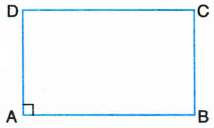
Let ABCD be a rectangle in which \(\angle\) A = 90°.
We have to show that \(\angle\) B = Ð C = \(\angle\) D = 90°
We have, AD || BC and AB is a transversal
(see Fig.).
So, \(\angle\) A + \(\angle\) B = 180° (Interior angles on the same
side of the transversal)
But, \(\angle\) A = 90°
So, \(\angle\) B = 180° – \(\angle\) A = 180° – 90° = 90°
Now, \(\angle\) C = Ð A and \(\angle\) D = \(\angle\) B
(Opposite angles of the parallellogram)
So, \(\angle\) C = 90° and \(\angle\) D = 90°.
Therefore, each of the angles of a rectangle is a right angle.
21.
\(p(z)={ 3z }^{ 2 }=4z+\sqrt { 17 } \)
\(\therefore p(3)=3{ (3) }^{ 2 }-4(3)+\sqrt { 17 }\)
\(=15+\sqrt { 17 }\)
22.
\(=\frac { 40 }{ 2\sqrt { 10 } +\sqrt { 2\times 2\times 5 } +\sqrt { 2\times 2\times 10 } -2\sqrt { 5 } } \)
\(\\ =\frac { 40 }{ 2\sqrt { 10 } +\sqrt { 20 } +\sqrt { 40 } -2\sqrt { 5 } } \)
\(\\ =\frac { 40 }{ 4\sqrt { 10 } } =\frac { 10 }{ \sqrt { 10 } } \)
\(\\ \sqrt { 10 } =3.162\)
23.
()
140
24.
()
Amount of water displaced = Volume of solid spherical ball
\(\therefore \ Volume\ of\ solid\ spherical\ ball=\frac { 4 }{ 3 } \pi { r }^{ 3 }\)
\(r=\frac { 4.2 }{ 2 } =2.1\) (given)
\(\therefore\) Volume of solid sperical ball=\(\frac { 4 }{ 3 } \pi ({ 2.1) }^{ 3 }\)
\(=\frac { 4 }{ 3 } \times \frac { 22 }{ 7 } \times { (2.1) }^{ 3 }\quad { cm }^{ 3 }\)
\(=\frac { 38808 }{ 1000 } litre\)
\(\therefore\) Amount of water displaced = 38808 litre (\(\because\)1 litre = 1000 cm3)
25.
()
Two
26.
()
Since D and E are mid-points of sides AB and AC respectively, so, by mid-point theorem, DE=\(\frac{1}{2}\)BC.
27.
()
In \(\triangle ABC,\)
\(\angle A+\angle B+\angle C=180^o\)(By given conditions)
\(\Rightarrow \angle A+2\angle A+6\angle A=180^o\)
\(\Rightarrow 9\angle A=180^o\)
\(\Rightarrow \angle A=20^o\)
28.
()
ASA congruence: Two triangles are congruent, if two angles and the included side of one triangle are equal to two angles and the included side of other triangle.
29.
()
Dimension of surface= Length and Breadth (which is 2)
30.
()
Since, \(f\left( -\frac { 1 }{ 3 } \right) \) =0
\(\therefore -\frac { 1 }{ 3 } \) is a zero of polynomial f(x)
So, x+\(\frac { 1 }{ 3 } \)or 3x+1 is a factor of f(x).
31.
()
(0,-4)
32.
()
\(0.\bar{3}+0.\bar{4}\)=(0.333...) + (0.444...)
= 0.777...
Let x = 0.777...
10x = 7.777...
⇒ 10x - x = (7.777...) - (0.777...)
⇒ 9x = 7.0
⇒ x = \(\frac{7}{9}\)
33.
Proof: In \(\triangle\) PQR,
PQ =PR
\(\angle\) PQR = \(\angle\)PRQ
(Angles opp. to equal sides are equal) ...(i)
In \(\triangle\)PQS, \(\angle\)PQR > \(\angle\)PSQ
(Ext. angle of a 6 is greater than each of interior opp. angle)
\(\angle\)PRQ > \(\angle\)PSQ, using (i)
\(\Rightarrow\) \(\angle\)PRS >\(\angle\)PSR \(\Rightarrow\) PS > PR
PS>PQ (\(\because\) PR = PQ)
(Side opp. to greater angle is larger)
34.
\(\sqrt { \frac { \left( \sqrt { 2 } -1 \right) }{ \left( \sqrt { 2 } +1 \right) } } \)is an irrational number.
\(\sqrt { \frac { \left( \sqrt { 2 } -1 \right) }{ \left( \sqrt { 2 } +1 \right) } } =\sqrt { \frac { \left( \sqrt { 2 } -1 \right) }{ \left( \sqrt { 2 } +1 \right) } \times \frac { \left( \sqrt { 2 } -1 \right) }{ \left( \sqrt { 2 } -1 \right) } } \)
\(=\sqrt { \frac { { \left( \sqrt { 2 } -1 \right) }^{ 2 } }{ 2-1 } } \)
\(=\sqrt { \frac { { \left( \sqrt { 2 } -1 \right) }^{ 2 } }{ 1 } } =\sqrt { 2 } -1\)
which is an irrational number.
Let, there is a number x such that x3 is an irrational number but x5 is a rational number.
Let, x =\(\sqrt[5]{7}\) be the number.
⇒ x3 = (5√7)3 = (7)3/5
is an irrational number.
But x5 = (\(\sqrt[5]{7}\))5=(7)5/5 = 7
=7 is a rational number.
(ii) Accepting own mistakes gracefully, co-operative learning among the classmates.

9th Standard CBSE Syllabus & Materials
9th Standard CBSE
CBSE 9th Mathematics Lines and Angles Sample Question Papers Study Material - QB365 Set A
NEW9th Standard CBSE
CBSE 9th Mathematics Introduction to Euclid's Geometry Sample Question Papers Study Material - QB365 Set A
NEW9th Standard CBSE
CBSE 9th Mathematics Linear Equations in Two Variables Sample Question Papers Study Material - QB365 Set A
NEW9th Standard CBSE
CBSE 9th Mathematics Coordinate Geometry Sample Question Papers Study Material - QB365 Set A



CBSE 9th Standard CBSE Subjects
CBSE Standards