
 100% FREE ACCESS
11th Standard Syllabus & Materials
11th Standard
TN 11th Tamil இயற்கை வேளாண்மை,சுற்றுச்சூழல் -செய்யுள் - மனோன்மணீயம் Important Questions And Answers Study Material - QB365 Set A
NEW11th Standard
TN 11th Tamil என்னுயிர் என்பேன் -துணைப்பாடம் - இசைத்தமிழர் இருவர் Important Questions And Answers Study Material - QB365 Set A
NEW11th Standard
TN 11th Tamil மொழி கலை -செய்யுள் - ஒவ்வொரு புல்லையும் Important Questions And Answers Study Material - QB365 Set A
NEW11th Standard
TN 11th Tamil பீடு பெற நில் - இலக்கணம் - பகுபத உறுப்புகள் Important Questions And Answers Study Material - QB365 Set A
NEW11th Standard
TN 11th Tamil பீடு பெற நில் - துணைப்பாடம் - வாடிவாசல் Important Questions And Answers Study Material - QB365 Set A
NEW11th Standard
TN 11th Tamil பீடு பெற நில் - செய்யுள் - குறுந்தொகை Important Questions And Answers Study Material - QB365 Set A

Published on: 01/08/2018
Some of the important questions are prepared from this chapter Cell: The Unit of Life. In this question paper, questions are prepared from the book back and creative question.
For students subscribe and get plenty of question paper with answer key. For subscription please click here
Download Tamil Nadu 11th Standard Biology question papers, model tests, one-mark questions, important questions, and public exam papers in PDF format. Free study materials and answer keys for TN State Board students.
Questions + Answers key
Take MCQ Biology Test1.
Choose the correct statement with regard to working of scanning electron microscope.
(a) Glass slides are used
(b) They work in a vacuum medium
(c) The stubs are coated in gold
(d) A 2-D picture is obtained.
i and ii
ii and iii
i and iv
(a) are wrong
2.
_________ provides 3 dimensional images of surface of microscopic objects.
TEM
SEM
Phase Contrast microscope
Dark field microscope
3.
A patch stop carrier is a part of_______
Bright field microscope
Dark field microscope
Electron microscope
Phase contrast microscope
4.
The term animalcules was used by______.
Pasteur
Dutrochet
Leeuwenhoek
Robert Hooke
5.
Robert Hooke coined the term cell based on observation of_______
Cork
Bacteria
Cyano bacteria
Pus cells
6.
Match the columns and identify the correct option:
| Column I | Column II | ||
| A | Thylakoids | 1. | Disc-shaped sacs in Golgi apparatus |
| B. | Cristae | 2. | Condensed structure of DNA |
| C. | Cisternae | 3. | Flat membranous sacs in stroma |
| D | Chromatin | 4. | Infoldings in mitochondria |
| A | B | C | D |
| (iii) | (iv) | (ii) | (i) |
| A | B | C | D |
| (iv) | (iii) | (i) | (ii) |
| A | B | C | D |
| (iii) | (iv) | (i) | (ii) |
| A | B | C | D |
| (iii) | (i) | (iv) | (ii) |
7.
Keeping in view the fluid mosaic model for the structure of cell membrane which one of the following statements is correct with respect to the movement of lipids and proteins from one lipid monolayer to the other.
Neither lipid nor proteins can flip-flop
Both lipid and proteins can flip flop
While lipids can rarely flip-flop proteins cannot
While proteins can flip-flop lipids cannot
8.
Many cells function properly and divide mitotically even though they do not have.
plasma membrane
cytoskeleton
mitochondria
plastids
9.
Sequences of which of the following is used to know the phylogeny.
mRNA
rRNA
tRNA
HnRNA
10.
The two subunits of ribosomes remain united at critical ion level of _______.
Magnesium
Calcium
Sodium
Ferrous
11.
Write down the functions of Golgi bodies.
12.
List out the function of cell wall
13.
What is Glyoxysomes?
14.
How do peroxisomes perform photorespiration?
15.
What are the functions of Chloroplast?
16.
Differentiate between Chromoplasts and Leucoplasts.
17.
What are the structural elements of endoplasmic reticulum? Explain in detail.
18.
Describe the Fine Structure of a cell wall.
19.
What is microphotography?
20.
What is Holocentromere?
21.
What is Point centromere?
22.
What is Chromomeres?
23.
What is Cell Inclusions?
24.
What is Endosymbiont theory?
1.
(b)
ii and iii
2.
(b)
SEM
3.
(b)
Dark field microscope
4.
(c)
Leeuwenhoek
5.
(a)
Cork
6.
(c)
| A | B | C | D |
| (iii) | (iv) | (i) | (ii) |
7.
(c)
While lipids can rarely flip-flop proteins cannot
8.
(d)
plastids
9.
(b)
rRNA
10.
(a)
Magnesium
11.
Functions of Golgi bodies:
1. Glycoproteins and glycolipids are produced.
2. Transporting and storing lipids.
3. Formation of lysosomes.
4. Production of digestive enzymes.
5. Cell plate and cell wall formation.
6. Secretion of Carbohydrates for the formation of plant cell walls and insect cuticles.
7. Zymogen granules (proenzyme/precursor of all enzyme) are synthesised.
12.
The cell wall plays a vital role in holding several important functions given below
1. Offers definite shape and rigidity to the cell.
2. Serves as barrier for several molecules to enter the cells.
3. Provides protection to the internal protoplasm against mechanical injury.
4. Prevents the bursting of cells by maintaining the osmotic pressure.
5. Plays a major role by acting as a mechanism of defense for the cells.
13.
1. Glyoxysome is a single membrane bound organelle.
2. It is a sub cellular organelle and contains enzymes of glyoxylate pathway.
3. β-oxidation of fatty acid occurs in glyoxysomes of germinating seeds Eg: Castor seeds.
14.
1. Peroxisomes are small spherical bodies and single membrane bound organelle.
2. It takes part in photorespiration and associated with glycolate metabolism. In plants, leaf cells have many peroxisomes.
15.
1. Photosynthesis.
2. Light reactions takes place in granum.
3. Dark reactions take place in stroma.
4. Chloroplast is involved in photorespiration.
16.
| S.No | Chromoplasts | Leucoplasts |
| 1. | Coloured Plastids. | Colourless Plastids store food materials |
| 2. | Eg: Chloroplast Occurs in green algae and higher plants Pigments chlorophyll a and b | Eg: Amyloplast - Stores - Starch. |
17.
The largest of the internal membranes is called the Endoplasmic Reticulum (ER). The name endoplasmic reticulum was given by K R. Porter (1948). It consists of double membrane. Morphologically the structure of endoplasmic reticulum consists of:
1.Cisternae are long, broad, flat, sac-like structures arranged in parallel bundles or stacks to form lamella. The space between membranes of cisternae is filled with fluid.
2.Vesicles are oval membrane bound vacuolar structure.
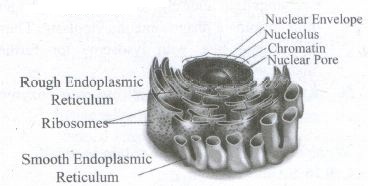
3.Tubules are irregular shaped, branched, smooth walled, enclosing a space.
(i) Endoplasmic reticulum is associated with nuclear membrane and cell surface membrane.
(ii) It forms a network in cytoplasm and gives mechanical support to the cell. Its chemical environment enables protein folding and undergo modification necessary for their function.
(iii) Misfolded proteins are pulled out and are degraded in endoplasmic reticulum. When ribosomes are present in the outer surface of the membrane it is called as Rough Endoplasmic Reticulum(RER), when the ribosomes are absent in the endoplasmic reticulum it is called as Smooth Endoplasmic Reticulum(SER).
(iv) Rough Endoplasmic reticulum is involved in protein synthesis and Smooth Endoplasmic reticulum are the sites of lipid synthesis.
(v) The smooth endoplasmic reticulum contains enzymes that detoxify lipid soluble drugs, certain chemicals and other harmful compounds.
18.
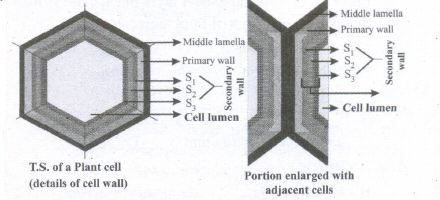
Cell wall is the outermost protective cover of cell. It was first observed by Robert Hooke. In plants it is made up of cellulose, hemicellulose, pectin, lignin, cutin. suberin and silica. In a plant cell wall shows J three distinct regions (a) Primary wall (b) Secondary wall (c) Middle lamellae
(a) Primary wall:
(i) It is the first layer inner to middle lamellae, primarily consisting of loose network of cellulose microfibrils in a gel matrix.
(ii) It is thin, elastic and extensible. In most plants the microfibrils are made up of cellulose oriented differently based on shape and thickness of the wall.
(iii) The matrix of the primary wall is composed of hemicellulose, pectin, glycoprotein and water.
(iv) Hemicellulose binds the microfibrils with matrix and glycoproteins control the orientation of microfibrils while pectin serves as filling material of the matrix.
(v) Cells such as parenchyma and meristems have only primary wall.
Plant Cell Wall
b. Secondary wall :
(i) Secondary wall is laid during maturation. It plays a key role in determining the shape of a cell. It is thick, inelastic and is made up of cellulose and lignin.
(ii) The secondary wall is divided into three sub layers termed as SI' S2 and S3 where the cellulose microfibrils are compactly arranged with different orientation forming a laminated structure and the cell wall strength is increased.
c. Middle lamellae:
(i) It is the outermost layer made up of calcium and magnesium pectate, deposited at the time of cytokinesis.
(ii) It is a thin amorphous layer which cements two adjacent cells. It is optically inactive (isotropic).
(iii) Plasmodesmata and Pits: Plasmodesmata act as a channel between the protoplasm of adjacent cells through which many substances pass through.
(iv) Moreover, at few regions the secondary wall layer is laid unevenly whereas the primary wall and middle lamellae are laid continuously such regions are called pits
(v) The pits of adjacent cells are opposite to each other. Each pit has a pit chamber and a pit membrane.
(vi) The pit membrane has many minute pores and thus they are permeable. The pits are of two types namely simple and bordered pit.
19.
Images of structures observed through microscopes can , be further magnified, projected and saved by attaching a camera to the microscope by a microscope coupler or eyepiece adaptor. Picture taken using aInbullt camera in a microscope is called microphotography or microphotograph.
20.
The microtubules bind all along the mitotic chromosome. Example: Caenorbabditis elegans (transparent nematode) and many insects.
21.
The type of centromere in which the kinetochore is assembled as a result of protein recognition of specific DNA sequences. Kinetochores assembled on point centromere bind a single, microtubule. It is also called as localized centromere. It occurs in budding yeasts.
22.
Chromomeres are bead like accumulations of chromatin material which are visible along interphase chromosomes. They can be seen in polytene chromosomes. At metaphase they are not visible.
23.
The cell inclusions are the non-living materials present in the cytoplasm. They are organic arid inorganic compounds.
24.
Two eukaryotic organelles believed to be the descendants of the endosymbiotic prokaryotes. The ancestors of the eukaryotic cell engulfed a bacterium and the bacteria continued to function inside the host cell.

11th Standard Syllabus & Materials
11th Standard
TN 11th Tamil பீடு பெற நில் - செய்யுள் - காவடிச்சிந்து Important Questions And Answers Study Material - QB365 Set A
NEW11th Standard
TN 11th Tamil பீடு பெற நில் - உரைநடை - மலை இடப்பெயர்கள் : ஓர் ஆய்வு Important Questions And Answers Study Material - QB365 Set A
NEW11th Standard
TN 11th Tamil மாமழை போற்றுதும் - துணைப்பாடம் - யானை டாக்டர் Important Questions And Answers Study Material - QB365 Set A
NEW11th Standard
TN 11th Tamil மாமழை போற்றுதும் - செய்யுள் - ஐங்குறுநூறு Important Questions And Answers Study Material - QB365 Set A



Tamilnadu Stateboard 11th Standard Subjects

Maths

Commerce

Economics
Biology

Business Maths and Statistics

Accountancy

Computer Science

Physics

Chemistry
Maths
Biology
Economics
Physics
Chemistry

History
Business Maths and Statistics

Computer Science
Accountancy

Computer Applications
History
Computer Technology
Commerce
Computer Applications
Computer Technology

Tamil

English

French
Tamilnadu Stateboard Standards

