
 100% FREE ACCESS
11th Standard Syllabus & Materials
11th Standard
TN 11th Tamil இயற்கை வேளாண்மை,சுற்றுச்சூழல் -செய்யுள் - மனோன்மணீயம் Important Questions And Answers Study Material - QB365 Set A
NEW11th Standard
TN 11th Tamil என்னுயிர் என்பேன் -துணைப்பாடம் - இசைத்தமிழர் இருவர் Important Questions And Answers Study Material - QB365 Set A
NEW11th Standard
TN 11th Tamil மொழி கலை -செய்யுள் - ஒவ்வொரு புல்லையும் Important Questions And Answers Study Material - QB365 Set A
NEW11th Standard
TN 11th Tamil பீடு பெற நில் - இலக்கணம் - பகுபத உறுப்புகள் Important Questions And Answers Study Material - QB365 Set A
NEW11th Standard
TN 11th Tamil பீடு பெற நில் - துணைப்பாடம் - வாடிவாசல் Important Questions And Answers Study Material - QB365 Set A
NEW11th Standard
TN 11th Tamil பீடு பெற நில் - செய்யுள் - குறுந்தொகை Important Questions And Answers Study Material - QB365 Set A

Published on: 27/04/2019
Creative three mark questions Quantum Mechanical Model of Atom - II
Download Tamil Nadu 11th Standard Chemistry question papers, model tests, one-mark questions, important questions, and public exam papers in PDF format. Free study materials and answer keys for TN State Board students.
Questions + Answers key
Take MCQ Chemistry Test
1.
Explain the meaning of the symbol 4f2. Write all the four quantum numbers for these electrons.
2.
How many unpaired electrons are present in the ground state of Fe3+ (z = 26), Mn2+(z = 25) and argon (z = 18)?
3.
Calculate the kinetic energy of a moving electron which has a wavelength 4.8 pm. (mass of electron = 9.11 x 10⁻³¹ kg, h = 6.63 x 10⁻³⁴ JS)
4.
A golf ball has a mass of 40g and a speed of 45 m/s. If the speed can be measured within accuracy of 2% calculate the uncertainty in position.
5.
Give a brief account of the shapes of atomic orbitals?
6.
The effect of uncertainty principle is significant only for motion of microscopic particles and is negligible for the macroscopic particles. Justify the statement with the help of a suitable example.
7.
Bring out the main points of difference between orbit and orbital.
8.
Can we apply Heisenberg's uncertainty principle to a stationary electron? Why?
9.
How does the Bohr theory of the hydrogen atom differ from that of Schrodinger?
10.
What are the significance of \(\Psi \) and \(\Psi ^{ 2 }\)
11.
State Heisenberg's uncertainty principle and give its mathematical expression
12.
Write the Schrodinger wave equation
13.
Which of the following are isoelectronic species? Na+, K+, Mg2+, Ca2+, S2-, Ar.
14.
Calculate the uncertainty in the position of a cricket ball of mass 150g if the uncertainty in velocity is 3.52 \(\times\) 10-24 ms-1
15.
If the velocity of the electron in Bohr's first orbit is \(2.19\times { 10 }^{ 6 }{ ms }^{ -1 }\) Calculate the de-Broglie wavelength with it.
16.
Two particles A and B are in motion. If the wavelength associated with the particle A is 5 \(\times\) 10-8 cm calculate the wavelength of particle B, if its momentum is half of A.
17.
What do you understand by dual character of matter?
18.
Orbits are also called as stationary states. Say whether the above statement is true or false. Justify your answer
19.
Explain why are Bohr's orbitals are called energy levels?
20.
What is Stark effect?
21.
What is Zeeman effect?
22.
Symbols \(_{ 35 }^{ 79 }{ Br }\) and 79Br can be written, where as symbols \(_{ 79 }^{ 35 }{ Br }\)r and 35Br are not acceptable. Answer briefly
23.
In a chemical reaction, chlorine atom undergoes reduction and aluminium atom undergoes oxidation. Will this redox reaction affect their initial number of protons, neutrons and electrons?
24.
In Rutherford's experiment, generally thin foil of heavy atoms, like gold, platinum etc. have been used to bombard the a-particles. If the thin foil of light atoms like aluminum is used, what difference would be observed from the above results?
25.
Calculate the number of electrons, protons and neutrons in
(i) Phosphorous atom
(ii) Phosphate ion.
26.
If the K.E of electron is 2.5 \(\times\)10-24 J, then calculate its de-Broglie wavelength.
27.
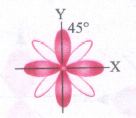
(i) What is common between dxy and dx2-y2 orbitals?
(ii) What is the difference between them?
(iii) What is the angle between the lobes of the above two orbitals?
28.
Write a note on the shape of f orbitals
29.
Discuss the shapes of d orbitals.
30.
Explain the shapes of p orbitals
31.
How many orbitals are possible in the 4th energy level? (n = 4)
1.
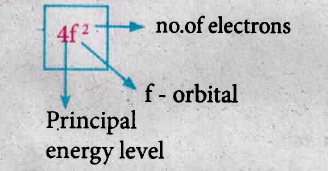
n = 4; f orbital l = 3 \(\Rightarrow\) m1= - 3, -2,-1, 0, +1, +2, +3
out of two electrons, one electron occupies 4f orbital with m1 = -3 and another electron occupies 4f orbital with m1 = -2.
All the four quantum numbers for the two electrons are
| Electron | n | l | m1 | m |
| 1e- | 4 | 3 | -3 | +1/2 |
| 2e- | 4 | 3 | -2 | +1/2 |
2.
Electronic configuration of Fe3+ 1s22s22p63s23p63d64s2
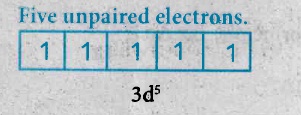
Electronic configuration of mn2+ is 1s2 2s2 2p6 3s2 3p6 4s2 3d5
Five unpaired electrons
Electronic configuration of Ar is 1s2 2s2 2p6 3s2 3p6
no unpaired electrons.
3.
\(\lambda =\frac{h}{\sqrt{2KEm}}\ \lambda=\frac{h}{mv}or \frac{h}{p}\)
E = Kinetic energy
m = mass of particle
\(\lambda\) = 4.8 pm = 4.8 x 10⁻¹² m
h = 6.63 x 10⁻³⁴ J.S.
m = 9.11 x 10⁻³¹ kg
4.8 x 10-12 = \(\frac{6.63\times 10^{-34}}{\sqrt{12\times E\times 9.11\times 10^{-31}}}\)
E = 1.047 x 10⁻¹⁴ J.
4.
Uncertainty in speed = 2% of 40 ms-1
i.e., \(\Delta v=\frac{2}{100}\times 45\) = 0.9 ms-1
Applying uncertainty principle,
\(\Delta x(m\times \Delta v)=\frac{h}{4\pi}\)
\(\Delta x=\frac{h}{4\pi.m.\Delta v}\)
= \(\frac{6.626\times 10^{-34}kgm^2 s^{-1}}{4\times 3.14\times (40\times 10^{-3}kg)(0.9ms^{-1})}\)
= 1.46 x 10⁻³³ m.
5.
The shape of an atomic orbital is found by finding the probability (\({ \Psi }^{ 2 }\) ) of the electron at different points around the nucleus and representing the density of the nucleus. Same orbitals are found to have a region of space where the probability of finding electron is zero. This is called a node.
(i) All 's' orbitals are spherical in shape.
(ii) All 'p' orbitals are dumb-bell in shape.
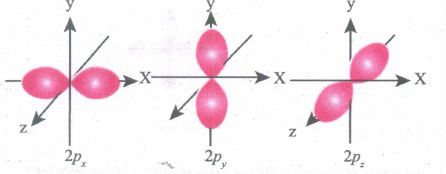
The three 'p' orbitals differ in orientation. They lie along the axes and called Px, Py and Pz orbitals.
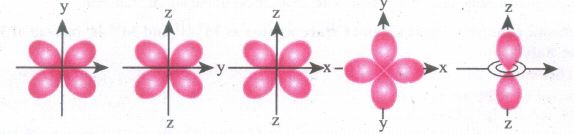
(iii) All 'd' orbitals have clover- leaf shaped with four lobes. Three have lobes between axes and are called dxy, dyz, dxz orbitals.
The fourth lobe is along the axes and is called \({ d }_{ { x }^{ 2 }-{ y }^{ 2 } }\) the fifth has two lobes along 'z' axis and dough-nut shape in the centre and is called \({ d }_{ { z }^{ 2 } }\)
6.
If uncertainty principle is applied to an object of mass say about a milligram (10-6 kg), then
Δv.Δx = \(\frac { h }{ 4\pi m } \)
Δv.Δx = \(\frac { 6.626\times { 10 }^{ -34 }kg\quad { m }^{ 2 }{ s }^{ -1 } }{ 4\times 3.14\times 10^{ -6 }kg } \)
= 0.52 \(\times\) 10-28 m2s-1
The value of Δv.Δx obtained is extremely small and is insignificant. Therefore, for milligram sized or heavier objects, the associated uncertainties are hardly of any real consequence.
7.
| ORBIT | ORBITALS | |
| 1. | It is a well defined circular path around the nucleus in which the electrons revolve/td> | Its the three dimensional space around the nucleus within which the probability of finding an electron is maximum |
| 2. | The concept of an orbit does not consider the wave character of electrons and uncertainty principle. |
The concept of an orbital is in accordance with the wave character of electrons and uncertainty principle. |
| 3. | They do not have any directional characteristics. | Except s-orbitals, all orbitals have directional characteristics. |
| 4. | The maximum number of electrons that an orbit can have is given by 2n2 where n is the number of the orbit |
The maximum number of electrons that can be occupied by an orbital is always two |
8.
No, for a stationary electron, velocity = 0 and thus, position can be measured accurately.
9.
Bohr's theory does not consider the de-Broglie concept of dual nature of electron and also contradicts with the Heisenberg's uncertainty principle, while the Schrodinger equation is based on quantum mechanics which deals with the microscopic objects having both the particle as well as wave like character.
10.
In an atom the wave function \(\Psi \) for an electron has no physical significance as such. However, its square i.e.\(\Psi ^{ 2 }\) at any point gives the intensity of the electron wave at that point.
In view of Heisenberg's uncertainty principle, it shows the probability of finding the electron at that point and therefore, termed as probability density
11.
It is impossible to accurately determine both the position as well as the momentum of a microscopic particle simultaneously.
\(\Delta x.\Delta p\ge h/4\pi \)
where, Δx and Δp are uncertainties in determining the position and momentum, respectively
12.
Schrodinger Wave Equation:
\(\frac { \partial ^{ 2 }\Psi }{ \partial x^{ 2 } } +\frac { \partial ^{ 2 }\Psi }{ \partial y^{ 2 } } +\frac { \partial ^{ 2 }\Psi }{ \partial z^{ 2 } } +\frac { 8\pi ^{ 2 }m }{ { h }^{ 2 } } (E-V)\Psi =0\)
\(\Psi \) = amplitude of wave; E = total energy of electron
V = potential energy; m = mass of electron
13.
Isoelectronic - Species having same number of electrons
11Na+ = 11 - 1 = 10e-; 19K+ = 19 - 1 = 18e-
12Mg2+= 12 - 2 = 10e-; .20Ca2+ = 20 - 2 = 18e-
16S2- 16 + 2 = 18e-; I8Ar = 18e-
Hence the isoelectronic species are
(i) Na+ and Mg2+
(ii) K+, Ca2+, S2- and Ar
14.
Mass of the ball = 150 g = 0.150 kg
Uncertainty in velocity (Δv) = 3.52 10-24 ms-1
Δx.mΔv ≥ \(\frac { h }{ 4\pi } \)
Δx = \(\frac { 6.626\times { 10 }^{ -34 }{ kg }\quad m^{ 2 }{ s }^{ -1 } }{ 4\times 3.142\times (0.150\quad kg)\times (3.52\times { 10 }^{ -24 }{ ms }^{ -1 }) } \)
Δx = 10-10 m
Δx = 1Å (1Å = 10-10 m)
15.
We know, mass of electron = 9.1\(\times\) 10-31 kg;
h = 6.626 \(\times\) 10-34 Js
∴ λ = \(\frac { 6.626\times { 10 }^{ -34 } }{ 9.1\times { 10 }^{ -31 }\times 2.19\times { 10 }^{ 6 } } \)
= 3.32\(\times\)10-10 m
16.
According to de-Broglie relation
λA = \(\frac { h }{ { P }_{ A } } \) ;λA = \(\frac { h }{ { P }_{ B } } \)
λA = 5 10-8 m ; λB = ?
PB = 2\(\times\) PA
λA PA = λB PB
λA PA = λB (2\(\times\) PA)
λB = \(\frac { { \lambda }_{ A }{ P }_{ A } }{ 2{ P }_{ A } } =5\times { 10 }^{ -8 }\times \frac { { P }_{ A } }{ 2{ P }_{ A } } \)
Wavelength of B = 2.\(\times\)5 10-8 m
17.
Any form of matter that exhibits both particle as well as wave characteristics is said to show dual character.
18.
The statement is true. According to Bohr, as long as an electron remains in a particular orbit, it does not lose or gain energy. This means that energy of an electron in a particular path remains constant. Therefore, these orbits are also called stationary states.
19.
According to Bohr, electrons revolve round the nucleus only in certain selected circular paths called orbits.. These orbits are associated with definite energies and so are called energy shells or energy levels or quantum levels.
20.
If a substance which gives a line emission spectrum is placed in an external electric field, its lines get split into a number of closely spaced lines. This phenomenon is known as Stark effect.
21.
If a substance which gives a line emission spectrum, is placed in a magnetic field, the lines of the spectrum get split up into a number of closely spaced lines. This phenomenon is known as Zeeman effect.
22.
The composition of any atom can be represented by using the normal element symbol X with superscript on the left side as the mass number A and subscript Z on the left side as atomic number (ie) \(_{ Z}^{ A }{ X }\)
Hence, the symbols \(_{ 79 }^{ 35 }{ Br }\) and 35Br are not acceptable.
23.
Chlorine atom on accepting an electron becomes CI- and aluminium atom after donating an electron becomes AI3+.
These changes will affect their number of protons, neutrons and electrons.
CI- :
No. of electrons 17 + 1 = 18
No. of protons = 17
No. of neutrons = 35 - 17 = 18
AI3+.
No. of electrons 13 - 3 = 10
No. of protons 13
No. of neutrons 27 -13 = 14.
24.
1. Heavy atoms like gold, platinum have heavy nucleus. Heavy nucleus contains large amount of positive charge.
2. When a beam of \(\alpha\)-particles is shot at a thin gold foil, most of them pass through without much effect.
3. Some are deflected back due to enormous repulsive force of heavy nucleus.
4. If thin foil is made of light aluminium, then the number of \(\alpha\) -particles deflected back will be negligible.
25.
(1) Phosphorous atom:
Atomic number (Z) No. of protons = 15
= No. of electrons = 15
Number of neutrons = Mass number - Atomic Number
= 31 - 15
= 16
(ii) Phosphate ion:( \({ PO }_{ 4 }^{ 3- }\))
Number of electron = 15+ 4 x 8 + 3 = 50
Number of protons = 15+ 4 x 8 = 47
Number of neutrons = 10+ 4 x 8 = 48.
26.
K.E = 2.5 \(\times\)10-24 J
Kinetic energy = \(\frac { 1 }{ 2 } \)mv2 = 2.5 \(\times\)10-24
m = 9.1\(\times\) 10-31 kg
v = \(\left( \frac { 2K.E }{ m } \right) ^{ \frac { 1 }{ 2 } }=\left[ \frac { 2\times 2.5\times { 10 }^{ -24 } }{ 9.1\times { 10 }^{ -31 } } \right] ^{ \frac { 1 }{ 2 } }\)
= 2.34 \(\times\)103 ms-1
\(\boxed{v = 2.34 103\ {ms}^{-1}}\)
Wavelength , \(\lambda =\frac { h }{ mv } \)
= \(\frac { 6.626\times { 10 }^{ -34 } }{ 9.1\times { 10 }^{ -31 }\times 2.34\times { 10 }^{ 3 } } =311.1\times { 10 }^{ -9 }m\)
\(\boxed{\lambda =311.1\times 10^{ -9 }m(or)311.1\ nm}\)
27.
(i) Both have identical shape, consisting of four lobes
(ii) Lobes of dx2-y2 lie along the x and y-axes where those of dxy lie between x and y-axes.
(iii) 45o
28.
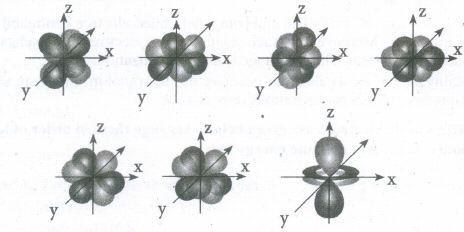
f-orbitals :
For 'f' orbital, l = 3 and the m values are -3, -2, -1, 0, + 1, +2, +3 corresponding to seven f orbitals \({ f }_{ { z }^{ 3 }, }{ f }_{ { xz }^{ 2 }, }{ f }_{ { yz }^{ 3 }, }{ f }_{ { xz }y },{ f }_{ { z({ x }^{ 2 }-y^{ 2 }) } },{ f }_{ { x({ x }^{ 2 }-3y^{ 2 }) } },{ f }_{ { y({ 3x }^{ 2 }-y^{ 2 }) } }\)
There are 3 nodal planes in the f-orbitals.
29.
d-orbitals :
(a) For 'd' orbital I= 2 and the corresponding m values are -2, -1,0 +1,+2.
(b) The shape of the d orbital looks like a clover leaf.
(c) The five m values give rise to five d orbitals namely dxy,dyz,dzx,dx2 -y2 and dz2.
(d) The 3d orbitals contain two nodal planes.
30.
p-orbitals :
(a) For p orbitals l = 1 and the corresponding m values are -1,0 and + 1. The angular distribution functions are quite complex
(b) The three different m values indicates that there are three different orientations possible for p orbitals. These orbitals are designated as px,py and pz and the angular distribution for these orbitals shows that the lobes are along the x, y and z axis respectively.
(c) The 2p orbitals have one nodal plane
31.
n = 4 l = 0,1,2,3
4 sub shells s, p, d & f.
I = 0 m1 = 0 + one 4s orbital.
I = 1 m1 = -1, 0, + 1 \(\Rightarrow\) three 4p orbitals.
I = 2 m1 = -2,:1, 0, +1, +2 \(\Rightarrow\) five 4d orbitals.
I = 3 m1 = -3, -2, -1,0, +1, +2, +3 \(\Rightarrow\) seven 4f orbitals.
Over all 16 orbitals are possible.

11th Standard Syllabus & Materials
11th Standard
TN 11th Tamil பீடு பெற நில் - செய்யுள் - காவடிச்சிந்து Important Questions And Answers Study Material - QB365 Set A
NEW11th Standard
TN 11th Tamil பீடு பெற நில் - உரைநடை - மலை இடப்பெயர்கள் : ஓர் ஆய்வு Important Questions And Answers Study Material - QB365 Set A
NEW11th Standard
TN 11th Tamil மாமழை போற்றுதும் - துணைப்பாடம் - யானை டாக்டர் Important Questions And Answers Study Material - QB365 Set A
NEW11th Standard
TN 11th Tamil மாமழை போற்றுதும் - செய்யுள் - ஐங்குறுநூறு Important Questions And Answers Study Material - QB365 Set A



Tamilnadu Stateboard 11th Standard Subjects

Maths

Commerce

Economics

Biology

Business Maths and Statistics

Accountancy

Computer Science

Physics
Chemistry
Maths
Biology
Economics
Physics
Chemistry

History
Business Maths and Statistics

Computer Science
Accountancy

Computer Applications
History
Computer Technology
Commerce
Computer Applications
Computer Technology

Tamil

English

French
Tamilnadu Stateboard Standards
