
 100% FREE ACCESS
11th Standard Syllabus & Materials
11th Standard
TN 11th Tamil இயற்கை வேளாண்மை,சுற்றுச்சூழல் -செய்யுள் - மனோன்மணீயம் Important Questions And Answers Study Material - QB365 Set A
NEW11th Standard
TN 11th Tamil என்னுயிர் என்பேன் -துணைப்பாடம் - இசைத்தமிழர் இருவர் Important Questions And Answers Study Material - QB365 Set A
NEW11th Standard
TN 11th Tamil மொழி கலை -செய்யுள் - ஒவ்வொரு புல்லையும் Important Questions And Answers Study Material - QB365 Set A
NEW11th Standard
TN 11th Tamil பீடு பெற நில் - இலக்கணம் - பகுபத உறுப்புகள் Important Questions And Answers Study Material - QB365 Set A
NEW11th Standard
TN 11th Tamil பீடு பெற நில் - துணைப்பாடம் - வாடிவாசல் Important Questions And Answers Study Material - QB365 Set A
NEW11th Standard
TN 11th Tamil பீடு பெற நில் - செய்யுள் - குறுந்தொகை Important Questions And Answers Study Material - QB365 Set A

Published on: 27/04/2019
Quantum Mechanical Model of Atom Public two mark questions - II
Download Tamil Nadu 11th Standard Chemistry question papers, model tests, one-mark questions, important questions, and public exam papers in PDF format. Free study materials and answer keys for TN State Board students.
Questions + Answers key
Take MCQ Chemistry Test
1.
State Hund's rule of maximum multiplicity
2.
The energies of the same orbital decreases with an increase in the atomic number. Justify this statement.
3.
Mention the shape of s, p, d orbitals.
4.
What are degenerate orbitals?
5.
Write the equation to calculate the energy of nth orbit.
6.
Calculate the total number of angular nodes and radial nodes present in 4p and 4d orbitals.
7.
What is meant by nodal surface?
8.
What are \(\psi\) and \(\psi^2\)?
9.
How many orbitals are possible in the 3rd energy level?
10.
How many electrons that can be accommodated in the subshell s, p, d, f?
11.
How many electrons can be accommodated in the main shell I,m and n?
12.
Explain about the significance of de Broglie equation.
13.
Explain how matter has dual character?
14.
Explain about theory of electromagnetic radiation.
15.
Explain Thomson's atom model.
16.
What is the actual configuration of copper (Z = 29)? Explain about its stability.
17.
Which is the actual configuration of Cr ( Z = 24). Why?
18.
What is meant by electronic configuration? Write the electronic configuration of N (Z = 7).
19.
How many unpaired electrons are present in the ground state of
(i) Cr3+ (Z = 24)
(ii) Ne (Z = 10)
1.
It states that electron pairing in the degenerate orbitals does not take place until all the available orbitals contain one electron each.
2.
The energy of the 2s orbital of hydrogen atom is greater than that of 2s orbital of lithium and that of lithium is greater than that of sodium and so on because H (Z = 1), Li (Z = 3) and Na (Z = 11). When atomic number increases, the energies of the same orbital decreases.
E2s(H) > E2s(Li) > E2s(Na) > E2s(K) ..............
3.
Shape of s-orbital - sphere
Shape of p-orbital- dumb bell
Shape of d-orbital- clover leaf
4.
As we know there are three different orientations in space that are possible for a p orbital. All the three p orbitals, namely, px, py and pz have same energies and are called degenerate orbitals. However, in the presence of magnetic or electric field the degeneracy is lost.
5.
\(E_n={(-1312.8)Z^2\over n^2}KJ\ mol^{-1}\)
Where Z = atomic number, n = principal quantum number.
6.
For 4p orbital: Number of angular nodes = l
For 4p orbital l = 1
\(\therefore\) Number of angular nodes = 1
Number of radial nodes = n - l - 1
= 4-1-1
= 2
\(\therefore\)Total number of nodes = n -1 = 4 - 1 = 3
1 angular node and 2 radial nodes.
For 4d orbital: Number of angular nodes = 1
For 4d orbital 1= 2
\(\therefore\) Number of angular nodes = 2,
Number of radial nodes = n - l- 1
=4-2-1
= 1
\(\therefore\) Total number of nodes = n - 1 = 4 - 1 = 3
1 radial nodes and 2 angular node.
7.
(i) The region where there is probability density function reduces to zero is called nodal surface or a radial node.
(ii) For ns orbital, (n -1) nodes are found in it.
8.
(i) \(\psi\) itself has no physical meaning but it represents an atomic orbital.
(ii) \(\psi^2\) is related to the probability of finding the electrons within a given volume of space.
9.
n = 3, main shell is m.
Total number of orbitals in 3rd energy level =?
| When n = 3 | l = 0 | 1 | 2 |
| Subshell | s | p | d |
| 3s |
3px, 3py, 3pz |
3dxz, 3dxy, 3dyz, 3dx2-y2,dz2 |
|
| 1 | 3 | 5 |
Total number of orbitals = 9.
10.
| Sub shell | s | p | d | f |
| Azimuthal quantum number | 0 | 1 | 2 | 3 |
| Total number of electrons in the sub shell 2(2l +1) | 2(2 x 0 + 1)=2 | 2(2 x 1 + 1)=6 | 2(2 x 2 + 1)=10 | 2(2 x 3 + 1)=14 |
11.
| Main shell | l | m | n |
| Principal quantum number | 2 | 3 | 4 |
| Number of electrons in the main shell 2n2 | 2(2)2 = 8 | 2(3)2 = 18 | 2(4)2 = 32 |
12.
(i) \(\lambda =\frac{h}{mv}\). This equation implies that a moving particle can be considered as a wave and a wave can exhibit the properties of a particle.
(ii) For a particle with high linear momentum (mv) the wavelength will be so small and cannot be observed.
(iii) For a microscopic particle such as an electron, the mass is of the order of 10-31 kg, hence the wavelength is much larger than the size of atom and it becomes significant.
(iv) For the electron, the de Broglie wavelength is significant and measurable while for the iron ball it is too small to measure, hence it becomes insignificant.
13.
(i) Albert Einstein proposed that light has dual nature. i.e. like photons behave both like a particle and as a wave.
(ii) Louis de Broglie extended this concept and proposed that all forms of matter showed dual character.
(iii) He combined the following two equations of energy of which one represents wave character (hv) and the other represents the particle nature (mc2).
14.
(i) The theory of electromagnetic radiation states that a moving charged particle should continuously loose its energy in the form of radiation.
(ii) Therefore, the moving electron in an atom should continuously loose its energy and finally collide with nucleus resulting in the collapse of the atom.
15.
J. J. Thomson's cathode ray experiment revealed that atoms consist of negatively charged particles called electrons. He proposed that atom is a positively,charged sphere in which the electrons are embedded like the seeds in the watermelon.
16.
Copper (Z = 29)
Expected configuration: 1S22s2 2p6 3s2 3p6 3d9 4s2
Actual configuration: 1s2 2s2 2p6 3s2 3p6 3d10 4s1
The reason is that fully filled orbitals have been found to have extra stability.
Copper has the electronic configuration [Ar] 3d 10 4s 1 and not [Ar] 3d9 4s2 due the symmetrical distribution and exchange energies of d electrons.
Symmetry leads to stability. The full filled configuration have symmetrical distribution of electrons and hence they are more stable than unsymmetrical configuration.
17.
Cr (Z = 24) 1s2 2s2 2p6 3s2 3p6 3d5 4s1.
The reason for this is, Cr with 3d5 configuration is half filled and it will be more stable.
Chromium has [Ar] 3d5 4s1 and not [Ar] 3d4 4s2 due to the symmetrical distribution and exchange energies of d electrons.
18.
The distribution of electrons into various orbitals of an atom is called its electronic configuration.
N (Z = 7)
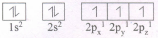
19.
(i) Cr (Z = 24) Is2 2s2 2p6 3s2 3p6 3d5 4s1
Cr3+ - Is2 2s2 2p6 3s2 3p6 3d4.
It contains 4 unpaired electrons.
(ii) Ne (Z = 10) 1s22s2 2p6. No unpaired electrons in it.

11th Standard Syllabus & Materials
11th Standard
TN 11th Tamil பீடு பெற நில் - செய்யுள் - காவடிச்சிந்து Important Questions And Answers Study Material - QB365 Set A
NEW11th Standard
TN 11th Tamil பீடு பெற நில் - உரைநடை - மலை இடப்பெயர்கள் : ஓர் ஆய்வு Important Questions And Answers Study Material - QB365 Set A
NEW11th Standard
TN 11th Tamil மாமழை போற்றுதும் - துணைப்பாடம் - யானை டாக்டர் Important Questions And Answers Study Material - QB365 Set A
NEW11th Standard
TN 11th Tamil மாமழை போற்றுதும் - செய்யுள் - ஐங்குறுநூறு Important Questions And Answers Study Material - QB365 Set A



Tamilnadu Stateboard 11th Standard Subjects

Maths

Commerce

Economics

Biology

Business Maths and Statistics

Accountancy

Computer Science

Physics
Chemistry
Maths
Biology
Economics
Physics
Chemistry

History
Business Maths and Statistics

Computer Science
Accountancy

Computer Applications
History
Computer Technology
Commerce
Computer Applications
Computer Technology

Tamil

English

French
Tamilnadu Stateboard Standards
