
 100% FREE ACCESS
11th Standard Syllabus & Materials
11th Standard
TN 11th Tamil இயற்கை வேளாண்மை,சுற்றுச்சூழல் -செய்யுள் - மனோன்மணீயம் Important Questions And Answers Study Material - QB365 Set A
NEW11th Standard
TN 11th Tamil என்னுயிர் என்பேன் -துணைப்பாடம் - இசைத்தமிழர் இருவர் Important Questions And Answers Study Material - QB365 Set A
NEW11th Standard
TN 11th Tamil மொழி கலை -செய்யுள் - ஒவ்வொரு புல்லையும் Important Questions And Answers Study Material - QB365 Set A
NEW11th Standard
TN 11th Tamil பீடு பெற நில் - இலக்கணம் - பகுபத உறுப்புகள் Important Questions And Answers Study Material - QB365 Set A
NEW11th Standard
TN 11th Tamil பீடு பெற நில் - துணைப்பாடம் - வாடிவாசல் Important Questions And Answers Study Material - QB365 Set A
NEW11th Standard
TN 11th Tamil பீடு பெற நில் - செய்யுள் - குறுந்தொகை Important Questions And Answers Study Material - QB365 Set A

Published on: 29/04/2019
Quantum Mechanical Model of Atom important five mark questions
Download Tamil Nadu 11th Standard Chemistry question papers, model tests, one-mark questions, important questions, and public exam papers in PDF format. Free study materials and answer keys for TN State Board students.
Questions + Answers key
Take MCQ Chemistry Test
1.
What are the main features of quantum mechanical model of an atom.
2.
Derive de-Broglie wave length.
3.
Describe about Bohr atom model.
4.
What is exchange energy? How it is related with stability of atoms? Explain with suitable examples.
5.
Explain the angular distribution function of 1s, 2s, 3s, 2p, 3d and 4f orbits.
6.
Explain about
(i) Magnetic quantum number
(ii) Spin quantum number
7.
Light of wavelength 12818 \(\overset { o }{ A } \) is emitted when the electron of a hydrogen atom drops from 5th to 3rd orbit. Find the wavelength of a photon emitted when the electron falls from 3rd to 2nd orbit.
8.
If an electron is moving with a velocity 600 ms-1 which is accurate upto 0.005%, then calculate the uncertainty in its position. (h = 6.63 x 10⁻³⁴ Js. mass of electron = 9.1 x 10⁻³¹ kg)
9.
Calculate the total number of angular nodes and radial nodes present in 3d and 4f orbitals.
10.
Calculate the de-Broglie wavelength of an electron that has been accelerated from rest through a potential difference of 1 keV.
11.
Calculate the uncertainty in the position of an electron, if the uncertainty in its velocity is 5.7 x 10⁵ ms-1.
1.
1. The energy of electrons in an atoms is quantised.
2. The existence of quantized electronic energy levels is a direct result of the wave like properties of electrons. The solutions of Schrodinger wave equation gives the allowed energy levels (orbits).
3. According to Heisenberg's uncertainty principle, the exact position and momentum of an electron cannot be determined with absolute accuracy. As a consequence, quantum mechanics introduced the concept of orbital. Orbital is a three dimensional space in which the probability of finding the electron is maximum.
4. The solution of Schrodinger wave equation for the allowed energies of an atom gives the wave function \(\psi\), which represents an atomic orbital. The wave nature of electron present in an orbital can be well defined by the wave function \(\psi\).
5. The wave function \(\psi\) itself has no physical meaning. However, the probability of finding the electron in a small volume dx, dy, dz around a point (x,y,z) is proportional to |\(\psi\)(x,y,z)|2 dxdydz |\(\psi\)(x,y,z)|2 is known as probability density and is always positive.
2.
Louis de Broglie proposed that all forms of matter showed dual character. To quantify this relation, he Jerived an equation for the wavelength of a matter wave. He combined the following two equations of energy of which one represents wave character (hu) and the other represents the particle nature (mc2).
Planck's quantum hypothesis:
E = hv ....(1)
Einsteins mass-energy relationship:
E = mc2 .... (2)
From (1) and (2)
hv = mc2
hc/\(\lambda\) = mc2
\(\therefore \lambda ={h\over mc}\) ...(3)
The equation (3) represents the wavelength of photons whose momentum is given by mc. (Photons have zero rest mass).
For a particle of matter with mass m and moving with a velocity v, the equation (3) can be written as
\(\lambda ={h\over mv}\) ....(4)
This is valid only when the particle travels at speed much less than the speed of Light.
3.
Assumptions of Bohr atom model.
1. The energies of electrons are quantised
2. The electron is revolving around the nucleus in a certain fixed circular path called stationary orbit.
3. Electron can revolve only in those orbits in which the angular momentum (mvr) of the electron must be equal to an integral multiple of h/\(2\pi\).
\(mvr={nh\over 2\pi}\)
where n = 1,2,3, ...etc.,
4. As long as an electron revolves in a fixed stationary orbit, it doesn't lose its energy. But if an electron jumps from higher energy state (E2) to a lower energy state (E1), the excess energy is emitted as radiation. The frequency of the emitted radiation is E2 - EI = hv.
\(\therefore v={E_2-E_1\over h}\)
Conversely, when suitable energy is supplied to an electron, it will jump from lower energy orbit to a higher energy orbit.
5. Bohr's postulates are applied to a hydrogen like atom (H, He+ and Li2+ etc ..) the radius of the nth orbit and the energy of the electron revolving in the nth orbit were derived.
\(r_n={(0.529)n^2\over Z}A\)
\(E_n={(-13.6)Z^2\over n^2}eV \ atom^{-1}\)(or)
\(E_n={(-1312.8)Z^2\over n^2}kJ \ mol^{-1}\)
4.
1. If two or more electrons with the same spin are present in degenerate orbitals, there is a possibility for exchanging their positions. During exchange process, the energy is released and the released energy is called exchange energy.
2. If more number of exchanges are possible, more exchange energy is released. More number of exchanges are possible only in the case of half filled and fully filled configurations.
3. For example, in chromium, the electronic configuration is [Ar]3d5 4s1. The 3d orbital is half filled and there are ten possible exchanges.
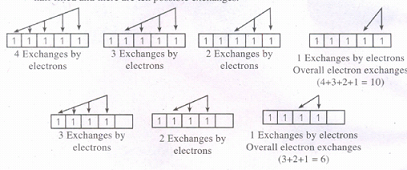
4. On the other hand only six exchanges are possible for [Ar]3d4 4s2 configuration.
5. Hence, exchange energy for the half filled configuration is more. This increases the stability of half filled 3d orbitals.
5.
The variation of the probability of locating the electron on a sphere with nucleus at its centre depends on the azimuthal quantum number of the orbital in which the electron is present.
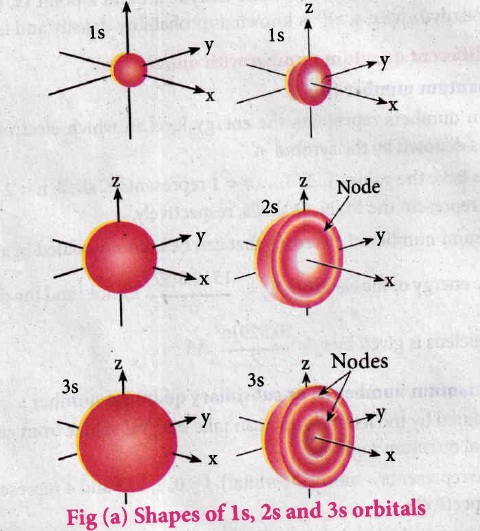
For 1s orbital, l = 0, m = 0,\(f(\theta)=\frac{1}{\sqrt 2}\)and \(g(\varphi)=\frac{1}{\sqrt 2\pi}\) Therefore, the angular distribution function is equal to \(\frac{1}{2\sqrt \pi }\)
i.e. it is independent of the angle \(\theta\) and \(\varphi\). Hence, the probability of finding the electron is independent of the direction from the nucleus. So, the shape of the s orbital is spherical.
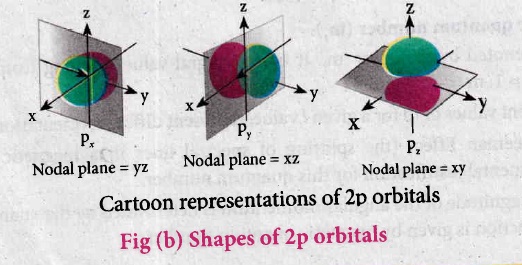
For p orbitals, l = 1 and the corresponding m values are -1, 0 and +1. The angular distribution functions are quite complex and are not discussed here, The shape of the p orbital is shown in Figure (b). The three different m values indicates that there are three different orientations possible for p orbitals. These orbitals are designated as Px, Py and Pz and the angular distribution for these orbitals shows that the lobes are along the x, y arid z axis respectively. As seen in the Figure the 2p orbitals have one nodal plane
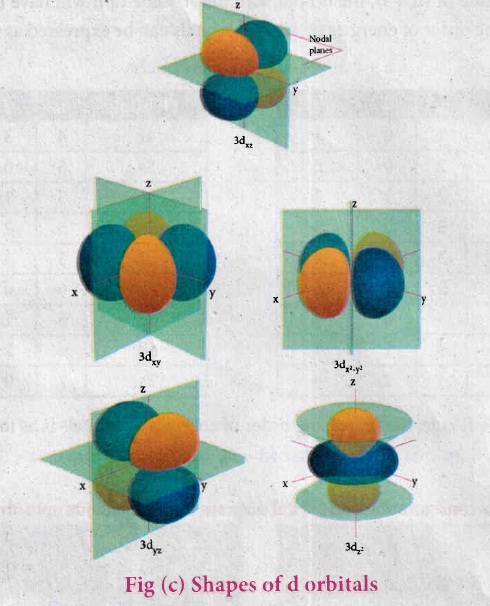
For 'd' orbital l = 2 and the corresponding m values are -2, -1, 0, +1, +2. The shape of the d orbital looks like a 'clover leaf'.
The five m values give rise to five d orbitals namely dxy, dyz, dzx, dx2-y2 and dz2. The 3d orbitals contain two nodal planes.
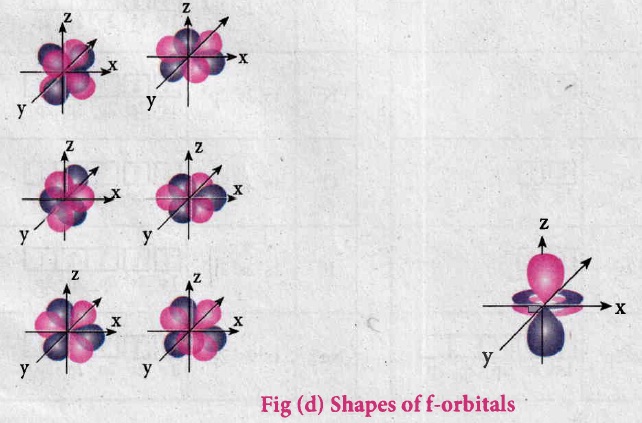
For 'f' orbital, l = 3 and the m values are -3, -2,-1,0, +1, +2, +3 corresponding to seven f orbitals. fz3, fxz2,fyz2,fxyz,fz(x2 - y2),fx(x2 - 3y2),fy(3x2 - y2) which are shown in Figure. There are 3 nodal planes in the f-orbitals.
6.
(i) Magnetic quantum number
1. It is denoted by the letter 'ml'. It takes integral values ranging from -I to +1 through 0. i.e. if l = 1; m = -1, 0 and +1.
2. The Zeeman Effect (the splitting of spectral lines in a magnetic field) provides the experimental justification for this quantum number.
3. The magnitude of the angular momentum is determined by the quantum number l while its direction is given by magnetic quantum number.
(ii) Spin quantum number
1. The spin quantum number represents the spin of the electron and is denoted by the letter 'ms'.
2. The electron in an atom revolves not only around the nucleus but also spins. It is usual to write this as electron spins about its own axis either in a clockwise direction or in anti-clockwise direction.
3. Corresponding to the clockwise and anti-clockwise spinning of the electron, maximum two values are possible for this quantum number.
4. The values of 'ms' is equal to \(-\frac{1}{2}\) and \(+\frac{1}{2}.\)
7.
\(\frac{1}{\lambda}=R[\frac{1}{n_1^2}-\frac{1}{n_2^2}]\)
n1 = 3, n2 = 5
\(\frac{1}{12818}=R[\frac{1}{9}-\frac{1}{25}]=\frac{16R}{9\times 25}\)
or 12418 = \(\frac{9\times 25}{16\times R}\)...(1)
When n1 = 2,
\(\frac{1}{\lambda}=R[\frac{1}{4}-\frac{1}{9}]=\frac{5}{36}R\)
\(\lambda=\frac{36}{5R}\)......(2)
Dividing equation (2) by equation (1)
\(\frac{\lambda}{12818}=\frac{36}{5R}\times \frac{16R}{9\times 25}=\frac{64}{125}\)
\(\lambda=\frac{64}{125}\) x 12818 = 6562.8 \(\overset { o }{ A } \)
8.
Velocity of the electron = 600 ms-1
Uncertainty in velocity = \(\frac{0.005}{100}\times 600 ms^{-1}\)
= 0.03 ms-1
= 3 x 10⁻² ms-1
Now, ( \(\Delta\)x) (m \(\Delta\) v) = \(\frac{h}{4\pi}\)
\(\therefore \Delta x=\frac{h}{4\pi.m.\Delta v}\)
= \(\frac{6.626\times 10^{-34}kgm^2 s^{-1}}{4\times 3.14\times 9.1\times10^{-31}kg\times 3\times 10^{-2}ms^{-1}}\)
= 1.93 x 10⁻³ m.
9.
| Orbital | n | l | Radial node n - l -1 | Angular node l | Total node n - 1 |
| 3d | 3 | 2 | 0 | 2 | 2 |
| 4f | 4 | 3 | 0 | 3 | 3 |
10.
accelerated potential = 1 keV
The kinetic energy of the electron = The energy due to accelerating potential.
\(\frac{1}{2} m v^{2}=e V\)
mv2 = 2eV
\(
m^{2} v^{2}=2 m e V \Rightarrow(m v)^{2}=2 m e V
\)
\(\Rightarrow \mathrm{mv}=\sqrt{2 \mathrm{meV}}\)
de-Broglie wavelength \(
\lambda=\frac{\mathrm{h}}{\mathrm{mv}}
\)
\(\lambda=\frac{\mathrm{h}}{\sqrt{2 \mathrm{meV}}}\)
m = Mass of the electron = 9.1 x 10⁻³¹ kg
h - Planck'sconstant = 6.626 x 10⁻³¹Js
1 eV = 1.6 x 10⁻¹⁹J
\(
\lambda=\frac{6.626 \times 10^{-34} \mathrm{Js}}{\sqrt{2 \times 9.1 \times 10^{-31} \mathrm{~kg} \times 1 \mathrm{keV}}}
\)
\(\lambda=\frac{6.626 \times 10^{-34} \mathrm{JS}}{\sqrt{2 \times 9.1 \times 10^{-31} \times 1 \times 10^{3} \times 1.6 \times 10^{-19} \mathrm{kgJ}}}
\)
\({\left[\because \frac{\mathrm{Js}}{\sqrt{\mathrm{Jkg}}}=\mathrm{J}^{1 / 2} \mathrm{~kg}^{-1 / 2} \cdot \mathrm{s}=\left(\mathrm{kgm}^{2} \mathrm{~s}^{-2}\right)^{1 / 2} \mathrm{~kg}^{-1 / 2} \cdot \mathrm{s}=\mathrm{m}\right]}\)
= 3.88 x 10⁻¹¹ m
11.
Given \(\triangle\)v = 5.7 x 10⁵ ms-1. \(\triangle\)x = ?
According to Heisenbergs uncertainty principle \(\Delta x \cdot \Delta p \geq \frac{\mathrm{h}}{4 \pi}\)
\(
\frac{\mathrm{h}}{4 \pi}=\frac{6.626 \times 10^{-34}}{4 \times 3.14} \mathrm{kgm}^{2} \mathrm{~s}^{-1}=5.28 \times 10^{-35}
\)
\(\Delta x \cdot \Delta \mathrm{p} \geq 5.28 \times 10^{-35}
\)
\(\Delta x . \mathrm{m} \Delta \mathrm{v} \geq 5.28 \times 10^{-35}
\)
\(\Rightarrow \Delta x \geq \frac{5.28 \times 10^{-35} \mathrm{kgm}^{2} \mathrm{~s}^{-1}}{9.1 \times 10^{-31} \mathrm{~kg} \times 5.7 \times 10^{5} \mathrm{~ms}^{-1}} \Rightarrow \Delta x \geq 1.017 \times 10^{-10} \mathrm{~m}\)

11th Standard Syllabus & Materials
11th Standard
TN 11th Tamil பீடு பெற நில் - செய்யுள் - காவடிச்சிந்து Important Questions And Answers Study Material - QB365 Set A
NEW11th Standard
TN 11th Tamil பீடு பெற நில் - உரைநடை - மலை இடப்பெயர்கள் : ஓர் ஆய்வு Important Questions And Answers Study Material - QB365 Set A
NEW11th Standard
TN 11th Tamil மாமழை போற்றுதும் - துணைப்பாடம் - யானை டாக்டர் Important Questions And Answers Study Material - QB365 Set A
NEW11th Standard
TN 11th Tamil மாமழை போற்றுதும் - செய்யுள் - ஐங்குறுநூறு Important Questions And Answers Study Material - QB365 Set A



Tamilnadu Stateboard 11th Standard Subjects

Maths

Commerce

Economics

Biology

Business Maths and Statistics

Accountancy

Computer Science

Physics
Chemistry
Maths
Biology
Economics
Physics
Chemistry

History
Business Maths and Statistics

Computer Science
Accountancy

Computer Applications
History
Computer Technology
Commerce
Computer Applications
Computer Technology

Tamil

English

French
Tamilnadu Stateboard Standards
