100% FREE ACCESS
9th Standard CBSE Syllabus & Materials
9th Standard CBSE
CBSE 9th Science Is matter around us pure? - New Model Questions Papers Study Material - QB365 Set A
NEW9th Standard CBSE
CBSE 9th Science Matter in our surroundings - New Model Questions Papers Study Material - QB365 Set A
NEW9th Standard CBSE
CBSE 9th Mathematics Heron's Formula Sample Question Papers Study Material - QB365 Set A
NEW9th Standard CBSE
CBSE 9th Mathematics Circles Sample Question Papers Study Material - QB365 Set A
NEW9th Standard CBSE
CBSE 9th Mathematics Quadrilaterals Sample Question Papers Study Material - QB365 Set A
NEW9th Standard CBSE
CBSE 9th Mathematics Triangles Sample Question Papers Study Material - QB365 Set A

Published on: 31/07/2018
From the chapter Circles, some of the important questions are covered in this question paper. The questions are covers from the Higher Order Thinking Questions and Value based questions.
Download CBSE Class 9th Standard CBSE Mathematics question papers, sample papers, important questions, and previous year solved papers in PDF format. Get free study materials, NCERT solutions, and exam preparation resources for Class 9th Standard CBSE Mathematics
Questions + Answers key
Take MCQ Mathematics Test
1.
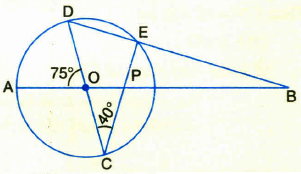
In the figure, straight lines AB and CD pass through the centre O of the circle. If \(\angle OCE=40°\) and \(\angle AOD=75°\), find \(\angle CDE\) and \(\angle OBE\).
2.
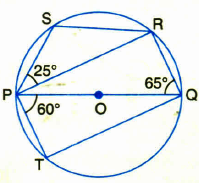
In given figure, PQ is the diameter of the circle. If \(\angle PQR= 65°\), \(\angle RPS= 25°\) and \(\angle QPT= 60°\). Then find the measure of
(i) \(\angle QPR\)
(ii) \(\angle PRS\)
(iii) \(\angle PSR\)
(iv) \(\angle PQT\)
3.
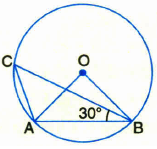
In the figure, \(\angle AOB= 90°\) and, \(\angle ABC= 30°\) then find the measure of \(\angle CAO\).
4.
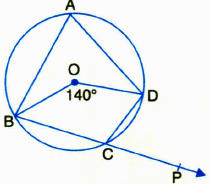
In the figure, O is the centre of the circle. Arc BCD subtends an angle of 140° at the centre. BC is produced to P and CD is joined. Find measure of \(\angle DCP\).
5.
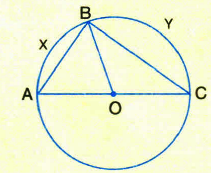
In the figure, AOC is a diameter of the circle and arc AXB =\(\frac { 1 }{ 2 } \) arc BYC. Find \(\angle BOC\).
6.
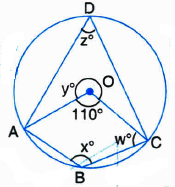
Find the values of x, y, z, w from the figure, where O is the centre of the circle, \(\angle AOC=110°\) and \(\angle OAB=65°\).
7.
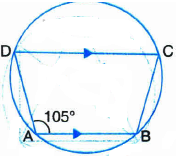
In the given figure, ABCD is a cyclic quadrilateral in which AB || DC. If \(\angle BAD=105°\), find
(i) \(\angle BCD\)
(ii) \(\angle ADC\)
(iii) \(\angle ABC\)
8.
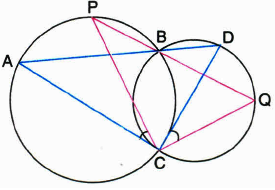
Two circles intersect at two points Band C. Through B, two line segments ABD and PBQ are drawn to intersect the circles at A, D and P, Q respectively (see figure). Prove that \(\angle ACP=\angle QCD\) .
9.
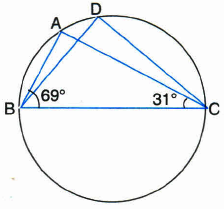
In figure, \(\angle ABC=69°,\ \angle ACB=31°\), find \(\angle BDC\) .
10.
If two circles intersect at two points, prove that their centres lie on the perpendicular bisector of the common chord.
11.
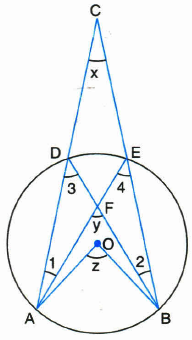
If O is the centre of a circle as shown in figure, then prove x + y = z.
12.
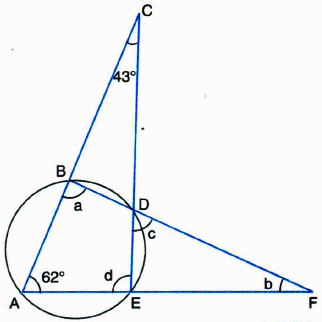
In the given figure, find the values of a, b, c and d. Given that \(\angle BCD=43°\) and \(\angle BAE=62°\).
13.
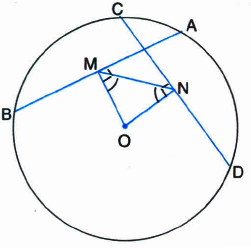
In figure, AB and CD are equal chords of a circle whose centre is O. If OM 丄 AB and ON 丄 CD, prove that \(\angle OMN=\angle ONM\)
14.
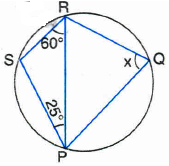
In the figure below, PQRS is cyclic quadrilateral. If \(\angle SPR=25°\) and \(\angle PRS=60°\), the value of x is:
105°
85°
95°
115°
15.
The length of a chord of a circle is equal to its radius. Find the measure of the angle subtended by that chord in major segment.
30°
60°
45°
none of these.
16.
The angle of a minor segment is
acute
right
obtuse
straight.
17.
How many points are sufficient to determine a line?
1
2
3
none of these
18.
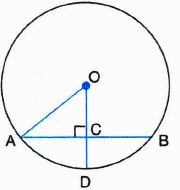
In figure, if OA = 5 cm, AB = 8 cm and OD丄AB then CD is equal to:
3 cm
2 cm
4 cm
5 cm
19.
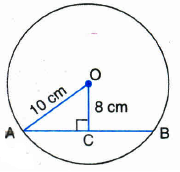
In the following figure, O is the centre of the circle. OA = 10 cm and perpendicular OC on chord AB = 8 cm, then the length of the chord AB is
8 cm
10 cm
12 cm
16 cm
20.
The perpendicular from the centre of a circle bisects the:
circle
circumference
chord
radius.
21.
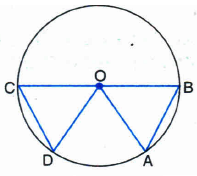
In the given figure, O is the centre of the circle. \(\Delta AOB\) is equilateral. CD = AB, then \(\angle COD=\)
30°
45°
60°
90°
22.
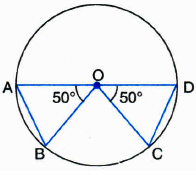
In the given figure, O is the centre of the circle. \(\angle AOB=\angle COD=50°\) and CD = 5 cm then AB is equal to:
2.5 cm
10cm
\(\frac { 10 }{ 3 } \) cm
5 cm
23.
The shape of the coin of RS 1 is
triangle
rhombus
circle
trapezium
1.
\(\angle\)AOD + \(\angle\)BOD = 180° (linear pair)
\(\angle\)BOD = 180°- \(\angle\)AOD
\(\angle\)BOD = 180°- 75° = 105°
\(\angle\)CED =90° (angle in semi-circle)
\(\angle\)CDE =90° - \(\angle\)OCE \(\Rightarrow\) 90° - 40° = 50°
\(\angle\)OBE = \(\angle\)OBD
\(\angle\)OBD = 180°- (105° + 50°)
(In \(\Delta\)DBO, Angle sum property of \(\Delta\))
\(\angle\)OBE = \(\angle\)OBD = 25°
2.
25°, 40°, 115°, 30°
3.
\(\angle\)ACB=1/2 * \(\angle\)AOB
=1/2*90o
=45o
In \(\Delta\)ACB, \(\angle\)CAB=180o-(30o+45o)
=105o
\(\angle\)OAB=\(\angle\)OBA
=45o
(Angles opp. to equal sides of triangle are equal as OA = OB radius of same circle)
\(\angle\)CAO = 105°- \(\angle\)OAB
= 105°-45°
= 60°
4.
70°
5.
\(120°\)
6.
125°, 250°, 55°, 60°
7.
(i) 75°
(ii) 75°
(iii) 105°
8.
Two circles intersect at two points Band C. Through B, two line segments ABD and PBQ are drawn to intersect the circles at A, D and P, Q respectively.
To Prove:\(\angle ACP=\angle QCD\)
Proof: \(\angle ACP=\angle ABP\) ...(1)
| Angles in the same segment of a circle are equal
\(\angle QCD=\angle QBD\) ...(2)
| Angles in the same segment of a circle are equal
\(\angle ABP=\angle QBD\)
| Vertically Opposite Angles
From (1), (2) and (3),
\(\angle ACP=\angle QCD\).
9.
In \(\Delta ABC\),
\(\angle BAC+\angle ABC+\angle ACB=180°\)
Sum of all the angles of a triangle is 180°
⇒ \(\angle BAC+69°+31°=180°\)
⇒ \(\angle BAC+100°=180°\)
⇒ \(\angle BAC=180°-100°=80°\) .........(1)
Now, \(\angle BDC=\angle BAC\)
Angles in the same segment of a circle are equal = 80°. Using (1)
10.
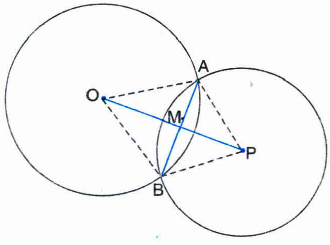
Given: Two circles with centres O and P intersecting at A and B.
Prove: OP is the perpendicular bisector of AB.
Construction: Join OA, OB, PA and PB. Let OP intersect AB at M.
Proof: In \(\Delta \) OAP and \(\Delta \) OBP,
OA = OB | Radii of a circle
PA = PB I Radii of a circle
OP = OP I Common
∴ \(\Delta \ OAP\cong \Delta \ OBP\) I SSS Rule
∴ \(\angle AOP=\angle BOP\) I CPCT
⇒\(\angle AOM=\angle BOM\) ...(1)
In \(\Delta \) AOM and \(\Delta \) BOM,
OA = OB I Radii of a circle
\(\angle AOM=\angle BOM\) | From (1)
OM = OM I Common
∴\(\Delta AOM\cong \Delta BOM\) I SAS Rule
∴ AM = BM ...(2)
I CPCT
and \(\angle AMO=\angle BMO\) ... (3)
I CPCT
But \(\angle AMO+\angle BMO=180°\) I Linear Pair Axiom
∴ \(\angle AMO+\angle BMO=90°\) ...(4)
∴ OM, i.e., OP is the perpendicular bisector of AB. I From (2) and (4)
11.
Given: O is the centre of a circle.
To Prove: x + y = z
Proof: \(\angle 3=\angle 4\)
| Angles in the same segment of a circle are equal
\(\angle z=2\angle 3\)
⇒ \(\angle z=\angle 3+\angle 3\)
⇒ \(\angle z=\angle 3+\angle 4\) .....(1)
Now \(\angle y=\angle 3+\angle 1\) .....(2)
| An exterior angle of a triangle is equal to the sum of its two interior opposite angles
(1) - (2) gives
\(\angle z-\angle y=\angle 4-\angle 1\)
As \(4=\angle x+\angle 1\Rightarrow \angle 4-\angle 1=\angle x\)
| An exterior angle of a triangle is equal to the sum of its two interior opposite angles
⇒ \(\angle 4-\angle 1=\angle x\) ....(4)
From (3) and (4),
\(\angle z-\angle y=\angle x\)
⇒ \(\angle x+\angle y=\angle z\)
⇒ x+y=z
12.
\(\angle c=\angle BAE\)
| An exterior angle of a cyclic quadrilateral is equal to its interior opposite angle
⇒ \(\angle c=62°\) ....(1)
In \(\Delta AEC\), \(\angle ACE+\angle CAE+\angle d=180°\)
| Angle sum property of a triangle
⇒\(43°+62°+\angle d=180°\)
⇒ \(\angle d=75°\) ..........(2)
\(\angle a+\angle d=180°\)
| Opposite angles of a cyclic quadrilateral are supplementary
⇒ \(\angle a+75°=180°\)
⇒ \(\angle a=105°\) ..........(3)
In \(\Delta FDE\),
\(\angle c+(180°-\angle d)+\angle b=180°\)
| Angle sum property of a triangle
⇒ \(62°+(180°-75°)+\angle b=180°\)
⇒ \(\angle b=13°\)
13.
Given: In figure, AB and CD are equal chords of a circle whose centre is O. OM 丄 AB and ON 丄 CD.
To Prove: \(\angle OMN=\angle ONM\).
Proof: ∵ Chord AB = Chord CD
∴ OM=ON .........(1)
| Equal chords of a circle are equidistant from the centre of the circle
In \(\Delta OMN\),
OM=ON I From (1)
∴ \(\angle OMN=\angle ONM\) | Angles opposite to equal sides of a triangle are equal.
14.
\(\angle PSR=95°\)
\(\angle PSR+x=180°\)
15.
\(\therefore \ OA=OB=AB\)
\(\therefore \ \angle AOB=60°\)
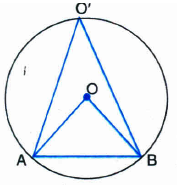
\(\therefore \angle AO'B=\frac { 1 }{ 2 } \angle AOB=30°\)
16.
Theorem
17.
Visualise
18.
\(AC=CB=\frac { 1 }{ 2 } AB=4\ cm\)
\(OA^{ 2 }=OC^{ 2 }+AC^{ 2 }\)
⇒ OC=3 cm
CD=OD-OC=5-3=2 cm
19.
\(AC=\sqrt { OA^{ 2 }+OC^{ 2 } }\)
\(\quad =\sqrt { 10^{ 2 }-8^{ 2 } } =6\quad cm\)
\(\therefore AB=2AC=12\quad cm\)
20.
Theorem
21.
Each angle of an equilateral triangle is 60°. Equal chords subtend equal angles at the centre.
22.
∵ \(\angle AOB=\angle COD\)
∴ AB=CD=5 cm
23.
(c)
circle

9th Standard CBSE Syllabus & Materials
9th Standard CBSE
CBSE 9th Mathematics Lines and Angles Sample Question Papers Study Material - QB365 Set A
NEW9th Standard CBSE
CBSE 9th Mathematics Introduction to Euclid's Geometry Sample Question Papers Study Material - QB365 Set A
NEW9th Standard CBSE
CBSE 9th Mathematics Linear Equations in Two Variables Sample Question Papers Study Material - QB365 Set A
NEW9th Standard CBSE
CBSE 9th Mathematics Coordinate Geometry Sample Question Papers Study Material - QB365 Set A



CBSE 9th Standard CBSE Subjects
CBSE Standards