
 100% FREE ACCESS
11th Standard Syllabus & Materials
11th Standard
TN 11th Tamil இயற்கை வேளாண்மை,சுற்றுச்சூழல் -செய்யுள் - மனோன்மணீயம் Important Questions And Answers Study Material - QB365 Set A
NEW11th Standard
TN 11th Tamil என்னுயிர் என்பேன் -துணைப்பாடம் - இசைத்தமிழர் இருவர் Important Questions And Answers Study Material - QB365 Set A
NEW11th Standard
TN 11th Tamil மொழி கலை -செய்யுள் - ஒவ்வொரு புல்லையும் Important Questions And Answers Study Material - QB365 Set A
NEW11th Standard
TN 11th Tamil பீடு பெற நில் - இலக்கணம் - பகுபத உறுப்புகள் Important Questions And Answers Study Material - QB365 Set A
NEW11th Standard
TN 11th Tamil பீடு பெற நில் - துணைப்பாடம் - வாடிவாசல் Important Questions And Answers Study Material - QB365 Set A
NEW11th Standard
TN 11th Tamil பீடு பெற நில் - செய்யுள் - குறுந்தொகை Important Questions And Answers Study Material - QB365 Set A

Published on: 26/09/2019
Basic concept of organic reactions
Download Tamil Nadu 11th Standard Chemistry question papers, model tests, one-mark questions, important questions, and public exam papers in PDF format. Free study materials and answer keys for TN State Board students.
Questions + Answers key
Take MCQ Chemistry Test
1.
Explain electromeric effect.
2.
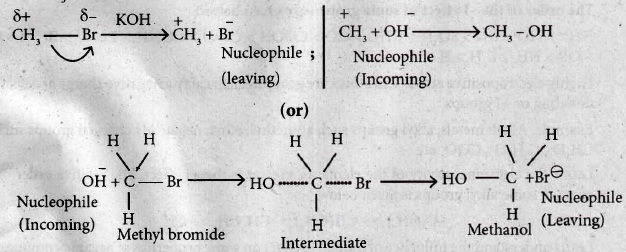
Show the heterolysis of covalent bond by using curved arrow notation and complete the following equations.
Identify the nucleophile is each case.
CH3 - Br + KOH →
3.
What are electrophiles and nucleophiles ? Give suitable examples for each.
4.
Explain inductive effect with suitable example.
5.
List out the salient features of inductive effect.
6.
How does inductive effect plays a vital role in determining the strength of acids and bases.
7.
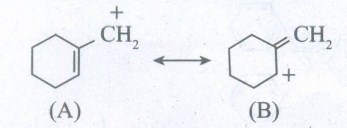
Which of the following ions is more stable ? Use resonance to explain your answer.
8.
Why does SO3 act as an electrophile ?
9.
\(C{ H }_{ 2 }=\overset { - }{ C } H\) is more basic than \(HC\equiv { C }^{ - }\) . Explain why ?
10.
Write a short note on oxidation and reduction reactions.
11.
How does the addition reaction affect the hybridisation of the substrale ? Give example.
12.
Discuss the effect of hyper conjugation in propene,
13.
How will you determine the rate of chemical I reaction ?
14.
Which of the two structures A and B given below is more stabilised by resonance ? Explain.
CH3COOH (A) and \(C{ H }_{ 3 }CO\overset { - }{ O } \) (B)
15.
Which of the two is expected to be more stable and why ? \({ O }_{ 2 }NC{ H }_{ 2 }C{ H }_{ 2 }\overset { - }{ O } \) (or) \(C{ H }_{ 3 }C{ H }_{ 2 }\overset { - }{ O } \)
1.
Electromeric is a temporary effect which operates in unsaturated compounds (containing >C = C <, > C = O, etc...) in the presence of an attacking reagent.
Let us consider two different compounds
(i) Compounds containing carbonyl group (> C = O) and
(ii) Unsaturated compounds such as alkenes (> C = C <).
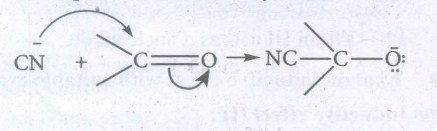
When a nucleophile approaches the carbonyl compound, the \(\pi\) electrons between C and O is instantaneously shifted to the more electronegative oxygen. This makes the carbon electron deficient and thus facilitating the formation of a new bond between the incoming nucleophile and the carbonyl carbon atom.
On the other hand When an electrophile such as H+ approaches an alkene molecule, the π electrons are instantaneously shified to the electrophile and a new bond is formed between carbon and hydrogen. is makes the other carbon electron decient and hence it acquires a positive charge.
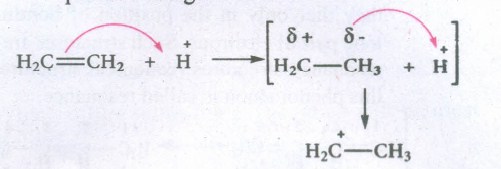
The electromeric effect, is denoted as E effect. Like the inductive effect, the electromeric effect is also classified as +E and -E based on the direction in which the pair of electron is transfered to form a new bond with the attacking agent.
When the π electron is transfer red towards the attacking reagent, it is called + E (positive electromeric) effect.
The addition of H+ to alkene as shown above is an example of +E effect.
When the π electron is transfered away from the attacking reagent, it is called, -E (negativc electromeric) effect.
The attack of CN- on a carbonyl carbon, as shown above, is an example of -E effect.
2.
3.
a) Electrophiles:
Electrophiles are reagents that are attracted towards negative charge or electron rich center. They are either positively charged ions or electron deficient neutral molecules. All Lewis acids act as electrophiles.
Neutral molecules like SnCl4 can also act as an electrophile, as it has vacant d-orbitals which can accommodate the electrons from others.
| Types | Examples | Electron deficiententity |
| Neutral electrophiles | Carbon dioxide (CO2), dichlorocarbene (CCl2) |
C |
| Aluminium chloride (AlCl3), boron trifluoride (BF3) and ferric chloride (FeCI3) | Metal (M) | |
| Positively charged electrophiles | Carbocations(R+) | C+ |
| Proton (H+) | H+ | |
| Alkyl halides (RX) | X+ | |
| Oxonium ion (H3O+) and nitrosonium ion (NO+) | O+ | |
| Nitronium ion (+NO2) | N+ |
b) Nucleophiles:
Nucleophiles are reagents that has high affinity for electro positive centers. They possess an atom has an unshared pair of electrons, and hence it is in search for an electro positive centre where it can have an opportunity to share its elections to form a covalent bond, and gets stabilised.
They are usually negatively charged ions or electron rich neutral molecules (contains one or more lone pair of electrons). AII Lewis bases act as nucleophiles.
| Types | Examples | Electron rich site |
| Neutral molecules having unshared pair of electron | Ammonia (NH3) and amines (RNH2) | N: |
| Water (H2O), alcohols(ROH) and ethers (R - O- R) |
:O: | |
| Hydrogen sulphide (H2S) and thiols (RSH) |
:S: | |
| Negatively, charged nucleophiles | Chlorides (Cl-), bromides (Br-) and iodides (I-) |
X- |
| Hydroxide ( HO-), alkoxide (RO-) and Carboxlate ions (RCOO-) |
O- | |
| Cyanide (CN-) | N- |
4.
Inductive effect (I):
(i) Inductive effect is defined as the change in the polarisation of a covalent bond due to the presence of adjacent bonds, atoms or groups in the molecule. This is a permanent phenomenon.
(ii) Let us explain the inductive effect by considering ethylchloride as example. The C-C bond in ethyl chloride is polar.
We know that chlorine is more electronegative than carbon, and hence it attracts the shared pair of electron between C-Cl in ethyl chloride towards itself. is develops a slight negative charge on Chlorine and a slight positive charge on carbon to which chlorine is attached.
To compensate it, the C1 draws the shared pair of electron between itself and. C2 . This polarisation effect is called inductive effect.
(iii) The magnitude of the charge separation decreases rapidly, as we move away from C1 and is observed maximum for 2 carbons and almost insignicant after 4 bonds from the active group.
\(\overset { \delta }{ C } \overset { \delta + }{ { H }_{ 3 } } \longrightarrow \underset { 1 }{ C\overset { \delta + }{ { H }_{ 2 } } } \twoheadrightarrow \overset { \delta - }{ C } { l }_{ 2 }\)
It is important to note that the inductive effect does not transfer electrons from one atom to another but the displacement effect is permanent. The inductive effect represents the ability of a particular atom or a group to either withdraw or donate electron density to the attached carbon. Based on this ability the substituents are classified as +I groups and -I groups. Their ability to release or withdraw the electron through sigma covalent bond is called +I effect and -I effect respectively.
Highly electronegative atoms and atoms of groups which are carry a positive charge are electron withdrawing or -I group
Example : -F, -CI, -COOH, -NO2, NH2,
Higher the electronegativity of the substitutent, greater is the -I effect.
The order of the -I effect of some groups are given below :
NH3+ > NO2 > CN > SO3H > CHO > CO > COOH > COCI > CONH2 > F > Cl > Br > I > OH > OR, NH2 > C6H5 > H
Highly electropositive atoms and atoms are groups which carry a negative charge are electron donating or +I groups.
Example. Alkali metals, alkyl groups such as methyl, ethyl, negatively charged groups such as CH3O-, C2H5O-, COO- etc.
Lesser the electronegativity of the elements, greater is the +I effect. The relative order of +I effect of some alkyl groups is given below
\(-\mathrm{C}\left(\mathrm{CH}_3\right)_3>-\mathrm{CH}\left(\mathrm{CH}_3\right)_2>-\mathrm{CH}_2 \mathrm{CH}_3>-\mathrm{CH}_3\)
Let us understand the influence of inductive effect on some properties of organic compounds.
Reactivity :
When a highly electronegative atom such as halogen is attached to a carbon then it makes the C-X bond polar. In such cases the -I effect of halogen facilitates the attack of an incoming nucleophile at the polarised carbon, and hence increases the reactivity.
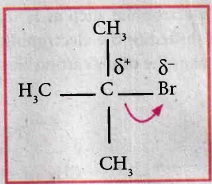
If a - I group is attached nearer to a carbonyl carbon, it decreases the availability of electron density-on the carbonyl carbon, and hence increases the rate of the nucelophilic addition reaction.
Aciditv of carborvlic acids :
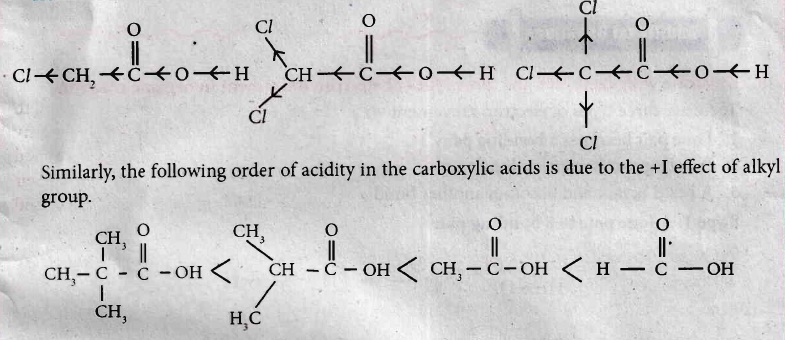
When a halogen atom is attached to the carbon which is nearer to the carboxylic acid group, its -I effect withdraws the bonded electrons towards itself and makes the ionisation of H+ easy. The acidity of various chloro acetic acid is in the following order. The strength of the acid increases with increase in the -I effect of the group attached to the carboxyl group.
Tiichloro acetic acid > Dichloro acetic acid > Chloro acetic acid > acetic acid
5.
(i) It is a permanent effect.
(ii) It operates through α-bond.
(iii) It decreases in magnitude as we move away from the cause of polarity.
(iv) It is generally observed in saturated compounds.
6.
| S. No. |
Acid/Base | Group with +I effect |
Group with -I effect |
| (i) | Acidic strength of acid |
Decreases with +I group |
Increases with -I group |
| (ii) | Basic strength of base |
Increases with +I group |
Decreases with +I group |
7.
(i) (A) is more stable than (B).
(ii) Carbocation (A) is more planar and is stabilised by resonance.
(iii) Carbocation (B) is non-planar and does not undergo resonance.
(iv) Double bond inside the ring is more stable than outside the ring.
8.
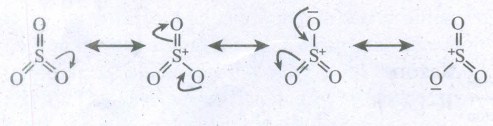
(i) Three highly electronegative oxygen atoms are attached to sulphur atom in SO3. It makes sulphur electron deficient.
(ii) Further, due to resonance, sulphur-acquires a positive charge.
∴ Resonance and electron defficiency make SO3 an electrophile.
9.
\(C{ H }_{ 2 }=\overset { { sp }^{ 2 } }{ C{ H }^{ - } } \) \(HC\equiv \overset { sp }{ { C }^{ - } } \)
(i) Since sp carbon is more electronegative than sp2 carbon.
(ii) ∴ \(CH\equiv \overset { - }{ C } \) is less interested in donating a pair of electrons than \(C{ H }_{ 2 }=\overset { - }{ C } H\) .
10.
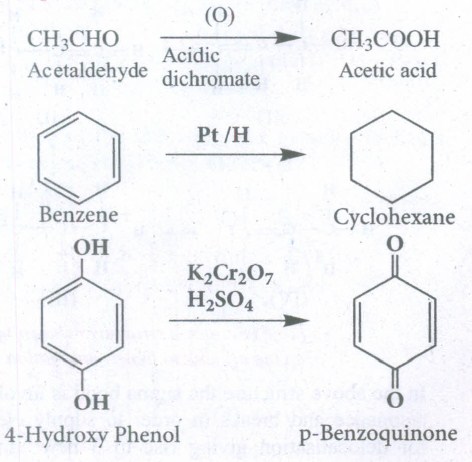
Many oxidation and reduction reactions of organic compounds fall into one of the four types of reaction that we already discussed but others do not. Most of the oxidation reaction of organic compounds involves gain of oxygen or loss of hydrogen Reduction involves gain of hydrogen and loss of oxygen.
Examples:
11.
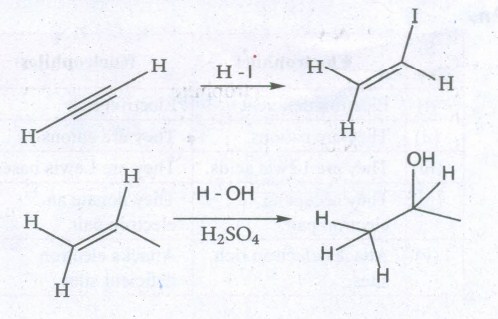
During the addition reaction the hydridisation of the substrate changes (from sp2 ⟶ sp3 in the addition reaction of alkenes or sp ⟶ sp2 in the addition reaction of alkynes) as only one bond breaks and two new bonds are formed.
12.
In propene, the a-electrons of C-H bond of methyl group can be delocalised into the π-orbital of doubly bonded carbon as represented below.
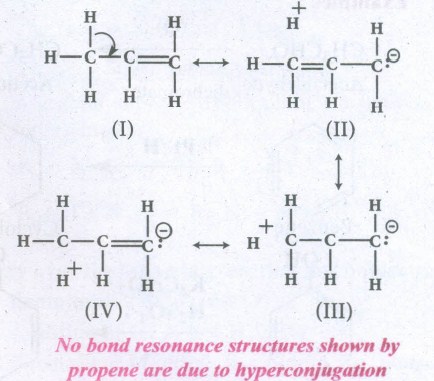
In the above structure the sigma bond is involved in resonance and breaks in order to supply electrons for delocalisation giving rise to 3 new canonical forms. In the contributing canonical structures: (II), (III) & (IV) of propene, there is no bond between an -carbon and one of the hydrogen atoms. Hence the hyperconjugation is also known as "no bond resonance" or "Baker-Nathan effect". The structures (II), (III) & (IV) are polar in nature.
13.
Substrate + Reagent ⟶ [Intermediate state (and/or) I Transition State] ⟶ Product
Many chemical reactions are depicted in one or I more simple steps. Each step passes through an energy barrier, leading to the formation of short lived intermediates or transition states. The series of simple steps which collectively represent the chemical. change, from substrate to product is called as the mechanism of the reaction. The slowest step in the mechanism determines the overall rate of the reaction.
14.
Resonating structures of A and B are as follows
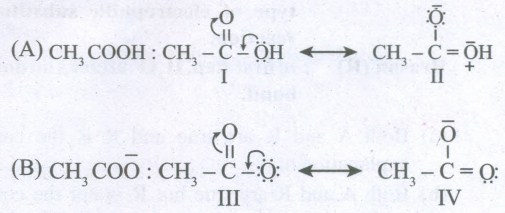
(i) Structure II is more stable than structure I, because later carries separation of positive and negative charges.
(ii) The contribution of structure II is less than that of I.
(iii) On the contrary, structure III and IV are of equal energy and hence contribute equally towards the resonance hybrid of compound B.
(iv) ∴ Structure (B) is more stable than (A).
15.
(i) \({ O }_{ 2 }NC{ H }_{ 2 }C{ H }_{ 2 }\overset { - }{ O } \) is expected to be more stable than \(C{ H }_{ 3 }-C{ H }_{ 2 }-\overset { - }{ O } \)
(ii) -NO2 has -I effect, this leads to the dispersal of negative charge.
(iii) On the other hand -CH3 group has +I effect, which intensity the negative charge
(iv) ∴ Dispersal of charge leads to the stability of ion and intensification of negative charge leads to unstability of ion.
\({ O }_{ 2 }N\longleftarrow C{ H }_{ 2 }\longleftarrow C{ H }_{ 2 }-\overset { - }{ O } \) More stable
\(C{ H }_{ 3 }\longrightarrow C{ H }_{ 3 }\longrightarrow \overset { - }{ O } \) Less stable

11th Standard Syllabus & Materials
11th Standard
TN 11th Tamil பீடு பெற நில் - செய்யுள் - காவடிச்சிந்து Important Questions And Answers Study Material - QB365 Set A
NEW11th Standard
TN 11th Tamil பீடு பெற நில் - உரைநடை - மலை இடப்பெயர்கள் : ஓர் ஆய்வு Important Questions And Answers Study Material - QB365 Set A
NEW11th Standard
TN 11th Tamil மாமழை போற்றுதும் - துணைப்பாடம் - யானை டாக்டர் Important Questions And Answers Study Material - QB365 Set A
NEW11th Standard
TN 11th Tamil மாமழை போற்றுதும் - செய்யுள் - ஐங்குறுநூறு Important Questions And Answers Study Material - QB365 Set A



Tamilnadu Stateboard 11th Standard Subjects

Maths

Commerce

Economics

Biology

Business Maths and Statistics

Accountancy

Computer Science

Physics
Chemistry
Maths
Biology
Economics
Physics
Chemistry

History
Business Maths and Statistics

Computer Science
Accountancy

Computer Applications
History
Computer Technology
Commerce
Computer Applications
Computer Technology

Tamil

English

French
Tamilnadu Stateboard Standards
