
 100% FREE ACCESS
11th Standard Syllabus & Materials
11th Standard
TN 11th Tamil இயற்கை வேளாண்மை,சுற்றுச்சூழல் -செய்யுள் - மனோன்மணீயம் Important Questions And Answers Study Material - QB365 Set A
NEW11th Standard
TN 11th Tamil என்னுயிர் என்பேன் -துணைப்பாடம் - இசைத்தமிழர் இருவர் Important Questions And Answers Study Material - QB365 Set A
NEW11th Standard
TN 11th Tamil மொழி கலை -செய்யுள் - ஒவ்வொரு புல்லையும் Important Questions And Answers Study Material - QB365 Set A
NEW11th Standard
TN 11th Tamil பீடு பெற நில் - இலக்கணம் - பகுபத உறுப்புகள் Important Questions And Answers Study Material - QB365 Set A
NEW11th Standard
TN 11th Tamil பீடு பெற நில் - துணைப்பாடம் - வாடிவாசல் Important Questions And Answers Study Material - QB365 Set A
NEW11th Standard
TN 11th Tamil பீடு பெற நில் - செய்யுள் - குறுந்தொகை Important Questions And Answers Study Material - QB365 Set A

Published on: 26/09/2019
Chemical Bonding
Download Tamil Nadu 11th Standard Chemistry question papers, model tests, one-mark questions, important questions, and public exam papers in PDF format. Free study materials and answer keys for TN State Board students.
Questions + Answers key
Take MCQ Chemistry Test
1.
Hydrogen gas is diatomic where as inert gases are monoatomic – explain on the basis of MO theory.
2.
Linear form of carbondioxide molecule has two polar bonds. yet the molecule has Zero dipolement why ?
3.
What is dipole moment ?
4.
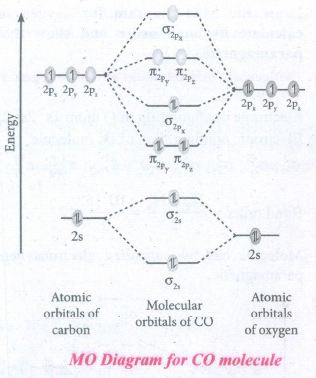
Draw MO diagram of CO and calculate its bond order.
5.
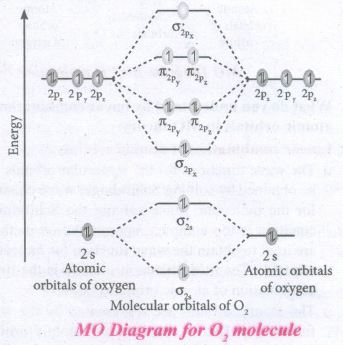
Draw the M.O diagram for oxygen molecule calculate its bond order and show that O2 is paramagnetic.
6.
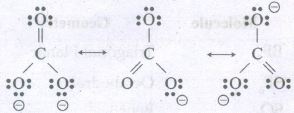
Explain the equal bond lengths of C-O bonds in \({ CO }_{ 3 }^{ 2 }\) ion.
7.
On the basis of VSEPR theory predict the shape of the Ozone.
8.
Write a short note on hybridisation.
9.
Draw the Lewis structure of N, C,O and He
10.
Give two examples of molecules undergoing sp3d2 hybridisation and predict their shapes.
11.
Give reason for the higher melting point value of A/F3 (solid) than SiF4 (gas).
12.
Define bond energy.
13.
14.
CO2 and H2O both are triatomic molecule but their dipole moment values are different. Why ?
15.
Explain the bond formation in ethylene and acetylene.
1.
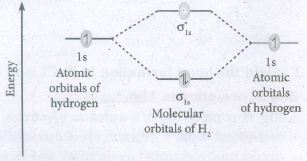
H2 molecule :
Electronic configuration of H atom 1s1
Electronic configuration of H2 molecule \(\sigma^{2}_{1s}\)
Bond order = \({N_b-N_a\over2}={2-0\over2}=1\)
Molecule has no unpaired electrons hence it is diamagnetic
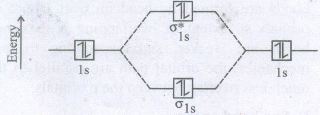
Helium molecule (i.e) He2 :
The electronic econfiguration of He atom is 1 s2
.'. Electronic configuration of He2 molecule is \((\sigma_{1s})^2(\sigma^*_{1s})^2\)
Bond order = \({N_b-N_a\over2}={2-2\over2}\)
= 0
He, cannot exist. Similarly all the inert gases, X2 cannot orist as their bond order = 0.
2.
Molecules having polar bonds will not necessarily have a dipole moment. For example, the linear form of carbon dioxide has zero dipole moment, even though it has two polar bonds. In CO2, tlie dipole moments of two polar bonds (CO) are equal in magnitude but have opposite direction. Hence, the net dipole moment of the CO2 is,
\(\mu=\mu_{1}+\mu_{2}=\mu_{1}+(-\mu_{1})=0.\)
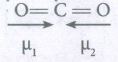
In this case \(\mu=\overrightarrow { { \mu }_{ 1 } } +\overrightarrow { { \mu }_{ 2 } } \quad \)
\(=\overrightarrow { { \mu }_{ 1 } } +\overrightarrow { ({ \mu }_{ 1 }) } =0\)
3.
Dipole moment :
The polarity of a covalent bond can be measured in terms of dipole moment which is defined as \(\mu=q \times 2d\)
Where \(\mu\) is the dipole moment, q is the charge and 2d is the distance between the two charges.
Where p is the dipole moment, q is the charge and 2d is the distance between the two charges. The dipole moment is a vector and the direction of the dipole moment vector points from the negative charge to positive charge.
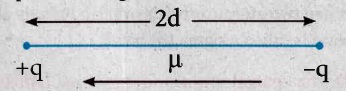
The unit for dipole moment is columb meter (C m). It is usually expressed in Debye unit (D). The conversion factor is 1 Debye = 3.336 x 10⁻³⁰ C m.
4.
Bonding in some heteronuclear di-atomic molecules:
Molecular orbital diagram of Carbon monoxide molecule (CO)
Electronic configuration of C atom 1s22s22p2
Electronic configuration of O atom 1s22s22p4
Electronic conguration of CO molecule
\(\sigma^{2}_{1s},\sigma^{*2}_{1s},\sigma^{2}_{2s},\sigma^{*2}_{2s}\)\(\pi^{2}_{2py},\pi^{2}_{2pz},\sigma^2_{2px}\)
Bond order = \({N_b-N_a\over2}={10-4\over2}=3\)
Molecule has no unpaired electrons hence it is diamagnetic
5.
Molecular orbital diagram of oxyge molecule (O2) :
Electronic configuration of O atom 1s22s22p4
Electronic configuration of O2 molecule
\(\sigma^{2}_{1s},\sigma^{*2}_{1s},\sigma^{2}_{2s},\sigma^{*2}_{2s},\sigma^{2}_{2px},\)\(\pi^{2}_{2py},\pi^{2}_{2pz},\pi^{*1}_{2py},\pi^{*1}_{2pz}\)
Bond order=\({N_b-N_a\over2}={10-6\over2}=2\)
Molecule has two unpaired electrons hence it is paramagnetic.
6.
According to experimental observations, the c-o bonds in \({ CO }_{ 3 }^{ 2- }\)equivalent.
Resonance is mainly responsible for the equal bond lengths of C-O bonds in \({ CO }_{ 3 }^{ 2- }\)
7.
The resonating structure of ozone are:

The central o-atom is considered to have two bond pairs and one lone pair of electrons (ie) it is of AB2E type.
Hence it is a bent molecule
8.
Hybridisation is the process of mixing of atomic orbitals of the same atom with comparable energy to form equal number of new equivalent orbitals with same energy. The resultant orbitals are called hybridised orbitals and they posses maximum symmetry and definite orientation in space so as to minimize the force of repulsion between their electrons
9.

Lewis Structure of Nitrogen atom
Similarly, Lewis dot structure of carbon, oxygen can be drawn as shown below.

Lewis Structures of C & O atoms
Only exception to this is helium which has only two electrons in its valence shell which is represented as a pair of dots (duet).
\(\overset{..}He\)
Lewis Structures of He atoms
10.
Examples : SF6, XeF4
Shapes :
SF6 - Octahedral
XeF4 - Square planar
11.
1. AlF3 is an ionic compound and SiF4 is a covalent compound.
2. Usually covalent compounds exhibit lower melting and boiling points.
3.\(\therefore\)AlF3 bring ionic in nature has strong coulombic force of attraction between the oppositely charged ions, Thereby posses higher melting point.
12.
The bond energy is defined as the minimum amount of energy required to break one mole of a particular bond in molecules in their gaseous state.
13.
14.
Molecules having polar bonds will not necessarily have a dipole moment. For example, the linear form of carbon dioxide haszero dipole moment, even though it has two polar bonds. In CO2, the dipole moments of two polar bonds (CO) are equal in magnitude but have opposite direction. Hence, the net dipole moment of the CO2 is,
\(\mu=\mu_{1}+\mu_{2}=\mu_{1}+(-\mu_{1})=0.\)
In this case \(\mu=\overrightarrow { { \mu }_{ 1 } } +\overrightarrow { { \mu }_{ 2 } } \quad \)
\(=\overrightarrow { { \mu }_{ 1 } } +\overrightarrow { ({ \mu }_{ 1 }) } =0\)
Incase of water net dipole moment is the vector sum of \(\mu_{1}+\mu_{2}\) as shown.
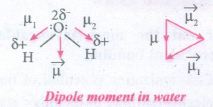
Dipole moment in water is found to be 1.85 D
15.
Bonding in ethylene:
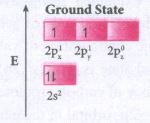
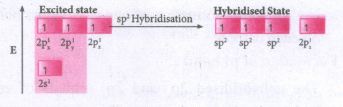
1. The bonding in ethylene can be explained using hybridisation concept. The molecular formula of ethylene is C2H4. The valency of carbon is 4. The electronic configuration of valence shell of carbon in ground state is [He]2s2 2\({ p }_{ x }^{ 1 }\) 2\({ p }_{ y }^{ 1 }\)2\({ p }_{ z }^{ 0 }\). To satisfy the valency of carbon promote an electron from 2s orbital to 2pz orbital in the excited state.
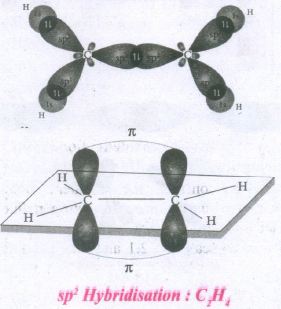
2. In ethylene both the carbon atoms undergoes Sp2 hybridisation involving 2s, 2px and 2p orbitals, resulting in three equivalent Sp2 hybridised orbitals lying in the xy plane at an angle of 1200 to each other. The unhybridised 2pz orbital lies perpendicular to the xy plane.
Formation of sigma bond :
One of the SP2 hybridised orbitals of each carbon lying on the molecular axis (x-axis) linearly overlaps with each other resulting in the formation a C-C sigma bond. Other two sp2 hybridised orbitals of both carbons linearly overlap with the four 1s orbitals of four hydrogen atoms leading to the formation of two C-H sigma bonds on each carbon.
Formation of pi bond:
The unhybridised 2pz orbital of both carbon atoms can overlap only sideways as they are not in the molecular axis. This lateral overlap results in the formation a pi bond between the two carbon atoms as shown in the figure.
Bonding in acetylene :
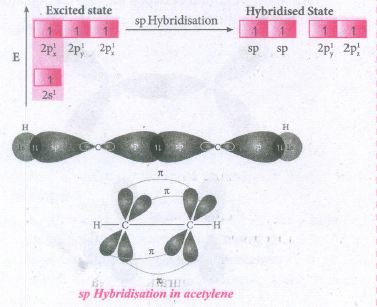
1. Similar to ethylene, the bonding in acetylene can also .be explained using hybridisation concept. The molecular formula of acetylene is C2H2. The electronic configuration of valence shell of carbon in ground state is [He ]2s2 2\({ p }_{ x }^{ 1 }\) 2\({ p }_{ y }^{ 1 }\)2\({ p }_{ z }^{ 0 }\). To satisfy the valency of carbon promote an electron from 2s orbital to 2pz orbital in the excited state.
2. In acetylene molecule, both the carbon atoms are in sp hybridised state. The 2s and 2px orbitals, resulting in two equivalent sp hybridised orbitals lying in a straight line along the molecular axis (x-axis). The unhybridised 2py and 2pz orbitals lie perpendicular to the molecular axis.
Formation of sigina bond:
1. One of the two sp hybridised orbitals of each carbon linearly overlaps with each other resulting in the formation a C-C sigma bond. The other sp hybridised orbital of both carbons linearly overlap with the two Is orbitals of two hydrogen atoms leading to the formation of one C-H sigma bonds on each carbon.
Formation of pi bond:
1. The unhybridised 2py and. 2pz orbitals of each carbon overlap sideways. This latera overlap results in the formation of two pi bonds (py-py and pz -pz) between the two carbon atoms as shown in the figure.

11th Standard Syllabus & Materials
11th Standard
TN 11th Tamil பீடு பெற நில் - செய்யுள் - காவடிச்சிந்து Important Questions And Answers Study Material - QB365 Set A
NEW11th Standard
TN 11th Tamil பீடு பெற நில் - உரைநடை - மலை இடப்பெயர்கள் : ஓர் ஆய்வு Important Questions And Answers Study Material - QB365 Set A
NEW11th Standard
TN 11th Tamil மாமழை போற்றுதும் - துணைப்பாடம் - யானை டாக்டர் Important Questions And Answers Study Material - QB365 Set A
NEW11th Standard
TN 11th Tamil மாமழை போற்றுதும் - செய்யுள் - ஐங்குறுநூறு Important Questions And Answers Study Material - QB365 Set A



Tamilnadu Stateboard 11th Standard Subjects

Maths

Commerce

Economics

Biology

Business Maths and Statistics

Accountancy

Computer Science

Physics
Chemistry
Maths
Biology
Economics
Physics
Chemistry

History
Business Maths and Statistics

Computer Science
Accountancy

Computer Applications
History
Computer Technology
Commerce
Computer Applications
Computer Technology

Tamil

English

French
Tamilnadu Stateboard Standards
