
 100% FREE ACCESS
11th Standard Syllabus & Materials
11th Standard
TN 11th Tamil இயற்கை வேளாண்மை,சுற்றுச்சூழல் -செய்யுள் - மனோன்மணீயம் Important Questions And Answers Study Material - QB365 Set A
NEW11th Standard
TN 11th Tamil என்னுயிர் என்பேன் -துணைப்பாடம் - இசைத்தமிழர் இருவர் Important Questions And Answers Study Material - QB365 Set A
NEW11th Standard
TN 11th Tamil மொழி கலை -செய்யுள் - ஒவ்வொரு புல்லையும் Important Questions And Answers Study Material - QB365 Set A
NEW11th Standard
TN 11th Tamil பீடு பெற நில் - இலக்கணம் - பகுபத உறுப்புகள் Important Questions And Answers Study Material - QB365 Set A
NEW11th Standard
TN 11th Tamil பீடு பெற நில் - துணைப்பாடம் - வாடிவாசல் Important Questions And Answers Study Material - QB365 Set A
NEW11th Standard
TN 11th Tamil பீடு பெற நில் - செய்யுள் - குறுந்தொகை Important Questions And Answers Study Material - QB365 Set A

Published on: 26/09/2019
Fundamentals of Organic Chemistry
Download Tamil Nadu 11th Standard Chemistry question papers, model tests, one-mark questions, important questions, and public exam papers in PDF format. Free study materials and answer keys for TN State Board students.
Questions + Answers key
Take MCQ Chemistry Test
1.
The ammonia evolved form 0.20 g of an organic compound by kjeldahl method neutralised 15ml of N/20 sulphare acid solution. Calculate the percentage of Nitrogen.
2.
0.30 g of a substance gives 0.88 g of carbon dioxide and 0.54 g of water calculate the percentage of carbon and hydrogen in it.
3.
Briefly explain geometrical isomerism in alkene by considering 2- butene as an example.
4.
Describe the reactions involved in the detection of nitrogen in an organic compound by Lassaigne method.
5.
Write a note on homologous series.
6.
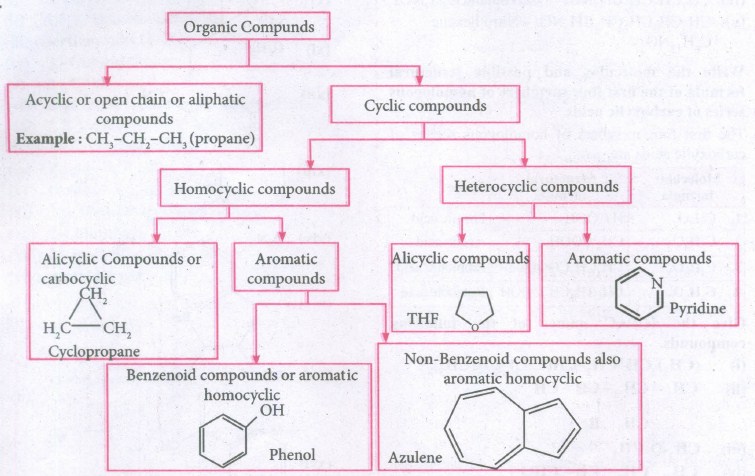
Describe the classification of organic compounds based on their structure.
7.
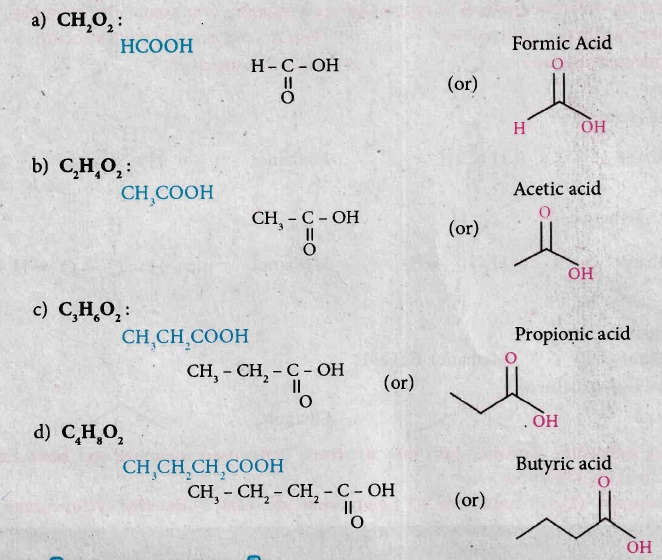
Write the molecular and possible structural formula of the first four members of homologous series of carboxylic acids.
8.
In steam distillation why does an organic liquid vapourises at a temperature lower than its boiling point?
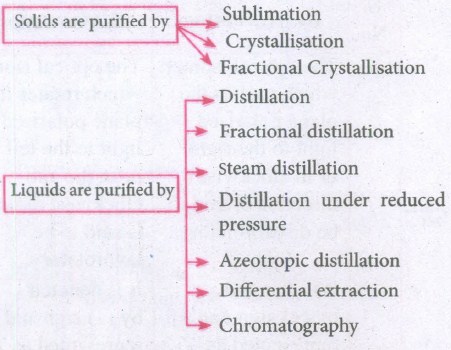
9.
Denote the methods employed for the purification of solid and liquid organic compounds.
10.
Distinguish between dextrarotatory and lavorotatory compounds.
11.
Define optical isomerism.
12.
Which of the following represents the correct IUPAC name for the compounds concerned?
(i) 2,2-dimethylpentane or 2-dimethylpentane.
(ii) 2,4,7-trimethyloctane or, 2,5,7-trimethyloctane.
(iii) 2-chlor0-4-methylpentane or 4-chloro-2. methylpentane.
(iv) But-3-yn-I-01 or But-4-0I-1-yne
13.
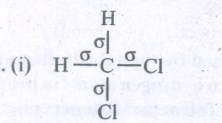
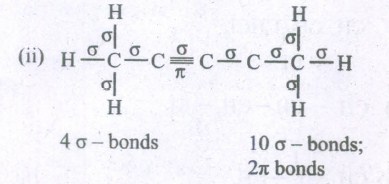
Indicate the \(\sigma \& \pi \) bonds in
(i) CH2 CI2
(ii) \({ CH }_{ 3 }-C\equiv C-C-{ CH }_{ 3 }\)
14.
What is the type of hybridisation of each carbon in the following compounds?
(i) CH3 - CH3
(ii) (CH3)2 Co
15.
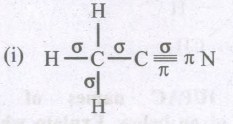
How many sigma and pi bonds are present in
(i) \({ CH }_{ 3 }-C\equiv N\)
(ii) \({ CH }_{ 3 }=C=N?\)
1.
w = 0.2 g ,N = 1/20 N, v = 15 ml
\(\mathrm{V}=15 \mathrm{ml} \% \mathrm{~N}=\frac{1.4 \mathrm{NV}}{\mathrm{W}}=\frac{1.4 \times 1 / 20^{\times 15}}{0.2}=5.25 \%\)
2.
W = 0.3 g
x = 0.54 g
y = 0.88 g
\(
\% \mathrm{C} =\frac{12}{44} \times \frac{\mathrm{y}}{\mathrm{w}} \times 100=\frac{12}{44} \times \frac{0.88}{0.30} \times 100=80 \%
\)
\(\% \mathrm{H}=\quad \frac{2}{18} \times \frac{\mathrm{x}}{\mathrm{w}} \times 100=\frac{2}{18} \times \frac{0.54}{0.30} \times 100=20 \%\)
3.
Geometrical isomers are the stereoisomers which have different arrangement of groups or atoms around a rigid frame work of double bonds. This type of isomerism occurs due to restricted rotation of double bonds, or about single bonds in cyclic compounds.
In alkenes, the carbon-carbon double bond is spz hybridized. The carbon-carbon double bond consists of a \(\sigma \) bond and a \(\pi \) bond. The \(\sigma \) bond is formed by the head on overlap of Sp2 hybrid orbitals. The \(\pi \) bond is formed by the side wise overlap of Sp2 orbitals. The presence of the 1t bond lock the molecule in one position. Hence, rotation around C=C bond is not possible. This restriction of rotation about C-C double bond is responsible for geometrical isomerism in alkenes.
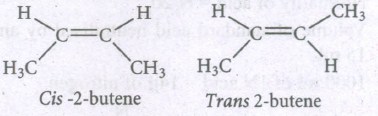
These two compounds are termed as geometrical isomers and are distinguished from each other by the terms cis and trans. The c is isomer is one in which two similar groups are on the same side of the double bond. The trans isomers is that in which the two similar groups are on the opposite side of the double bond, hence this type of isomerism is also called c is trans isomerism.
The cis-isomer can be converted to trans isomer or vice versa is only if either isomer heated to a high temperature or absorbs light. The heats applies the energy (about 62 kcal/mole) to break the n bond so that rotation about o bond becomes possible. Upon cooling, the reformation of the n bond can take place in two ways giving a mixture both cis and trans forms of trans-2-butene and cis-2-butene.
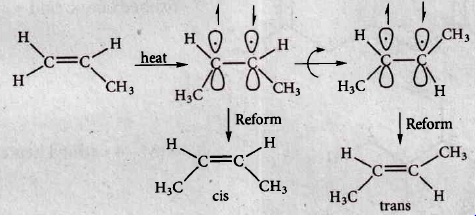
Generally the trans isomer is more stable than the corresponding cis isomers. This is because in the cis isomer, the bulky groups are onthe same side of the double bond. The steric repulsion of the groups makes the cis isomers less stable than the trans isomers in which bulky groups are on the opposite side. These cis and trans isomers have different chemical propery is they can be separated by fractional distillation, gas chromatography etc All alkenes with identical substiate do not show geometrical isomerism. Geometrical isomerism is possible only when each double bonded C atom is attached to two different atoms or groops eg. In piopene no geometrical isomers are possible because one of the ,double bonded carbon has two identical H atoms.
4.
A small piece of Na dried by pressing between the folds of a filter Paper is taken in a fusion tube and it is gently heated.
When it melts to a shining globule, put a pinch of the organic compound on it. Heat the tube till reaction ceases and becomes red hot. Plunge it in about 50 mL of distilled water taken in a china dish and break the bottom of the tube by striking against the dish. Boil the contents of the dish for about 10 mts and filter. This filtrate is known as lassaignes extract or sodium fusion extract and it used for detection of nitrogen, sulfur and halogens present in organic compounds.
If nitrogen is present it gets converted to sodium cyanide which reacts with freshly prepared furro,sulphate and feiric ion followed by conc. HCI and gives a Prussian blue color or green color precipitate. It confirms the presence of nitrogen. HCI is added to dissolve the lreenish precipitate of ferrous hydrbxide iroduced by the excess of NaOH on Feson which would otherwise markthe Prussian blue piecipitate. The following reaction takes part in the formation of Prussian blue.

from organic compounds
\(FeSo_{ 4 }+2NaOH\longrightarrow Fe(OH)_{ 2 }+Na_{ 2 }{ SO }_{ 4 }\)
from organic compounds
\(6FeCN+Fe(OH)_{ 2 }\longrightarrow Na_{ 4 }[Fe(CN)]_{ 6 }+2NaOH\)
Sod.ferrocyanide
\(3Na_{ 4 }[Fe(CN)_{ 6 }]+FeC1_{ 3 }\longrightarrow Fe_{ 4 }[Fe(CN)]_{ 3 }+12NaCI\)
ferric ferrocyanidePrussian blue or greenppt
Incase if both N & S are present, a blood red color is obtained due to the following reactions.
\(\mathrm{Na}+\mathrm{C}+\mathrm{N}+\mathrm{S} \stackrel{\text { Heat }}{\longrightarrow} \mathrm{NaCNS}\)
sodium sulphocyanide
\(3 \mathrm{NaCNS}+\mathrm{FeCl}_3 \longrightarrow \mathrm{Fe}(\mathrm{CNS})_3+3 \mathrm{NaCl}\)
ferric sulphocyanide
(Blood red colour).
5.
Homologous series: A series of organic compounds each containing a characteric functional group and the successive' members differ from each other in molecular formula by a CH2 group is called homologous series. Eg.
Alkanes : Methane (CH4), Ethane (C2H6), Propane (C3Hg) etc .
Alcohols: Methanol (CH3OH), Ethanol (C2H5OH) Propanol (C3H7OH) etc ..)
Compounds of the homologous series are represented by a general formula Alkanes CnH2n+2' Alkenes CnH2n, Alkynes CnH2n-2 and can be prepared by general methods. They show regular gradation in physical properties but have almost similar chemical property.
6.
7.
8.
In steam distillation, the liquid boils when the sum I of vapour pressures due to the organic liquid (P1) and that due to water (P2) becomes equal to the atmospheric pressure (P).
(ie)p = P1 +P2
Since PI
9.
10.
| S.NO. | Dextrorotatory | Lavorotatory |
| (i) | The optical isomer which rotates the plane polarised light to the right or in clockwise direction is said tobe dextrorotatory. | The optical isomerwhich rotates theplane polarisedlight to the leftor in the anti-clockwise directionis said to be lavorotatory. |
| (ii) | It is denotedby (+) sign and represented as 'd. | It is denoted by (-) sign and represented as 'l, |
| (iii) | Eg : d - tartaric acid | Eg : I - tartaric acid |
11.
Compounds having same physical and chemical property but differ only in the rotation of plane of the polarized light are known as optical isomers and the phenomenon is known as optical isomerism.
12.
(i) 2,2-dimethylpentane
(ii) 2,4,7-trimethyloctane
(iii) 2-chloro-4-methyl pentane.
(iv) But-3-yn-l-ol
13.
14.
(i) CH3 - CH3 - sp3 - sp3
(ii) \({ CH }_{ 3 }-\overset { \overset { O }{ || } }{ C } ={ CH }_{ 3 }\) sp3- sp2 - sp3
15.
 5 σ-bonds and 2π-bonds
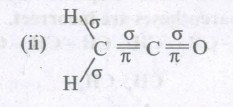 4 σ-bonds and 2π-bonds

11th Standard Syllabus & Materials
11th Standard
TN 11th Tamil பீடு பெற நில் - செய்யுள் - காவடிச்சிந்து Important Questions And Answers Study Material - QB365 Set A
NEW11th Standard
TN 11th Tamil பீடு பெற நில் - உரைநடை - மலை இடப்பெயர்கள் : ஓர் ஆய்வு Important Questions And Answers Study Material - QB365 Set A
NEW11th Standard
TN 11th Tamil மாமழை போற்றுதும் - துணைப்பாடம் - யானை டாக்டர் Important Questions And Answers Study Material - QB365 Set A
NEW11th Standard
TN 11th Tamil மாமழை போற்றுதும் - செய்யுள் - ஐங்குறுநூறு Important Questions And Answers Study Material - QB365 Set A



Tamilnadu Stateboard 11th Standard Subjects

Maths

Commerce

Economics

Biology

Business Maths and Statistics

Accountancy

Computer Science

Physics
Chemistry
Maths
Biology
Economics
Physics
Chemistry

History
Business Maths and Statistics

Computer Science
Accountancy

Computer Applications
History
Computer Technology
Commerce
Computer Applications
Computer Technology

Tamil

English

French
Tamilnadu Stateboard Standards
