
 100% FREE ACCESS
11th Standard Syllabus & Materials
11th Standard
TN 11th Tamil இயற்கை வேளாண்மை,சுற்றுச்சூழல் -செய்யுள் - மனோன்மணீயம் Important Questions And Answers Study Material - QB365 Set A
NEW11th Standard
TN 11th Tamil என்னுயிர் என்பேன் -துணைப்பாடம் - இசைத்தமிழர் இருவர் Important Questions And Answers Study Material - QB365 Set A
NEW11th Standard
TN 11th Tamil மொழி கலை -செய்யுள் - ஒவ்வொரு புல்லையும் Important Questions And Answers Study Material - QB365 Set A
NEW11th Standard
TN 11th Tamil பீடு பெற நில் - இலக்கணம் - பகுபத உறுப்புகள் Important Questions And Answers Study Material - QB365 Set A
NEW11th Standard
TN 11th Tamil பீடு பெற நில் - துணைப்பாடம் - வாடிவாசல் Important Questions And Answers Study Material - QB365 Set A
NEW11th Standard
TN 11th Tamil பீடு பெற நில் - செய்யுள் - குறுந்தொகை Important Questions And Answers Study Material - QB365 Set A

Published on: 26/09/2019
Haloalkanes and Haloarenes
Download Tamil Nadu 11th Standard Chemistry question papers, model tests, one-mark questions, important questions, and public exam papers in PDF format. Free study materials and answer keys for TN State Board students.
Questions + Answers key
Take MCQ Chemistry Test
1.
Why does the preparation of aryl iodides requires the presence of an oxidising agent?
2.
Consider the reaction, R-OH \(\overset { RedP/{ x }_{ 2 } }{ \longrightarrow } \)R-X (where, X = Br,I) Is it possible to prepare aryl halide through the above method? Give reason
3.
Write a note on carbylamine reaction.
4.
How does benzene diazonium chloride react with HBF4?
5.
Define Walden inversion
6.
Write a brief note on ammonolysis of haloalkane.
7.
Starting from CH3MgI, How will you prepare the following?
i) Acetic acid
ii) Acetone
iii) Ethyl acetate
iv) Iso propyl alcohol
v) Methyl cyanide.
8.
What are Freons? Discuss their uses and environmental effects
9.
In an experiment ethyliodide in ether is allowed to stand over magnesium pieces. Magnesium dissolves and product is formed
a) Name the product and write the equation for the reaction.
b) Why all the reagents used in the reaction should be dry? Explain
c) How is acetone prepared from the product obtained in the experiment.
10.
Compare SN1 and SN2 reaction mechanisms.
11.
Mention any three methods of preparation of haloalkanes from alcohols.
12.
Why is it necessary to avoid even traces of moisture during the use of Grignard reagent?
13.
Give reasons for polarity of C-X bond in halo alkane.
14.
What happens when chloroform reacts with oxygen in the presence of sunlight?
15.
What happens when acetyl chloride is treated with excess of CH3MgI?
1.
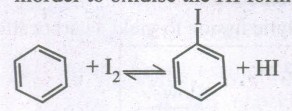
Reactions of arenes with iodine is reversible in nature. So aryl iodides are prepared in the presence of an oxideising agent such as HNO3, HIO4, etc., inorder to oxidise the HI formed during iodination.
2.
R-OH \(\overset { RedP/{ x }_{ 2 } }{ \longrightarrow } \)R-X (X-Br,I)
This method is not applicable for the preparation of aryl haldies because the C - 0 bond in phenol has a partial double bond character and it is difficult to break being stronger than a single bond.
3.
Carbylamine reaction:
Chloroform reacts with aliphatic or aromatic primary amine and alcoholic caustic potash, to give foul smelling alkyl isocyanide (carbylamines).
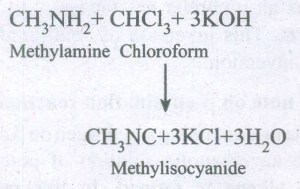
This reaction is used to test primary amine.
4.
Fluoro benzene is prepared by treating benzene diazonium chloride with fluoro boric acid. This reaction produces diazoriium fluoroborate which on heating produces fluorobenzene. This reaction is called Balz - Schiemann reaction.
\(\underset { Benzene\ diazonium \ chloride }{ { C }_{ 6 }{ H }_{ 5 }{ N }_{ 2 }Cl } +HB{ F }_{ 4 }\overset { \longrightarrow }{ -HCl } { C }_{ 6 }{ H }_{ 5 }{ N }_{ 2 }BF\overset { \longrightarrow }{ heat } \underset { Fluorobenzene }{ { C }_{ 6 }{ H }_{ 5 }F+{ BF }_{ 3 }+{ N }_{ 2 } } \)
5.
The attack of nucleophile occurs from the back side (i.e opposite to the side in which the halogen is attacked). The carbon at which substitution occurs has inverted configuration during the course of reaction just as an umbrella has tendency to invert in a wind storm. This inversion of configuration is called Walden inversion.
6.
Reaction with alcoholic ammonia (Ammonolysis) Haloalkanes react with alcoholic ammonia solution to form alkyl amines.
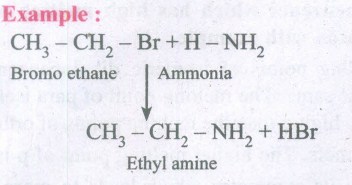
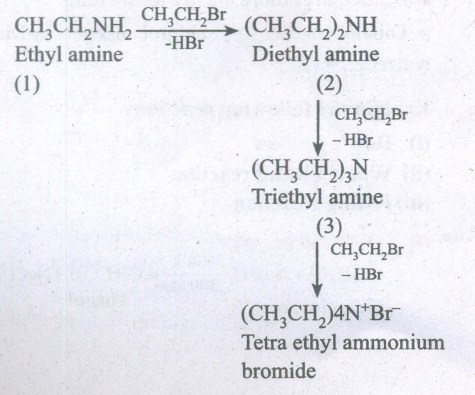
However, with excess of halo alkane, secondary and tertiary amines along with quartenary ammonium salts are obtained.
7.
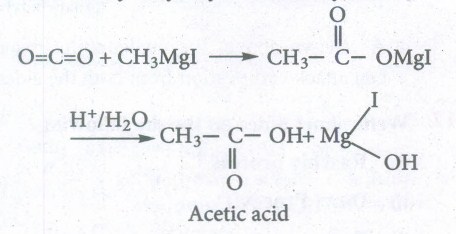
i) Acetic acid: Solid carbon dioxide reacts with Grignard reagent to form addition product which on hydrolysis yields carboxylic acids.
ii) Acetone :
\(\underset { Iodomethane }{ { CH }_{ 3 }-I+Mg } \overset { dryether }{ \longrightarrow } \underset { Methyl \ magnesium \ iodide }{ { CH }_{ 3 }MgI } \)
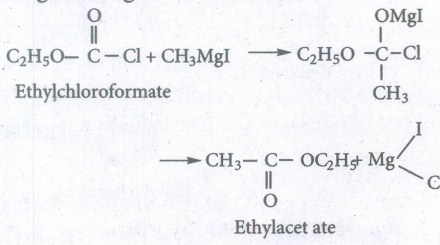
iii) Ethyl acetate: Ethy1chloroformate reacts with Grignard reagent to form esters.
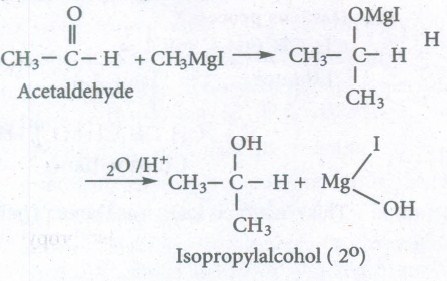
iv) Iso propyl alcohol : Aldehydes other than formaldehyde, react with Grignard reagent to give addition product which on hydrolysis yields secondary alcohol.
v) Methyl cyanide : Grignard reagent reacts with cyanogen chloride to from alkyl cyanide

8.
Freons (CFC): The chloro uoro derivatives of methane and ethane are called freons.
Uses:
(i) Freons are a used as refrigerants in refrigerators and air conditioners.
(ii) It is used as a propellant for aerosols and foams
(iii) It is used as propellant for foams to spray out deodorants, shaving creams, and insecticides
9.
a) The product formed is ethylmagnesium iodide (Grignard reagent)
\({ C }_{ 2 }{ H }_{ 5 }+Mg\overset { dryether }{ \rightarrow } { { C }_{ 2 }H }_{ 5 }Mgl\)
Ethyl magnesium iodide
b) The Grignard carbon is highly basic and reacts with acidic protons of polar solvents like water to form an alkani so all reagents should be pure and dry.

10.
| SN1 Reaction | SN2 product |
| It is unimolecular reaction | It is a bimolecular reaction. |
| Its mechanism occurs in two steps | It is a one step process |
| It involves the formation of an intermediate (Carbocation) | It involves the formation of transition sate. |
| Rate = k[Alkyl halide] | Rate = k[Alkyl halide] [Nuclophile] |
| Products have both retained and inverted configuration | Products have inverted configuration. |
| Carbocation rearrangement occurs. | No carbocation rearrangement occurs. |
| Reactirity : Methyl <1 ° < 2° < 3° |
IReactirity : Methyl >1° > 2° > 3° |
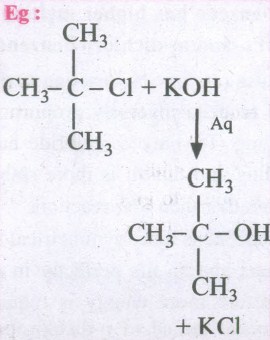 |
Eg: \(CH_{ 3 }Cl+KOH\overset { Aq }{ \rightarrow } { CH }_{ 3 }OH+KCl\) |
11.
Alcoholscanbeconvertedintohaloalkenesbyreactingit withanyoneofthefollowingreagent
1.hydrogen halide
2. Phosphorous halides
3. Thionyl chloride
a) Reaction with hydrogen halide:
\(\underset { Ethanol }{ { CH }_{ 3 }{ CH }_{ 2 }OH+HCl } \overset { Anhydrous\\ ZN{ Cl }_{ 2 } }{ \underset { \triangle }{ \longrightarrow } } \underset { Chloroethane }{ { CH }_{ 3 }{ CH }_{ 2 }Cl+{ H }_{ 2 }O } \)
Mixture of con.HCI and anhydrous ZnCl2 is called Lucas reagent
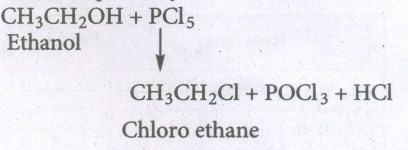
b) Reaction with phosphorous halides :
Alcohols react with PX5 or PX3 to form haloalkane. PBr3 and PI3 are usually generated in situ (produced in the reaction mixture) by the reaction of red phosphorus with bromine and iodine, respectively.
c)Reaction with thionyl chloride :
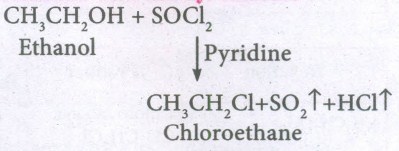
This reaction is known as Darzen's halogenation
12.
If moisture is present, the Grignard reagent will react with water to give alkanes.
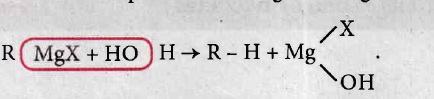
So. moisture should not be present
13.
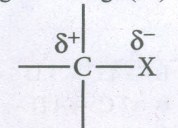
Carbon halogen bond is a polar bond as halogens are more electro negative than carbon. The carbon atom exhibits a partial positive charge (\(\delta \)+) and halogen atom a partial negative charge (\(\delta \)-)
The C -X bond is formed by overlap of sp3 orbital of carbon atom I with half filled p-orbitat of the halogen atom. The atomic size of halogen increases from fluorine to iodine, which increases the C - X bond length. Larger the size, greater is the bond length, and weaker is the bond formed. The bond strength of C - X decreases from C - F to C - I in CH3X
14.
Chloroform undergoes oxidation in the presence of light and air to form phosgene (carbonyl chloride)
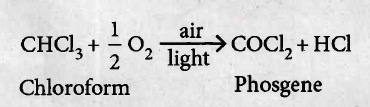
Since phosgene is very poisonous, its presence makes chloroform unfit for use as anaesthetic.
15.
With acetyl chloride, CH3MgI given first acetone.
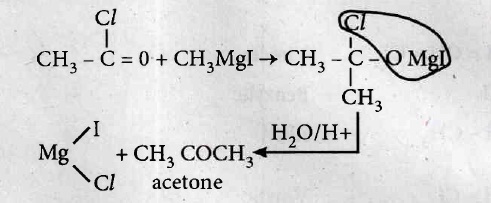
The acetone formed will react with excess CH3MgI to give a tertiary alcohol, t - butyl alcohol.


11th Standard Syllabus & Materials
11th Standard
TN 11th Tamil பீடு பெற நில் - செய்யுள் - காவடிச்சிந்து Important Questions And Answers Study Material - QB365 Set A
NEW11th Standard
TN 11th Tamil பீடு பெற நில் - உரைநடை - மலை இடப்பெயர்கள் : ஓர் ஆய்வு Important Questions And Answers Study Material - QB365 Set A
NEW11th Standard
TN 11th Tamil மாமழை போற்றுதும் - துணைப்பாடம் - யானை டாக்டர் Important Questions And Answers Study Material - QB365 Set A
NEW11th Standard
TN 11th Tamil மாமழை போற்றுதும் - செய்யுள் - ஐங்குறுநூறு Important Questions And Answers Study Material - QB365 Set A



Tamilnadu Stateboard 11th Standard Subjects

Maths

Commerce

Economics

Biology

Business Maths and Statistics

Accountancy

Computer Science

Physics
Chemistry
Maths
Biology
Economics
Physics
Chemistry

History
Business Maths and Statistics

Computer Science
Accountancy

Computer Applications
History
Computer Technology
Commerce
Computer Applications
Computer Technology

Tamil

English

French
Tamilnadu Stateboard Standards
