
 100% FREE ACCESS
11th Standard Syllabus & Materials
11th Standard
TN 11th Tamil இயற்கை வேளாண்மை,சுற்றுச்சூழல் -செய்யுள் - மனோன்மணீயம் Important Questions And Answers Study Material - QB365 Set A
NEW11th Standard
TN 11th Tamil என்னுயிர் என்பேன் -துணைப்பாடம் - இசைத்தமிழர் இருவர் Important Questions And Answers Study Material - QB365 Set A
NEW11th Standard
TN 11th Tamil மொழி கலை -செய்யுள் - ஒவ்வொரு புல்லையும் Important Questions And Answers Study Material - QB365 Set A
NEW11th Standard
TN 11th Tamil பீடு பெற நில் - இலக்கணம் - பகுபத உறுப்புகள் Important Questions And Answers Study Material - QB365 Set A
NEW11th Standard
TN 11th Tamil பீடு பெற நில் - துணைப்பாடம் - வாடிவாசல் Important Questions And Answers Study Material - QB365 Set A
NEW11th Standard
TN 11th Tamil பீடு பெற நில் - செய்யுள் - குறுந்தொகை Important Questions And Answers Study Material - QB365 Set A

Published on: 26/09/2019
Hydrocarbons
Download Tamil Nadu 11th Standard Chemistry question papers, model tests, one-mark questions, important questions, and public exam papers in PDF format. Free study materials and answer keys for TN State Board students.
Questions + Answers key
Take MCQ Chemistry Test
1.
How is propyne prepared from an alkyene dihalide?
2.
Suggest the route for the preparation of the following from benzene.
3 – chloro nitrobenzene
3.
How does Huckel rule help to decide the aromatic character of a compound.
4.
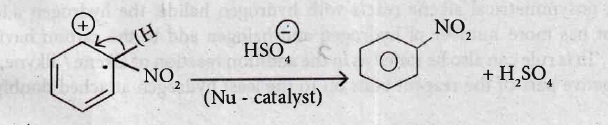
Describe the mechanism of Nitration of benzene.
5.
(i) Which salt of carboxylic acid will be required to prepared ethane by sodalime decarboxylation? Give equation for the reation?
(ii) Sodium salt of which acid is required for the preparation of butane? Write chemical equation for the reaction.
6.
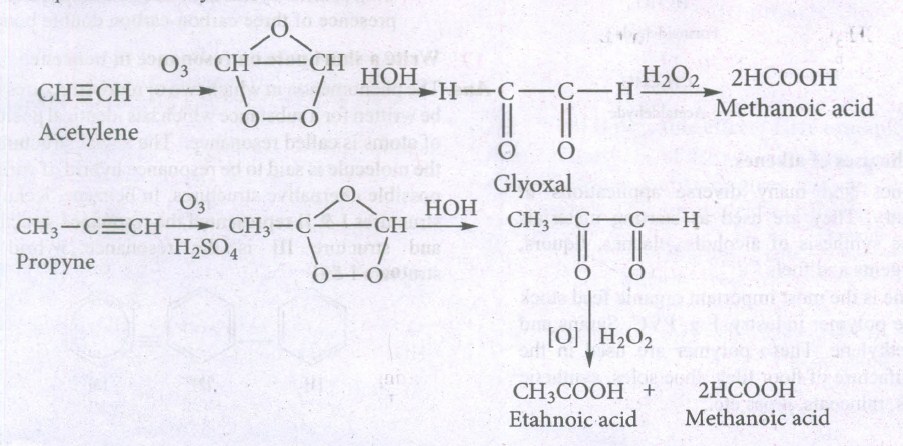
Write a note on Ozonolysis of
i) Acetylene
ii) Propyne
7.
Why benzene undergoes substitution reaction more readily than addition reaction?
8.
List out the uses of alkynes.
9.
List out the uses of alkenes.
10.
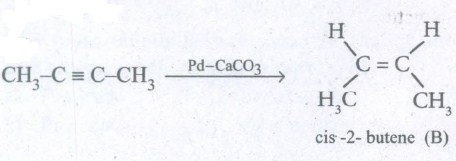
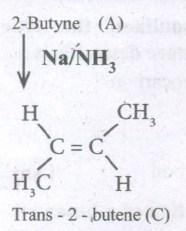
Identify A, Band C from the following equation
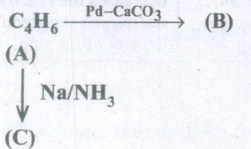
11.
How are branched alkanes formed from normal alkanes?
12.
Define benzenoid and non-benzenoid compounds with example.
13.
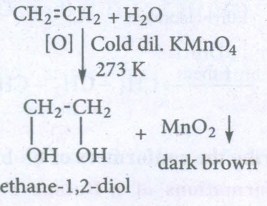
What happens when ethylene is passed through cold dilute alkaline potassium permanganate.
14.
Explain Markow nikoff's rule with suitable example.
15.
Write the chemical equations for combustion of propane.
1.
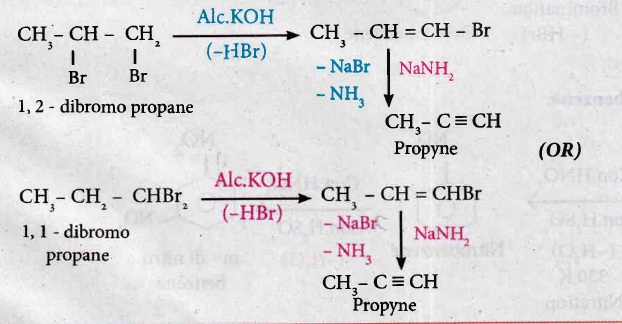
2.
3 - chloro nitrobenzene :
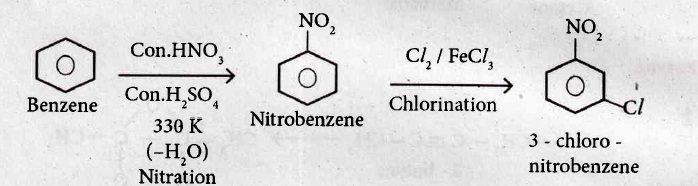
3.
Huckel proposed that aromaticity is a function of electronic structure. A compound may be aromatic, if it obeys the following rules
(i) The molecule must be co-planar
(ii) Complete delocalization of \(\pi\) electron in the ring
(iii) Presence of (4n+2) \(\pi\) electrons in the ring where n is an integer (n = 0,1,2 .... ) This is known as Huckel's rule.
Eg:
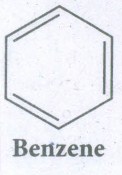
(i) The benzene is a planar molecule
(ii) It has six deloclaised \(\pi\) electoms
(iii) 4n + 2 = 6
4n = 6-2
4n = 4
n = 1
it obeys Huckel's (4n+2) \(\pi\) electron rule with n = 1 hence, benzene is aromatic.
4.
Benzene undergoes nitration reaction becasuse it is an elecron - rich system due to delocalised \(\pi\) electron. So it is easily attacked by electrophiles and gives substituted products.

Mechanism:
Step - I : Formafion of the electrophile:

Step - II : Formation of carbocation intermediate:
The electrophile attacks the aromatic ring to form a carbocation intermediate which is stabilised by resonance.

Step - III: Formation of nitro benzene:
The electrophile attacks the artomatic ring to fo
5.
(i) Sodium Propionate:
\(\underset { Sodium\quad Propionate }{ C{ H }_{ 3 }C{ H }_{ 2 }CO{ O }^{ - }N{ A }^{ + } } +NaOH\overset { CaO }{ \underset { \Delta }{ \longrightarrow } } \underset { Ethane }{ C{ H }_{ 3 }-C{ H }_{ 3 } } +N{ a }_{ 2 }C{ O }_{ 3 }\)
(ii) Pentanoic acid:
\(C{ H }_{ 3 }C{ H }_{ 2 }C{ H }_{ 2 }C{ H }_{ 2 }COONa+NaOH+NaOH\overset { CaO }{ \underset { \Delta }{ \longrightarrow } } C{ H }_{ 3 }C{ H }_{ 2 }C{ H }_{ 2 }C{ H }_{ 3 }+N{ a }_{ 2 }C{ O }_{ 3 }\)
6.
Ozone adds to carbon-carbon triple bond of alkynes to form ozonides. The ozonides are hydrolyzed by water to form carbonyl compounds. The hydrogen peroxide (H2O2) formed in the reaction may cxidise the carbonyl compound to carboxylic acid.
7.
(i) Benzene contains delocalized \(\pi\)-electrons which make the ring to act as an electro rich centre. So electrophilic substitution reaction occurs in benzene.
(ii) Benzene ring is stabilized by delocalized \(\pi\) electrons. Though it is highly stable, it undergoes addition and oxidation reaction under specic conditions.
8.
1) Acetylene is used in oxyacetylene torch used for welding and cutting metals.
2) It is used for manufacture of PVC, polyvinyl acetate, polyvinyl ether, orlon and neoprene rubbers.
9.
1) Alkenes find many diverse applications in industry. They are used as starting materials in the synthesis of alcohols, plastics, liquors, detergents and fuels
2) Ethene is the most important organic feed stock in the polymer industry. E.g. PVC, Sarans and polyethylene. These polymer are used in the manufacture of floor tiles, shoe soles, synthetic fibres, raincoats, pipes etc.,
10.
11.
Isomerisation is a chemical process by which a compound is transformed into any its isomeric forms. Normal alkanes can be converted into branched alkanes in the presence of AICl3 and HCI at 298 K.
CH3 - CH2 - CH2 - CH3 \(\overset { AIC{ I }_{ 3 }/HCI }{ \underset { 298\quad K }{ \longrightarrow } } \overset { { CH }_{ 3 }-CH-{ CH }_{ 3 } }{ \underset { { CH }_{ 3 } }{ | } } \)
This process is of great industrial importance. The quality of gasoline is improved by isomerising its components.
12.
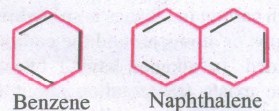
(i) Benzenoid compounds:
Benzene and its derivatives are called benzenoid compounds
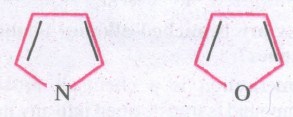
(ii) Non-benzenoid compounds:
The aromatic compounds that are not have benzene ring in their structure are called non-benzenoid compounds.
13.
Ethene reacts with cold alk KMno4 (Balyer's regent to give ethane 1,2 - diol
14.
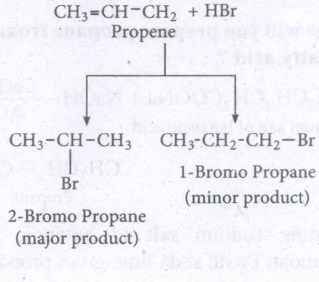
Markovnikoff's rule: "When an unsymmetrical alkene reacts with hydrogen halide, the hydrogen adds to the carbon that has more number of hydrogen and halogen add to the carbon having fewer hydrogen".
Eg: Addition HBr to unsymmetrical alkene: In the addition of hydrogen halide to an unsymmetrical alkene, two products are obtained.
15.
Propane burns in excess of oxygen to form water and carbon di oxide.
CH2CH2CH3 + 502 \(\rightarrow\) 3CO2 + 4H2O
Propane

11th Standard Syllabus & Materials
11th Standard
TN 11th Tamil பீடு பெற நில் - செய்யுள் - காவடிச்சிந்து Important Questions And Answers Study Material - QB365 Set A
NEW11th Standard
TN 11th Tamil பீடு பெற நில் - உரைநடை - மலை இடப்பெயர்கள் : ஓர் ஆய்வு Important Questions And Answers Study Material - QB365 Set A
NEW11th Standard
TN 11th Tamil மாமழை போற்றுதும் - துணைப்பாடம் - யானை டாக்டர் Important Questions And Answers Study Material - QB365 Set A
NEW11th Standard
TN 11th Tamil மாமழை போற்றுதும் - செய்யுள் - ஐங்குறுநூறு Important Questions And Answers Study Material - QB365 Set A



Tamilnadu Stateboard 11th Standard Subjects

Maths

Commerce

Economics

Biology

Business Maths and Statistics

Accountancy

Computer Science

Physics
Chemistry
Maths
Biology
Economics
Physics
Chemistry

History
Business Maths and Statistics

Computer Science
Accountancy

Computer Applications
History
Computer Technology
Commerce
Computer Applications
Computer Technology

Tamil

English

French
Tamilnadu Stateboard Standards
