
 100% FREE ACCESS
11th Standard Syllabus & Materials
11th Standard
TN 11th Tamil இயற்கை வேளாண்மை,சுற்றுச்சூழல் -செய்யுள் - மனோன்மணீயம் Important Questions And Answers Study Material - QB365 Set A
NEW11th Standard
TN 11th Tamil என்னுயிர் என்பேன் -துணைப்பாடம் - இசைத்தமிழர் இருவர் Important Questions And Answers Study Material - QB365 Set A
NEW11th Standard
TN 11th Tamil மொழி கலை -செய்யுள் - ஒவ்வொரு புல்லையும் Important Questions And Answers Study Material - QB365 Set A
NEW11th Standard
TN 11th Tamil பீடு பெற நில் - இலக்கணம் - பகுபத உறுப்புகள் Important Questions And Answers Study Material - QB365 Set A
NEW11th Standard
TN 11th Tamil பீடு பெற நில் - துணைப்பாடம் - வாடிவாசல் Important Questions And Answers Study Material - QB365 Set A
NEW11th Standard
TN 11th Tamil பீடு பெற நில் - செய்யுள் - குறுந்தொகை Important Questions And Answers Study Material - QB365 Set A

Published on: 26/09/2019
Solutions
Download Tamil Nadu 11th Standard Chemistry question papers, model tests, one-mark questions, important questions, and public exam papers in PDF format. Free study materials and answer keys for TN State Board students.
Questions + Answers key
Take MCQ Chemistry Test
1.
State Raoult law and obtain expression for lowering of vapour pressure when nonvolatile solute is dissolved in solvent.
2.
Explain why the aquatic species are more comfortable in cold water during winter season rather than warm water during the summer.
3.
A litre of sea water weighing about 1.05 kg contains 5 mg of dissolved oxygen (O2). Express the concentration of dissolved oxygen in ppm.
4.
Define solubility.
5.
What are the non-aqueous solution ? Give example
6.
Define solution
7.
Define colligative properties.
8.
Write a short note on Van't Hoff equation
9.
why a solution of KCL in water deviates from ideal behaviour ?
10.
why acetic acid deviates from ideal behaviour in solutions ?
11.
State Raoult's law
12.
Define the term ‘isotonic solution’.
13.
Define molality
14.
Explain the effect of pressure on the solubility.
15.
State and explain Henry’s law.
1.
Raoult law states that. "in the case of a solution of volatile liquids, the partial vapour pressure of each component (A & B) of the solution is directly proportional to its mole fraction.
According to Raoult's law,
PA \(\alpha\) XA
pA = K XA
When xA = 1, k = \({ p }_{ A }^{ 0 }\)
Where \({ p }_{ A }^{ 0 }\) is the vapour pressure of pure component 'A' at the same temperature
"The relative lowering of vapour pressure of an ideal solution containing the nonvolatile solute is equal to the mole fraction of the solute at a given temperature".
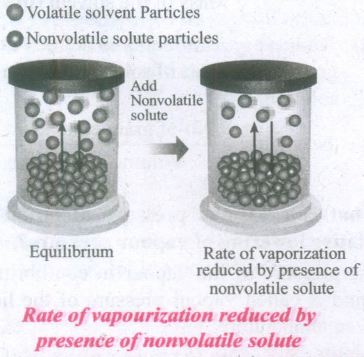
Derivation:
when sodium chloride is added to the water, the vapour pressure of the salt solution is lowered. The vapour Pressure of the solution is determined by the number of molecules of the solvent present in the surface at any time and is proportional to the mole fraction of the solvent.
Psolution \(\infty \) XA
Where XA is the mole fraction of the solvent
Psolution = K XA
When XA = 1, K = P0 solvent
\({ P }_{ solvent }^{ 0 }\) is the partial pressure of pure solvent
Psolution = \({ P }_{ solvent }^{ 0 }\) XA
\(\frac { { P }_{ solution } }{ { P }_{ solvent }^{ 0 } } ={ X }_{ A }\)
\(1-\frac { { P }_{ solution } }{ { P }_{ solvent }^{ 0 } } 1-{ X }_{ A }\)
\(\frac { { P }_{ solvent }^{ 0 }-{ P }_{ solution } }{ { P }_{ solvent }^{ 0 } } ={ x }_{ B }\)
Where XB the mole fraction of the solute
( \(\because\) XA + AB = 1, XB = 1 - XA)
The above expression gives the relative lowering of vapour pressure. Based on this expression, Raoult's law can also be stated as "the relative lowering of vapour pressure of an ideal solution containing, the nonvolatile solute is equal to the mole fraction of the solute at a given temperature".
2.
The amount of dissolved oxygen in water decreases with rise in water's temperature. Cold water has more dissolved oxygen per unit area than warm water. So they are more comfortable is cold water during winter. During summer the warm water contain less dissolved oxygen.
3.
ppm = \({mass\ of\ dissolved\ solid\over mass\ of\ water}\times 10^6\)
\({5\times 10^{-3}\ g\over 1.05\times 10^{3}\ g}\times 10^6=\) 4.76 ppm.
4.
The solubility of a substance at a given temperature is defined as the amount of the solid that dissolves in 100 g of the solvent at a given temperature to form a saturated solution.
5.
If the water is not the solvent, the solution is non- aqueous solution. (Benzene, CCI4, ether etc., act as solvent in these solutions).
6.
Solution is a homogeneous mixture of two or more substances. If the water is the solvent in the solution, then it is an aqueous solution.
7.
For an ideal dilute solution, the properties, namely, relative lowering of vapour pressure, elevation of boiling point, depression in freezing point and osmotic pressure do not depend on the chemical nature of the solute but depends only on the number of solute· particles (ions/molecules) present in the solution. These four properties are known as colligative properties.
8.
Van't Hoff found out that for dilute solutions, the osmotic pressure is directly proportional to the molar concentration ofthe solute and the temperature of the solution. He proposed the following equation to calculate osmotic pressure which is now called as van't Hoff equation.
\(\pi\) = cRT
Here,
c = Concentration of the solution in molarity
T = Temperature
R = Gas constant
9.
A solution of potassium chloride in water deviates from ideal behavior because the solute dissociates to give K+ and CI- ion which form strong ion-dipole interaction with water molecules.
\(\mathrm{KCl}_{(3)}+\mathrm{H}_{2} \mathrm{O}(l) \rightarrow \mathrm{K}^{+}(\mathrm{aq})+\mathrm{Cl}^{-}(\mathrm{aq})\)
10.
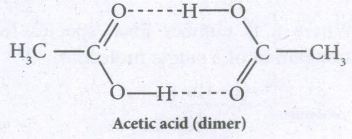
In solution, acetic acid exists as a dimer by forming intermolecular hydrogen bonds, and hence deviates from Raoult's law.
11.
This law states that "in the case of a solution of volatile liquids, the partial vapour pressure of each component (A & B) of the solution is directly proportional to its mole fraction".
According to Raoult's law,
PA \(\alpha\) XA
PA = K XA
when XA = 1, K p p0
where p0 A is the vapour pressure of pure component 'A' at the same temperature.
Therefore, pA = \({ p }_{ A }^{ 0 }x_{ A }\)
12.
Two solutions having same osmotic pressure at a given temperature are called isotonic solutions.
13.
Molality : It is the number of moles of the solute present one kg of the solvent
Molality = \(\frac { No.of \ moles\ of \ solute }{ Mass\ of\ the\ solvent\ (in\ kg) } \)
14.
Generally the change in pressure does not have any significant effect in the solubility of solids and liquids as they are not compressible. However, the solubility of gases generally increases with increase of pressure.
Consider a saturated solution of a gaseous solute dissolved in a liquid solvent in a closed container. In such a system, the following equilibrium exists.
Gas (in gaseous state) = Gas (in solution)
According to Le-Chatelier principle, the increase in pressure will shift the equilibrium in the direction which will reduce the p.ressure. Therefore, more number of gaseous molecules dissolves in the solvent and the solubility increases.
15.
Henry's law states that, "the partial pressure of the gas in vapour phase is directly proportional to the mole fraction(x) of the gaseous solute in the solution at low concentrations".
Henry's law can be expressed as,
\(\rho \)solute \(\alpha\) X solute in solution
Psolute = KHx solute in solution
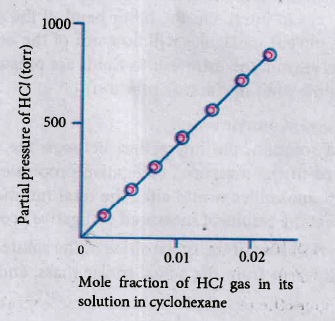
Explanation: Here, Psolute represents the partial pressure of the gas in vapour state which is commonly called as vapour pressure. x solute in solution represents the mole fraction of solute in the solution. KH is a empirical consiint with the dimensions of pressure. The value of 'KH' depends on the nature of the gaseous solute and solvent. The above equation is a straight-line in the form of y = mx. The plot partial pressure of the gas against its mole fraction in a solution will give a straight line as shown in fig The slope of the. straight line gives the value of KH.
Limitation of Henry's law:
i) Henry's law is applicable at moderate temperature and pressure only.
ii) Only the less soluble gases obeys Henry's law.
iii) The gases reacting with the solvent do not obey Henlry s law For example, ammonia or HCI reacts \Mith water and hence does not obey this law.
\(\mathrm{NH}_3+\mathrm{H}_2 \mathrm{O} \leftrightarrows \mathrm{NH}_4^{+}+\mathrm{OH}^{-}\)
(iv) The gases obeying Henry's law should not associate or dissociate while dissolving in the solvent.

11th Standard Syllabus & Materials
11th Standard
TN 11th Tamil பீடு பெற நில் - செய்யுள் - காவடிச்சிந்து Important Questions And Answers Study Material - QB365 Set A
NEW11th Standard
TN 11th Tamil பீடு பெற நில் - உரைநடை - மலை இடப்பெயர்கள் : ஓர் ஆய்வு Important Questions And Answers Study Material - QB365 Set A
NEW11th Standard
TN 11th Tamil மாமழை போற்றுதும் - துணைப்பாடம் - யானை டாக்டர் Important Questions And Answers Study Material - QB365 Set A
NEW11th Standard
TN 11th Tamil மாமழை போற்றுதும் - செய்யுள் - ஐங்குறுநூறு Important Questions And Answers Study Material - QB365 Set A



Tamilnadu Stateboard 11th Standard Subjects

Maths

Commerce

Economics

Biology

Business Maths and Statistics

Accountancy

Computer Science

Physics
Chemistry
Maths
Biology
Economics
Physics
Chemistry

History
Business Maths and Statistics

Computer Science
Accountancy

Computer Applications
History
Computer Technology
Commerce
Computer Applications
Computer Technology

Tamil

English

French
Tamilnadu Stateboard Standards
