100% FREE ACCESS
9th Standard CBSE Syllabus & Materials
9th Standard CBSE
CBSE 9th Science Is matter around us pure? - New Model Questions Papers Study Material - QB365 Set A
NEW9th Standard CBSE
CBSE 9th Science Matter in our surroundings - New Model Questions Papers Study Material - QB365 Set A
NEW9th Standard CBSE
CBSE 9th Mathematics Heron's Formula Sample Question Papers Study Material - QB365 Set A
NEW9th Standard CBSE
CBSE 9th Mathematics Circles Sample Question Papers Study Material - QB365 Set A
NEW9th Standard CBSE
CBSE 9th Mathematics Quadrilaterals Sample Question Papers Study Material - QB365 Set A
NEW9th Standard CBSE
CBSE 9th Mathematics Triangles Sample Question Papers Study Material - QB365 Set A

Published on: 31/12/2018
IX Grade Revision Test
Download CBSE Class 9th Standard CBSE Mathematics question papers, sample papers, important questions, and previous year solved papers in PDF format. Get free study materials, NCERT solutions, and exam preparation resources for Class 9th Standard CBSE Mathematics
Questions + Answers key
Take MCQ Mathematics Test
1.
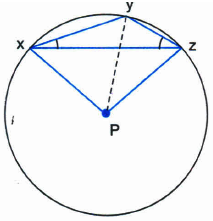
In the figure, P is the centre of a circle. Prove that \(2(\angle XZY+\angle YXZ)=\angle XPZ\)
2.
ABCD is a parallelogram and line segments AX, CY bisects the angles A and C respectively. Show that AX II CY.
3.
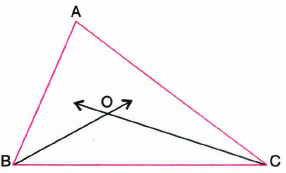
In figure the bisectors of \(\angle ABC\) and \(\angle BCA\) intersect each other at the point O.prove that \(\angle BOC=90^{ 0 }+\frac { 1 }{ 2 }\angle A\)
4.
Evaluate 105 x 93 without multiplying directly.
5.
Find two irrational numbers between \(\frac { 1 }{ 3 } \)and \(\frac { 1 }{ 2 } \)
6.
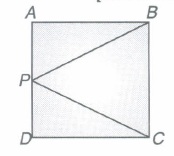
In the figure below, ABCD is a square and P is the mid-point of AD. BP and CP are joined. Prove that \(\angle\)PCB = \(\angle\)PBC.
7.
Simplify: (4√3 - 3√5)2
8.
Find the mode of the following data:
| 1 | 3 | 5 | 7 | 3 |
| 5 | 4 | 7 | 2 | 6 |
| 7 | 12 | 10 | 11 | 3 |
| 7 | 8 | 6 | 7 | 7 |
| 4 | 2 | 11 | 7 | 15 |
9.
Find the volume, total surface area, lateral surface area and the length of diagonal of a cube, each of whose edges measures 20 cm.
10.
A triangle and a parallelogram have the same base and the same area. If the sides of the triangle are 26 cm, 28 cm and 30 cm, and the parallelogram stands on the base 30 cm, find the height of the parallelogram.
11.
In the adjoining figure is a circle with centre O. If \(\angle BAC=60°\) and \(\angle DCB=100°\), then find \(\angle DBC\) .
12.
See figure and complete the following statements:
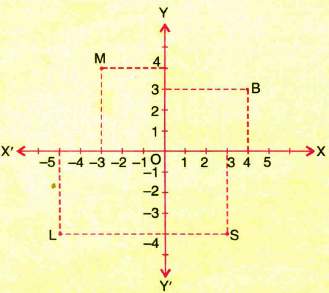
(i) The abscissa and the ordinate of the point B are ________ and _________ respectively.Hence the coordinates of B are (________).
(ii) The x-coordinate and the y-coordinate of the point M are _______ and ________ respectively. Hence the coordinates of M are (________)
(iii) The x-coordinate and the y-coordinate of the point L are _______and _________ respectively. Hence the coordinates of L are (__________)
(iv) The x-coordinate and the y-coordinate of the point S are ________ and __________respectively. Hence the coordinates of S are (__________)
13.
If \(x^3-5x^2-px+25=(x-4)q(x)\) then what is the value of p?
14.
Prove that the perimeter of a triangle is greater than the sum of its three altitudes.
15.
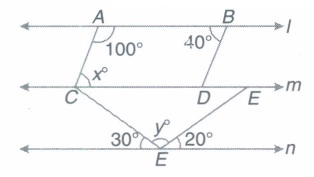
In the given figure, l||m||n. From the figure, find the ratio of (x+y):(y-x).
16.
Find the values of 'a' and 'b' when \(\frac { 5+\sqrt { 6 } }{ 5-\sqrt { 6 } } \) = a + b√6
17.
100 surnames were randomly picked up from a local telephone and a frequency distribution of the number of letters in the English alphabet in the surnames was found as follows:
| Number of letters | Number of surnames |
| 1-4 | 6 |
| 4-6 | 30 |
| 6-8 | 44 |
| 8-12 | 16 |
| 12-20 | 4 |
(i) Draw a histogram to depict the given information.
(ii) Write the class interval in which the maximum number of surnames lie.
18.
A cuboidal water tank is 6 m long, 5 m wide and 4.5 m deep. How many litres of water can it hold? (1 m3 = 1000 l)
19.
An isosceles triangle has perimeter 30 cm and each of the equal sides is 12 cm. Find the area of the triangle.
20.
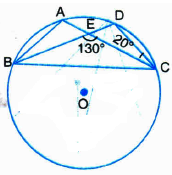
In the above figure, chords BD and AC intersect at the point E such that \(\angle BEC=130°\) and \(\angle ECD=20°\). Find the measure of \(\angle BAC\).
21.
The co-ordinates of points given in the following table represent some of the solutions of the equation. y - 5x = 2.
| x | 1 | - | - | -2 | 2 | - |
|---|---|---|---|---|---|---|
| y | - | 17 | -3 | - | - | 3 |
Find the missing values.Also find the coordinates of the points where the line cuts x-axis and y-axis
22.
The class-mark of the class 130-150 is
23.
Find the amount of water displaced by a solid spherical ball of diameter 4.2 cm, when it is completely immersed in water.
24.
If a 60o angle is bisected twice,what will be measure of each that is constructed?
25.
D, E, F are the mid-points of sides BC, CA and AB of ΔABC. If perimeter of ΔABC is 12·8 cm, then perimeter of ΔDEF is: .....
26.
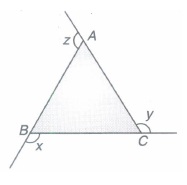
In the figure below, if x,y and z are exterior angles of \(\triangle ABC\), then calculate the value of x+y+z.
27.
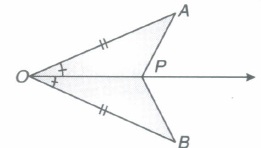
Given\(\triangle OAP\cong \triangle OBP\) in the figure below. Prove the criteria by which the triangles are congruent.
28.
Write the number of dimension(s) of a surface.
29.
Draw the graph representing the equation of x + y = 0.
30.
Find two rational numbers between 4 and 5
31.
What is the degree of the polynomial (x3+5) (4-x5)?
32.
For spreading the message "Save Girl Child Save Future" a rally was organized by some students of a school. They were given triangular cardboard piece PQR which they divided in to two parts by drawing the angle bisectors QO and RO of base angles Q and R and wrote a slogan. Prove that \(\angle\)QOR = 90° + \(\frac{1}{2}\)\(\angle\)P. What is the benefit of these types of rallies?
33.
Geetha told her classmate Radha that "\(\sqrt { \frac { \left( \sqrt { 2 } -1 \right) }{ \left( \sqrt { 2 } +1 \right) } } \) is an irrational number." Radha replied that "you are wrong" and further claimed that "If there is a number 'x' such that x3 is an irrational number, then x5 is also irrational". Geetha said, "No Radha, you are wrong". Radha took some time and after verification accepted her mistakes and thanked Geetha for pointing out these mistakes.
(i) Justify both the statements.
(ii) What value is depicted from this question?
1.
Given: P is the centre of a circle.
To prove: \(2(\angle XZY+\angle YXZ)=\angle XPZ\)
Proof: \(\angle XPY=2\angle XZY\) ....................(1)
| The angle subtended by an arc of a circle at the centre is twice the angle subtended by it at any point on the remaining part of the circle
\(\angle YPZ=2\angle YXZ\) ...............(2)
| The angle subtended by an arc of a circle at the centre is twice the angle subtended by it at any point on the remaining part of the circle
Adding (1) and (2), we get
\(\angle XPY+\angle YPZ=2\angle XZY+2\angle YXZ\)
⇒ \(\angle XPZ=2(\angle XZY+\angle YXZ)\)
⇒ \(2(\angle XZY+\angle YXZ)=\angle XPZ\).
2.
Given: ABCD is a parallelogram and line segments AX, CY bisect the angles A and C respectively.
To Prove: AX IICY.
Proof: \(\because\) ABCD is a parallelogram.
\(\therefore\) \(\angle \)A = \(\angle \)C I Opposite \(\angle \)s of a parallelogram are equal
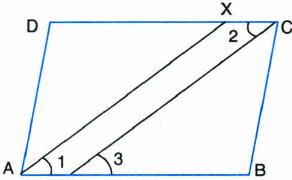
⇒ \(1\over 2\)\(\angle \)A=\(1\over 2\)
⇒ \(\angle \)1 = \(\angle \)2 ...(1) I \(\because\) AX is the bisector of \(\angle \)A and CY is the bisector of \(\angle \)C
\(\therefore\) \(\angle \)2 =\(\angle \)3 ....(2) I Alternate interior \(\angle \) s
From (1) and (2), we get
\(\angle \)1 = \(\angle \)3
But these form a pair of equal corresponding angles
\(\therefore\) AX II CY.
3.
\(\therefore \) BO is the bisector of \(\angle ABC\)
\(\therefore \angle OBC=\frac { 1 }{ 2 } \angle ABC=\frac { 1 }{ 2 } \angle B\)
\(\therefore \) CO is the bisector of \(\angle ACB\)
\(\angle OCB=\frac { 1 }{ 2 } \angle ACB=\frac { 1 }{ 2 } \angle C\)
In OBC ,\(\angle BOC+\angle OBC+\angle OCB=180^{ 0 }\)
| \(\therefore \) The sum of the three angles of a is \(180^{ 0 }\)
\(\Rightarrow \angle BOC+\frac { 1 }{ 2 } \angle B+\angle C)=180^{ 0 }\)
\(\Rightarrow \angle BOC=180^{ 0 }-\frac { 1 }{ 2 } (\angle B+\angle C)\)
In \(\triangle \) ABC
\(\angle A+\angle B+\angle C=180^{ 0 }\)
| The sum of the three angles of a triangle is \(180^{ 0 }\)
\(\Rightarrow \angle B+\angle C=180^{ 0 }-\angle A\)
\(\Rightarrow \frac { 1 }{ 2 } (\angle B+\angle C)=\frac { 180^{ 0 }-\angle A }{ 2 } \)
=\(90^{ 0 }-\frac { 1 }{ 2 } \angle A\)
From (3) and (4) we have
\(\angle BOC=180^{ 0 }-90^{ 0 }-\frac { 1 }{ 2 } \angle A=90^{ 0 }+\frac { 1 }{ 2 } \angle A\)
4.
105 x 93
=(100+5) x (100 x7)
=(100+5) x {100+(-7)}
=(100)2+{5+(-7)}(100)+(5)(-7) | Using Identity IV
=10000-200-35=9765
5.
\(\frac { 1 }{ 3 } \)=0.3333...
\(\frac { 1 }{ 2 } \)=0.5
Hence two irrational numbers between \(\frac { 1 }{ 3 } \) and \(\frac { 1 }{ 2 } \) can be taken as 0.343443444... and 0.353553555...
6.
In \(\triangle\)PAB and \(\triangle\)PDC,
PA = PD (Given)
(P is the mid-point of AD)
AB = CD (Side of a square)
\(\angle\)PAB = \(\angle\)PDC = 90°
By R.H.S., \(\triangle PAB\cong \triangle PDC\)
\(\therefore\) PB = PC (By c.p.c.t.)
(Angles opp. to equal sides are equal)
\(\Rightarrow\) \(\angle\)PCB = \(\angle\)PBC. Proved.
7.
(4√3 - 3√5)2 = (4√3)2 + (3√5)2-2 x 4√3 x 3√5
[Using (a - b)2 = a2 + b2 - 2ab]
= 48 + 45-24√15
= 93 - 24√15
=3 (31 - 8√15)
8.
7
9.
8000 cm3, 2400 cm2, 1600 cm2, \(20\sqrt { 3 } \)cm
10.
11.2 cm
11.
20°
12.
(i) 4,3, (4,3)
(ii) -3,4, (-3,4)
(iii) -5,-4, (-5,-4)
(iv) 3,-4, (3,-4)
13.
2
14.
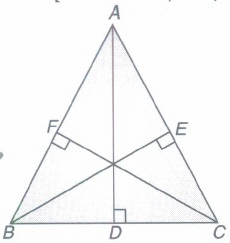
Since from a point \({ \bot }^{ r }\) line is the shortest.
CF\({ \bot }\) AB
\(\therefore\) CF < AC and CF < BC ...(1)
Similarly, BCis a line segment and A does not lie on
it. AD \({ \bot }\) BC
\(\therefore\) AD < AB and AD < AC ...(2)
Also, AC a line segment and B does not lie on it.
BE\({ \bot }\)AC
\(\therefore\) BE < AB and BE < BC ...(3)
Adding (I), (2) and (3), we get
2(AD + BE + CF) < 2(AB + BC + CA)
\(\therefore\) AB + BC + CA > AD + BE + CF
i.e., Perimeter is greater than the sum of three altitudes. Proved.
15.
y=180o-(30o+20o)=130o
l||m \(\Rightarrow\)x+100o=180o\(\Rightarrow\)x=80o
x+y=210o,y-x=50o
(x+y):(y-x)=21:5
16.
\(\frac { 5+\sqrt { 6 } }{ 5-\sqrt { 6 } } =\frac { 5+\sqrt { 6 } }{ 5-\sqrt { 6 } } \times \frac { 5+\sqrt { 6 } }{ 5+\sqrt { 6 } } \)
\(=\frac { { \left( 5+\sqrt { 6 } \right) }^{ 2 } }{ { \left( 5 \right) }^{ 2 }-{ \left( \sqrt { 6 } \right) }^{ 2 } } \)
\(=\frac { 25+6+10\sqrt { 6 } }{ 25-6 } \)
\(=\frac { 31+10\sqrt { 6 } }{ 19 } \)
\(a+b\sqrt { 6 } =\frac { 31 }{ 19 } +\frac { 10 }{ 19 } \sqrt { 6 } \)
Comparing the rational and irrational parts of both sides, we get
a = \(\frac{31}{19}\) , b = \(\frac{10}{19}\)
17.
Modified Table
[Minumum class-]
| Number of letters | Number of surnames | Width of the class | Length of the rectangle |
| 1-4 | 6 | 3 | \(\frac {6}{3}\times 2 =4\) |
| 4-6 | 30 | 2 | \(\frac {30}{2}\times 2 =30\) |
| 6-8 | 44 | 2 | \(\frac {44}{2}\times 2 =44\) |
| 8-12 | 16 | 4 | \(\frac {16}{4}\times 2 =8\) |
| 12-20 | 4 | 8 | \(\frac {4}{8}\times 2 =1\) |
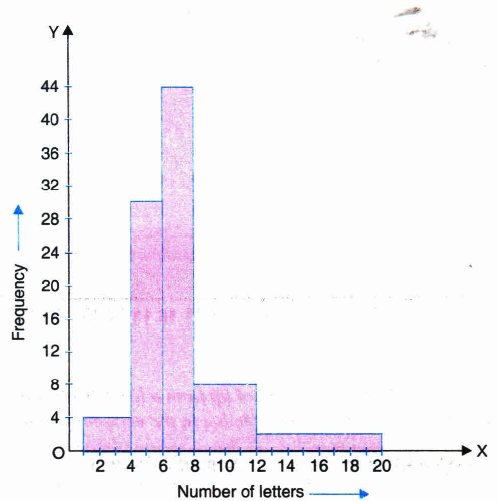
(ii) The class interval in which the maximum number of surname lie is 6-8.
18.
Capacity of the tank
= 6 \(\times\) 5 \(\times\) 4.5 m3 = 135 m3
\(\therefore\) Volume of water it can hold = 135 m3
= 135 \(\times\) 1000 l = 135000 l.
19.
a = 12 cm, b = 12 cm Perimeter = 30 cm
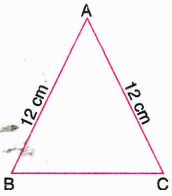
\(\Rightarrow \) a + b + c = 30
\(\Rightarrow \) 12 + 12 + c = 30
\(\Rightarrow \) 24 + c = 30
\(\Rightarrow \) c = 30 - 24
\(\Rightarrow \) c = 6 cm
\(s=\frac { 30 }{ 2 } \) cm = 15 cm
\(\therefore \) Area of the triangle \(=\sqrt { s(s-a)(s-b)(s-c) } \)
\(=\sqrt { 15(15-12)(15-12)(15-6) } \)
\(=\sqrt { 15(3)(3)(9) } =9\sqrt { 15 } \) cm2.
20.
110°
21.
| x | 1 | 3 | -1 | -2 | 2 | \(1\over 5\) |
|---|---|---|---|---|---|---|
| y | 7 | 17 | -3 | -8 | 12 | 3 |
\(\left(-{2\over5}, 0\right);(0,2)\)
22.
()
140
23.
()
Amount of water displaced = Volume of solid spherical ball
\(\therefore \ Volume\ of\ solid\ spherical\ ball=\frac { 4 }{ 3 } \pi { r }^{ 3 }\)
\(r=\frac { 4.2 }{ 2 } =2.1\) (given)
\(\therefore\) Volume of solid sperical ball=\(\frac { 4 }{ 3 } \pi ({ 2.1) }^{ 3 }\)
\(=\frac { 4 }{ 3 } \times \frac { 22 }{ 7 } \times { (2.1) }^{ 3 }\quad { cm }^{ 3 }\)
\(=\frac { 38808 }{ 1000 } litre\)
\(\therefore\) Amount of water displaced = 38808 litre (\(\because\)1 litre = 1000 cm3)
24.
()
Since bisector of an angle divides it in two equal parts,so,when it is bisected twice,measure of each angle is 15o
25.
()
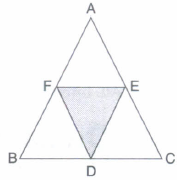
Given, perimeter of ΔABC=12.8 cm
ஃ Perimeter of ΔDEF=\(\frac{12.8}{2}\)=6.4cm
26.
()
Since sum of all the exterior angles formed by producing the sides of a polygon is 360o
xo+yo+zo=360o
27.
()
OA = OB (Given)
OP = OP (Common)
\(\angle\)AOP = \(\angle\)BOP (Given)
\(\triangle\)OAP\(\cong\)\(\triangle\)OBP (By SAS)
28.
()
Dimension of surface= Length and Breadth (which is 2)
29.
()
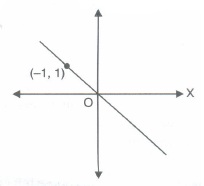
30.
()
4 = \(\frac{4}{5}\) x 5 and 5=\(\frac{5}{5}\) x 5
4 = \(\frac{20}{5}\) and 5 = \(\frac{25}{5}\)
The numbers are \(\frac{21}{5}\) and \(\frac{22}{5}\)
31.
()
Degree of x3+5 = 3
Degree of 4-x5 = 5
Degree of (x3-5) (4-x5) = 3+5 = 8.
32.
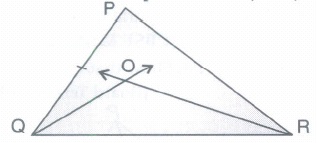
Proof: QO is bisector of \(\angle\)PQR
\(\angle\)OQR = \(\frac{1}{2}\)\(\angle\)PQR = \(\frac{1}{2}\) =\(\angle\)Q
RO is bisector \(\angle\)ORQ
\(\therefore\) \(\angle\)ORQ =\(\frac{1}{2}\) \(\angle\)PRQ = \(\frac{1}{2}\) \(\angle\)R
In \(\angle\)OQR
\(\angle\)QOR + \(\angle\)OQR + \(\angle\)ORQ = 180°
(Angle sum property)
\(\angle\)QOR + \(\frac{1}{2}\) \(\angle\)Q + \(\frac{1}{2}\) \(\angle\)R = 180°
\(\angle\)QOR = 180°- \(\frac{1}{2}\)(\(\angle\)Q + \(\angle\)R)
But in \(\angle\)PQR
\(\angle\)P + \(\angle\)Q + \(\angle\)R = 180°
\(\angle\)Q + \(\angle\)R = 180°- \(\angle\)P
\(\angle\)QOR = 180°- \(\frac{1}{2}\) (180°- \(\angle\)P)
= 180°-90° + \(\frac{1}{2}\)\(\angle\)P
= 90° + \(\angle\)P Hence Proved.
These type of rallies spread awareness among people for not to kill girl child and helping in equalising sex ratio.
33.
\(\sqrt { \frac { \left( \sqrt { 2 } -1 \right) }{ \left( \sqrt { 2 } +1 \right) } } \)is an irrational number.
\(\sqrt { \frac { \left( \sqrt { 2 } -1 \right) }{ \left( \sqrt { 2 } +1 \right) } } =\sqrt { \frac { \left( \sqrt { 2 } -1 \right) }{ \left( \sqrt { 2 } +1 \right) } \times \frac { \left( \sqrt { 2 } -1 \right) }{ \left( \sqrt { 2 } -1 \right) } } \)
\(=\sqrt { \frac { { \left( \sqrt { 2 } -1 \right) }^{ 2 } }{ 2-1 } } \)
\(=\sqrt { \frac { { \left( \sqrt { 2 } -1 \right) }^{ 2 } }{ 1 } } =\sqrt { 2 } -1\)
which is an irrational number.
Let, there is a number x such that x3 is an irrational number but x5 is a rational number.
Let, x =\(\sqrt[5]{7}\) be the number.
⇒ x3 = (5√7)3 = (7)3/5
is an irrational number.
But x5 = (\(\sqrt[5]{7}\))5=(7)5/5 = 7
=7 is a rational number.
(ii) Accepting own mistakes gracefully, co-operative learning among the classmates.

9th Standard CBSE Syllabus & Materials
9th Standard CBSE
CBSE 9th Mathematics Lines and Angles Sample Question Papers Study Material - QB365 Set A
NEW9th Standard CBSE
CBSE 9th Mathematics Introduction to Euclid's Geometry Sample Question Papers Study Material - QB365 Set A
NEW9th Standard CBSE
CBSE 9th Mathematics Linear Equations in Two Variables Sample Question Papers Study Material - QB365 Set A
NEW9th Standard CBSE
CBSE 9th Mathematics Coordinate Geometry Sample Question Papers Study Material - QB365 Set A



CBSE 9th Standard CBSE Subjects
CBSE Standards