100% FREE ACCESS
9th Standard CBSE Syllabus & Materials
9th Standard CBSE
CBSE 9th Science Is matter around us pure? - New Model Questions Papers Study Material - QB365 Set A
NEW9th Standard CBSE
CBSE 9th Science Matter in our surroundings - New Model Questions Papers Study Material - QB365 Set A
NEW9th Standard CBSE
CBSE 9th Mathematics Heron's Formula Sample Question Papers Study Material - QB365 Set A
NEW9th Standard CBSE
CBSE 9th Mathematics Circles Sample Question Papers Study Material - QB365 Set A
NEW9th Standard CBSE
CBSE 9th Mathematics Quadrilaterals Sample Question Papers Study Material - QB365 Set A
NEW9th Standard CBSE
CBSE 9th Mathematics Triangles Sample Question Papers Study Material - QB365 Set A

Published on: 09/09/2022
QB365 provides a detailed and simple solution for every Possible Case Study Questions in Class 9th Maths Subject - Coordinate Geometry, CBSE. It will help Students to get more practice questions, Students can Practice these question papers in addition to score best marks.
Download CBSE Class 9th Standard CBSE Mathematics question papers, sample papers, important questions, and previous year solved papers in PDF format. Get free study materials, NCERT solutions, and exam preparation resources for Class 9th Standard CBSE Mathematics
Questions + Answers key
Take MCQ Mathematics Test
1.
Student of class IX are on visit of Sansad Bhawan. Teacher assign them the activity of observe and take some pictures to analyses the seating arrangement between variuos MP and speaker based on coordiate geometry. The staff tour guide explained various facts related to Math's of Sansad Bhawan to the students, students were surprised when teacher ask them you need to apply coordiante geometry on the seating arrangement of MP's and speaker.
Calcualte the following reger to the below image and graph. Answer the following questions:
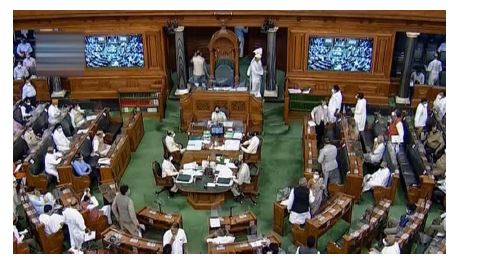
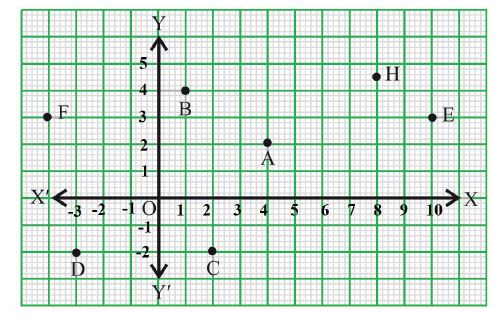
Answer the following refer to the above image and graph:
(i) What are the coordinates of postion 'F'?
| (a) (3, 4) | (b) (4, 3) |
| (c) (-3, 4) | (d) (-4, 3) |
(ii) What are the coordinates of position 'D'?
| (a) (3, 2) | (b) (-3, -2) |
| (c) (-3, 2) | (d) (3, -2) |
(iii) What are the coordinates of position 'H'?
| (a) (8, 5) | (b) (8, 4.5) |
| (c) (8, 4) | (d) (8, 5.5) |
(iv) In which quadrant, the point 'C' lie?
| (a) I | (b) II |
| (c) III | (d) IV |
(v) Find the perpendicular distance of the point E from the y-axis.
| (a) 13 units | (b) 10 units |
| (c) 11 units | (d) 3 units |
2.
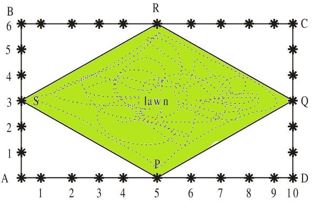
The Class IX students of a secondary school in Krishinagar have been allotted a rectangular plot of land for their gardening activity. Sapling of Gulmohar are planted on the boundary at a distance of 1m from each other. There is a lawn PQRS in the ground as shown in below figure.
(a) What are the coordinates of C, taking A as origin?
| (i) C(6, 10) | (ii) C(10, 10) |
| (iii) C(6, 6) | (iv) C(10, 6) |
(b) What are the coordinates of R, taking A as origin?
| (i)R(6, 5) | (ii) R(5, 5) |
| (iii) R(5, 6) | (iv) R(6, 6) |
(c) Side of lawn is :
| (i) 4 units | (ii) \(\sqrt{34}\) units | (iii) 34 units | (iv) None |
(d) Shape of lawn is :
| (i) Rectangle | (ii) Square |
| (iii) Parallelogram | (iv) Rhombus |
(e) Area of lawn is :
| (i) 30 sq. units | (ii) 60 sq. units |
| (iii) 45 sq. units | (iv) None |
3.
Kumar has a rectangular sketch, which he needs to draw on a coloured paper of length and breadth 32 units and 16 units respectively, using a plotter. Plotter is a device which is attached to a computer like a printer It is used for drawing complicated sketches. Plotter accepts only positive coordinates where the point (0, 0) is the left-bottom corner of the paper. The sketch ABCD needs to be centrally aligned on the paper.
(a) What are the coordinates of A and B respectively?
12.JPG)
| (i) A(13, 10); B(19, 6) | (ii) A(13, 10); B(19, 10) |
| (iii) A(19, 6); B(13, 10) | (iv) A(19, 6); B(13, 6) |
(b) What are the coordinates of A and B respectively?
| (i) A(13, 10); B(19, 6) | (ii) A(13, 10); B(19, 10) |
| (iii) A(13, 10); B(13, 6) | (iv) A(19, 6); B(13, 6) |
(c) The coordinates of point O in the sketch -2 is
| (i) (0, 8) | (i) (0, 8) | (i) (0, 8) | (iv) (0,-8) |
(d) The point on the y-axis ( in sketch 2) which is equidistant from the points B and C is
| (i) (0, 8) | (i) (0, 8) | (i) (0, 8) | (i) (0, 8) |
(e) The point on the x-axis ( in sketch 2) which is equidistant from the points C and D is
| (i) (0, -16) | (ii) (16, 0) | (ii) (16, 0) | (iv) (0, 16) |
4.
Aditya is a Class IX student residing in a village. One day, he went to a city Hospital along with his grandfather for general checkup. From there he visited three places - School, Library and Police Station. After returning to his village, he plotted a graph by taking Hospital as origin and marked three places on the graph as per his direction of movement and distance. The graph is shown below:
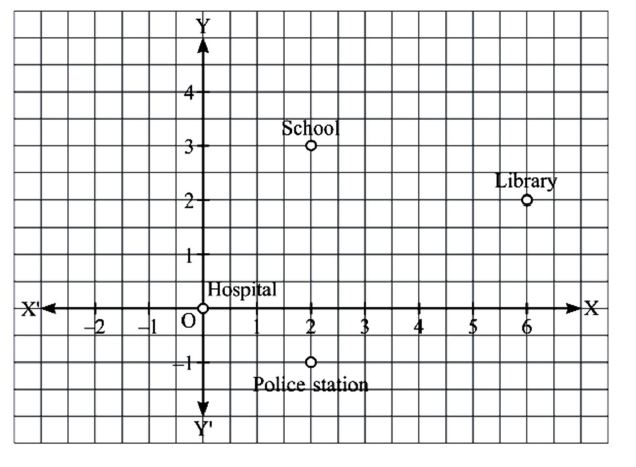
(i) What are the coordinates of School?
| (a) (3, 2) | (b) (2, 3) |
| (c) (3, 5) | (d) (5, 3) |
(ii) What are the coordinates of Police Station?
| (a) (2, -1) | (b) (2, 1) |
| (c) (-2, -1) | (d) (-2, 1) |
(iii) Distance between school and police station:
| (a) 4 | (b) 3 | (c) 2 | (d) 1 |
(iv) What are the coordinates of Library?
| (a) (2, 6) | (b) (2, -6) |
| (c) (6, -2) | (d) (6, 2) |
(v) In which quadrant the point (-1, 4) lies?
| (a) I | (b) II |
| (c) III | (d) IV |
5.
Students of a school are standing in rows and columns in their playground for a drill practice. A, B, C and D are the positions of four students as shown in the figure.
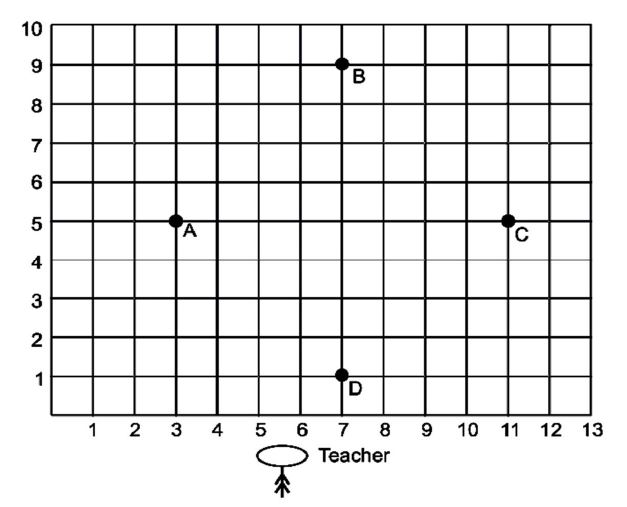
(a) What are the coordinates of A and B respectively?
| (i) A(3, 5); B(7, 8) | (ii) A(5, 3); B(8, 7) |
| (iii) A(3, 5); B(7, 9) | (iv) A(5, 3); B(9, 7) |
(b) What are the coordinates of C and D respectively?
| (i) C(11, 5); D(7, 1) | (ii) C(5, 11); D(1, 7) |
| (iii) C(5, 11); D(7, 1) | (iv) C(5, 11); D(-1, 7) |
(c) What is the distance between B and D?
| (i) 5 units | (ii) 14 units |
| (iii) 8 units | (iv) 10 units |
(d) What is the distance between A and C?
| (i) 5 units | (ii) 14 units |
| (iii) 8 units | (iv) 10 units |
(e) What are the coordinates of the point of intersection of AC and BD?
| (i) (7, 5) | (ii) (5, 7) |
| (iii) (7, 7) | (iv) (5, 5) |
1.
(i) (d) (-4, 3)
(ii) (b) (-3, -2)
(iii) (b) (8, 4.5)
(iv) (d) IV
(v) (b) 10 units
2.
(a) (iv) C(10, 6)
(b) (iii) R(5, 6)
(c) (ii) \(\sqrt{34}\) units
PS2 = AS2 + AP2 = 52 + 32
= 25 + 9 = 34
⇒ PS = \(\sqrt{34}\)
(d) (iv) Rhombus
(e) (i) 30 sq. units
Area of rhombus = \(1 / 2\) x product of diagonals
= \(1 / 2\) x 6 x 10
= 30 sq. units
3.
(a) (ii) A(13, 10); B(19, 10)
(b) (iv) A(19, 6); B(13, 6)
(c) (ii) (16, 8)
(d) (i) (0, 8)
(e) (ii) (16, 0)
4.
(i) (b) (2, 3)
(ii) (a) (2, -1)
(iii) (a) 4
(iv) (d) (6, 2)
(v) (b) II
5.
(a) (iii) A(3, 5); B(7, 9)
(b) (i) C(11, 5); D(7, 1)
(c) (iii) 8 units
(d) (iii) 8 units
(e) (i) (7, 5)

9th Standard CBSE Syllabus & Materials
9th Standard CBSE
CBSE 9th Mathematics Lines and Angles Sample Question Papers Study Material - QB365 Set A
NEW9th Standard CBSE
CBSE 9th Mathematics Introduction to Euclid's Geometry Sample Question Papers Study Material - QB365 Set A
NEW9th Standard CBSE
CBSE 9th Mathematics Linear Equations in Two Variables Sample Question Papers Study Material - QB365 Set A
NEW9th Standard CBSE
CBSE 9th Mathematics Coordinate Geometry Sample Question Papers Study Material - QB365 Set A



CBSE 9th Standard CBSE Subjects
CBSE Standards