100% FREE ACCESS
9th Standard CBSE Syllabus & Materials
9th Standard CBSE
CBSE 9th Science Is matter around us pure? - New Model Questions Papers Study Material - QB365 Set A
NEW9th Standard CBSE
CBSE 9th Science Matter in our surroundings - New Model Questions Papers Study Material - QB365 Set A
NEW9th Standard CBSE
CBSE 9th Mathematics Heron's Formula Sample Question Papers Study Material - QB365 Set A
NEW9th Standard CBSE
CBSE 9th Mathematics Circles Sample Question Papers Study Material - QB365 Set A
NEW9th Standard CBSE
CBSE 9th Mathematics Quadrilaterals Sample Question Papers Study Material - QB365 Set A
NEW9th Standard CBSE
CBSE 9th Mathematics Triangles Sample Question Papers Study Material - QB365 Set A

Published on: 09/09/2022
QB365 provides a detailed and simple solution for every Possible Case Study Questions in Class 9th Maths Subject - Probability, CBSE. It will help Students to get more practice questions, Students can Practice these question papers in addition to score best marks.
Download CBSE Class 9th Standard CBSE Mathematics question papers, sample papers, important questions, and previous year solved papers in PDF format. Get free study materials, NCERT solutions, and exam preparation resources for Class 9th Standard CBSE Mathematics
Questions + Answers key
Take MCQ Mathematics Test
1.
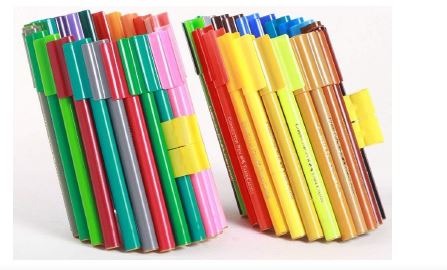
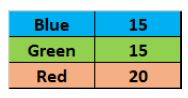
Mohan has a box of coloured pens. He takes a pen at random from the box. The probability that she takes a red pen is 0.4. If the box contains total 50 pens of blue, green and red colour and there are 15 blue pens and 15 green pens, then Answer the following questions:
(i) Probability that she does not take red pen is:
| (a) \(\begin{equation} \frac{3}{5} \end{equation}\) | (b) \(\begin{equation} \frac{4}{5} \end{equation}\) |
| (c) \(\begin{equation} \frac{2}{5} \end{equation}\) | (d) \(\begin{equation} \frac{1}{2} \end{equation}\) |
(ii) The number of red pens in the box are:
| (a) 15 | (b) 20 |
| (c) 25 | (d) 30 |
(iii) Probability of taking blue pen is:
| (a) .6 | (b) .5 |
| (c) .4 | (d) .3 |
(iv) Probability of taking green pen is:
| (a) .6 | (b) .5 |
| (c) .4 | (d) .3 |
(v) Probability of taking blue or green pen is:
| (a) .6 | (b) .3 |
| (c) .7 | (d) 1 |
2.
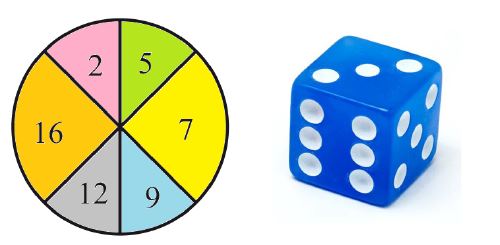
Diwali Fest is an annual South Asian arts & culture festival, produced by the Diwali Celebration Society. In the Diwali fest, a game is played which is like that, there is a spinner on which some numbers are written. The numbers on spinner are 2, 5, 7, 9, 12, 16. Depending on the condition of stall owner, if a particular number comes, than a die will be thrown.
(i) What is the probablity, that spinner stops on an even number?
| (a) \(\begin{equation} \frac{1}{8} \end{equation}\) | (b) \(\begin{equation} \frac{1}{4} \end{equation}\) |
| (c) \(\begin{equation} \frac{1}{2} \end{equation}\) | (d) \(\begin{equation} \frac{1}{16} \end{equation}\) |
(ii) A player will get a special prize, if spinner stops on a perfect square:
| (a)\(\begin{equation} \frac{1}{3} \end{equation}\) | (b)\(\begin{equation} \frac{1}{2} \end{equation}\) |
| (c)\(\begin{equation} \frac{1}{4} \end{equation}\) | (d)\(\begin{equation} \frac{1}{8} \end{equation}\) |
(iii) If the player gets a chance to throw, a dice, what is the probability of getting a multiple of 2 on dice?
| (a)\(\begin{equation} \frac{1}{3} \end{equation}\) | (b)\(\begin{equation} \frac{1}{2} \end{equation}\) |
| (c)\(\begin{equation} \frac{1}{4} \end{equation}\) | (d)\(\begin{equation} \frac{1}{8} \end{equation}\) |
(iv) If a dice is thrown, what is the probability of getting a number less than 4?
| (a)\(\begin{equation} \frac{1}{2} \end{equation}\) | (b)\(\begin{equation} \frac{1}{4} \end{equation}\) |
| (c)\(\begin{equation} \frac{1}{8} \end{equation}\) | (d)\(\begin{equation} \frac{2}{7} \end{equation}\) |
(v) An event whose probability to occur is 1. Then this type of event is called:
| (a) Impossible event | (b) Possible event |
| (c) Independent event | (d) Sure event |
3.
Aditya went to shop to purchase a child's game along with his friend. He selected one child's game which has 8 triangles of which 3 are blue and rest are red, and 10 squares of which 6 are blue and rest are red. While checking the game, one piece is lost at random.
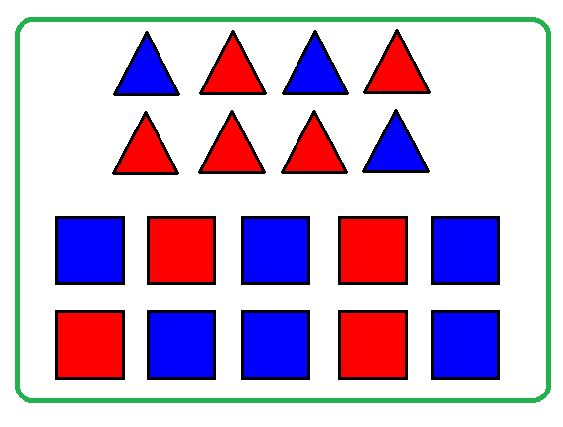
(a) How many triangles are of red colour and how many squares are of red colour?
| (i) 5, 4 | (ii) 4, 5 | (iii) 5, 5 | (iv) 8,6 |
(b) Find the probability that lost piece is square.
| (i) \(\frac{4}{9}\) | (ii) \(\frac{5}{9}\) | (iii) \(\frac{1}{3}\) | (iv) \(\frac{5}{18}\) |
(c) Find the probability that lost piece is triangle.
| (i) \(\frac{4}{9}\) | (ii) \(\frac{5}{9}\) | (iii) \(\frac{1}{3}\) | (iv) \(\frac{5}{18}\) |
(d) Find the probability that lost piece is square of blue color.
| (i) \(\frac{4}{9}\) | (ii) \(\frac{5}{9}\) | (ii) \(\frac{1}{3}\) | (iv) \(\frac{5}{18}\) |
(e) Find the probability that lost piece is triangle of red color.
| (i) \(\frac{4}{9}\) | (ii) \(\frac{5}{9}\) | (iii) \(\frac{1}{3}\) | (iv) \(\frac{5}{18}\) |
4.
One day Rahul visited park along with his friend. There he saw a game of change that consists of spinning an arrow (as shown in below figure) that comes to rest pointing at one of the numbers 1, 2, 3, 4, 5, 6, 7, 8 and these are equally likely outcomes.
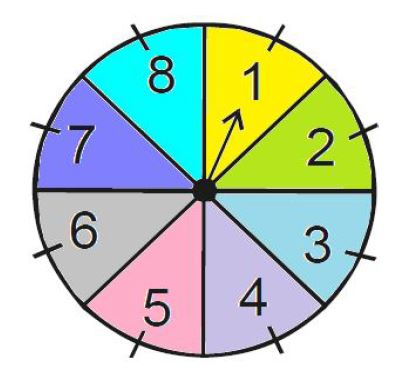
(a) Find the probability that the arrow will point at 2.
| (i) \(\frac{1}{2}\) | (ii) \(\frac{1}{8}\) | (iii) \(\frac{3}{8}\) | (iv) \(\frac{5}{8}\) |
(b) Find the probability that the arrow will point at an even number.
| (i) \(\frac{1}{2}\) | (ii) \(\frac{1}{8}\) | (iii) \(\frac{3}{8}\) | (iv) \(\frac{1}{4}\) |
(c) Find the probability that the arrow will point at a prime number.
| (i) \(\frac{1}{2}\) | (ii) \(\frac{1}{8}\) | (iii) \(\frac{3}{8}\) | (iv)\(\frac{5}{8}\) |
(d) Find the probability that the arrow will point at a number divisible by 3.
| (i) \(\frac{1}{2}\) | (ii) \(\frac{1}{8}\) | (iii) \(\frac{3}{8}\) | (iv) \(\frac{1}{4}\) |
(e) Find the probability that the arrow will point at a number greater than 2.
| (i) \(\frac{1}{2}\) | (ii) \(\frac{1}{8}\) | (iii) \(\frac{3}{4}\) | (iv) \(\frac{1}{4}\) |
5.
One day, during games period four friends A, B, C and D planned to play game using number cards. They prepared 20 numbered cards with labelled 1 to 20 and then they put all the number cards in the empty chalk box available in the classroom. In this game, every friend was asked to pick the card randomly and after each draw, card was replaced back in the chalk box.
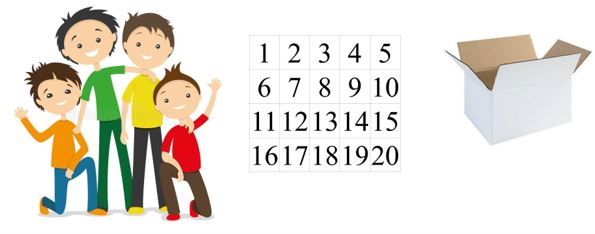
(i) Find the probability, first boy pick the card and he get the card with an even number?
| (a) \(\frac{1}{4}\) | (b) \(\frac{1}{2}\) | (c) \(\frac{1}{6}\) | (d) \(\frac{3}{8}\) |
(ii) If the card drawn in first case is replaced, and the second boy draws a card. What is the probability getting a prime number?
| (a) \(\frac{2}{5}\) | (b) \(\frac{4}{5}\) | (c) \(\frac{7}{8}\) | (d) \(\frac{9}{11}\) |
(iii) If the card drawn, is not replaced in the second draw, what is the probability that he got a multiple of 3 greater than 4?
| (a) \(\frac{1}{11}\) | (b) \(\frac{7}{20}\) | (c) \(\frac{6}{19}\) | (d) \(\frac{5}{19}\) |
(iv) For a sure event A, P(A) = ?
| (a) 1 | (b) 0 | (c) -1 | (d) 2 |
(v) If all cards drawn are replaced then what is the probability of getting a multiple of 3 and 5?
| (a) \( \frac{1}{2}\) | (b) \(\frac{1}{5}\) | (c) \(\frac{1}{20}\) | (d) \(\frac{1}{18}\) |
6.
Aditi runs a handicraft shop in Bapu bazar in Jaipur. She makes beautiful necklaces using colourful beads which she keeps in a potli. Today she prepared 19 necklaces but could not make the 20th necklace as she had no yellow beads left. She counted the beads and found that there were 8 red, 6 green and 14 blue beads remaining in her potli. Her little daughter Dulari requested for a bead. Aditi decides to take out one bead from her potli for Dulari.
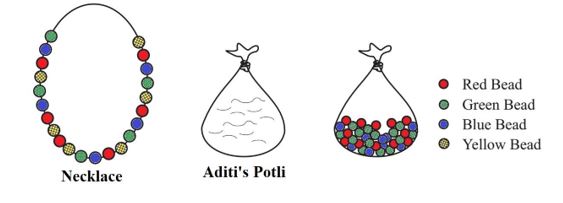
(a) Find the probability that she draws a green bead.
| (i) 3/11 | (ii) 3/7 | (iii) 11/4 | (iv) 3/14 |
(b) Find the probability that the bead drawn by her is not green.
| (i) 3/11 | (ii) 3/7 | (iii) 11/4 | (iv) 3/14 |
(c) Find the probability that she draws either a green or a blue bead.
| (i) 5/7 | (ii) 5/12 | (iii) 7/12 | (iv) 3/14 |
(d) Find the probability that she draws neither a red nor a green bead.
| (i) 3/14 | (ii) 1/3 | (iii) 3/7 | (iv)1/2 |
(e) Which of the following is an impossible event?
(i) The bead drawn is not red
(ii) The bead drawn is neither red nor blue
(iii) The bead drawn is either red or green or blue.
(vi) The bead drawn is yellow.
1.
(i) (a) \(\begin{equation} \frac{3}{5} \end{equation}\)
P(not red) = 1 - P(R)
= 1 - 0.4 = 0.6 = \(\begin{equation} \frac{3}{5} \end{equation}\)
(ii) (b) 20
Let number of red pens is x.
P(R) = \(\begin{equation} \frac{x}{x+15+15} \end{equation}\)
\(\begin{equation} \frac{4}{10} \end{equation}\) = \(\begin{equation} \frac{x}{x+30} \end{equation}\) This given x = 20
(iii) (d) .3
P(B) = \(\begin{equation} \frac{15}{50} \end{equation}\) = .3
(iv) (d) .3
P(G) = \(\begin{equation} \frac{15}{50} \end{equation}\) =0.3
(v) (a) .6
P(blue or green pen) = P(blue) + P(green)
= 0.3 + 0.3 = 0.6
2.
(i) (c) \(\begin{equation} \frac{1}{2} \end{equation}\)
Total number of cases = 6
Favourable outcomes = (2, 12, 16) i.e., 3
P (getting an even number) = \(\begin{equation} \frac{3}{6} \end{equation}\) = \(\begin{equation} \frac{1}{2} \end{equation}\)
(ii) (a) \(\begin{equation} \frac{1}{3} \end{equation}\)
Only perfect square number in spinner is 9, 16
Then, P(getting a perfect square) = \(\begin{equation} \frac{2}{6} \end{equation}\) = \(\begin{equation} \frac{1}{3} \end{equation}\)
(iii) (b) \(\begin{equation} \frac{1}{2} \end{equation}\)
Mulitple of 2 on dice = 2, 4, 6 i.e. 3.
P(getting a multiple of 2) = \(\begin{equation} \frac{3}{6} \end{equation}\) = \(\begin{equation} \frac{1}{2} \end{equation}\)
(iv) (a) \(\begin{equation} \frac{1}{2} \end{equation}\)
Number less than 4 = 1, 2, 3 i.e. 3
P(number less than 4) = \(\begin{equation} \frac{3}{6} \end{equation}\) = \(\begin{equation} \frac{1}{2} \end{equation}\)
(v) (d) Sure event
3.
(a) (i) 5, 4
(b) (ii) \(\frac{5}{9}\)
(c) (i) \(\frac{4}{9}\)
(d) (iii) \(\frac{1}{3}\)
(e) (iv) \(\frac{5}{18}\)
4.
(a) (ii) \(\frac{1}{8}\)
(b) (i) \(\frac{1}{2}\)
(c) (i) \(\frac{1}{2}\)
(d) (iv) \(\frac{1}{4}\)
(e) (iii) \(\frac{3}{4}\)
5.
(i) (b) \(\frac{1}{2}\)
Number of possible outcomes = 20
Number of favourable outcomes = {2,4,6,8,10,12,14,16,18,20} i.e., 10
∴ P (even number) = \(\frac{10}{20}\) = \(\frac{1}{2}\)
(ii) (a) \(\frac{2}{5}\)
∴ Number of favourable outcomes = {2,2,5,7,11,13,17,19,} i.e., 8
∴ P(prime number) = \(\frac{8}{20}\) = \(\frac{2}{5}\)
(iii) (d) \(\frac{5}{19}\)
Number of possible outcomes = 20 - 1 = 19
Favourable outcomes = {6,9,12,15,18} i.e,. 5
∴ P(multilple of 3 greater than 4) = \(\frac{5}{19}\)
(iv) (a) 1
(v) (c) \(\frac{1}{20}\)
Number of possible outcomes = 20
Favourable cases = {15} i.e,. 1
P(multiple of 3 and 5) = \(\frac{1}{20}\)
6.
(a) (iv) 3/14
Total number of beads in the Potli = 8 + 6 + 14 = 28
Number of green beads in the Potli = 6
Required probability = 6/28 = 3/14
(b) (iii) 11/14
Number of beads not green in the Potli = 28 – 6 = 22
Required probability =22/28 = 11/14
(c) (i) 5/7
Number of blue and green beads in the Potli = 14 + 6 = 20
Required probability = 20/28 = 5/7
(d) (iv) 1/2
Number of beads neither green nor red in the Potli = Number of blue beads in the Potli = 14
Required probability =14/28 = 1/2
(e) (iv) The bead drawn is yellow.

9th Standard CBSE Syllabus & Materials
9th Standard CBSE
CBSE 9th Mathematics Lines and Angles Sample Question Papers Study Material - QB365 Set A
NEW9th Standard CBSE
CBSE 9th Mathematics Introduction to Euclid's Geometry Sample Question Papers Study Material - QB365 Set A
NEW9th Standard CBSE
CBSE 9th Mathematics Linear Equations in Two Variables Sample Question Papers Study Material - QB365 Set A
NEW9th Standard CBSE
CBSE 9th Mathematics Coordinate Geometry Sample Question Papers Study Material - QB365 Set A



CBSE 9th Standard CBSE Subjects
CBSE Standards