
 100% FREE ACCESS
11th Standard Syllabus & Materials
11th Standard
TN 11th Tamil இயற்கை வேளாண்மை,சுற்றுச்சூழல் -செய்யுள் - மனோன்மணீயம் Important Questions And Answers Study Material - QB365 Set A
NEW11th Standard
TN 11th Tamil என்னுயிர் என்பேன் -துணைப்பாடம் - இசைத்தமிழர் இருவர் Important Questions And Answers Study Material - QB365 Set A
NEW11th Standard
TN 11th Tamil மொழி கலை -செய்யுள் - ஒவ்வொரு புல்லையும் Important Questions And Answers Study Material - QB365 Set A
NEW11th Standard
TN 11th Tamil பீடு பெற நில் - இலக்கணம் - பகுபத உறுப்புகள் Important Questions And Answers Study Material - QB365 Set A
NEW11th Standard
TN 11th Tamil பீடு பெற நில் - துணைப்பாடம் - வாடிவாசல் Important Questions And Answers Study Material - QB365 Set A
NEW11th Standard
TN 11th Tamil பீடு பெற நில் - செய்யுள் - குறுந்தொகை Important Questions And Answers Study Material - QB365 Set A

Published on: 27/04/2019
Creative two mark questions Basic Concepts of Chemistry and Chemical Calculations English medium - II
Download Tamil Nadu 11th Standard Chemistry question papers, model tests, one-mark questions, important questions, and public exam papers in PDF format. Free study materials and answer keys for TN State Board students.
Questions + Answers key
Take MCQ Chemistry Test
1.
Justify the following reaction is a redox reaction. \({CuO}_{(s)}+{H}_{{2}_{(g)}}\rightarrow{Cu}_{{(s)}}+{H}_{2}{O}_{(g)}\)
2.
What will be the mass of one 12C atom in g?
3.
If 10 volumes of H2 gas react with 5 volumes of O2 gas, how many volumes of water vapour would be produced?
4.
Calculate the oxidation number of underlined elements in the following. - Cr2O72-
5.
Calculate the oxidation number of underlined elements in the following. - KMnO4
6.
Mention any 4 redox reaction that takes place in our daily life.
7.
On the formation of SF6 by the direct combination of S and F2 which is the limiting reagent ? Prove it.
8.
What is meant by limiting reagent?
9.
How much volume of chlorine is required to prepare 89.6 L of HCI gas at STP?
10.
How much volume of Carbon dioxide is produced when 25 g of calcium carbonate is heated completely under standard conditions?
11.
How many moles of hydrogen is required to produce 20 moles of ammonia?
12.
Calculate the equivalent mass of sulphuric acid
13.
Calculate the equivalent mass of - Phosphate ion (PO43-)
14.
Calculate the equivalent mass of - Sulphate ion
15.
Calculate the equivalent mass of Copper. (Atomic mass of copper = 63.5)
16.
Calculate the number of moles present in 60 g of ethane.
17.
Calculate the molecular mass of Sulphuric acid (H2SO4)
18.
Define molecular mass of a substance.
19.
Chlorine has fractional average atomic mass. Justify this statement.
20.
Distinguish between a molecule and a compound.
21.
Differentiate an element and an atom
22.
What is meant by Plasma state? Give an example.
23.
Prove that states of matter are inter convertible
24.
Define matter. What are the types of matter?
25.
What do you understand by the terms empirical formula and molecular formula?
26.
Calculate the equivalent mass of hydrated sodium carbonate.
27.
What do you understand by the terms acidity and basicity ?
28.
What is molar volume ?
29.
Calculate the molar mass of the following.
Sucrose (C12H22O11)
30.
Calculate the molar mass of the following.
Potassium dichromate (K2Cr2O7)
31.
Calculate the molar mass of the following.
Potassium permanganate (KMnO4)
32.
33.
The density of carbon dioxide is equal to 1.977 kg m-3 at 273 K and 1 atm pressure. Calculate the molar mass of CO2
34.
Calculate the equivalent mass of the following : CO3-2,
35.
Calculate the equivalent mass of the following : H3PO4.
36.
What is the equivalence factor (n) for K2Cr2O7
37.
What is the equivalence factor (n) for Ba(OH)2
38.
What is the equivalence factor (n) for H2SO4
39.
What is equivalence factor 'n' ? How is it useful in determining the equivalent mass of a substance ?
40.
Define gram equivalent mass of an element.
41.
What do you understand by the term stoichiometry of the reaction ?
42.
3 grams of hydrogen reacts with 29g of O, to yield H2O. Calculate the amount of one of the reactants which remains unreacted.
43.
3 grams of hydrogen reacts with 29 g of O, to yield H2O. Calculate the maximum amount of H2O that can be formed.
44.
Define - Molecular formula of a compound
45.
Define - Empirical formula of a compound
46.
3 grams of hydrogen reacts with 29 g of O, to yield H2O. Which is the limiting reagent ?
47.
Explain the term limiting reagent.
48.
Calculate the equivalent mass of the following - Potassium Sulphate
49.
Calculate the equivalent mass of the following - Sodium Hydroxide
50.
Calculate the equivalent mass of the following - Aluminium hydroxide
1.
\(\overset { (+2)(-2) }{ { CuO }_{ (s) } } +\overset { (0) }{ { H }_{ { 2 }_{ (g) } } } \rightarrow \overset { (0) }{ { Cu }_{ (s) } } +\overset { (+1)(+2) }{ { H }_{ 2 }O_{ (g) } } .\)
In the above reaction, oxygen is removed from CuO. So CuO gets reduced. Oxygen is added to H2 to form water. So H2 gets oxidised. i.e. In CuO, oxidation number of Cu +2 is reduced to 0 whereas in H2, oxidation of H2 O is increased to + 1. So the above reaction is a redox reaction.
2.
Molar mass of 12C = 12.00 g mol-1.
Mass of 6.023\(\times\)1023 carbon atom = 12.0 g
\(\therefore\) Mass of 1 carbon atom \(={12\over6.023\times{10}^{23}}\)
= 1.992\(\times\)10-23 g.
3.
\(\underset { 2\ volumes }{ { 2H }_{ { 2 }_{ (g) } } } +\underset { 1\ volumes }{ { O }_{ { 2 }_{ (g) } } } \rightarrow \underset { 2\ volumes }{ { 2H }_{ 2 }{ O }_{ (g) } } \)
Thus 2 volumes of H2 reacts with 1 volume of O2 to produce 2 volumes of H2O (g)
\(\therefore\) 10 volumes of H2 would react with 5 volumes of O2 to produce 10 volumes of H2O(g).
Thus 10 volumes of H2O will be produced.
4.
2x + 7 (-2) = -2
2x - 14 = -2
2x = +12
\(\therefore\) x = + 6
Oxidation state of Cr = +6.
5.
1 (+1) + x + 4 (-2) = 0
x -7 = 0
\(\therefore\) x = + 7
Oxidation state of Mn = +7.
6.
(a) Burning of cooking gas, wood
(b) Rusting of iron articles
(c) Electroplating
(d) Galvanic and electrolytic cells
7.
SF6 is formed by burning Sulphur in an atmosphere of Fluorine. Suppose 3 moles of S is allowed to react with 12 moles of Fluorine.
\({ S }_{ (1) }+{ 3F }_{ 2_{ (g) } }\rightarrow { SF }_{ { 6 }_{ (g) } }\)
As per the stoichiometric reaction, one mole of S reacts with 3 moles of fluorine to complete the reaction. Similarly, 3 moles of S requires only 9 moles of fluorine.
\(\therefore\) It is understood that the limiting reagent is Sulphur and the excess reagent is Fluorine.
8.
A large excess of one reactant is supplied to ensure the more expensive reactant is completely converted to the desired product. The reactant used up first in a reaction is called the limiting reagent.
9.
\(\underset { (1\times 22.4L) }{ { H }_{ { 2 }_{ (g) } } } +\underset { (1\times 22.4L) }{ Cl_{ { 2 }_{ (g) } } } \rightarrow \underset { (2\times 22.4L) }{ 2HCl_{ _{ (g) } } } \)
2 x 22.4 L of HCI is produced by 22.4 L of Cl2.
\(\therefore\) 89.6 L of HCl will be produced by
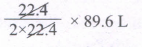
= 44.8 L of chlorine.
10.
CaCO3(s) \(\rightarrow\) CaO(s) + CO(g)
100g 22.4L
100 g of CaCO3 produces 22.4 L of CO2.
\(\therefore\) 25 g of CaCO3 will purchase = \(\frac { 22.4 }{ 100 } \times 25\)
= 5.6 L of CO2.
11.
3H2 + N2 \(\rightarrow\) 2NH3
A per stoichiometric equation,
No. of moles of hydrogen required for 2 moles of ammonia = 3 moles
No. of moles of hydrogen required for 20 moles of ammonia = \(\frac { 3 }{ 2 } \times 20=30\) moles.
12.
Sulphuric acid = H2SO4
Molar mass of sulphuric acid = 2 + 32 + 64 = 96
Basicity of sulphuric acid = 2
equivalent mass of acid = \(\frac { Molar\ mass\ of\ an\ acid }{ Basicity } \)
= \(\frac { 96 }{ 2 } \) = 49g eq-1.
13.
Phosphate ion (PO43-).
Equivalent mass of Phosphate ion = \(\frac { Molar\ mass\ of\ sulphate\ ion }{ charge } \)
= \(\frac { 31+64 }{ 2 } =\frac { 95 }{ 3 } =31.6\)
= 31.6g eq-1.
14.
Sulphate ion (SO42-).
Equivalent mass of Sulphate ion = \(\frac { Molar\ mass\ of\ sulphate\ ion }{ charge } \)
\(=\frac { 32+64 }{ 2 } =\frac { 96 }{ 2 } \)
= 48 g eq-1.
15.
Equivalent mass = \(\frac { Atomic\ mass }{ Velency } \)
Equivalent mass of Copper = \(\frac { 63.5 }{ 2 } =31.75\ g\)eq-1.
16.
No.of moles = \(\frac { mass\ of\ the\ substance }{ Molar\ mass\ of\ the\ substanc } =\frac { W }{ M } \)
Molar mass of ethane (C2H6) = 24 + 6 = 30
\(\therefore\) Number of moles in 60 g of ethane = \(\frac { 60 }{ 30 } \) = 2 moles.
17.
| Element | No.of atoms | Relative atomic mass | Total relative atomic mass |
|---|---|---|---|
| H | 2 | 1 | 2 |
| S | 1 | 32 | 32 |
| O | 4 | 16 | 64 |
| Molecular mass of sulphuric acid = 98 | |||
18.
Molecular mass of a substance (element or compound) represents the number of times the molecule of that substance is heavier than 1/12th of the mass of an atom of C-12 isotope. Molecular mass = 2 x Vapour density
19.
Chlorine molecule has two isotopes as in 17Cl35, 17Cl37in the ratio of 77 : 23, so when we are calculating the average atomic mass, it becomes fractional.
The average relative atomic mass of Chlorine = \(\frac { \left( 35\times 77 \right)+ \left( 37\times 23 \right) }{ 100 } \)
= 35.46 amu.
20.
| Molecule | Compound | |
|---|---|---|
| i) | A molecule is the smallest particle made up of one or more than one atom in a definite ratio having stable and independent existence. | A molecule which contains two or more atoms of different elements are called a compound molecule |
| ii) | e.g. Na - Monoatomic molecule O2 - Diatomic molecule P4 - Polyatomic molecule |
e.g. CO2 - Carbon dioxid CH4 - Methane H2O- Water |
21.
An atom is the ultimate smallest electrically neutral, being made up of fundamental particles such as proton, neutron and electron.
An element consists of only one type of atoms. Elements are further divided into metals, non-metals, and metalloids
22.
Gaseous state of matter at very high temperature containing gaseous ions and free electron is referred to as the Plasma state. e.g. Lightning.
23.
States of matter are inter convertible by changing temperature and pressure.
\(Solid\overset { Heat }{ \underset { Cool }{ \rightleftharpoons } } Liquid\overset { Heat }{ \underset { Cool }{ \rightleftharpoons } } Gas.\)
24.
A matter is anything which has mass and occupies space. Matters exist in all three states such as solid, liquid and gas.
25.
| Empirical Formula | Molecular Formula |
|---|---|
| It is the simplest formula | It is the actual formula |
| It shows the ratio of number of atoms of different elements in one molecule of the compound. | It shows the actual number of different types of atoms present in one molecule of the compound |
26.
Hydrated sodium carbonate = Na2CO3.10H2O
Molecular mass of Na2CO3 = (23 x 2) + (12 x 1) + (16 x 13) + (1 x 20)
= 46 +12 + 208 + 20
= 286
Equivelent mass of Na2CO3.10H2O = \(\frac { Molecular\ mass }{ acidity } \)
= \(\frac { 286 }{ 2 } =143\)
27.
Acidity : The number of hydroxyl ions present in one mole of a base is known as the acidity of the base.
Basicity : The number of replaceable hydrogen atoms present in a molecule of the acid is referred to as its basicity.
28.
Molar volume is the volume occupied by one mole of a substance in the gaseous state at STP. It is equal to 2.24 x 1O-2m3(22.4 L).
29.
= (12 x 12) + (22 x 1) + (11 x 16)
= 342 g /mol
30.
= (39 x 2) + (2 x 52) + (7 x 16)
= 294 g mol.
31.
= (1 x 39) + (1 x 55) + (4 x 16)
= 158 g / mol
32.
33.
Molecular mass = Density x Molar volume
Molar volume of CO2 = 2.24 x 10⁻²m3
Density of CO2 1.977 kg m-3
\(\therefore \text { Molecular mass of } \mathrm{CO}_{2}=1.977 \times 10^{3} \mathrm{~g} \mathrm{~m}^{\not -3} \times 2.24 \times 10^{-2} \mathrm{~m}^{\not -3}\)
= 1.977 X 101 x 2.24
= 44g
34.
\(Equivalent \ mass ={sum \ of \ the \ atomic \ masses \ of \ atoms \ present \ in \ the \ ion \over charge \ on \ the \ ion}\)
For CO3 -2 ion
\(Equivalent \ mass ={1 x atomic \ mass \ of C + 3 x atomic \ mass \ of 'O'\over 2}\)
\(={12+3\times 16\over 2}={60\over2}=30\ g\ eq^{-1}\)
35.
equivalent mass = \(Molar \ mass \over Basically\)
For H3PO4 equiavalent mass = \(3 \times atomic \ mass \ of \ 'H' + 1 \times atomic \ mass \ of \ phosphorous \ + 4 \times atomic \ mass \ of 'O '\over3\)
\(=3\times 1+ 1\times 31+4\times16\over3\)
\(={3+31+64\over3}={98\over3}=32.66\ g\ of\ eq^{-1}\)
36.
Molar mass of K2Cr2O7 = 2 x 39 + 2 x 52 + 7 x 16
= 78 + 104 + 112 = 294
In acid medium Cr2O7-2 is reduced to Cr+3
Cr2O7 -2 + 6e + 14H + \(\rightarrow\) 2cr+3 + 7H2O
equivalent mass of K2Cr2O7 = \({Molar \ mass \over No, \ of \ electrons \ taken \ Up }\)
\(={294\over6}=49\)
\(\therefore\) 'n' factor \(={294\over49}=6 eq.mol^{-1}\)
37.
'n' factor for Ba(OH)2 = \({Molar \ mass \ of \ Ba(OH)2 \over equivalent \ mass \ of Ba(OH)2 }\)
Molar mass of Ba(OH)2 = 137 + 2 x 16 + 2 x 1
= 137 + 32 + 2 = 171
Equivalent mass of Ba(OH)2 = \({molar \ mass \over acidity}\)
\(={171\over2}=85.5\)
\(\therefore\)'n' factor for Ba(OH)2 \(={171\over85.5}=2\)
38.
'n' factor for H2SO4 =\({Molar \ mass \ of \ the \ acid \over equivalent \ mass \ of \ the \ acid}\)
\({98\over49}=2\)
39.
\(Equivalence \ factor (n) ={Molar \ mass \ (g mol^{-I})\over equivalent \ mass \ of \ the \ acid}\)
The usefulness of this factor is that the equivalent masses of all the substances can be calculated whether it is an acid, base, salt, or an oxidising or reducing agent.
40.
Gram equivalent mass of an element, compound or ion is the mass of their species that combines or displaces 1.008g hydrogen or 8g oxy,gen or 35.5g chlorine.
41.
Stoichiometry gives the numerical relationship between chemical quantities in a balanced chemical equation.
42.
2 mole of H2 react with 1mole of O2.
1.5 mole of H react with 0.75 mole of O2.
Excess O2 = 0.9062 - 0.75 = 0.1562 mol.
43.
2 mole of H2 give 2 mole of H2O.
1.5 mole of H2 will give 1.5 mol of H2O.
44.
Molecular formula : Molecular formula of a compound gives the actual number of different atoms present in one molecule
45.
Empirical formula : It is the simplest formula of a compound which gives the ratio of the number of different atoms present in one molecule of the compound.
46.
\(\underset { 2\quad mol }{ { 2H }_{ 2 } } +\underset { 1\quad mol }{ { { O }_{ 2 } } } \rightarrow \underset { 2\quad mol }{ { 2H }_{ 2 }O } \)
Number of mole of H2 taken = \(\frac{3}{2}\) = 1.5
Number of mole of O2 taken = \(\frac{29}{32}\) = 0.9062
\(\therefore\) 2 mole of H2 react with 1 mole of O2
\(\therefore\) 1.5 mol of H2 will react with = \(\frac{1}{2}\times \) 1.5 = 0.75 mole of O2
Available mole of O2 (0.9062) > required mol of O2 (0.75)
Thus, O2 is in excess and therefore, H2 will be the limiting reagent.
47.
When a reaction is carried out using non-stoichiometric quantities of the reactants, the product yield will be determined by the reactant that is completely consumed. This reagent is called as the limiting reagent.
48.
Molar Mass of K2SO4 = \( \begin{cases} 2x\ atomic\ \ mass\ of\ K+1\times atomic\ \ mass\ of\ 's' \\ +\ 4x\ atomic\ \ mass\ of\ 'O' \end{cases}\)
= 2\(\times\)40 +1\(\times\)32 + 4\(\times\)16 = 80 + 32 + 64 = 176
Equivalent Mass of salt = \(\frac { atomic\ \ mass\ \ of\ \ cation }{ Velency } +\frac { sum\ \ of\ \ atomic\ \ equivelent\ \ mass\ \ of\ \ anion }{ valency } \)
= \(\frac { 40 }{ 1 } +\frac { 32+64 }{ 2 } \)
= 40 + 48 = 88g eq-1
49.
Molar Mass of NaOH = 23 + 16 + 1 = 40
Acidity = 1
Equivalent Mass = \(\frac { Molar\ mass }{ acidity } =\frac { 40 }{ 1 } =40geq^{ -1 }\)
50.
Molar Mass of Al(OH)3 = \(\begin{cases} atomic\ \ mass\ 'al'+3x\ atomic\ \ mass\ \ of \ 'O' \\ +3x\ atomic\ \ mass\ \ of\ \ 'h' \end{cases}\)
= 27 + 3\(\times\)16 + 3\(\times\)1 = 78
Acidity = 3
Equivalent mass of AL(OH)3 = \(\frac { Molar\quad mass }{ acidity } =\frac { 78 }{ 3 } =26geq^{ -1 }\)

11th Standard Syllabus & Materials
11th Standard
TN 11th Tamil பீடு பெற நில் - செய்யுள் - காவடிச்சிந்து Important Questions And Answers Study Material - QB365 Set A
NEW11th Standard
TN 11th Tamil பீடு பெற நில் - உரைநடை - மலை இடப்பெயர்கள் : ஓர் ஆய்வு Important Questions And Answers Study Material - QB365 Set A
NEW11th Standard
TN 11th Tamil மாமழை போற்றுதும் - துணைப்பாடம் - யானை டாக்டர் Important Questions And Answers Study Material - QB365 Set A
NEW11th Standard
TN 11th Tamil மாமழை போற்றுதும் - செய்யுள் - ஐங்குறுநூறு Important Questions And Answers Study Material - QB365 Set A



Tamilnadu Stateboard 11th Standard Subjects

Maths

Commerce

Economics

Biology

Business Maths and Statistics

Accountancy

Computer Science

Physics
Chemistry
Maths
Biology
Economics
Physics
Chemistry

History
Business Maths and Statistics

Computer Science
Accountancy

Computer Applications
History
Computer Technology
Commerce
Computer Applications
Computer Technology

Tamil

English

French
Tamilnadu Stateboard Standards
