
 100% FREE ACCESS
11th Standard Syllabus & Materials
11th Standard
TN 11th Tamil இயற்கை வேளாண்மை,சுற்றுச்சூழல் -செய்யுள் - மனோன்மணீயம் Important Questions And Answers Study Material - QB365 Set A
NEW11th Standard
TN 11th Tamil என்னுயிர் என்பேன் -துணைப்பாடம் - இசைத்தமிழர் இருவர் Important Questions And Answers Study Material - QB365 Set A
NEW11th Standard
TN 11th Tamil மொழி கலை -செய்யுள் - ஒவ்வொரு புல்லையும் Important Questions And Answers Study Material - QB365 Set A
NEW11th Standard
TN 11th Tamil பீடு பெற நில் - இலக்கணம் - பகுபத உறுப்புகள் Important Questions And Answers Study Material - QB365 Set A
NEW11th Standard
TN 11th Tamil பீடு பெற நில் - துணைப்பாடம் - வாடிவாசல் Important Questions And Answers Study Material - QB365 Set A
NEW11th Standard
TN 11th Tamil பீடு பெற நில் - செய்யுள் - குறுந்தொகை Important Questions And Answers Study Material - QB365 Set A

Published on: 05/02/2019
Download Tamil Nadu 11th Standard Business Maths and Statistics question papers, model tests, one-mark questions, important questions, and public exam papers in PDF format. Free study materials and answer keys for TN State Board students.
Questions + Answers key
Take MCQ Business Maths and Statistics Test1.
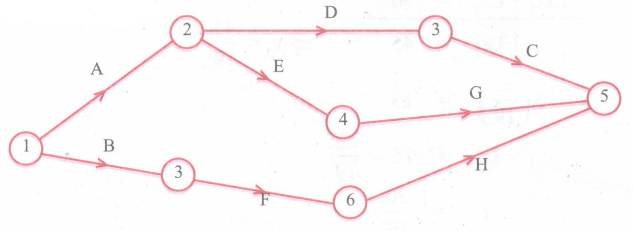
Construct the network for the projects consisting of various activities and their precedence relationships are as given below: A, B can start simultaneously
A < D, E; B < F; E < G, D < C, F < H.
2.
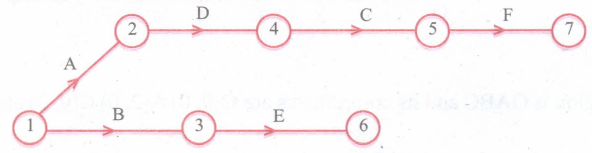
Draw a network diagram for the project whose activities and their predecessor relationships are given below
| Activity | A | B | C | D | E | F |
|---|---|---|---|---|---|---|
| Predecessor activity | - | - | D | A | B | C |
4.
A dealer whises to purchase a number of fans and sewing machines. He has only Rs.5760 to invest and has a space for atmost 20 items. A fan costs him Rs.360 and a sewing machine Rs. 240. His expectation is he can sell a fan at a profit of Rs.22 and a sewing machine at a profit of ns. Formulate this as an LPP to maximize his profit?
5.
A factory owner purchases two types of machines A and B for his factory. The requirements and the limitations for the machines are as follows:
| Machine | Area occupied | Labour Force | Daily Output (in units) |
|---|---|---|---|
| A | 1000 m2 | 12 men | 60 |
| B | 1200 m2 | 8 men | 40 |
He has maximum area of 9000 m2 available, and 72 skilled labourers who can operate both the machines. How many machines of each type should he buy to maximize the daily output. Formulate the above as LPP.
6.
A retired person has Rs. 70,000 to invest and two types of bonds are available in the market for investment. First type of bond yields an annual income of 8% on the amount invested and the second type yields 10% per annum. As per norms, he has to invest a minimum of Rs. 10,000 in the first type and not more than Rs.30,000 in the second type. How should he plan his investment, so as to get maximum returns after one year of investment? Formulate the above as LPP.
7.
A producer has 30 and 17 units of labour and capital respectively which he can use to produce two types of goods X and Y. To produce one unit of X, 2 unit of labour and 3 units of capital are required. Similarly, 3 units of labour and 1 unit of capital is required to produce one unit of Y. If X and Yare priced at HOO and H20 per unit respectively, how should the producer use his resources to maximize the total revenue? Formulate the LPP for the above.
8.
A toy company manufactures two types of dolls A and B. Market tests and available resources have indicated that the combined production level should not exceed 1200 dolls per week and the demand for dolls of type B is atmost half of that for dolls of type A. Further, the production level of dolls of type A can exceed three times the production of dolls of other type by at most 600 units. If the company makes profit of n2 and n6 per doll, how many of each should be produced weekly in order to maximize the profit. Formulate the above as mathematical LPP.
9.
A fruit grower can use two types of fertilizers in his garden, brand P and brand Q. The amounts (in Kg) of nitrogen, phosphoric acid, potash and chlorine in a bag of each brand are given in the table. Tests indicate that the garden needs atIeast 240 kgs of phosphoric acid, at least 270 kg of potash and atmost 310 kg of chlorine. If the grower wants to minimize the amount of nitrogen added to the garden, formulate the above as mathematical LPP.
10.
An aeroplane can carry a maximum of 200 passengers. A profit of Rs.1000 is made on each executive class ticket and a profit of Rs. 600 is made on each economy class ticket. The airline reserves at least 20 seats for executive class. However, at least 4 times as many passengers prefer to travel by economy class than by the executive class. Determine how many tickets of each type must be sold in order to maximize the profit for the airline. Formulate the mathematical LPP for the above.
11.
If f(x,y) = 3x2 + 4y3 + 6xy - x2y3 + 6. Find fxy(2,1)
12.
If f(x,y) = 3x2 + 4y3 + 6xy - x2y3 + 6. Find fyy(1,1)
13.
If y=x-1/x, prove that y is a strictly increasing function for all real vaules of x(x\(\neq\)0).
14.
Find \(\frac { dy }{ dx } \) if x2 + xy + y2 = 100
15.
Differentiate \({ x }^{ \frac { 2 }{ 3 } }\) from first principles
16.
Find the principal value of \(\cos^{-1}\left(\frac{-1}{\sqrt2}\right)\)
17.
Evaluate : \(\cos\left[\frac{\pi}{3}-\cos^{-1}\left(\frac{1}{2}\right)\right]\)
18.
If \(\tan^2x=2\tan^2\phi+1\), prove that \(\cos2x+sin^2\phi=0\)
19.
Differentiate \(\frac { { x }^{ 2 }cos\frac { \pi }{ 4 } }{ sinx } \)
20.
Evaluate \(\underset { x\rightarrow \frac { 1 }{ 2 } }{ lim } \frac { { 4x }^{ 2 }-1 }{ 2x-1 } \)
21.
Prove that the function given by f(x) = \(\left| x-1 \right| \), x \(\in\) R is not differentiable at x =1
22.
Prove that \(\cos18^o-\sin18^o=\sqrt{2}.\sin27^o\)
23.
Prove that \(\frac{\tan 69^o+\tan 66^o}{1-\tan 69^o\tan 66^o}=-1\)
24.
Prove that \(sin^2\left(\frac{\pi}{8}+\frac x2\right)-sin^2\left(\frac{\pi}{8}-\frac x2\right)=\frac{1}{\sqrt2}\sin x.\)
25.
Find the value of \(\cos\left(\frac{5\pi}{12}\right)\)
26.
In any quadrilateral ABCD, prove that sin (A + B) + sin (C + D) = 0
27.
Find the focus, equation of the directrix, vertex and length of latus rectum of the parabola x2=6y.
28.
Show that the function f(x) = 5x -3 is continuous at x = +3
29.
Evaluate \(\cot\left(\frac{-15\pi}{4}\right)\)
30.
If \(\cos x=-\frac{1}{2}\) and \(\pi
31.
For what value of k, the following function is continuous at x =0?
f(x) = \(\begin{cases} \frac { 1-cos4x }{ 8{ x }^{ 2 } } \quad ifx\neq 0 \\ k\quad \quad \quad ifx=0 \end{cases}\)
32.
Find the angle between the pair of lines represented by the equation 3x2+10xy+8y2+14x+22y+15=0.
33.
Show that the functions f(x) = 5x - \(\left| x \right| \) is continuous at x = 0
34.
Convert the equation of the parabola x2+y=6x-14 into the standard form.
35.
Convert the parabola y2=4x+4y into standard form.
36.
If P(n) is the statement "23n -1 is a multiple of 7" then show that P(5) is true.
37.
Find the co-efficient of x40 in (1+2x+x2)27
38.
In the expansion of \({ \left( x+\frac { 1 }{ x } \right) }^{ 6 }\), find the third term.
39.
Find the number of diagonals that can be drawn by joining the vertices of octagon?
40.
Find n if 25 Cn+5 = 25 C2n-1.
41.
In how many ways can 10 beads of different colours form a necklace?
42.
How many permutations can be made out of the letters of the word "TRIANGLE" beginning with T?
43.
Find the number of permutations of English vowels A, E, I, O, U taking two at a time?
44.
Show that 10P3 = 9 P3 + 3. 9P2
45.
Evaluate\(\frac { 1 }{ 5! } +\frac { 1 }{ 6! } +\frac { 1 }{ 7! } \)
46.
In a railway compartment, 6 seats are vacant on a bench. In how many ways can 3 passengers sit on them?
47.
Resolve into partial fractions :\(\frac { 12x-17 }{ (x-2)(x-1) } \)
48.
Using the property of determinants show that \(\begin{vmatrix} x &a &x+a \\ y & b &y+b \\z & c & z+c \end{vmatrix}=0.\)
49.
Using the property of determinant, evaluate \(\begin{vmatrix} 6 &5 &12 \\ 2 & 4 &4 \\2 & 1 & 4 \end{vmatrix}.\)
50.
Find the values of x if \(\begin{vmatrix} 2 & 4 \\5 & 1 \end{vmatrix}=\begin{vmatrix} 2x & 4\\6 & x \end{vmatrix}.\)
51.
Evaluate \(\begin{vmatrix} 2 &-1 &-2 \\0 & 2 & -1\\3 & -5& 0 \end{vmatrix}.\)
52.
If \(A=\begin{bmatrix} 1 & 2 \\ 4 & 2 \end{bmatrix}\) then show that |2A| = 4 |A|.
53.
If A \(=\begin{bmatrix} 1 \\ -4\\3 \end{bmatrix}\) and B = [-1 2 1], verify that (AB)T = BT. AT
54.
A manufacturer has to supply 12,000 units of a product per year to his customer. The demand is fixed and known and no shortages are allowed. The inventory holding cost is 20 paise per unit per month and the set up cost per run is Rs.350. Determine (i) the optimum run size q0. (ii) Optimum scheduling period t0 (iii) minimum total variable yearly cost.
55.
A certain manufacturing concern has the toal cost function C = \({1\over5}x^2-6x+100\).Find when the tatal cost is minimum.
56.
Find the maximum and minimum values of x3-6x2+7
57.
Prove that 75-12x+6x2-x3 always decreases as x increases.
58.
If y=1+1/x, show that y is a strictly decreasing function for all real values of x(x\(\neq\)0).
59.
Differentiate (sec x -1) (sec x +1)
60.
Evaluate \(\underset { h\rightarrow 0 }{ lim } \frac { \sqrt { x+h } -\sqrt { x } }{ h } \)
1.
Using the precedence relationship and following the rules of network construction, the required network is shown in the following diagram
2.
3.
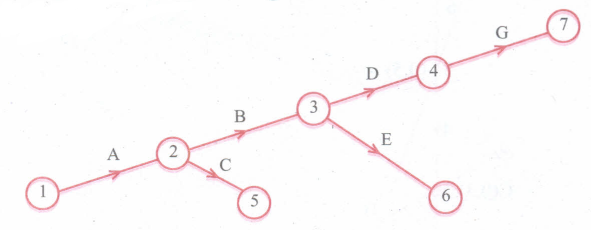
Using the precedence relationship and following the rules of network construction, the required network is shown in the following figure.
4.
(i) Variables:
Let x1 and x2 represent the number of fans and sewing machines.
(ii) Objective functions:
Let Z be the profit of the dealer.
∴ Maximize Z = 22x1 + 18x2 is the objective function.
(iii) Constraints:
\({ x }_{ 1 }+{ x }_{ 2 }\le 20\)
\({ 360x }_{ 1 }+{ 240x }_{ 2 }\le 5760\)
(iv) Non-negative restrictions:
Since the number of fans and sewing machine cannot be negative, we have x1, x2 ≥ 0.
Hence, mathematical formulation of the LPP is
Maximize \(Z=22{ x }_{ 1 }+18{ x }_{ 2 }\)
Subject to the constraints
\({ x }_{ 1 }+{ x }_{ 2 }\le 20\)
\({ 360x }_{ 1 }+{ 240x }_{ 2 }\le 5760\)
and x1, x2 ≥ 0.
5.
(i) Variables:
Let x1, x2 represent the machines of type A and B.
(ii) Objective function:
Let Z be the maximum daily output \(\therefore Z=60{ x }_{ 1 }+40{ x }_{ 2 }\)
(iii) Constraints:
\(1000{ x }_{ 1 }+2000{ x }_{ 2 }\le 9000\)
\({ 12x }_{ 1 }+8{ x }_{ 2 }\le 72\)
(iv) Non-negative restrictions:
Since the number of machines of type A and B cannot be negative, x1, x2 ≥ 0.
Hence, mathematical formulation of the LPP is Maximize \(Z=60{ x }_{ 1 }+40{ x }_{ 2 }\)
Subject to the constraints
\(1000{ x }_{ 1 }+2000{ x }_{ 2 }\le 9000\)
\( { 12x }_{ 1 }+8{ x }_{ 2 }\le 72\)
and x1, x2 ≥ 0.
6.
(i) Variables:
Let x1, x2 represents the first and second type of bonds respectively.
(ii) Objective function:
Let Z be the maximum return
\(\therefore \quad Z=\frac { 8 }{ 100 } { x }_{ 1 }+\frac { 10 }{ 100 } { x }_{ 2 } \Rightarrow Z=0.08{ x }_{ 1 }+0.1{ x }_{ 2 }\)
(iii) Constraints:
\({ x }_{ 1 }+{ x }_{ 2 } \le 70,000\)
\({ x }_{ 1 } \ge 10,000\)
\( { x }_{ 2 } \le 30,000\)
(iv) Non-negative restrictions:
Since the number of first and second type of bonds cannot be negative,x1, x2 ≥ 0.
Hence, the mathematical formulation of the LPP is maximize \(Z=0.08{ x }_{ 1 }+0.1{ x }_{ 2 }\)
Subject to the constraints
\({ x }_{ 1 }+{ x }_{ 2 } \le 70,000\)
\( { x }_{ 1 }\ge 10,000\)
\({ x }_{ 2 }\le 30,000\)
and x1, x2 ≥ 0.
7.
(i) Variables:
Let x1, x2 represent the number of units of X and Y.
(ii) Constraints:
| Labour | Capital | |
|---|---|---|
| X | 2 | 3 |
| Y | 3 | 1 |
∴ 2x1 + 3x2 ≤ 30 and 3x1 + x2 ≤ 17
(iii) Non-negative restrictions:
Since the number of units of X and Y cannot be negative,x1, x2 ≥ 0.
Hence, the mathematical formulation of the LPP is maximize \(Z=100{ x }_{ 1 }+120{ x }_{ 2 }\)
Subject to the constraints
\( { 2x }_{ 1 }+3{ x }_{ 2 }\le 30\)
\({ 3x }_{ 1 }+{ x }_{ 2 }\le 17\)
and x1, x2 ≥ 0.
8.
(i) Variables:
Let x1, x2 represent the dolls of A and B produced in a week.
(ii) Objective function:
Let Z be the total profit in a week.
\(\therefore Z={ 12x }_{ 1 }+16{ x }_{ 2 }\)
Since we have to maximize the profit, we have maximize \(Z={ 12x }_{ 1 }+16{ x }_{ 2 }\)
(iii) Constraints:
\({ x }_{ 1 }+{ x }_{ 2 } \le 2000\)
\({ x }_{ 1 }-{ 2x }_{ 2 }\ge 0\)
\( { x }_{ 1 }-{ 3x }_{ 2 }\le 600\)
(iv) Non-negative restictions:
Since the number of dolls on type A and B cannot be negative, we have \({ x }_{ 1 },{ x }_{ 2 }\ge 0\)
Hence, the mathematical formation of LPP is
Maximize \(Z={ 12x }_{ 1 }+16{ x }_{ 2 }\)
Subject to the constraints
\({ x }_{ 1 }+{ x }_{ 2 } \le 2000\)
\({ x }_{ 1 }-{ 2x }_{ 2 }\ge 0\)
\( { x }_{ 1 }-{ 3x }_{ 2 }\le 600\)
and x1, x2 ≥ 0.
9.
(i) Variables:
Let x1, x2 represent bags of brand P and brand Q.
(ii) Objective function:
Let Z be the amount of nitrogen. Since the amount of nitrogen is to be minimized, we have minimize Z = 3x + 3.5y
(iii) Constraints:
For Phosphoric acid,\({ x }_{ 1 }+2{ x }_{ 2 }\ge 240\)
For Potash, \({ 3x }_{ 1 }+{ 1.5x }_{ 2 }\ge 270\)
For Chlorine, \({ 1.5x }_{ 1 }+2{ x }_{ 2 }\ge 310\)
(iv) Non-negative restrictions:
Since the number of bags of brand P and Q, cannot be negative,\({ x }_{ 1 },{ x }_{ 2 }\ge 0\).
Here Mathematical form of the LPP is Minimize Z = 3x1 + 3.5x2
Subject to the constraints
\({ x }_{ 1 }+2{ x }_{ 2 }\ge 240\)
\({ 3x }_{ 1 }+{ 1.5x }_{ 2 }\ge 270\)
\( { 1.5x }_{ 1 }+2{ x }_{ 2 }\ge 310\)
and x1, x2 ≥ 0.
10.
(i) Variables: Let x1be the executive class tickets and x2 be the economy class ticket.
(ii) Objective function: Let Z be the maximum profit
Maximize Z=1000x1+600x2
(iii) Constraints:\({ x }_{ 1 }\ge 20\)
\(\Rightarrow { x }_{ 2 }\ge 4{ x }_{ 1 }\ and\ { x }_{ 1 }+{ x }_{ 2 }\le 200\)
\( \Rightarrow 4{ x }_{ 1 }\le { x }_{ 2}\ and\ { x }_{ 1 }+{ x }_{ 2 }\le 200\)
\(\Rightarrow 4{ x }_{ 1 }-{ x }_{ 2 }\le 0 \ and \ { x }_{ 1 }+{ x }_{ 2 }\le 200\)
(iv) Non-negative restrictions:
Since the number of tickets cannot be negative, \({ x }_{ 1 },{ x }_{ 2 }\ge 0\)
Hence, the mathematical formulation of the LPP is Maximize Z=1000x1+600x2
Subject to the constraints
\({ x }_{ 1 }+{ x }_{ 2 } \le 2000\)
\( { x }_{ 1 } \ge 20\)
\(4{ x }_{ 1 }-{ x }_{ 2 } \le 0 \ and \ { x }_{ 1 },{ x }_{ 2 }\ge 0\)
11.
Given f(x, y) =3x2+4y3+6xy-x2y3+6
We know that fy(x, y) 12y2 + 6x - 3x2y2
Differentiating again partially w.r.t. 'x' we get,
fxy(x,y) 0 + 6 - 3y2 (2x) = 6 - 6xy2
\(\therefore\)fxy(2, 1) = 6 - 6(2)(1)2 = 6 - 12 = - 6
12.
Given f(x, y) =3x2+4y3+6xy-x2y3+6
Differentiating 'f' partially w.r.t. 'y' we get
fy(x,y) = 0+ 12y2+6x(1)-x2(3y2)+0
=12y2+ 6x - 3x2y2
Differentiating again partially w.r.t. 'y' we get,
fy(x, y) =24y + 0 - 3x2(2y) = 24y - 6x2y
\(\therefore\)fyy(1, 1)= 24(1) - 6(12)(1) = 24 - 6 = 18
13.
Given y=x-1/x
Differentiating w.r.t.'x' we get,
\({dy\over dx}=1+{1\over x^2}>0\) for all real values of x, except x=0
\(\therefore \) y is a strictly increasing function for all real values of x(x\(\neq\)0)
14.
Given x2 +xy +y2 = 100
Differentiating with respect to 'x' we get
2x +x.\(\frac { dy }{ dx } \) + y(1) + 2y \(\frac { dy }{ dx } \) = 0
\(\Rightarrow\) \(\frac { dy }{ dx } \) (x + 2y) = (x + 2y) = -2 x - y
\(\Rightarrow\) \(\frac { dy }{ dx } \) = \(\frac { -(2x+y) }{ x + 2y } \)
15.
Let f(x) = \({ x }^{ \frac { 2 }{ 3 } }\)
f(x+h) = (x+h)\(^{ \frac { 2 }{ 3 } }\)
\(\frac { d }{ dx } (f(x))=\underset { h\rightarrow 0 }{ lim } \frac { f(x+h)-f(x) }{ h } \)
= \(\underset { h\rightarrow 0 }{ lim } \frac { (x+h)^{ \frac { 2 }{ 3 } }-x^{ \frac { 2 }{ 3 } } }{ x+h-x } \) [adding and subtracting x in the denominator]
= \(\frac { 2 }{ 3 } .x^{ \frac { 2 }{ 3 } -1 }\)
\(\left[ \therefore \underset { x\rightarrow a }{ Lt } \frac { { x }^{ n }-{ a }^{ n } }{ x-a } =n-a^{ n-1 } \right] =\frac { 2 }{ 3 } { x }^{ \frac { -1 }{ 3 } }\)
\(\therefore \frac { d }{ dx } \left( x^{ \frac { 2 }{ 3 } } \right) -\frac { 2 }{ 3 } .x^{ \frac { -1 }{ 3 } }\)
16.
Let \(\cos^{-1}\left(\frac{-1}{\sqrt2}\right)=\theta\)
\(\Rightarrow\cos\theta=-\frac{1}{\sqrt2}\)
We know that the range of principal value of \(\cos^{-1}\)is \([0,\pi]\)
\(\therefore\cos\theta=-\frac{1}{\sqrt2}\Rightarrow-\cos\frac{\pi}{4}=\cos\left(\pi-\frac{\pi}{4}\right)=\cos\frac{3\pi}{4}\)
\(\therefore\cos\theta=\cos\frac{3\pi}{4}\)
\(\Rightarrow\theta=\frac{3\pi}{4}\epsilon[0,\pi]\)
Thus the principal value of \(\cos^{-1}\left(-\frac{1}{\sqrt2}\right)\)is \(\frac{3\pi}{4}\)
17.
Let \(\cos^{-1}(\frac12)=\theta\)
\(\Rightarrow\frac12=\cos\theta\Rightarrow\cos=\frac{\pi}{3}\cos\theta\)
\(\Rightarrow\theta=\frac{\pi}{3}\)
\(\therefore\cos\left[\frac{\pi}{3}-\cos^{-1}(\frac{1}{2})\right]=\cos\left[\frac{\pi}{3}-\frac{\pi}{3}\right]=\cos(0)=1.\)
18.
We have \(\cos 2x=\frac{1-\tan^2x}{1+\tan^2x}\)
\(\therefore LHS=\cos2x+\sin^2\phi=\frac{1-\tan^2x}{1+\tan^2x}+\sin^2\phi\)
\(=\frac{1-\left(2\tan^\phi+1\right)}{1+(2\tan^2\phi)+1}+\sin^2\phi\) \([\because tan^{ 2 }x=2tan^{ 2 }\phi +1]\)
\(=\frac{-2\tan^2\phi}{2(1+\tan^2\phi)}+\sin^2\phi=\frac{-\tan^2\phi}{\sec^2\phi}+\sin^2\phi\)
\(=\frac{-\sin^2\phi}{\cos^2\phi.\frac{1}{\cos^2\phi}}+\sin^2\phi=-\sin^2\phi+\sin^2\phi=0=RHS\)
Hence Proved.
19.
\(lety=\frac { { x }^{ 2 }cos\frac { \pi }{ 4 } }{ sinx } ={ x }^{ 2 }\times \frac { 1 }{ \sqrt { 2 } sinx } \)
\(\therefore y=\frac { 1 }{ \sqrt { 2 } } \frac { { x }^{ 2 } }{ sinx } \)
Differentiating with respect to 'x' we get
\(\frac { dy }{ dx } =\frac { 1 }{ \sqrt { 2 } } \left[ \frac { sinx.(2x)-{ x }^{ 2 }cosx }{ sin^{ 2 }x } \right] \)[by quotient rule]
= \(\frac { x }{ \sqrt { 2 } } \left[ \frac { 2sinx-xcosx }{ { sin }^{ 2 }x } \right] \)
= \(\frac { x }{ \sqrt { 2 } } \left[ \frac { 2sinx }{ { sin }^{ 2 }x } -\frac { xcosx }{ sin^{ 2 }x } \right] =\frac { x }{ \sqrt { 2 } } \)[cosec x-x cot x cosec x]
\(\frac { x }{ \sqrt { 2 } } cosecx[2-cotx]\)
20.
\(\underset { x\rightarrow \frac { 1 }{ 2 } }{ lim } \frac { { 4x }^{ 2 }-1 }{ 2x-1 } =\underset { x\rightarrow \frac { 1 }{ 2 } }{ lim } \frac { \left( { 2x }^{ 2 } \right) -1^{ 2 } }{ 2x-1 } =\underset { x\rightarrow \frac { \pi}{ 2 } }{ lim } \frac { (2x+1)(2x-1) }{ 2x-1 } =\underset { x\rightarrow \frac { \pi }{ 2 } }{ lim } (2x+1)\)
= \(2\left( \frac { 1 }{ 2 } \right) +1=1+1=2\)
21.
Given f(x) = |x - 1|
\(f(x) = \begin{cases} x-1\quad if\quad x\ge 1 \\ 1-x\quad if\quad x<1 \end{cases}\)
\(L\left[ f\left( 1 \right) \right] =\underset { h\rightarrow 0 }{ lim } \frac { f(1-h)-f(1) }{ 1-h-1 } \left[ \therefore f(x)=1-xifx<1 \right] \)
\(=\underset { h\rightarrow 0 }{ lim } \frac { \left[ 1-(1-h)-[1-1] \right] }{ 1-h-1 } \)
\(=\underset { h\rightarrow 0 }{ lim } \frac { (1-1+h)-0 }{ -h } =\underset { h\rightarrow 0 }{ lim } \frac { h }{ -h } =-1\);...(1)
\(R\left[ f\left( 1 \right) \right] =\underset { h\rightarrow 0 }{ lim } \frac { f(1+h)-f(1) }{ 1+h-1 } [\therefore f(x)-x-1ifx\ge 1]\)
\(=\underset { h\rightarrow 0 }{ lim } \frac { (1+h)-1-[1-1] }{ 1+h-1 } \)
= \(\underset { h\rightarrow 0 }{ lim } \frac { h-0 }{ h } =1\) ......(2)
From (1) and (2),
L[f '(1)]\(\neq \) \(R\left[ { f }^{ ' }\left( 1 \right) \right] \)
f(x) is not differentiable at x=1
22.
LHS=cos18o-sin 18o
=cos18o-cos72o[sin18o=sin(90-72o)=cos72o]
\(=2\sin\left(\frac{18^o+72'}{2}\right).\sin\left(\frac{72^o-18'}{2}\right)\left[\because\cos C-\cos D=2\sin\left(\frac{C+D}{2}\right)\sin\left(\frac{D-C}{2}\right)\right]\)
\(=2\sin45^o\sin27^o=2\times\frac{1}{\sqrt2}\sin27^o=\sqrt{2}\sin27^o=RHS\)
Hence proved.
23.
LHS=\(\frac{\tan 69^o+\tan 66^o}{1-\tan 69^o\tan 66^o}\left[\because\frac{\tan A+\tan B}{1-\tan A\tan B}=\tan(A+B)\right]\)
= tan (69° + 66°) = tan (135°)
= tan (180 - 45°) = - tan 45° = -1 = RHS.
Hence proved.
24.
Using \(\sin^2A-\sin^2B=\sin(A+B)\sin(A-B)\), we get
\(LHS=\sin^2\left(\frac{\pi}{8}+\frac{x}{2}\right)-\sin^2\left(\frac{\pi}{8}-\frac{x}{2}\right)=\sin\left(\frac{\pi}{8}+\frac x2+\frac{\pi}{8}-\frac x2\right).\sin\left(\frac{\pi}{8}+\frac x2-\frac{\pi}{8}+\frac x2\right)\)
\(=\sin\left(\frac{2\pi}{8}\right).\sin\left(\frac{2x}{2}\right)=\sin\left(\frac{\pi}{4}\right).\sin x=\frac{1}{\sqrt2}.\sin x=RHS\)
Hence proved.
25.
\(\cos\left(\frac{5\pi}{12}\right)=\cos\left(\frac{\pi}{4}+\frac{\pi}{6}\right)\)
\(=\cos\frac{\pi}{4}\cos\frac{\pi}{6}-\sin\frac{\pi}{4}\sin\frac{\pi}{6}[\therefore \cos(A+B)=\cos A\cos B-\sin A\sin B]\)
\(=\frac{1}{\sqrt2}\times\frac{\sqrt3}{2}-\frac{1}{\sqrt2}\times\frac{1}{2}=\frac{\sqrt3-1}{2\sqrt2}\)
26.
Since A, B, C, D are angles of a quadrilateral, A + B + C + D =\(2\pi\)
A + B + C + D =\(2\pi\)
\(\Rightarrow A+B=2\pi-(C+D)\)
\(\Rightarrow\sin(A+B)=\sin[2\pi-(C+D)]\)
=-sin(C+D)[\(\therefore2\pi-(C+D)\)is in the IV quadrant]
\(\Rightarrow\sin(A+B)+\sin(C+D)=0\)
27.
The given parabola x2=6y is of the form x2=4 ay where 4a=6 \(\Rightarrow a=\frac { 6 }{ 4 } \Rightarrow a=\frac { 3 }{ 2 } \)
Focus is (0, a)=\(\left( 0,\frac { 3 }{ 2 } \right) \)
Vertex is (0, 0)
Equation of the directrix is y=-a \(\Rightarrow\) \(y=\frac { -3 }{ 2 } \Rightarrow 2y+3=0\)
Length of the latus rectum = 4a=6 units.
28.
Given f(x) = 5x - 3
\(L\left[ f\left( x \right) \right] _{ x=3 }\) =\(\underset { x\rightarrow 3 }{ lim } f(x)=\underset { h\rightarrow 0 }{ lim } f(3-h)\)
= \(\underset { h\rightarrow 0 }{ lim } 5(3-h)-3=\underset { h\rightarrow 0 }{ lim } (15-5h-3)\)
= \(\underset { h\rightarrow 0 }{ lim } \) (12-5h) = 12-0=12
\(R\left[ f\left( x \right) \right] _{ x=3 }=\underset { x\rightarrow 3^{ + } }{ lim } f(x)=\underset { h\rightarrow 0 }{ lim } f(3+h)\)
= \(\underset { h\rightarrow 0 }{ lim } 5(3+h)-3=\underset { h\rightarrow 0 }{ lim } 15+5h-3\)
= \(\underset { h\rightarrow 0 }{ lim } 12+5h=12-0=12\)
\(L\left[ f\left( x \right) \right] _{ x=3 }=R\left[ f\left( x \right) \right] _{ x=3 }\)
ஃ f(x) is continuous at x = 3
29.
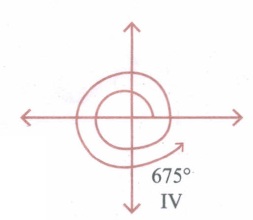
\(\frac{15\pi}{4}=15\times45^o=675^o\)
\(\cot\left(\frac{-15\pi}{4}\right)=\)cot (-675°)= - cot 675° = - cot (720 -45°) = -cot (2 x 360° - 45°)
= -(-cot 45°)(\(\therefore\) 675° is in the IV quadrant) =-(-1) = 1.
30.
Since \(\pi
\(\therefore\) sin x is negative and tan x is positive
\(\therefore\sin x=\pm\sqrt{1-\cos^2x}=-\sqrt{1-\frac{1}{4}}=-\frac{\sqrt3}{2}\)
\(\therefore cosec\ x=-\frac{2}{\sqrt{3}}\)
\(\tan x=\frac{\sin x}{\cos x}=\frac{-\frac{\sqrt3}{2}}{-\frac{1}{2}}=\sqrt3\)
Hence, \(4\tan^2x-3cosec^2x=4\times3-3\times\frac43=12-4=8\)
31.
Given \(f(x) =\begin{cases} \frac { 1-cos4x }{ 8{ x }^{ 2 } } \quad ifx\neq 0 \\ k\quad \quad \quad ifx=0 \end{cases}\)
\(\neq \underset { x\rightarrow 0 }{ lim } \quad f(x)=\underset { x\rightarrow 0 }{ lim } \frac { 1-cos4x }{ { 8x }^{ 2 } } =\underset { x\rightarrow 0 }{ lim } \frac { 2sin^{ 2 }2x }{ { 8x }^{ 2 } } \) [ஃ 1-cos2z =sin2x]
= \(\underset { x\rightarrow 0 }{ lim } \frac { sin^{ 2 }2x }{ { 4x }^{ 2 } } =\underset { x\rightarrow 0 }{ lim } \left( \frac { sin2x }{ 2x } \right) ^{ 2 }\)
= (1)2 ....(1)
Given f(0) = k ...(2)
Since f(x) is continuous at x = 0,
\(\underset { x\rightarrow 0 }{ lim } \) f(x) = f(0)
1 = k [using (1) and (2)
k = 1
32.
Given pair of lines is
3x2+10xy+8y2+14x+22y+15=0
2h=10
Here a=3, h=5, b=8,
Let \(\theta\) be the angle between the pair of lines
Then \(tan\quad \theta =\frac { \pm 2\sqrt { { h }^{ 2 }-ab } }{ a+b } =\frac { \pm 2\sqrt { 25-3(8) } }{ 3+8 } =\frac { \pm 2\sqrt { 1 } }{ 11 } =\frac { \pm 2 }{ 11 } \)
\(\therefore \quad tan\quad \theta =\frac { 2 }{ 11 } \Rightarrow \theta ={ tan }^{ -1 }\left( \frac { 2 }{ 11 } \right) \)
33.
Given f(x) = 5x - \(\left| x \right| \)
\(\therefore f(x)=\begin{cases} 5x-x\quad if\quad x\ge 0 \\ 5x-(-x)\quad if\quad x>0 \end{cases}=\begin{cases} 4x\quad ifx\ge 0 \\ 6x\quad if\quad x<0 \end{cases}\)
\(L\left[ f\left( x \right) \right] _{ x=0 }=\underset { x\rightarrow 0 }{ lim }f\left( x \right) =\underset { h\rightarrow 0- }{ lim } \quad f(o-h)\)
\(=\underset { h\rightarrow 0 }{ lim } f(-h)=\underset { h\rightarrow 0 }{ lim } 6(-h)\quad \quad \left[ \therefore f(x)=6x\quad ifx\ge 0 \right] \)
= 0
\(R\left[ f\left( x \right) \right] _{ x=0 }=\underset { x\rightarrow 0 }{ lim } lif\left( x \right) =\underset { h\rightarrow 0 }{ lim } \quad f(o+h)\)
\(\underset { h\rightarrow 0 }{ lim } f(h)=\underset { h\rightarrow 0 }{ lim } 4(h)\quad \left[ \therefore f(x)=4xi\quad fx\ge 0 \right] \)
=0
∴ \(L\left[ f\left( x \right) \right] _{ x=0 }=R\left[ f\left( x \right) \right] _{ x=0 }\)
∴ f(x) is continuous at x = 0
34.
Equation of the parabola is x2+y=6x-14
⇒ x2-6x=-y-14
⇒ x2-6x+9=-y-14+9 (Adding 9 both sides)
⇒ (x-3)2=-y-5
⇒ (x-3)2=-1(y+5)
⇒ x2=-y where X = x - 3, Y = y + 5
35.
The given equation is
y2=4x+4y
⇒ y2-4y=4x
⇒ y2-4y=4x
⇒ y2-4y+4=4x+4 (Adding 4 on both sides)
⇒ (y-2)2=4(x+1)
⇒ y2=4 where X = x + 1 ⇒ Y = y - 2
36.
We have P(n): 23n-1 is a multiple of 7
∴ P (5) : 215 -1 = 32767
= 7 (4681) which is multiple of 7
\(\therefore\) P (5) is true
37.
(1+2x + x2)27 = [(1 + x)2]27 = (1 + x)54
Here n = 54, x = 1, a = x
The general term is tr+ 1 = nCrxn-r ar
\(\Rightarrow\) tr+ 1 = 54Cr (1)54-r.Xr
\(\Rightarrow\) tr+1 = 54Crxr
To find the co-efficient of x40, put r = 40
∴ t41 = 54 C40 x40
∴ Co-efficient of x40 is 54 C40 = 54CI4 \(\left[ \because ncr=nc_{ n-r } \right] \)
38.
In \({ \left( x+\frac { 1 }{ x } \right) }^{ 6 }\)n = 6,x = x ,a =\(\frac { 1 }{ x } \)
General term is tr+ 1 =nCrxn-rar
tr+1 = 6Crx6-r\({ \left( \frac { 1 }{ x } \right) }^{ r }\)
To find t3, put r =2
∴ t3=6C2x6-2\({ \left( \frac { 1 }{ x } \right) }^{ 2 }\)=\(\frac { 6\times 5 }{ 2\times 1 } \).x4.\(\frac { 1 }{ { x }^{ 2 } } \)=15x2
39.
An octagon has 8 angular points
∴ Number of lines = 8 C2 =\(\frac { 8\times 7 }{ 1\times 2 } =27\)
Number of sides = 8
∴ Number of diagonals 28 - 8 = 20
40.
nCx = nCy \(\Rightarrow\)x= y or x + y = n
\(\Rightarrow\) \(\therefore\) 25 Cn+5 = 25 C2n-1
\(\Rightarrow\) n + 5 = 2n-1
\(\Rightarrow\) n = 5 (or) n + 5 + 2n - 1 = 25
\(\Rightarrow\) 6 = 2n - n or 3n + 4 = 25
\(\Rightarrow\) n= 6 or 3n = 21\(\Rightarrow\) n=7
∴ n = 6 or n = 7
41.
Number of ways of forming necklace
\(\frac { (10-1)! }{ 2! } =\frac { 9! }{ 2 } =181440\)
42.
The first place can be filled in only one way namely T and the remaining 7 letters can be arranged in 7! ways.
\(\therefore\) Total number of arrangements = 1 x 7! = 5040.
43.
Number of vowels are A, E, I, O, U = 5
∴ Taking 2 vowels from 5 vowels = 5P2
= 5 x 4 = 20
44.
LHS 10P3 = 10 x 9 x 8 = 720
RHS 9P3 + 3. 9P2 = 9 x 8 x 7 + 3 x 9 x 8
= 9 x 8 (7 + 3) = 72 (10) = 720
LHS= RHS Hence proved.
45.
\(\frac { 1 }{ 5! } +\frac { 1 }{ 6! } +\frac { 1 }{ 7! } \)
\(=\frac { 1 }{ 5! } +\frac { 1 }{ 6\times 5! } +\frac { 1 }{ 7\times 6\times 5! } =\frac { 1 }{ 5! } \left( 1+\frac { 1 }{ 6 } +\frac { 1 }{ 42 } \right) =\frac { 1 }{ 5! } \left( \frac { 42+7+1 }{ 42 } \right) \)
\(=\frac { 1 }{ 5! } \frac { \left( 50 \right) }{ 42 } =\frac { 5 }{ 5! } \)
46.
Number of ways for first passenger to occupy seat = 6. ....(1)
Number of ways for the second passenger to occupy seat = 5
Number of ways for the third passenger to occupy seat = 4.
∴By fundamental principle of counting, the total number of ways for all the three to occupy seats
= 6 x 5 x 4 = 120.
47.
\(\frac { 12x-17 }{ (x-2)(x-1) } =\frac { A }{ x+2 } +\frac { B }{ x-1 } \)
\(\Rightarrow \frac { 12x-17 }{ (x-2)(x-1) } =\frac { A(x-1)+B(x-2) }{ (x-2)(x-1) } \)
\(\Rightarrow 12x-17=A(x-1)+B(x-2)\)
Putting x=1 in (1) we get,
\(12-17= B(1-2) \Rightarrow -5=-B \Rightarrow \boxed { B=5 } \)
Putting x=2 in (1) we get,
\(24-17=A(2-1) \Rightarrow 7=A(1) \Rightarrow \boxed { A=7 } \)
\(\therefore \frac { 12x-17 }{ (x-2)(x-1) } =\frac { 7 }{ x+2 } +\frac { 5 }{ x-1 } \)
48.
Let A = \(\begin{vmatrix} x &a &x+a \\ y & b &y+b \\z & c & z+c \end{vmatrix}\)
Applying the elementary transformation, \(C_1\rightarrow C_1+C_2\) we get,
\(A=\begin{vmatrix} x+a&a&a+x\\y+b&b&y+b\\z+c&c&z+c\end{vmatrix}=0[C_1\equiv C_3]\)
\(\therefore\) |A| = 0.
49.
Let |A| = \(\begin{vmatrix} 6 &5 &12 \\ 2 & 4 &4 \\2 & 1 & 4 \end{vmatrix}\)
Taking 2 common from C1 and 4 common from C3, we get,
\(|A|=2\times4\begin{vmatrix} 3 & 5&3 \\ 1 & 4 & 1\\1 &1 &1\end{vmatrix}=8\times 0\ [\because C_1\equiv C_3]=0\)
50.
Given \(\begin{vmatrix}2 & 4 \\5 & 1 \end{vmatrix}=\begin{vmatrix} 2x & 4 \\ 6 & x \end{vmatrix}\)
\(\Rightarrow\) 2 - 20 = 2x2 - 24
\(\Rightarrow\) -18 = 2x2 - 24
\(\Rightarrow\) -18 + 24 = 2x2
\(\Rightarrow\) 6 = 2x2
\(\Rightarrow\) x2 = 3
\(\Rightarrow\) x = \(\pm\sqrt{3}\)
51.
Let \(|A|=\begin{vmatrix} 2&-1&-2 \\ 0 &2&-1\\3&-5&0 \end{vmatrix}\)
Expanding along R1 we get,
\(|A|=2\begin{vmatrix} 2 & -1\\ -5 & 0\end{vmatrix}+1\begin{vmatrix} 0 & -1 \\ 3 & 0 \end{vmatrix}-2\begin{vmatrix} 0 & 2 \\ 3 & -5 \end{vmatrix}\)
= 2 ( 0 - 5 ) + 1 ( 0 + 3 ) - 2 ( 0 - 6 )
= - 10 + 3 + 12 = 5
\(\therefore\) |A| = 5.
52.
Given = \(\begin{bmatrix} 1 & 2 \\ 4 & 2\end{bmatrix},\) then 2A = \(\begin{bmatrix} 2 & 4 \\ 8 & 4 \end{bmatrix}\)
\(\therefore\) |2A| = \(\begin{vmatrix}2 & 4 \\8 & 4 \end{vmatrix}\) = 8 - 32 = -24 ...(1)
Also, |A| = \(\begin{vmatrix} 1&2 \\4 & 2 \end{vmatrix}\) = 2 - 8 = -6
\(\therefore\) 4|A| = 4(-6) = -24 ....(2)
From (1) and (2), |2A| = 4.|A|
53.
AB = \(\begin{bmatrix} 1 \\ -4 \\3 \end{bmatrix}\begin{bmatrix} -1 &2 & 1 \end{bmatrix}=\begin{bmatrix} -1 & 2 & 1 \\ 4 & -8 & -4 \\-3 & 6 & 3 \end{bmatrix}\)
\(\therefore\) \({(AB)}^{T}=\begin{bmatrix} -1 &4&-3 \\ 2 & -8&6\\1&-4&3 \end{bmatrix}\) ....(1)
\({B}^{T}=\begin{bmatrix} -1 & 2 & 1 \end{bmatrix}^{T}=\begin{bmatrix} -1\\2\\1\end{bmatrix}\)and \({A}^{T}={\begin{bmatrix} 1\\-4\\3\end{bmatrix}}^{T}=\begin{bmatrix} 1&-4&3 \end{bmatrix}\)
\(\therefore\) \({B}^{T}{A}^{T}=\begin{bmatrix} -1\\2\\1 \end{bmatrix}\begin{bmatrix} 1&-4&3 \end{bmatrix}=\begin{bmatrix} -4 & 4&-3 \\ 2&-8 &6\\1&-4&3 \end{bmatrix}\) ....(2)
From (1) and (2), (AB)T = BT . AT
54.
Given R=\({12000\over12}=1000 units /month\)
C1= 20 paise per unit / month
C2= Rs.350 per run
(i) \(q_o=\sqrt{2C_3R\over C_1}=\sqrt{2\times 350\times 1000\over 0.20}=1870 units/ run\)
(ii)\(t_o=\sqrt{2C_3\over C_1R}=\sqrt{2\times 350\over 0.20\times 1000}=1.87 months\)
=1.87 x 30 = 56 days
(iii)\(C_o=\sqrt{2C_1 C_3R}=\sqrt{2\times 0.20\times12\times350\times(1000\times12)}\)
=Rs. 4490 per year
55.
Given C =\({1\over5}x^2-6x+100\)
Differentiating w.r.t. 'x' we get,
\({dC\over dx}={1\over5}(2x)-6\)
\({dC\over dx}=0\)
\(\Rightarrow {2x\over 5}-6=0\)
\(\Rightarrow {2x\over 5}=6\)
\(\Rightarrow x={6\times5\over2}=15\)
Now \({d^2C\over dx^2}={2\over5}>0\)
\(\therefore\)Cost function is minimum when x = 15.
56.
Let y=x3-6x2+7
Differentiating w.r.t. 'x' we get,
\({dy\over dx}=3x^2-12x\)
\({dy\over dx}=0\)
\(\Rightarrow3x^2-12x=0\)
\(\Rightarrow3x(x-4)=0\)
\(\Rightarrow x=0 \ or \ x=4\)
\({d^2y\over dx^2}=6x-12\)
when x=0 \({d^2y\over dx^2}=-12<0\)
\(\therefore \) y is maximum at x=0
\(\therefore \) maximum value=03-6(0)2+7=7
when x=4, \({d^2y\over dx^2}=-6(4)-12=12>0\)
\(\therefore \) y is minimum at x=4
\(\therefore \) Minimum value =44-6(4)2+7=64-96+7=-25
Hence maximum value is 7 and minimum value is -25.
57.
Let y= 75-12x+6x2-x3
Differentiating w.r.t. 'x' we get,
\({dy\over dx}=0-12+12x-3x^2=-3(x^2-4x+4)=-3(x-2)^2\)
\(\Rightarrow{dy\over dx}\le 0\) for all \(x \in (-\infty , \infty)\)
\(\therefore \) y decreases as x increases.
58.
Given y=1+1/x
Differentiating w.r.t. 'x' we get,
\({dy\over dx}={-1\over x^2}<0\) for all real values of x, except x=0.
\(\therefore \) y is a strictly decreasing function for all real values of x(x\(\neq\)0).
59.
Let y = (sec x -1) (sec x +1)
y = sec2 x -1 \(\left[ \therefore (a+b)(a-b)={ a }^{ 2 }-{ b }^{ 2 } \right] \)
\(\therefore\)y =tan2x
Differentiating with respect to 'x' we get
\(\frac { dy }{ dx } =2tanx\frac { d }{ dx } (tan x)\) \([\therefore 1+tan^{ 2 }x=sec^{ 2 }x]\)
=2tan x.sec2 x
60.
\(\underset { h\rightarrow 0 }{ lim } \frac { \sqrt { x+h } -\sqrt { x } }{ h } =\underset { h\rightarrow 0 }{ lim } \frac { (x+h)^{ \frac { 1 }{ 2 } }-{ x }^{ \frac { 1 }{ 2 } } }{ (x+h)-x } \) [Adding and subtracting x in the denominator]
= \(\frac { 1 }{ 2 } { x }^{ \frac { 1 }{ 2 } -1 }\left[ \therefore \underset { x-\rightarrow a }{ lim } \frac { { x }^{ n }-{ a }^{ n } }{ z-a } =n.a^{ n-1 } \right] \)
= \(\frac { 1 }{ 2 } { x }^{ \frac { 1 }{ 2 } }=\frac { 1 }{ 2\sqrt { x } } \)

11th Standard Syllabus & Materials
11th Standard
TN 11th Tamil பீடு பெற நில் - செய்யுள் - காவடிச்சிந்து Important Questions And Answers Study Material - QB365 Set A
NEW11th Standard
TN 11th Tamil பீடு பெற நில் - உரைநடை - மலை இடப்பெயர்கள் : ஓர் ஆய்வு Important Questions And Answers Study Material - QB365 Set A
NEW11th Standard
TN 11th Tamil மாமழை போற்றுதும் - துணைப்பாடம் - யானை டாக்டர் Important Questions And Answers Study Material - QB365 Set A
NEW11th Standard
TN 11th Tamil மாமழை போற்றுதும் - செய்யுள் - ஐங்குறுநூறு Important Questions And Answers Study Material - QB365 Set A



Tamilnadu Stateboard 11th Standard Subjects

Maths

Commerce

Economics

Biology
Business Maths and Statistics

Accountancy

Computer Science

Physics

Chemistry
Maths
Biology
Economics
Physics
Chemistry

History
Business Maths and Statistics

Computer Science
Accountancy

Computer Applications
History
Computer Technology
Commerce
Computer Applications
Computer Technology

Tamil

English

French
Tamilnadu Stateboard Standards

