
 100% FREE ACCESS
11th Standard Syllabus & Materials
11th Standard
TN 11th Tamil இயற்கை வேளாண்மை,சுற்றுச்சூழல் -செய்யுள் - மனோன்மணீயம் Important Questions And Answers Study Material - QB365 Set A
NEW11th Standard
TN 11th Tamil என்னுயிர் என்பேன் -துணைப்பாடம் - இசைத்தமிழர் இருவர் Important Questions And Answers Study Material - QB365 Set A
NEW11th Standard
TN 11th Tamil மொழி கலை -செய்யுள் - ஒவ்வொரு புல்லையும் Important Questions And Answers Study Material - QB365 Set A
NEW11th Standard
TN 11th Tamil பீடு பெற நில் - இலக்கணம் - பகுபத உறுப்புகள் Important Questions And Answers Study Material - QB365 Set A
NEW11th Standard
TN 11th Tamil பீடு பெற நில் - துணைப்பாடம் - வாடிவாசல் Important Questions And Answers Study Material - QB365 Set A
NEW11th Standard
TN 11th Tamil பீடு பெற நில் - செய்யுள் - குறுந்தொகை Important Questions And Answers Study Material - QB365 Set A

Published on: 21/09/2021
Download Tamil Nadu 11th Standard Maths question papers, model tests, one-mark questions, important questions, and public exam papers in PDF format. Free study materials and answer keys for TN State Board students.
Questions + Answers key
Take MCQ Maths Test1.
If the logarithm of 324 to base a is 4, then find a.
2.
Discuss the nature of roots of -x2 + 3x + 1 = 0
3.
For a set A, A\(\times\)A contains 16 elements and two of its elements are (1, 3) and (0, 2). Find the elements of A.
4.
Solve for x \(\left| 3-x \right| <7\)
5.
Write the following in roster form {x\(\in \)N : 4x + 9 < 52}
6.
Simplify \((-1000)^{ \frac { -2 }{ 3 } }\)
7.
Let f, g: \(R \rightarrow R\) be defined as f (x) = 2x -|x| and g(x) = 2x + |x|. find f o g.
8.
Resolve the following rational expressions into partial fractions.
\({{x^2+x+1}\over{x^2-5x+6}}\)
9.
Prove that \(log_{10}2+16log_{10}\frac { 16 }{ 15 } +12log_{10}\frac { 25 }{ 24 } +7log_{10}\frac { 81 }{ 80 } =1\)
10.
Simplify \(\frac { 1 }{ 3-\sqrt { 8 } } -\frac { 1 }{ \sqrt { 8 } -\sqrt { 7 } } +\frac { 1 }{ \sqrt { 7 } -\sqrt { 6 } } -\frac { 1 }{ \sqrt { 6 } -\sqrt { 5 } } +\frac { 1 }{ \sqrt { 5 } -2 } \)
11.
A simple cipher takes a number and codes it, using the function f(x) = 3x - 4. Find the inverse of this function, determine whether the inverse is also a function and verify the symmetrical property about the line y = x(by drawing the lines)
12.
If log2x + log4x + log16x = \(\frac{7}{2}\), find the value of x.
13.
Let f and g be the two functions from R to R defined by f(x) = 3x - 4 and g(x) = x2+ 3. Find g o f and f o g.
14.
Find the largest possible domain for the real valued function given by \(f(x)={\sqrt{9-x^2}\over{x^2-1}}.\)
15.
Solve the equation \(\sqrt{6-4x-x^2}=x+4\)
16.
Find the domain of \(\frac { 1 }{ 1-2sinx } \)
17.
Solve \(2{ x }^{ 2 }+x-15\le 0.\)
18.
If a2+b2 = 7ab. Show that log \(\ \frac { a+b }{ 3 } =\frac { 1 }{ 2 } \) (log a + log b)
1.
We are given loga 324 = 4, which gives
a4 = 324 = 34(\(\sqrt{2}\))4. Therefore a = 3\(\sqrt{2}\)
2.
-x2 + 3x + 1 = 0
Given equation is -x2 + 3x + 1 = 0
Here a = -1, b = 3, c = 1
\(\therefore\) D = b2 - 4ac = 32 - 4 (-1) (1)
= 9 + 4 = 13
Since D > 0, the two roots are real and distinct.
3.
Since A\(\times\) A contains 16 elements, then A must have 4 elements
\(\Rightarrow\) n(A) = 4.
The elements of A \(\times\) A are (1, 3) and (0, 2)
\(\therefore\) The possibilities of elements of A are {0, 1, 2, 3}
4.
.png)
[a < b ⇒ ay > by for all y< 0]
Here y = -1
Given |3-x| < 7
This means -7 < 3 -x < 7
⇒-7-3 < -x < 7-3
⇒-10 < -x < 4
⇒10 > x > -4
\(\therefore\) The Solution set is \(x\in \left( -\infty ,-4 \right) \cup \left( -4,10 \right) \)
5.
{x \(\in \) N : 4x + 9 < 52}
Let C = {x\(\in \)N:4x + 9 < 52}
\(\Rightarrow\) C = {x\(\in \)N:4x < 52 - 9}
\(\Rightarrow\) C = {x\(\in \)N: 4x < 43}
\(\Rightarrow\) C = \(\left\{ x\in N:x<\frac { 43 }{ 4 } \right\} \) \(\Rightarrow\) C = {x \(\in \) N : x < 10.75}
\(\Rightarrow\) C = {1,2,3,4,5,6,7,8,9,10}.
6.
= \(\left( { -10 }^{ 3\times \frac { -2 }{ 3 } } \right) =-{ 10 }^{ -2 }=\frac { -1 }{ { 10 }^{ 2 } } =\frac { -1 }{ 100 } \)
7.
We know \(|x|=\begin{cases} -x\ \ if\ x\le0 \\ x\quad if\ x>0 \end{cases}\)
So, \(f(x)=\begin{cases} 2x-(-x)\quad if x \le 0\\ 2x-x\quad if\ x>0 \end{cases}\)
Thus, \(f(x)=\begin{cases}3x\quad ifx\le0\\x\quad if\ x>0 \end{cases}\)
Also, \(g(x)=\begin{cases} 2x+(-x)\quad if \ x\le 0\\2x+x\quad if\ x>0 \end{cases}\)
Thus, \(g(x)=\begin{cases} x\quad if x \le 0\\3x\quad if x >0 \end{cases}\)
Let \(x\le0.\) Then
(f o g) (x) = f(g{x)) = f(x) = 3x.,
The last equality is taken because \(3x\le0\) whenever \(x\le0.\)
Let x > 0. Then
(f o g)(x) = f(g(x)) = f(3x) = 3x.
Thus (f o g)(x) = 3x for all x.
8.
Since the degree of the numerator is equal to the degree of the denominator, let us divide the numerator by the denominator
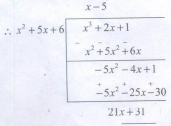
\(∴\ \ {x^2+x+1\over x^2-5x+6}=1+{6x-5\over x^2-5x+6 }\)
Consider \({6x-5\over x^2-5x+6}={6x-5\over (x-3)(x-2)}={A\over (x-3)}+{B\over (x-2)}\)
\(⇒\ {6x-5\over x^2-5x+6}={A(x-2)+B(x-3)\over (x-3)(x-2}\)
⇒ 6x - 5 = A(x - 2) + B(x - 3)
Putting x=2 in (2) we get
7 = B(-1) ⇒ B = -7
Putting x = 3 in (2) we get
13 = A(1) ⇒ A = 13
\(∴\ {6x-5\over x^2-5x+6}={13\over x-3}-{7\over x-2}\)
Substituting in (1) we get
\({x^2+x+1\over x^2-5x+6}=1+{13\over x-3}-{7\over x-2}\)
9.
LHS = \(log2+16log{16\over 15}+12log{25\over 24}+7log{81\over 80}\)
\(=log2+log\left(16\over 15\right)^{16}+log\left(25\over 24\right)^{12}+log \left(81\over 80\right)^7\)
\(=log2\times{(2^4)^{16}\over (3\times5)^{16}}\times{(5^2)^{12}\over (2^2\times3)^{12}}\times{(3^4)^7\over 2^{28}\times5^7}\)
\(=log2^1\times{2^{64}\over 3^{16}}\times{5^{24}\over 2^{36}\times3^{12}}\times{3^{28}\over 2^{28}\times5^7}\)
\(=log{2^{1+64}.5^{24}.3^{28}\over 3^{16+12}.5^{16+7}.2^{36+28}}\) \(\left[∵\ {a^m\over a^n}=a^{m-n} \right]\)
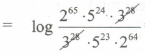
= log 265-64 x 524-23 = log 21 \(\times\) 51 = log1010 = 1 = RHS
10.
Given \(\frac { 1 }{ 3-\sqrt { 8 } } -\frac { 1 }{ \sqrt { 8 } -\sqrt { 7 } } +\frac { 1 }{ \sqrt { 7 } -\sqrt { 6 } } -\frac { 1 }{ \sqrt { 6 } -\sqrt { 5 } } +\frac { 1 }{ \sqrt { 5 } -2 } \) ..(1)
Multiplying each term by the conjugate of the denominator we get
\(\frac { 1 }{ 3-\sqrt { 8 } } \) = \(\frac { 1 }{ 3-\sqrt { 8 } } \times \frac { 3+\sqrt { 8 } }{ 3+\sqrt { 8 } } =\frac { 3+\sqrt { 8 } }{ { 3 }^{ 2 }-\sqrt { 8 } ^{ 2 } } =\frac { 3+\sqrt { 8 } }{ 9-8 } =3+\sqrt { 8 } \)
\(\frac { 1 }{ \sqrt { 8 } -\sqrt { 7 } } \)= \(\frac { 1 }{ \sqrt { 8 } -\sqrt { 7 } } \times \frac { \sqrt { 8 } +\sqrt { 7 } }{ \sqrt { 8 } +\sqrt { 7 } } =\frac { \sqrt { 8 } +\sqrt { 7 } }{ 8-7 } =\frac { \sqrt { 8 } +\sqrt { 7 } }{ 1 } =\sqrt { 8 } +\sqrt { 7 } \)
\(\frac { 1 }{ \sqrt { 7 } -\sqrt { 6 } } \) =\(\frac { 1 }{ \sqrt { 7 } -\sqrt { 6 } } \times \frac { \sqrt { 7 } +\sqrt { 6 } }{ \sqrt { 7 } +\sqrt { 6 } } =\frac { \sqrt { 7 } +\sqrt { 6 } }{ \sqrt { 7 } ^{ 2 }+\sqrt { 6 } ^{ 2 } } =\frac { \sqrt { 7 } +\sqrt { 6 } }{ 7-6 } =\sqrt { 7 } +\sqrt { 6 } \)
\(\frac { 1 }{ \sqrt { 6 } -\sqrt { 5 } } \) = \(\frac { 1 }{ \sqrt { 6 } -\sqrt { 5 } } \times \frac { \sqrt { 6 } +\sqrt { 5 } }{ \sqrt { 6 } +\sqrt { 5 } } =\frac { \sqrt { 6 } +\sqrt { 5 } }{ \sqrt { 6 } ^{ 2 }+\sqrt { 5 } ^{ 2 } } =\frac { \sqrt { 6 } +\sqrt { 5 } }{ 6-5 } \)
\(\frac { 1 }{ \sqrt { 5 } -2 } \) = \(\frac { 1 }{ \sqrt { 5 } -2 } \times \frac { \sqrt { 5 } +2 }{ \sqrt { 5 } +2 } =\frac { \sqrt { 5 } +2 }{ \sqrt { 5 } ^{ 2 }+2^{ 2 } } =\frac { \sqrt { 5 } +2 }{ 5-4 } =\sqrt { 5 } +2\)
Substituting all these values in (1)we get
\(\frac { 1 }{ 3-\sqrt { 8 } } -\frac { 1 }{ \sqrt { 8 } -\sqrt { 7 } } +\frac { 1 }{ \sqrt { 7 } -\sqrt { 6 } } -\frac { 1 }{ \sqrt { 6 } -\sqrt { 5 } } +\frac { 1 }{ \sqrt { 5 } -2 } \) = 5
11.
Given f(x) = 3x - 4
Let y = 3x - 4 ⇒ y + 4 = 3x
\(⇒ x={y+4\over 3}\)
Let g(y) = \(y+4\over 3\)
Now gof(n) = g(f(n)) = g(3\(\times\) -4) = \({3x-4+4\over 3}={3x\over 3}=x\)
and fog(y) = f(g(y)) = \(f\left(y+4\over 4\right)=3\left(y+4\over 3\right)-4=y+4-4=y\)
Thus, gof(x) = Ix and fog (y) = Iy
This implies that f and g are bijections and inverses to each other
Hence f is bijection and \(f^{-1} (x)={y+4\over 3}\)
Replacing y by x, we get f-1 (x) = \(\frac { x+4 }{ 3 } \)
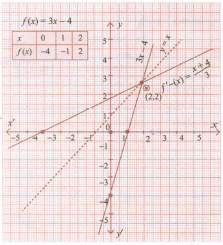
Hence, the graph of y = f-1(x) is the reflection of the graph of f in y = x
12.
Note that x > 0.
log2x + log4x + log16x = \(\frac{7}{2}\) becomes \(\frac{1}{log_x2}+\frac{1}{log_x4}+\frac{1}{log_x16}=\frac{7}{2}\) (change of base rule)
Thus \(\frac{1}{a}+\frac{1}{2a}+\frac{1}{4a}=\frac{7}{2}\) where a = logx 2. That is \(\frac{7}{4a}=\frac{7}{2}\)
Thus, a = \(\frac{1}{2}\) and so, logx 2 =\(\frac{1}{2}\) which gives \(x^{\frac{1}{2}}\)= 2
Thus, x = 22 = 4
13.
(g o f) (x) = g(f(x)) = g(3x - 4) = (3x-4)2+3 = 9x2-24x+19
(f o g)(x) = f(g(x)) = f(x2+ 3) = 3(x2+ 3)-4 = 3x2+5.
Thus the operation "Composition of functions" is in general. (not commutative)
14.
If x < -3 or x > 3, then x2 will be greater than 9 and hence 9 - x2 will become negative which has no square root in R.
So x must lie on the interval [- 3, 3].
Also if \(x\ge-1\) or \(x\le 1,\) then x2-1 will become negative or zero. If it is negative, x2 - 1 has no square root in R. If it is zero, f is not defined. So, x must lie outside [- 1, 1].
That is x must lie on \(( -\infty,-1 ]\cup[1,\infty),\) Combining these two conditions, the largest possible domain for f is \([-3,3]\cap((-\infty, -1)\cup(1,\infty)).\) That is \([-3,-1)\cup(1, 3].\)
15.
The given equation is equivalent to the system (x + 4) ≥ 0 and 6 - 4x - x2 = (x + 4)2
This implies x ≥ -4 and x2 + 6x + 5 = 0. Thus x = -1, -5.
But only x = -1 satisfies both the conditions. Hence, x = -1.
16.
Let f(x) = \(\frac { 1 }{ 1-2sinx } \)
When the denominator is 0,
1-2 sin x = 0
\(\Rightarrow\) 1 = 2 sin x
\(\Rightarrow sin\quad x=\frac { 1 }{ 2 } \)
\(\Rightarrow sin\quad x=sin\frac { \pi }{ 6 } \)
\(\Rightarrow x=n\pi +{ (-1) }^{ n }\frac { \pi }{ 6 } n\in Z\) \(\left[ \because sin\quad x=sin\alpha \Rightarrow x=n\pi +{ (-1) }^{ n }\alpha \quad n\in Z \right] \)
Domain of f(x) is R - \(\left( n\pi +{ (-1) }^{ n }\frac { \pi }{ 6 } \right) ,n\in Z\)
17.
Given inequality is 2x2 + x - 15 < 0.
On factorising we get,
(x + 3)(2x - 5) < 0
\(⇒\ 2(x+3)\left(x-{5\over 2}\right)\le0\)
.png)
The critical points are \(-3,{5\over 2}.\) where the factors Vanish.
Draw the number line and mark the critical points.
The possible intervals are \((-\infty ,-3)\left(-3,{5\over 2}\right)\left({5\over 2},\infty\right)\)
.png)
| Internal | Sign of (x + 3) | Sign of \(\left(x-{5\over 4}\right)\) | Sign of 2x2 +x - 15 |
|---|---|---|---|
| (-∞,-3) [say x =-4] | - | - | + |
| \(\left(-3,{5\over 2}\right)\)[say x = 0] | + | - | - |
| \(\left({5\over 2},-\infty\right)\)[say x = 3] | + | + | + |
The in equality 2x2 +x - 15 < 0 is satisfied only in the interval \(\left[-3,{+5\over 2}\right]\)
∴ Solution set is \(\left[-3,{+5\over 2}\right]\)
18.
Given a2+ b2 = 7ab
Adding 2ab both sides we get,
a2+b2+2ab = 7ab + 2ab
⇒ (a+b)2 = 9ab
⇒ \(\frac { (a+b)^{ 2 } }{ 9 } \) = ab
⇒ \(\left( \frac { a+b^{ 2 } }{ 9 } \right) ^{ 2 }\) = ab
Taking square root,we get
\(\frac { a+b }{ 3 } \) = ab
\(log\left( \frac { a+b }{ 3 } \right) =log(ab)^{ \frac { 1 }{ 2 } }\)
= \(\frac { 1 }{ 2 } \) log (ab)
log \(\left( \frac { a+b }{ 3 } \right) \) = \(\frac { 1 }{ 2 } \) [log a + log b]
Hence proved.

11th Standard Syllabus & Materials
11th Standard
TN 11th Tamil பீடு பெற நில் - செய்யுள் - காவடிச்சிந்து Important Questions And Answers Study Material - QB365 Set A
NEW11th Standard
TN 11th Tamil பீடு பெற நில் - உரைநடை - மலை இடப்பெயர்கள் : ஓர் ஆய்வு Important Questions And Answers Study Material - QB365 Set A
NEW11th Standard
TN 11th Tamil மாமழை போற்றுதும் - துணைப்பாடம் - யானை டாக்டர் Important Questions And Answers Study Material - QB365 Set A
NEW11th Standard
TN 11th Tamil மாமழை போற்றுதும் - செய்யுள் - ஐங்குறுநூறு Important Questions And Answers Study Material - QB365 Set A



Tamilnadu Stateboard 11th Standard Subjects
Maths

Commerce

Economics

Biology

Business Maths and Statistics

Accountancy

Computer Science

Physics

Chemistry
Maths
Biology
Economics
Physics
Chemistry

History
Business Maths and Statistics

Computer Science
Accountancy

Computer Applications
History
Computer Technology
Commerce
Computer Applications
Computer Technology

Tamil

English

French
Tamilnadu Stateboard Standards

