
 100% FREE ACCESS
11th Standard Syllabus & Materials
11th Standard
TN 11th Tamil இயற்கை வேளாண்மை,சுற்றுச்சூழல் -செய்யுள் - மனோன்மணீயம் Important Questions And Answers Study Material - QB365 Set A
NEW11th Standard
TN 11th Tamil என்னுயிர் என்பேன் -துணைப்பாடம் - இசைத்தமிழர் இருவர் Important Questions And Answers Study Material - QB365 Set A
NEW11th Standard
TN 11th Tamil மொழி கலை -செய்யுள் - ஒவ்வொரு புல்லையும் Important Questions And Answers Study Material - QB365 Set A
NEW11th Standard
TN 11th Tamil பீடு பெற நில் - இலக்கணம் - பகுபத உறுப்புகள் Important Questions And Answers Study Material - QB365 Set A
NEW11th Standard
TN 11th Tamil பீடு பெற நில் - துணைப்பாடம் - வாடிவாசல் Important Questions And Answers Study Material - QB365 Set A
NEW11th Standard
TN 11th Tamil பீடு பெற நில் - செய்யுள் - குறுந்தொகை Important Questions And Answers Study Material - QB365 Set A

Published on: 29/04/2019
Public one mark questions Periodic Classification Of Elements
Download Tamil Nadu 11th Standard Chemistry question papers, model tests, one-mark questions, important questions, and public exam papers in PDF format. Free study materials and answer keys for TN State Board students.
Questions + Answers key
Take MCQ Chemistry Test
1.
The first ionisation potential (in eV) of Be and B respectively are ____________
8.29,9.32
9.32, 8.29
9.32, 9.32
8.29, 8.29
2.
The ionisation potential of Na is 5.48 eV. The ionisation potential of K will be __________
tho same as Na
4.34 eV
5.68 eV
10.88 eV
3.
Among the following which one has highest cation to anion ratio?
CsI
CsF
LiF
NaF
4.
The ionic radii (in A) of N-3, 0-2 and P- are respectively _________
1.71, 1.40 and 1.36
1.71, 1.36 and 1.40
1.36, 1.40 and 1.71
1.36, 1.71 and 1.40
5.
Among the elements Ca, Mg, P and CI the order of increasing atomic radii is ___________
Mg < Ca < Cl < P
Cl < P < Mg < Ca
p < Cl < Ca < Mg
Ca < mg < P < Cl
6.
The number of d- electrons in Fe+2 (Z = 26) is not equal to the number of electrons in which one of the following?
d-electron in Fe (Z = 26)
p-electron in Ne (Z = 10)
s-electron in Mg (Z = 12)
p-electron in CI (Z = 17)
7.
Gadolinium belong to 4f series. Its atomic number is 64. Which of the following is the correct electronic configuration of gadolinium?
[Xe]4f95s1
[Xe]4f75d16s2
[Xe]4f65d26s2
[Xe]4f8d2
8.
Element with atomic number 56 belongs to which block _________
s
p
d
f
9.
Pick the incorrect statement about the factors affecting ionization energy
More is the shielding of valence electrons more is the ionization energy
Ionization enthalpy ∝ effective nuclear charge
Half filled or fully filled atomic orbitals have high ionization energy
Larger is the atomic radii lower is ionization energy
10.
Which orbital diagram gives an insight to the highest ionization energy?
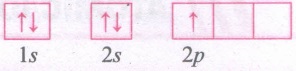
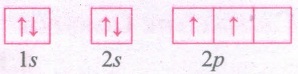
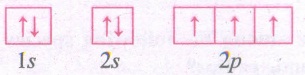
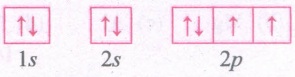
11.
Which of the following sets contain only isoelectronic ions?
Zn2+, Ca2+, Ga3+, Al3+
K+, Ca2+, Sc3+, Cl-
P3-, S2-, Cl-, Al3+
Ti4+, Ar, Cr3+, V5+
12.
Ionic radii are ____________
Inversely proportional to effective nuclear charge
Inversely proportional to square of effective nuclear charge
Directly proportional effective nuclear charge
Directly proportional to square of effective nuclear charge.
13.
Correct order of 1st ionization potential among elements Be, B, C, N, O is ___________
B < Be < C< O < N
B < Be < C< N < O
Be < B < C< N < O
Be < B < C< O < N
14.
Which of the following statement is incorrect?
The ionization potential of nitrogen is greater than that of oxygen
The electron affinity of F is greater than that of Cl.
The ionization potential of Mg is greater than aluminium.
The electronegativity of F is greater than that of Cl.
15.
Which of the following atom has the lowest ionization enthalpy?
1s2 2s2 2p3
1s2 2s2 2p6 3s1
Is2 2s2 2p6
Is2 2s2 2p5
16.
The radii of F, F-, O and O2- are in the order
O2- > O> F- > F
F- > O2- > F > 0
O2- > F- > O > F
O2 > F- > F> O
17.
Which of the following N3-, O2-, F- is largest in size?
N3-
O2-
F-
All of these
18.
The effective nuclear charge across the period (from left to right)
Decreases
Increases
First decreases and then increases
First increases and then decreases
19.
Ionisation enthalpy is an _____ process.
exothermic
endothermic
reversible
both (a) and (b)
20.
Match the list I with List II and select the correct answer using. the code given below the lists.
| List I | List II |
| A.Element with first highest ionization enthalpy |
1.Fluorine |
| B.Element with second highest ionization enthalpy |
2.Chlorine |
| C.Element with highest electron gain enthalpy |
3.Sodium |
| D.Element with highest electronegativity |
4.Neon |
| A | B | C | D |
| 1 | 3 | 2 | 4 |
| A | B | C | D |
| 4 | 3 | 2 | 1 |
| A | B | C | D |
| 3 | 1 | 4 | 2 |
| A | B | C | D |
| 2 | 1 | 4 | 3 |
21.
Which of the following has the highest positive electron gain enthalpy?
F
O-
Na+
Mg2+
22.
Which set of elements shows positive electron gain enthalpy?
He,N,O
Ne,N,Cl
O,Cl,F
N,He,Ne
23.
Which of the following processes involves absorption of energy?
Cl(g) +e- ⟶ Cl-
O-(g) +e- ⟶ O2-
O(g) +e- ⟶ O(g)-
S(g)+e- ⟶ S-(g)
24.
In a group with decrease in electronegativity the metallic character
(a) decreases across a period
(b) increases down the group
(c) does not vary
Which of the above statement(s) is true
a only
b only
both (a) and (b)
(c) only
25.
Among the elements given below,_____ has the highest value of electro negativity.
Li
Ne
F
Be
26.
Which of the following property has no unit?
ionisation energy
electronegativity
electron affinity
atomic radius
27.
"The relative tendency of a bonded atom in a molecule to attract the shared pair of electrons towards itself" is termed as_____
electron gain enthalpy
electronegativity
electron affinity
ionisation energy
28.
With respect to chlorine, hydrogen will be __________
Electropositive
Electronegative
Neutral
None of these
29.
The most electronegative element of the periodic table is _______
Iodine
Fluorine
Chlorine
Oxygen
30.
Match the list I with list II and select the correct answer using the code given below the list.
| List I | List II | ||
| A | Ionisation energy | 1 | ionic compound |
| B | electro negativity | 2 | alloys |
| C | s-block elements | 3 | KJ mol-1 |
| D | d-block elements | 4 | No unit |
| A | B | C | D |
| 1 | 2 | 3 | 4 |
| A | B | C | D |
| 3 | 2 | 1 | 4 |
| A | B | C | D |
| 2 | 3 | 1 | 4 |
| A | B | C | D |
| 3 | 4 | 1 | 2 |
31.
Which of the following factor decreases across the period?
Ionisation energy
electron affinity
atomic radius
electronegativity
32.
Which of the following statements are correct?
(i) Helium has the highest first ionisation enthalpy
(ii) Chlorine has less electron affinity than fluorine
(iii) Ne has more ionisation energy than Boron.
(iv) The ionisation energy of noble gases is zero
(i), (ii) and (iii)
(i) and (iii)
(i), (iii) and (iv)
(i), (ii), (iii) and (iv)
33.
Which among the following has the highest ionisation energy _______________
Ne
Na
K
Kr
34.
Across the period, Ionisation energy _______
increases
decreases
does not vary
first decreases and then increases
35.
Arrange the following ions in order of decreasing ionic radius He, Li2+, Be3+
He > Li2+ > Be3+
Li2+ > Be3+ > He
He > Li2+ > Be3+
Be3+ > Li2+ > He
36.
The elements having highest ionization energies within their periods are called _____
Halogens
Noble gases
Alkali metals
Transition elements
37.
The correct order of size among Br, Br+, Br- is __________
Br < Br+ < Br-
Br+ < Br < Br-
Br < Br- < Br+
Br- < Br+ < Br-
38.
Which one among the following species has the largest atomic radius?
Na
Mg
AI
Si
39.
Which one among the following exhibits a valency greater than 4?
Na
P
H
Ar
40.
Pick the metalloid among the following elements ____________
P
S
Si
Al
41.
The IUPAC name of element having atomic number 108 is ____________
Unniloctium
Ununoctium
Nilniloctium
Ununoctinium
42.
Which pair of elements has the same characteristic chemical properties?
Z = 13, Z = 22
Z = 2, Z =4
Z = 4, Z = 24
Z = 3, Z = 11
43.
All the elements in a group in the periodic table have the same ____________
electronic configuration
number of electrons in the valence shell
atomic number
atomic weight
44.
The oxidation state of alkali metal is _______
+2
+1
+3
0
45.
The element with atomic number 31 belongs to _____
s-block
p-block
d-block
f-block
46.
The elements in which extra electrons enter into (n - 2) f-orbitals are called ____ elements.
p-block
d-block
f-block
s-block
47.
d-block elements form _____ compounds.
ionic
covalent
metallic
both (a) and (b)
48.
The general electronic configuration of d-block element is _____
ns2np6
(n-1) d1-10 ns0-2
(n-1) d1 ns0-2
(n-1) d0-10 ns2
49.
The general electronic configuration of p-block element is _____
ns1-2
np1-6
np6
ns2 np6
50.
The p-block elements comprise of group ____________
1,2
13 to 18
3 to 12
12 to 18
51.
The general electronic configuration of s-block element is ______
ns1
ns2
ns1 and ns2
ns1-2
52.
Match the list I with list II and select the correct answer using the code given below the list.
| List I | List II | ||
| A | Unnilbium/td> | 1 | Bohrium |
| B | Unnilhexium | 2 | Roentgenium |
| C | Ununnunium | 3 | Seaborgium |
| D | Unnilseptium | 4 | Nobelium |
| A | B | C | D |
| 1 | 2 | 4 | 3 |
| A | B | C | D |
| 3 | 1 | 4 | 2 |
| A | B | C | D |
| 4 | 3 | 2 | 1 |
| A | B | C | D |
| 4 | 3 | 1 | 2 |
53.
Excluding hydrogen and helium, the smallest element in the periodic table is _____
Lithium
Oxygen
Fluorine
Chlorine
54.
Elements whose atoms have their s and p-sub-levels complete are the _____
Normal elements
Transition elements
Halogens
Inert gases
55.
Match the list I with List II and select the correct answer using. the code given below the lists.
| List I | List II | ||
| A | Metalloid | 1 | Cerium |
| B | Noble gas | 2 | Nobelium |
| C | Trans uranium element | 3 | Arsenic |
| D | Lanthanide | 4 | Argon |
| A | B | C | D |
| 1 | 3 | 2 | 4 |
| A | B | C | D |
| 4 | 2 | 1 | 3 |
| A | B | C | D |
| 3 | 4 | 2 | 1 |
| A | B | C | D |
| 2 | 1 | 4 | 3 |
56.
The element with atomic number 103 is ______
lawrencium
Mendelevium
fermium
nobelium
57.
Representative elements are those which belong to ____________
s and d-blocks
s and p-blocks
p and d-blocks
d and f-blocks
58.
The metal which is a liquid at room temperature is _______
Gallium
Mercury
Germanium
Tellurium
59.
Group 16 of the periodic table is called as ____
oxygen family
chalcogen family
both a and b
halogen family
60.
The number of elements in the first period of the modern periodic table is _____
2
8
18
32
61.
In the first transition series the incoming electron enters the ____________
4d-orbital
3d-orbital
5d-orbital
6d-orbital
62.
Characteristic of transition elements is incomplete ____________
d-orbitals
f-orbitals
p-orbitals
s-orbitals
63.
Halogens belong to the _____________
s-block
p-block
d-block
Zero group of the periodic table
64.
Which of the following set has atomic numbers of only representative elements?
2,10,17,35
2,12,22,32
3,15,35,45
4,20,36,79
65.
Valence electrons in the atom of element A is 4 and in the element B is 2. Most probable compound fc from A and B is
AB3
AB2
A2B3
A2B
66.
Find the incorrect statement.
Smallest atom of periodic table is He
p-block elements are metals, nonmetals and metalloids
Noble gases have 8 valence electrons except He
Valence electron and valency is same for group I
67.
The elements eka aluminum and eka silicon named by Mendeleev known today as ___________
gallium and germanium
germanium and silicon
aluminium and silicon
indium and thallium
68.
Elements which generally exhibit multiple oxidation states and whose ions are usually coloured are ___________
metalloids
transition elements
non-metals
gases
69.
Modern periodic law is ____________
The physical and chemical properties of the elements are periodic functions of their atomic numbers.
The physical and chemical properties of the elements depend upon the energy of the electrons.
The physical and chemical properties of the elements depend upon atomic weight.
None of these
70.
X, Y and Z are three members of a Dobereiner's triad. If the atomic mass of X is 7 and that of Z is 39, what in the atomic mass of Y?
23
7
46
39
71.
d-block elements form ____ compounds.
ionic
covalent
Coordinate
both (a) and (b)
72.
On moving diagonally across the periodic table, the second and third period elements show certain similarities. Pick out the pair which shows such a property.
Be & Na
Be & Al
Be & Mg
B & Al
73.
The elements at the extreme left of periodic table has strong behaviour ______
Oxidizing
Reducing
both oxidisation and reducing
electro negative
74.
Pd has exceptional electronic configuration of 4d10 5s0 It belongs to period ______ and group _____
4, 11
5, 10
6, 9
3, 16
75.
He is placed in ______ group.
1
2
17
18
76.
______ is the lightest metal known.
Na
Li
Mg
Al
77.
The element with Z = 24 is placed in the _____ period
5
2
3
4
78.
The first transition series is from _____ to _____
Sc to Zn
Hf to Hg
Y to Cd
Ac to Lr
79.
The electronic configuration of nitrogen is _____
Is22s22p3
Is22s2 2Px12py12P21
Is22s12p4
both (a) and (b)
80.
Lithium shows diagonal relationship with _____
Mg
Al
Na
Si
81.
The element with atomic number 57 belongs to _____
s-block
p-block
d-block
f-block
82.
The number of groups in the periodic table ___________
7
18
5
6
83.
There are _____ periods in the periodic table.
18
7
6
5
84.
The vertical columns in the periodic table are called as ___________
family
group
period
both (a) and (c)
85.
Consider the following statements according to modern periodic table.
(i) Modern periodic table contains 18 vertical columns and 7 horizontal rows.
(ii) The elements after uranium are called transuranium elements
(iii) The 17th group elements are called chalcogens
(iv) The elements of Groups 13 to 18 are called p-block elements.
which of the following statement(s) given above is/are correct.
(i), (iii) & (iv)
(i), (ii) & (iii)
(i), (ii) & (iv)
all the 4 statements
86.
Match the list I with list II and select the correct answer using the code given below the list.
| List I | List II | ||
| A | de Chancourtois | 1 | Addition of synthetic elements. |
| B | Moseley | 2 | first periodic law |
| C | Newland | 3 | Modern periodic law |
| D | Glenn seaborg | 4 | Law of octaves |
| A | B | C | D |
| 1 | 2 | 3 | 4 |
| A | B | C | D |
| 3 | 2 | 4 | 1 |
| A | B | C | D |
| 2 | 3 | 4 | 1 |
| A | B | C | D |
| 2 | 3 | 1 | 4 |
87.
The horizontal rows in the periodic table are called as ______
group
family
period
column
88.
The atomic weight of Au is ______
195
197
198
196
89.
______ proposed modern periodic law.
Henry Moseley
Mendeleev
Newland
Dobereiner
90.
Law of octaves was proposed by _____
Lothar Meyer
Johann Dobereiner
Newland
Mendeleev
91.
Law of triad was unable to explain for the element
Ca, Sr and Ba
Fe, Co, Ni
Li, Na, K
Cl, Br, I
92.
An element M combines with Cl. What would be the formula of the compound obtained if M has a valence of 2?
MCI
MCl2
M2CI
M2Cl2
93.
What would be the formula of the compound formed by A and B, where A has the valence 3 and B has the valence 3?
AB
AB3
A3B
3AB3
94.
The statement that is not correct for modern classification of element is
(1) The properties of elements are periodic function of these atomic numbers.
(2) The ionisation enthalpy of the elements generally increase with increase in atomic number
(3) For transition elements the 3d orbitals are filled after 3p-orbitals and before 4s orbitals.
(4) Fifth period contain 18 elements.
1 and 2
2 and 3
4 only
3 only
95.
Which of the following is Dobereiner's triad?
Ne,Ca,Na
H2, N2, O2
Li, Na, K
Na, Br, K
96.
Which of the following statement (s) about the Modern Periodic Table is are incorrect
i. The elements in the Modern Periodic Table are arranged on the basis of their decreasing atomic number.
ii. The elements in the Modern Periodic Table are arranged on the basis of their increasing atomic masses.
iii. Isotopes are placed in adjoining group (s) in the Periodic Table.
iv. The elements in the Modern Periodic Table are arranged on the basis of their increasing atomic number.
(i) only
(i), (ii) and (iii)
(i), (ii) and (iv)
(iv) only
97.
Match the list I with List II and select the correct answer using. the code given below the lists.
| List I | List II | ||
| A | Chancourtois | 1 | Addition of synthetic elements |
| B | Rang | 2 | Families and periods Long form |
| C | Glenn Seaborg | 3 | Modern periodic law |
| D | Moseley | 4 | First periodic law |
| A | B | C | D |
| 1 | 3 | 2 | 4 |
| A | B | C | D |
| 4 | 2 | 1 | 3 |
| A | B | C | D |
| 3 | 4 | 1 | 2 |
| A | B | C | D |
| 2 | 1 | 4 | 3 |
98.
The first list of 23 chemical elements was published by _____ in the year 1789.
Berzelius
Dobereiner
Lavoisier
John Dalton
99.
Period of an element is represented by _____ quantum number
Principal
Azimuthal
Magnetic
Spin
100.
Match the list I with List II and select the correct answer using. the code given below the lists.
| List I | List II | ||
| A | A halogen | 1 | Cesium |
| B | An alkali metal | 2 | Germanium |
| C | A chalcogen | 3 | Iodine |
| D | A metalloid | 4 | Selenium |
| A | B | C | D |
| 1 | 3 | 2 | 4 |
| A | B | C | D |
| 4 | 3 | 1 | 2 |
| A | B | C | D |
| 3 | 1 | 4 | 2 |
| A | B | C | D |
| 2 | 1 | 4 | 3 |
1.
(b)
9.32, 8.29
2.
(b)
4.34 eV
3.
(b)
CsF
4.
(a)
1.71, 1.40 and 1.36
5.
(b)
Cl < P < Mg < Ca
6.
(d)
p-electron in CI (Z = 17)
7.
(b)
[Xe]4f75d16s2
8.
(a)
s
9.
(a)
More is the shielding of valence electrons more is the ionization energy
10.
(c)
11.
(b)
K+, Ca2+, Sc3+, Cl-
12.
(a)
Inversely proportional to effective nuclear charge
13.
(b)
B < Be < C< N < O
14.
(b)
The electron affinity of F is greater than that of Cl.
15.
(b)
1s2 2s2 2p6 3s1
16.
(c)
O2- > F- > O > F
17.
(a)
N3-
18.
(b)
Increases
19.
(b)
endothermic
20.
(b)
| A | B | C | D |
| 4 | 3 | 2 | 1 |
21.
(b)
O-
22.
(d)
N,He,Ne
23.
(b)
O-(g) +e- ⟶ O2-
24.
(b)
b only
25.
(c)
F
26.
(b)
electronegativity
27.
(b)
electronegativity
28.
(a)
Electropositive
29.
(b)
Fluorine
30.
(d)
| A | B | C | D |
| 3 | 4 | 1 | 2 |
31.
(c)
atomic radius
32.
(b)
(i) and (iii)
33.
(a)
Ne
34.
(a)
increases
35.
(a)
He > Li2+ > Be3+
36.
(b)
Noble gases
37.
(b)
Br+ < Br < Br-
38.
(a)
Na
39.
(b)
P
40.
(c)
Si
41.
(a)
Unniloctium
42.
(d)
Z = 3, Z = 11
43.
(b)
number of electrons in the valence shell
44.
(b)
+1
45.
(b)
p-block
46.
(c)
f-block
47.
(d)
both (a) and (b)
48.
(b)
(n-1) d1-10 ns0-2
49.
(d)
ns2 np6
50.
(b)
13 to 18
51.
(d)
ns1-2
52.
(c)
| A | B | C | D |
| 4 | 3 | 2 | 1 |
53.
(c)
Fluorine
54.
(d)
Inert gases
55.
(c)
| A | B | C | D |
| 3 | 4 | 2 | 1 |
56.
(a)
lawrencium
57.
(b)
s and p-blocks
58.
(b)
Mercury
59.
(c)
both a and b
60.
(a)
2
61.
(b)
3d-orbital
62.
(a)
d-orbitals
63.
(b)
p-block
64.
(a)
2,10,17,35
65.
(b)
AB2
66.
(a)
Smallest atom of periodic table is He
67.
(a)
gallium and germanium
68.
(b)
transition elements
69.
(a)
The physical and chemical properties of the elements are periodic functions of their atomic numbers.
70.
(a)
23
71.
(d)
both (a) and (b)
72.
(b)
Be & Al
73.
(b)
Reducing
74.
(b)
5, 10
75.
(d)
18
76.
(b)
Li
77.
(d)
4
78.
(a)
Sc to Zn
79.
(d)
both (a) and (b)
80.
(a)
Mg
81.
(c)
d-block
82.
(b)
18
83.
(b)
7
84.
(b)
group
85.
(c)
(i), (ii) & (iv)
86.
(c)
| A | B | C | D |
| 2 | 3 | 4 | 1 |
87.
(c)
period
88.
(b)
197
89.
(a)
Henry Moseley
90.
(c)
Newland
91.
(b)
Fe, Co, Ni
92.
(b)
MCl2
93.
(a)
AB
94.
(d)
3 only
95.
(c)
Li, Na, K
96.
(b)
(i), (ii) and (iii)
97.
(b)
| A | B | C | D |
| 4 | 2 | 1 | 3 |
98.
(c)
Lavoisier
99.
(a)
Principal
100.
(c)
| A | B | C | D |
| 3 | 1 | 4 | 2 |

11th Standard Syllabus & Materials
11th Standard
TN 11th Tamil பீடு பெற நில் - செய்யுள் - காவடிச்சிந்து Important Questions And Answers Study Material - QB365 Set A
NEW11th Standard
TN 11th Tamil பீடு பெற நில் - உரைநடை - மலை இடப்பெயர்கள் : ஓர் ஆய்வு Important Questions And Answers Study Material - QB365 Set A
NEW11th Standard
TN 11th Tamil மாமழை போற்றுதும் - துணைப்பாடம் - யானை டாக்டர் Important Questions And Answers Study Material - QB365 Set A
NEW11th Standard
TN 11th Tamil மாமழை போற்றுதும் - செய்யுள் - ஐங்குறுநூறு Important Questions And Answers Study Material - QB365 Set A



Tamilnadu Stateboard 11th Standard Subjects

Maths

Commerce

Economics

Biology

Business Maths and Statistics

Accountancy

Computer Science

Physics
Chemistry
Maths
Biology
Economics
Physics
Chemistry

History
Business Maths and Statistics

Computer Science
Accountancy

Computer Applications
History
Computer Technology
Commerce
Computer Applications
Computer Technology

Tamil

English

French
Tamilnadu Stateboard Standards
