
 100% FREE ACCESS
11th Standard Syllabus & Materials
11th Standard
TN 11th Tamil இயற்கை வேளாண்மை,சுற்றுச்சூழல் -செய்யுள் - மனோன்மணீயம் Important Questions And Answers Study Material - QB365 Set A
NEW11th Standard
TN 11th Tamil என்னுயிர் என்பேன் -துணைப்பாடம் - இசைத்தமிழர் இருவர் Important Questions And Answers Study Material - QB365 Set A
NEW11th Standard
TN 11th Tamil மொழி கலை -செய்யுள் - ஒவ்வொரு புல்லையும் Important Questions And Answers Study Material - QB365 Set A
NEW11th Standard
TN 11th Tamil பீடு பெற நில் - இலக்கணம் - பகுபத உறுப்புகள் Important Questions And Answers Study Material - QB365 Set A
NEW11th Standard
TN 11th Tamil பீடு பெற நில் - துணைப்பாடம் - வாடிவாசல் Important Questions And Answers Study Material - QB365 Set A
NEW11th Standard
TN 11th Tamil பீடு பெற நில் - செய்யுள் - குறுந்தொகை Important Questions And Answers Study Material - QB365 Set A

Published on: 27/04/2019
Most asked three mark questions Quantum Mechanical Model of Atom
Download Tamil Nadu 11th Standard Chemistry question papers, model tests, one-mark questions, important questions, and public exam papers in PDF format. Free study materials and answer keys for TN State Board students.
Questions + Answers key
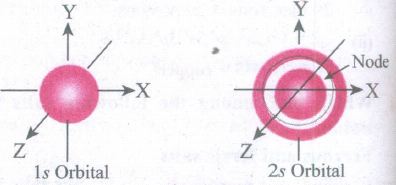
Take MCQ Chemistry Test
1.
Using angular distribution function discuss the shapes of s orbitals
2.
Discuss the filling of electron in a carbon atom
3.
Write note on the necessity for Hund's rule.
4.
What are the atomic numbers of elements whose outermost electrons are represented by
(a) 3s2
(b) 2p3
(c) 3p5
5.
State Hund's rule of maximum multiplicity.
6.
Write the electronic configurations of the following ions:
(a) H-
(b) Na+
(c) O2-
(d) F-
7.
Which of the following orbitals are possible? 1p, 2s, 2p and 3f.
8.
Which atoms are indicated by the following configurations?
(a) [He]2s1
(b) [Ne]3s23p3
(c)[Ar]4s2 3d1
9.
List the quantum numbers (m1 and l) of electrons for 3d-orbital.
10.
An atomic orbital has n = 3. What are the possible values of 1 and m1?
11.
Write down the quantum numbers n, and I for the following orbitals
(i) \({ 3d }_{ { x }^{ 2 }-y^{ 2 } }\)
(ii) \({ 4d }_{ { z }^{ 2 } }\)
(iii) \({ 3d }_{ { xy } }\)
(iv) \({ 4d }_{ { xy } }\)
(v) \({ 2p }_{ z }\)
(vi) \({ 3p }_{ x }\)
12.
Explain, giving reasons which of the following sets of quantum numbers are not possible?
(i) n = 0, l = 0, m1 = 0, ms = + 1 /2
(ii) n = 1 l = 0 m1 = 0 ms = \(-\frac { 1 }{ 2 } \)
(iii) n = 1 l = 1 m1 = 0 ms =\(+\frac { 1 }{ 2 } \)
(iv) n = 2 l = 1 m1 = 0 ms =\(-\frac { 1 }{ 2 } \)
(v) n = 3 l = 3 m1 = -3 ms =\(+\frac { 1 }{ 2 } \)
(vi) n = 3,l = 1,m1 = 0 ,ms =\(+\frac { 1 }{ 2 } \)
13.
(i) State (n + 1) rule.
(ii) Arrange the orbitals in the increasing order of energies based on (a) principal quantum number and (b) (n + 1) rule.
14.
An atom having atomic mass number 13 has 7 neutrons. What is the atomic number of the atom?
15.
Calculate the total number of angular nodes and radial nodes present in 3p-orbital.
16.
Which one among the following salts is more stable? Ferrous and ferric salts
17.
An atom of an element contains 29 electrons and 35 neutrons. Deduce
(i) the number of protons.
(ii) the electronic configuration of the element.
18.
Discuss the similarities and differences between 1s and 2s-orbitals.
19.
Which orbital in each of the following pairs is lower in energy?
(i) 2s,2p
(ii) 3p < 3d
(iii) 3s < 4s
(iv) 4d < 5f
20.
Using s, p, d notations, describe the orbital with the following quantum numbers.
(i) n =1 ,l = 0
(ii) n = 3, l= 1
(iii) n = 4, l= 2
(iv) n =4 , l = 3
21.
How many electrons can have s+ 1/2 in a d-subshell?
22.
An atom of an element has 19 electrons. What is the total number of p-orbital?
23.
Which energy level does not have p-orbital?
24.
Which quantum accounts for the orientation of the electron orbital?
25.
Write the values of I and m for p-orbitals
26.
What is shape of the orbital with
(i) n = 2 and = 0
(ii) n = 2 and I = 1?
27.
What is meant by nodal surface or node?
28.
What is the maximum number of electrons that can be accommodated in a shell?
29.
Explain why the uncertainty principle is significant only for the motion of sub-atomic particles but is negligible for the macroscopic objects?
30.
An electron a proton which one will have a higher velocity to produce matter waves of the same wavelength? Explain it
31.
What are quantum numbers?
1.
s-orbitals: For Is orbital, l = 0 and m = 0, f(θ) = 1/✓2 and g(φ) = 1/✓2π. Therefore, the angular distribution function is equal to 1/✓2π.i.e it is independent of the angle θ and φ. Hence, the probability of finding the electron is independent of the direction from the nucleus. The shape of the s orbital is spherical.
2.
The carbon atom has six electrons. According to Aufbau principle, the electronic configuration is 1s2,2s2,2p2
It can be represented as below,
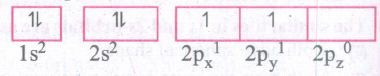
In this case, in order to minimise the electron-electron repulsion, the sixth electron enters the unoccupied 2py orbital as per Hund's rule. i.e. it does not get paired with the fifth electron already present in the 2Px orbital
3.
Aufbau's principle does not deal with the filling of electrons in the degenerate orbitals (i.e. orbitals having same energy) such as px, py and pz
4.
To obtain atomic number of an element fill the orbitals in order of their increasing energies up to the given outer orbital configuration
(a) Is22s2, 2p6, 3s2 (Z = 12)
(b) Is2 2S2, 2p3 (Z = 7)
(c) Is22s2, 2p6, 3s2, 3p5 (Z = 17)
5.
It states that electron pairing in the degenerate orbitals does not take place until all the available orbitals contains one electron each.
6.
(a) 1H = 1s1, H- = 1s2
(b) 11Na = 1s2 2s2,2p6,3s1,Na+ = 1s22s22p6
(c) 8O = 1s2 2s2,2p4,O2- = 1s22s22p6
(d) 9F = 1s2 2s2,2p5,F- =1s22s22p6
7.
1p is not possible because if n = 1 then l = 0 only and for p, l = 1
2s is possible because if n = 2 then l = 0, 1 and for s, l = 0
2p is possible because if n = 2 then l = 0, 1 and for p, l = 1
3f is not possible because if n = 3 then l = 0, 1 and 2 for f, l = 3.
8.
(a) [He]2s1 represents 3Li (lithium)
(b) [Ne]3s23p3 represents 15P(phosphorus)
(c) [Ar]4s2 3d1 represents 21SC (scandium).
9.
For 3d-orbital, n = 3, l = 2,m1 = -2,-1,0,+1,+2
10.
For n = 3, l = 0, 1,2
l= 0,m1 = 0
l = 1, m1=-1+0,+1
l = 2, m1=-2,-1,0,+1,+2
11.
(i) n = 3, l = 2
(ii) n = 4, l = 2
(iii) n = 2, l = 2
(iv) n = 4, l = 2
(v) n = 2 , l = 2
(vi) n = 3 , l = 2
12.
(i) is not possible as n ≠ 0
(ii) is possible (Is)
(iii) is not possible because if n = 1, 1 = 0 only (l ≠ 1)
(iv) is possible (2p)
(v) is not possible because if n = 3, 1 = 0 ,1 and 2 (l ≠ 3)
(vi) is possible (3p)
13.
(i) It states that, the lower the value of (n + 1) for an orbital, the lower is its energy. If two orbitals have the same value of (n + 1), the orbital with lower value of n will have the lower energy.
(ii) (a) Principal quantum number : 1s < 2s = 2p < 3s = 3p = 3d <4s = 4p = 4d = 4f < 5s = 5p = 5d = 5f < 6s = 6p = 6d = 6f < 7s
(b) Based on the (n+1) rule: 1s < 2s < 2p < 3s < 3p < 4s <3d <4p <5s <4d < 5p <6s <4f < 5d < 6p < 7s < 5f < 6d.
14.
A = 13, A - Z = 7 (Neutrons)
Then Z= 6
(ie) Atomic number = 6
15.
For 3p-orbital n = 3, l = 1
Number of angular nodes = l = 1
Number of radial nodes = n - l -1 = 3 - 1 - 1 =1
16.
Ferrous and ferric salts: In ferrous salts Fe2+, the configuration is 1s22s2,2p6,3s2, 3p6, 3d6.In ferric salts Fe3+ ,the configuration is 1s22s2,2p6,3s2, 3p6, 3d5.
As half-filled 3d5 configuration is more stable therefore ferric salts are more stable than ferrous salts.
17.
(i) For a neutral atom,
Number of electrons =number of protons
29 electrons = 29 protons.
(ii) 29z = 1s2,2s2,2p6,3s2,3p6,3d10,4s1
(The element is copper)
18.
The similarities in 1s and 2s-orbitals are as follows :
(i) Both have the spherical shape
(ii) Both have the same angular momentum.
The difference in between them are as follows :
(i) Size of 2s-orbital is larger than that of 1s-orbital.
(ii) Energy of 2s-orbital is greater than that of 1s-orbital.
(iii) 2s-orbital has one node while 1s-orbital has no node.
19.
(i) 2s,2p
(ii) 3p < 3d
(iii) 3s < 4s
(iv) 4d < 5f
This is because lower the value of (n + 1), lower is the energy and if(n + 1) are same, the orbital with lower value of n is of lower energy.
20.
| S.No | n | l | Subshell notation |
| (i) | 1 | 0 | 1s |
| (ii) | 3 | 1 | 3p |
| (iii) | 4 | 2 | 4d |
| (iv) | 4 | 3 | 4f |
21.
d sub-shell has five orientations. Each orientation can accommodate one electron with spin quantum number +1/2 and another electron with -1/2 Hence number of electrons with s+1/2 in 'd' sub shell is 5.
22.
The number of electrons in an atom of an element is 19.
The electronic configuration is 1s2 2s2 2p6 3s2 3p6 4s1
The total number of p-orbitals for the element is 2p level- 3 and 3p level- 3. i.e. '6' orbitals.
23.
The K shell or the first energy level does not have p-orbital.
24.
Magnetic quantum number accounts for the orientation of the electron in orbital.
25.
1 value of p-orbital is 1. The possible 'm' values are -1,0 and +1
26.
(i) n= 2 and 1 =0. The orbital is 2s. Its shape is symmetrically spherical.
(ii) n = 2 and 1 = 1. The orbital is 2p. Its shape is dumbbell.
27.
The region within the orbital where the probability of finding the electron is zero is called a node
28.
Maximum number of electrons in any shell is given by the expression 2n2 where n is the principal quantum number,
29.
(i) The energy of photon is sufficient to disturb a sub-atomic particle so that there is uncertainty in the measurement of position and momentum of the sub-atomic particle.
(ii) However, the energy is insufficient to disturb a macroscopic object.
30.
From de Broglie equation, wavelength \(\lambda =\frac { h }{ mv } \)
For same wavelength with two different particles, (ie) electron and proton m1v1 = m2v2 (h is constant) Lesser the mass of the particle, greater will be the velocity.
Hence electron will have higher velocity
31.
Quantum numbers are a set of four numbers which are used to specify the position, energy, shape, size, angular momentum, magnetic properties spin and orientation of an electron in an atom.

11th Standard Syllabus & Materials
11th Standard
TN 11th Tamil பீடு பெற நில் - செய்யுள் - காவடிச்சிந்து Important Questions And Answers Study Material - QB365 Set A
NEW11th Standard
TN 11th Tamil பீடு பெற நில் - உரைநடை - மலை இடப்பெயர்கள் : ஓர் ஆய்வு Important Questions And Answers Study Material - QB365 Set A
NEW11th Standard
TN 11th Tamil மாமழை போற்றுதும் - துணைப்பாடம் - யானை டாக்டர் Important Questions And Answers Study Material - QB365 Set A
NEW11th Standard
TN 11th Tamil மாமழை போற்றுதும் - செய்யுள் - ஐங்குறுநூறு Important Questions And Answers Study Material - QB365 Set A



Tamilnadu Stateboard 11th Standard Subjects

Maths

Commerce

Economics

Biology

Business Maths and Statistics

Accountancy

Computer Science

Physics
Chemistry
Maths
Biology
Economics
Physics
Chemistry

History
Business Maths and Statistics

Computer Science
Accountancy

Computer Applications
History
Computer Technology
Commerce
Computer Applications
Computer Technology

Tamil

English

French
Tamilnadu Stateboard Standards
