
 100% FREE ACCESS
11th Standard Syllabus & Materials
11th Standard
TN 11th Tamil இயற்கை வேளாண்மை,சுற்றுச்சூழல் -செய்யுள் - மனோன்மணீயம் Important Questions And Answers Study Material - QB365 Set A
NEW11th Standard
TN 11th Tamil என்னுயிர் என்பேன் -துணைப்பாடம் - இசைத்தமிழர் இருவர் Important Questions And Answers Study Material - QB365 Set A
NEW11th Standard
TN 11th Tamil மொழி கலை -செய்யுள் - ஒவ்வொரு புல்லையும் Important Questions And Answers Study Material - QB365 Set A
NEW11th Standard
TN 11th Tamil பீடு பெற நில் - இலக்கணம் - பகுபத உறுப்புகள் Important Questions And Answers Study Material - QB365 Set A
NEW11th Standard
TN 11th Tamil பீடு பெற நில் - துணைப்பாடம் - வாடிவாசல் Important Questions And Answers Study Material - QB365 Set A
NEW11th Standard
TN 11th Tamil பீடு பெற நில் - செய்யுள் - குறுந்தொகை Important Questions And Answers Study Material - QB365 Set A

Published on: 27/04/2019
Most expected three mark questions in Basic Concepts of Chemistry and Chemical Calculations - II
Download Tamil Nadu 11th Standard Chemistry question papers, model tests, one-mark questions, important questions, and public exam papers in PDF format. Free study materials and answer keys for TN State Board students.
Questions + Answers key
Take MCQ Chemistry Test
1.
Calculate the number of atoms/molecules present in the following 100 g of sulphur dioxide
2.
Calculate the number of atoms/molecules present in the following 1.8 g of water
3.
Calculate the number of atoms/molecules present in the following : 10 g of Hg
4.
Calculate the oxidation number of underlined atoms \(\\ { Na }_{ 2 }[\underline { F } e{ (CN) }_{ 6 }]\)
5.
Calculate the oxidation number of underlined atoms \({ C }_{ \underline { 6 } }{ H }_{ 12 }{ O }_{ 6 }\)
6.
Calculate the oxidation number of underlined atoms \(\underline { { S }_{ 2 } } { O }_{ 3 }\)
7.
Calculate the oxidation number of underlined atoms \(\underline { A } sO_{ 3 }^{ 3- }\)
8.
Calculate the oxidation number of underlined atoms \(\underline { C } l{ O }_{ 3 }\)-
9.
Calculate the oxidation number of underlined atoms \(H_{ 4 }\underline { { P }_{ 2 } } { O }_{ 7 }\)
10.
Calculate the molecular mass of the following Methane
11.
Calculate the molecular mass of the following Crystalline oxalic acid
12.
Calculate the molecular mass of the following KMnO4
13.
Elucidate the steps involved in arriving at the molecular formula of a compound.
14.
Write the simplest formula for the following. - H2O2
15.
Write the simplest formula for the following. - H2O
16.
Write the simplest formula for the following. - C6H12O6
17.
Write the simplest formula for the following. - N2O4
18.
How are 0.5 mol Na2CO3 and 0.50 M Na2CO3 different?
19.
What is the simplest formula of the compound which has the following percentage composition? C = 80%; H = 20%
20.
The reactant which is entirely consumed in reaction is known as limiting reagent. In the reaction 2A + 4B \(\longrightarrow \) 3C + 4D, when 5 moles of A react with 6 moles of B, then
(i) Which is the limiting reagent
(ii) Calculate the amount of C formed.
21.
What do you understand by stoichiometric coefficients in a chemical equation?
22.
Why is it necessary to balance a chemical equation?
23.
The percentage of all the elements present o in a compound is 95. What does it indicate?
24.
Define stoichiometry.
25.
Calculate the oxidation number of underlined atoms \({ K }_{ 2 }\underline { Mn } { O }_{ 4 }\)
26.
An iron nail is placed in copper sulphate solution taken in the beaker. Observe it for some time ?. Find the changes that takes place and why ?
27.
Place an iron piece in a moist atmosphere and observe it after two days. Is there any deposition of new substance? Why does it happen? What is this phenomenon called?
28.
A piece of cut apple becomes brown. Why? Can you prevent it by a simple method
29.
The organic compound Vitamin-C, has the following composition by mass: 40.92% C, 4.58% H, and the rest is oxygen. Determine its molecular formula. Molar mass of the substance is 176 g mol-1
30.
An organic compound used for welding operation contains the following composition by mass: C = 92.3%, H = 7.7%. Find out the molecular formula of the compound. At STP, 10.0 L of this gas is found to weigh 11.6g.
31.
A compound contains 11.99 % N, 13.70 % O, 9.25 % B and 65.06 % F. Find its empirical formula
32.
3.24g of titanium reacts with oxygen to form 5.40g of the metal oxide. Find the empirical formula of the metal oxide?
33.
Calculate the equivalent mass of potassium dichromate in acid medium
[K2Cr2O7 + 4H2SO4 )\(\rightarrow\)K2SO4 + Cr2(SO4)3 +4H2O + 3(O) 3 x 16 = 48 294 g]
34.
Calculate equivalent mass of the Magnesium hydroxide
35.
Calculate equivalent mass of the Calcium hydroxide
36.
Calculate equivalent mass of the Ammonium hydroxide
37.
Calculate equivalent mass of the Aluminium hydroxide
38.
Calculate equivalent mass of the Sodium hydroxide
39.
Balance the following reaction by oxidation number method.
40.
A compound on analysis was found to contain C = 34.6%; H = 3.85% and O = 61.55%. Calculate its empirical formula.
41.
What will be the molecular formula for the compound, whose empirical formula is CH2Ci and molar mass is 98.96 g ?
42.
Calculate the number of moles in the following 65.6 mg of oxygen
43.
Calculate the number of moles in the following 4.66 mg of silicon
44.
Calculate the number of moles in the following 7.85 g of copper
45.
Calculate Equivalent mass of the Phosphorous acid
46.
Calculate Equivalent mass of the Crystalline oxalic acid
47.
Calculate Equivalent mass of the Acetic acid
48.
Calculate Equivalent mass of the Nitric acid
49.
Calculate Equivalent mass of the Hydrochloric acid
50.
1.05g of a metal gives on oxidation 1.5g of its oxide. Calculate its equivalent mass.
51.
Write down the formulae for calculating the equivalent mass of an acid, base and oxidizing agent.
52.
Why are the atomic masses of most of the elements fractional?
53.
(i) If an acid is monobasic, how will you relate their equivalent mass and molecular mass.
(ii) What is the basicity of H4 P2 O7 ?
(iii) Give any two examples for dibasic acids.
1.
Molecular mass of SO2 = 64
64 g of sulphur dioxide contains = 6.023 \(\times\) 1023
Molecules of SO2
∴ 100g of SO2 contains = \(\frac { 100\times 6.023\times { 10 }^{ 23 } }{ 64 } \)
= 9.41
Molecules of SO2
2.
1 mole of water = 18 g mol-1
18 g of water contains 6.023 \(\times\)1023 molecules of water
1.8 g of water contains = \(\frac { 1.8\times 6.023\times { 10 }^{ 23 } }{ 18 } \)
= 0.602 \(\times\)1023
= 6.02 \(\times\) 1024
Molecules of water
3.
Atomic mass of Hg = 200 gmol-1
200 g of mercury contains 6.023 \(\times\) 1023 atoms of mercury.
10g of mercury contains = \(\frac { 10\times 6.023\times { 10 }^{ 23 } }{ 200 } \)
= 0.301 \(\times\)1023
= 3.01\(\times\) 1024
atoms of mercury
4.
2(1) + x + 6(-1) = 0
2 + x - 6 = 0
x - 4 = 0
x = 4
Oxidation number of Fe in Na2[Fe(CN)6 ] is +4
5.
6x + 12(1) + 6(-2) = 0
6x + 12 -12 = 0
6x = 0
x = 0
Oxidation number of C in C6H12O6 is zero.
6.
2x + 3(-2) = 0
2x - 6 = 0
2x = 6
x = 3
Oxidation number of S in S2O3 is +3.
7.
X + 3(-2) = -3
x - 6 = -3
x = -3 + 6
x = +3
Oxidation number of As in \(\underline { A } sO_{ 3 }^{ 3- }\) is +3
8.
x + 3(-2) = -1
x - 6 = -1
Oxidation number of Cl in \(\underline { C } l{ O }_{ 3 }\)- is +5.
9.
4(1) + 2x + 7(-2) = 0
4 + 2x - 14 = 0
2x - 10 = 0
2x = 10
x = 5
Oxidation number of P in H4P2O7 is +5.
10.
C ⟶ 1 \(\times\)12 =12
H ⟶ 4\(\times\) 1 = 4
\(\underline { \overline { 16 } } \)
∴ Molecular mass of CH4 = 16
11.
\(\overset { COOH }{ \underset { COOH }{ |\quad \quad \quad } } .2{ H }_{ 2 }O\)
C ⟶ 1 \(\times\) 12 = 24
O ⟶ 4 \(\times\) 16 = 64
H2 \(\times\) 1 = 2
\(\underline { \overline { 90 } } \)
4\(\times\) 1 = 4
2 \(\times\)16 = 32
\(\underline { \overline { 126 } } \)
∴ Molecular mass of oxalic acid 126
12.
1 atomic mass of K = 1 \(\times\) 39 = 39
Mn = 1\(\times\) 55 = 55
O = 4\(\times\) 16 = 63
\(\overline { \underline { 158 } } \)
∴ Molecular mass of KMnO4 = 158
13.
Step 1: Moles of the element = \(\frac { percentage\ of\ element }{ at.mass } \)
Step 2: Simplest molar ratio = \(\frac { molar\ ratio }{ minium\ molar\ ratio } \)
Step 3: Empirical Formula
Step 4; \(\frac { Molar\ mass }{ Empirical\ formula\ mass } \) = n
Molecular formula = n x Empirical formula n is integer such as 1, 2, 3...etc
14.
HO
15.
H2O
16.
CH2O
17.
NO2
18.
(i) 0.5 mol refers to the number of moles of Na2CO3 which is weight / molecular weight.
(ii) 0.5 M refers to the molarity of Na2CO3 solution which is number of moles of solute dissolved per litre of solution.
19.
| Element | % | Relative No.of Moles | Simple whole moles | simplest whole number ratio |
|---|---|---|---|---|
| C | 80 | \(\frac { 80 }{ 12 } \) = 6.66 | \(\frac { 6.66 }{ 6.66 } \) = 1 | 1 |
| H | 20 | \(\frac { 20 }{ 1.008 } \)= 19.84 | \(\frac { 19.84 }{ 6.66 } \)= 2.9 | 3 |
The empirical formula is CH3.
20.
2A + 4B \(\longrightarrow \) 3C +4D
According to the above equation, 2 mols of 'A' require 4 mols of'B' for the reaction.
Hence, for 5 mols of 'A', the moles of 'B' required
= 5 mol of A x \(\frac { 4\ mol\ of\ B }{ 2\ mol\ of\ A } \)
= 10 mol B
But we have only 6 mols of ' B'. hence, ' B ' is the limiting reagent. So amount of ' C ' formed is determined by amount of ' B'.
Since 4 mols of 'B' give 3 mols of 'C'. Hence 6 mols of 'B' will give
6 mol of B x \(\frac { 3\ mol\ of\ C }{ 4\ mol\ of\ B } \)
21.
The coefficients of reactants and products involved in a chemical equation represented by the balanced form are known as stoichiometric coefficients
N2(g) + 3H2(g) \(\longrightarrow \) 2NH3(g)
The stoichiometric coefficients are 1, 3 and 2 respectively
22.
A chemical equation has to be balanced to satisfy the law of conservation of mass. According to this law mass is conserved during the change from I I the reactant to product.
23.
This indicates that the compound contains oxygen. Its percentage is given as 100 - 95 = 5
24.
Stoichiometry is the quantitative relationship between reactants and products in a balanced chemical equation in moles.
25.
\({ K }_{ 2 }\underline { Mn } { O }_{ 4 }\)
Oxidation number of Mn be x
2 (1) + x + 4 (-2) = 0
2 + x - 8 = 0
x - 6 = 0
x = 6
Oxidation number of Mn in K2 MoO4 is +6.
26.
When iron nail is dipped in copper sulphate solution, the colour of copper sulphate turns from blue to light green and reddish brown deposits is formed on iron nail. This is because iron is more reactive than copper, so it displaces Cu from CuS04 solution. The displacement reaction can be written as
CuSO4 + Fe \(\rightarrow\) FeS04 + Cu
27.
When iron is exposed to moist air, the iron reacts with oxygen in the presence of moisture to form a reddish - brown chemical compound, iron - oxide. This phenomenon is called rusting. A new substance Iron (III) oxide is formed.
4 Fe(OH)2 + O2 + xH2O\(\rightarrow\)2 Fe2O3 (x + 4)H2O
28.
Apple turns brown when cut since the surface is exposed to air and undergoes oxidation. It can be prevented by dipping sliced apples in lemon juice. Lemon juice is an antioxidant which takes in all the available oxygen and prevents it from reaching the apple's tissues
29.
| Element | Percentage | Atomic mass | Relative No. of moles | Simple ratio | Simplest whole Number Ratio |
| C | 40.92 | 12 | \(\frac{40.92}{14}=3.41\) | \(\frac{3.41}{3.406}=1.001\) | 3 |
|
H |
4.58 | 1 | \(\frac{4.58}{1}=4.58\) | \(\frac{4.58}{3.406}=1\) | 4 |
| O | 100-[40.92+4.58] | 16 | \(\frac{54.5}{10}=3.406\) | \(\frac{3.406}{3.406}=1\) | 3 |
30.
| Element | Percentage | Atomic mass | Relative No. of moles | Simple ratio mole | Simplest whole Number Ratio |
| C | 92.3 | 12 | \(\frac{92.3}{12}=7.7\) | \(\frac{7.7}{7.7}=1\) | 1 |
| H | 7.7 | 1 | \(\frac{7.7}{1}=7.7\) | \(\frac{7.7}{7.7}=1\) | 1 |
Empirical formula is CH
Molecular formula = n x emprical formula
Emperical formula mass (1\(\times\)12) + (1\(\times\)1) 12 + 1 = 13
\(n=\frac{Molecular \ mass}{Empirical\ formula \ mass}\)
Molar mass = \(\frac{wt. of \ the \ substance \ x \ Molar \ volume}{vol.of\ the \ substance}\)
Molar volume at STP = 2.24\(\times\)10-2 m3 = 22.4 I = 22400 ml
Molar mass of the gas at STP =\(\frac{11.6 \times 22.4}{10}=25.9=26\)
\(n=\frac{26}{13}=2\)
Molecular formula = n\(\times\) (emp. formula) = 2\(\times\)(CH) = C2 H2
31.
| Element | Percentage | Atomic mass | Relative No. of moles | Simple ratio | Simplest whole Number Ratio |
| N | 11.99 | 14 | \(\frac{11.99}{14}=0.856\) | \(\frac{0.856}{0.856}=1\) | 1 |
| O | 13.70 | 16 | \(\frac{13.70}{16}=0.856\) | \(\frac{0.856}{0.856}=1\) | 1 |
| B | 9.25 | 10 | \(\frac{9.25}{10}=0.925\) | \(\frac{0.925}{0.856}=1\) | 1 |
| F | 65.06 | 19 | \(\frac{65.06}{19}=3.424\) | \(\frac{3.424}{0.856}=4\) | 4 |
Empirical formula of the compound in NOBF4
32.
Weight of Titanium = 3.24 g
Weight of metal oxide = 5.40 g
Weight of Oxygen = (5.40 - 3.24).
= 2.16 g
| Element | Percentage | Atomic mass | Relative No. of moles | Simple ratio mole | Simplest whole Number Ratio |
| Ti | 3.24 | 48 | \(\frac{3.24}{48}=0.0675\) | \(\frac{0:067}{0:067}=1\) | 1 |
| O | 2.16 | 16 | \(\frac{2.16}{16}=0.135\) | \(\frac{0.135}{0.067}=2\) | 2 |
∴ The empirical formula is Ti O2
33.
48 parts by mass of oxygen are made available from 294 parts by mass of K2Cr2O7
∴ 8 parts by mass of oxygen will be furnished by =\(\frac{294\times8}{48}=49\)
Equivalent mass of K2Cr2O7 = 49 g equiv-1
34.
Magnesium hydroxide Mg(OH)2
equivalent mass of Magnesium hydroxide = \(\frac{58}{2}=29\)
35.
Calcium hydroxide
equivalent mass of Ca(OH)2 =\(\frac{74}{2}=37\)
36.
Ammonium hydroxide
equivalent mass of NH4OH = \(\frac{35}{1}=35\)
37.
Aluminium hydroxide
equivalent mass of AI(OH)3 = \(\frac{78}{3}=26\)
38.
NaOH
equivalent mass of NaOH =\(\frac{40}{1}=40\)
39.
MnO4-1 + H2S + H+ \(\longrightarrow\)Mn2+ + S (Acidic Medium)
(i) Write oxidation number of elements
\(\underset {(+7)(-2)}{ { MnO }_{4 }^{ -1 } } +\underset {(+1) (-2) }{ {H}_{2} } S\longrightarrow\underset{+2}{{Mn}^{2+}}+\underset{0}{S} \)
(ii) Balance the number of atoms of the elements in which oxidation number changes
\(\underset {(+7)}{ { MnO }_{4 }^{ -1 } } +\underset {(-2) }{ {H}_{2} } S\longrightarrow\underset{(+2)}{{Mn}^{2+}}+\underset{0}{S} \)
(iii) Decide the oxidation and reduction reaction on the basis of difference of oxidation number. Increase in oxidation number by 2(Oxidation)
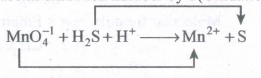
Decrease in oxidation number by 5(Reduction)
(iv) On multiplying oxidation reaction by 5 and reduction reaction by 2 to balance the change in oxidation number.
\(2{Mn }_{ 4 }^{ -1 }+H_2S\longrightarrow{2Mn}^{2+}+5S\)
Balance the electric charge and atoms which do not change in oxidation number (spectators).
\(2{Mn }_{ 4 }^{ -1 }+5H_2S+6{H}^{+}\longrightarrow{2Mn}^{2+}+5S+8{H}_{2}O\)
2(-1) 5(0) + 6(+1) 2(+2) + 5(0) + 8(0)
-2 + 6 = +4
+4 = +4
In the above reaction the reactants and products are balanced in terms of electric charge and mass equivalence.
40.
| Element | % | \(\frac { Percentage\quad mass }{ At.mass } \) | Molar Ratio | Simplest Whole Number Ratio |
| C | 34.6 | 34.6/12 = 2.88 | 2.88/2.88 = 1 | 3 |
| H | 3.85 | 3.85/1 = 3.85 | 3.85/2.88 = 1.335 | 4 |
| O | 61.55 | 61.55/16 = 3.85 | 3.85/2.88 = 1.335 | 4 |
The empirical formula of the compound = C3H4O4
41.
Empirical formula = CH2CI
Empirical formula mass = 12.01 + 2 x 1.008 + 35.453
= 49.48 g
n = \(\frac { molecular\quad mass }{ empirical\quad formula\quad mass } \)
\(=\frac { 98.96 }{ 49.48 } \)
= 2(n)
Molecular formula = n x Empirical formula
= 2 x CH2CI = C2H4Cl2
42.
Moles of oxygen = \(\frac { Mass\ of\ oxygen }{ atomic\ mass } \)
= \(\frac { 65.6\times { 10 }^{ -6} }{ 16} \)
= 4.1 x 10⁻⁶ mol
43.
Moles of silicon = \(\frac { Mass\ of\ silicon }{ atomic\ mass } \)
= \(\frac { 4.66\times { 10 }^{ -3 } }{ 28.1 } \)
= 1.658 x 10⁻⁴ mol
44.
Moles of copper = \(\frac { Mass\ of\ copper }{ atomic\ mass } \)
= \(\frac { 7.85 }{ 63.546 } \)
= 0.123 Mol
45.
Phosphorous acid (H3 P03)
equivalent mass of phosphorous acid
= \(\frac{Molar \ mass}{basicity} =\frac{82}{2}=41\)
∴ equivalent mass of H3P03 = 41
46.
Crystalline oxalic acid
equivalent mass of acetic acid = \(\frac{Molar \ mass}{basicity}\)
equivalent mass = \(\frac{126}{2}=63\)
47.
Acetic acid (CH3 COOH)
equivalent mass of acetic acid = \(\frac{Molar \ mass}{basicity}\)
= \(\frac{60}{1}\)
= 60
48.
Nitric acid
equivalent mass of HNO3 = \(\frac{Molar \ mass}{basicity}\)
\(=\frac{63}{1}\)
= 63
49.
Hydrochloric acid
equivalent mass of an acid
\(=\frac{Molar \ mass \ of \ the\ acid}{Basicity \ of\ the \ acid}\)
Equivalent mass of HCl = \(\frac{36.5}{1}\)
= 36.5
50.
Mass of oxygen = 1.5 - 1.05
= 0.45 g
0.45g of oxygen combines with 1.05 g of metal.
ஃ 8g of oxygen combines with \(\frac{8\times1.05}{0.45}\) g of metaI
= 18.66 g of metal
ஃequivalent mass of metal = 18.66g equ-1
51.
(i) Equivalent Mass of Acids:
E = \(\frac { Molar\ mass\ of\ the\ acid }{ basicity\ of\ the\ acid } \)
(ii) Equivalent Mass of Bases
E = \(\frac { Molar\ mass\ of\ the\ base }{ Acidity\ of\ the\ base } \)
(iii) Equivalent Mass of Oxidising agent:
E = \(\frac { Molar\ mass\ of\ the\ oxidising\ agent }{ no.\ of\ moles\ of\ electrons\ gained\ by\ one\ mole\ of\ the\ oxidsing\ agent } \)
52.
It is because most of the elements occur in nature as a mixture of isotopes and their atomic masses are the average atomic masses of the isotopes depending in their abundance
53.
(i) If an acid is mono basic, then its equivalent mass = Molecular mass
(ii) Basicity of H4P2O7 is 4 (Tetrabasic acid )
(iii) Examples of dibasic acid are H2SO4, H3PO3

11th Standard Syllabus & Materials
11th Standard
TN 11th Tamil பீடு பெற நில் - செய்யுள் - காவடிச்சிந்து Important Questions And Answers Study Material - QB365 Set A
NEW11th Standard
TN 11th Tamil பீடு பெற நில் - உரைநடை - மலை இடப்பெயர்கள் : ஓர் ஆய்வு Important Questions And Answers Study Material - QB365 Set A
NEW11th Standard
TN 11th Tamil மாமழை போற்றுதும் - துணைப்பாடம் - யானை டாக்டர் Important Questions And Answers Study Material - QB365 Set A
NEW11th Standard
TN 11th Tamil மாமழை போற்றுதும் - செய்யுள் - ஐங்குறுநூறு Important Questions And Answers Study Material - QB365 Set A



Tamilnadu Stateboard 11th Standard Subjects

Maths

Commerce

Economics

Biology

Business Maths and Statistics

Accountancy

Computer Science

Physics
Chemistry
Maths
Biology
Economics
Physics
Chemistry

History
Business Maths and Statistics

Computer Science
Accountancy

Computer Applications
History
Computer Technology
Commerce
Computer Applications
Computer Technology

Tamil

English

French
Tamilnadu Stateboard Standards
