
 100% FREE ACCESS
11th Standard Syllabus & Materials
11th Standard
TN 11th Tamil இயற்கை வேளாண்மை,சுற்றுச்சூழல் -செய்யுள் - மனோன்மணீயம் Important Questions And Answers Study Material - QB365 Set A
NEW11th Standard
TN 11th Tamil என்னுயிர் என்பேன் -துணைப்பாடம் - இசைத்தமிழர் இருவர் Important Questions And Answers Study Material - QB365 Set A
NEW11th Standard
TN 11th Tamil மொழி கலை -செய்யுள் - ஒவ்வொரு புல்லையும் Important Questions And Answers Study Material - QB365 Set A
NEW11th Standard
TN 11th Tamil பீடு பெற நில் - இலக்கணம் - பகுபத உறுப்புகள் Important Questions And Answers Study Material - QB365 Set A
NEW11th Standard
TN 11th Tamil பீடு பெற நில் - துணைப்பாடம் - வாடிவாசல் Important Questions And Answers Study Material - QB365 Set A
NEW11th Standard
TN 11th Tamil பீடு பெற நில் - செய்யுள் - குறுந்தொகை Important Questions And Answers Study Material - QB365 Set A

Published on: 27/04/2019
Most expected three mark questions in Basic Concepts of Chemistry and Chemical Calculations - III
Download Tamil Nadu 11th Standard Chemistry question papers, model tests, one-mark questions, important questions, and public exam papers in PDF format. Free study materials and answer keys for TN State Board students.
Questions + Answers key
Take MCQ Chemistry Test
1.
Balance the following reaction:
Sb3++ Mn\({ O }_{ 4 }^{ - }\)\(\rightarrow \) Sb5++ Mn2+
2.
Balance the following reaction
S2O32- + I2 \(\rightarrow \) S2 O42- + I-
3.
Balance the following reaction:
C2O42-+ Cr2O72-\(\rightarrow \)Cr3++ CO2
4.
0.456 g of a metal gives 0.606 g of its chloride. Calculate the equivalent mass of the metal.
5.
Balance the following reaction:
S2O32- + I2\(\rightarrow\)S2O62- + I-
6.
Balance the following reaction:
MnO4- + Fe2+ \(\rightarrow\) Mn2+ + Fe3+
7.
Balance the following reaction:
MnO42-\(\rightarrow\) MnO42- + MnO2
8.
Balance the following reaction:
MnO-4 + Sn2+\(\rightarrow\) Mn2+ + Sn4+
9.
Balance the following reaction:
Zn + HNO3 \(\rightarrow\) Zn (NO3)2 + NH4NO3 +H2O
10.
Balance the following reaction:
CuO+ NH3 \(\rightarrow\)Cu + N2+ H2O
11.
Balance the following reaction:
H2C2O4+KMnO4 + H2SO4 \(\rightarrow\) H2SO4 + MnSO4 + CO2 + H2O
12.
Balance the following reaction:
P+5HNO3 \(\rightarrow\) H3PO4 + 5NO2 + H2O
13.
Balance the following reaction:
P+ HNO3\(\rightarrow\) H3PO4 + NO2 + H2O
14.
What will be oxidation number of sulphur in\({ S }_{ 2 }{ O }_{ 8 }^{ 2- }\) ions and \({ S }_{ 2 }{ O }_{ 6 }^{ 2- }\) ion?
15.
Balance the following reaction:
Cu + HNO3\(\rightarrow\)Cu(NO3)2 + NO2 + H2O
16.
Balance the following redox reaction:
K2Cr2O7 + KCI + H2SO4 \(\rightarrow\) KHSO4 + CrO2CI2 + H2O
17.
Balance the following reaction:
KMnO4 + Na2SO3\(\rightarrow\)MnO2 + Na2SO4 + KOH (Alkaline medium)
18.
Balance the following reaction:
K2Cr2O7 + KI + H2SO4 \(\rightarrow\) K2SO4 + Cr2(SO4)3 + I2 + H2O
19.
Identify the type of redox reaction taking place in the following
\(\overset { 0 }{ { Cl }_{ 2(g) } } +{ 2OH^{ - }_{ (aq) } }\longrightarrow \overset { -1 }{ Cl } { O }_{ (aq) }^{ - }+\overset { -1 }{ { Cl }^{ - } } _{ (aq) }+{ H }_{ 2 }{ O }_{ (l) }\)
20.
Identify the type of redox reaction taking place in the following
\({ Br }_{ 2(1) }+2I_{ (aq) }\longrightarrow 2{ Br }_{ (aq) }^{ - }+{ I }_{ 2(s) }\)
21.
Identify the type of redox reaction taking place in the following
\(\overset { 0 }{ { Ca }_{ (s) } } +\overset { +1 }{ 2 } \overset { -2 }{ { H }_{ 2 }O_{ (l) } } \longrightarrow \overset { +2 }{ Ca } \overset { -2+1 }{ { (0H) }_{ 2(aq) } } +\overset { 0 }{ H } _{ 2(g) }\)
22.
Identify the type of redox reaction taking place in the following
\(\overset { +1 }{ 2K } \overset { +5 }{ Cl } \overset { -2 }{ O_{ 3(s) } } \longrightarrow 2\overset { +1 }{ K } \overset { -1 }{ { Cl }_{ (s) } } +3\overset { 0 }{ { O }_{ 2 }(g) } \)
23.
Identify the type of redox reaction taking place in the following
\(\overset { +5 }{ { Y }_{ 2 } } \overset { -2 }{ { O }_{ 5(s) } } +5\overset { 0 }{ { Ca }_{ (s) } } \longrightarrow \overset { 0 }{ 2 } { V }_{ (s) }+\overset { +2 }{ 5 } \overset { -2 }{ { CaO }_{ (s) } } \)
24.
Identify the type of redox reaction taking place in the following
\(3{ M }^{ 0 }g_{ (s) }+{ N }_{ 2(g) }^{ 0 }\longrightarrow \overset { +2 }{ { Mg }_{ 3 } } \overset { -3 }{ N_{ 2(s) } } \)
25.
Determine the empirical formula of a compound containing K = 24.75%, Mn = 34.77% and rest is oxygen
26.
A compound contains 50% of X (atomic mass 10) and 50% Y (atomic mass 20). Give its molecular formula.
27.
Boric acid, H3BO3 is a mild antiseptic and is often used as an eyewash. A sample contains 0.543 mol H3BO3. What is the mass of boric acid in the sample ?
28.
Calculate the equivalent mass of barium hydroxide
29.
Decide whether each of the following reaction involves oxidation reduction reaction or not. If it does , identify which species is oxidised and which gets oxidised ?
\({ CH }_{ 3 }-\overset { \underset { || }{ O } }{ C } -OH+{ CH }_{ 3 }{ NH }_{ 2 }\rightleftharpoons { CH }_{ 3 }-\overset { \underset { || }{ O } }{ C } -O^{ - }+{ CH }_{ 3 }{ NH }_{ 3 }^{ + }\)
30.
Decide whether each of the following reaction involves oxidation reduction reaction or not. If it does ,identify which species is oxidised and which gets oxidised?
\({ CH }_{ 3 }{ CH }_{ 2 }OH\overset { { H }_{ 2 }{ SO }_{ 4 } }{ \longrightarrow } { CH }_{ 2 }={ CH }_{ 2 }+{ H }_{ 2 }O\)
31.
Decide whether each of the following reaction involves oxidation reduction reaction or not. If it does,identify which species is oxidised and which gets oxidised ?
\({ 4CH }_{ 3 }-\overset { \overset { O }{ || } }{ C } -{ CH }_{ 3 }+LiAl{ H }_{ 4 }={ 4H }_{ 2 }O\rightleftharpoons { 4CH }_{ 3 }-\overset { \overset { OH }{ || } }{ CH } -{ CH }_{ 3 }+LiOH+Al({ OH })_{ 3 }\)
32.
0.456 g of a metal gives 0.606g of its chloride Calculate its equivalent mass
33.
Calculate the equivalent mass of the following : Sodium
34.
Calculate the equivalent mass of the following : nitrate ion (NO3-)
35.
Calculate the equivalent mass of the following : Zn
36.
Calculate the molar volume of the following 3.0115 \(\times\)1023 molecules of SO2 gas
37.
Calculate the molar volume of the following 460g of formic acid
38.
Calculate the molar volume of the following 5 moles of methane
39.
Calculate the molar volume of the following 88 g of CO2
40.
Calculate the equivalent mass of bicarbonate ion.
41.
Calculate the weight of 0.2 mole of sodium carbonate.
42.
How many moles of glucose are present in 720 g of glucose
43.
The density of CO2 = 1.977 kgm-3 at STP. Calculate I the molecular mass of CO2
44.
Calculate the number of moles present in the following 19.5g of potassium
45.
Calculate the number of moles present in the following 90 g of magnesium oxide
46.
Calculate the number of moles present in the following 46g of ethanol
47.
Calculate the number of moles present in the following 120g of sodium hydroxide
48.
Calculate the number of moles present in the following 50g of calcium chloride
49.
Find the molecular mass of FeSO47H2O.
50.
Calculate number of moles of carbon atoms in three .moles of ethane.
51.
The approximate production of Na2C03 per month is 424 x 106g while that of methyl alcohol is 320 x 106 g. Which is produced more in terms of moles?
52.
Calculate the number of atoms/molecules present in the following 1Kg of acetic acid
53.
The balanced equation for a reaction is given below 2x + 3y \(\rightarrow\) 41 + m
When 8 moles of x react with 15 moles of y, then
i) Which is the limiting reagent ?
ii) Calculate the amount of products formed.
iii) Calculate the amount of excess reactant left at the end of the reaction
54.
Experimental analysis of a compound containing the elements x,y,z on analysis gave the following data.
x = 32 %, y = 24 %, z = 44 %. The relative number of atoms of x, y and z are 2, 1 and 0.5, respectively. (Molecular mass of the compound is 400 g) Find out.
i) The atomic masses of the element x,y,z.
ii) Empirical formula of the compound and
iii) Molecular formula of the compound.
1.
.png)
Equalise the increase/decrease in Oxidation number by multiplying with suitable numbers.
5Sb3++ 2Mn\({ O }_{ 4 }^{ - }\)\(\rightarrow \) Sb5++ Mn2+
Balance all other atoms except O and H
5Sb3++ 2Mn\({ O }_{ 4 }^{ - }\)\(\rightarrow \) 5Sb5++ 2Mn2+
Balance Oxygen atom by adding H2O on the side falling short of oxygen.
5Sb3++ 2Mn\({ O }_{ 4 }^{ - }\)\(\rightarrow \) 5Sb5++ 2Mn2+ +8H2O
Balance hydrogen atom by adding H+ on the side falling short of hydrogen atoms.
5Sb3++ 2Mn\({ O }_{ 4 }^{ - }\)\(\rightarrow \) 5Sb5++ 2Mn2+ +8H2O + 16H+
2.
.png)
S2O32- + I2 \(\rightarrow \) S2 O42- + I-
S2O32- + I2 \(\rightarrow \) S2 O42- + 2I-
S2O32- + I2 + H2O \(\rightarrow \) S2 O42- + 2I-
S2O32- + I2 + H2O \(\rightarrow \) S2 O42- + 2I- + 2H+
3.
.png)
3C2O42-+ Cr2O72-\(\rightarrow \)2Cr3++ 6CO2 + 7H2O
3C2O42-+ Cr2O72- + 14H+\(\rightarrow \)2Cr3++ 6CO2 + 7H2O
4.
Mass of the metal = 0.456 g
Mass of the metal chloride = 0.606 g
0.456 g of the metal combines with 0.15 g of chlorine.
Mass of the metal that combines with 35.5 g of chlorine is \(\frac{0.456}{0.15}\) x 35.5
= 107.92 g eq-1.
5.
S2O32-+I2\(\rightarrow\)S2O62-+I-
.png)
Equalise the increase/decrease in O.N by multiplying the S species by 1 and I species by 3.
S2O32-+I2\(\rightarrow\)S2O62-+3I-
Balance all other atoms except 0 and H
S2O32-+3I2\(\rightarrow\)S2O62-+6I-
Balance 0 atom by adding H20 on the side falling short of Oxygen.
S2O32-+3I2+3H2O\(\rightarrow\)S2O62-+6I-
Balance H atom by adding H+ ion on the side falling short of hydrogen.
S2O32-+3I2+3H2O\(\rightarrow\)S2O62-+6I- + 6H+
Add the equal number of OH- ion on both side since the medium is alkaline
S2O32-+3I2+3H2O + 6OH-\(\rightarrow\)S2O62-+6I- + 6H+ + 60H-
S2O32-+3I2+3H2O + 6OH-\(\rightarrow\)S2O62-+6I- + 6H2
6.
MnO4- + Fe2+ \(\rightarrow\) Mn2+ + Fe3+
.png)
Equalise the increase / decrease in Oxidation number by multiplying Mn species by 1 and Fe species by 5.
MnO4- + 5Fe2+ \(\rightarrow\) Mn2+ + 5Fe3+
Balance all other atoms except O and H
MnO4- + 5Fe2+ \(\rightarrow\) Mn2+ + 5Fe3+
Balance O atom by adding H2O on the side falling short of hydrogen and equal number OH- on the opposite side.
MnO4- + 5Fe2+ \(\rightarrow\) Mn2+ + 5Fe3+ + 4H2O + 8OH-
MnO4- + 5Fe2+ \(\rightarrow\) Mn2+ + 5Fe3+ + 4H2O + 8OH-
7.
MnO42-\(\rightarrow\) MnO42- + MnO2
MnO42-\(\rightarrow\) MnO42- + MnO2 +e- (Oxidation)....(1)
+6 +7
MnO42- +2e-\(\rightarrow\) MnO2 (Reduction) ...(2)
+6 +4
Multiply equation (1) by (2)
2 MnO42-\(\rightarrow\) MnO42- + 2e-
Add equation (2) and (3)
3 MnO42- -\(\rightarrow\) MnO2 +2MnO4-
Balance O atoms by adding H2O on the side falling short of oxygen atoms
3 MnO42- \(\rightarrow\) MnO2 +2MnO4- + 2H2O
Balance H atoms by adding H+ on the side falling short of hydrogen atoms
3MnO42- +4H+\(\rightarrow\) MnO2 +2MnO4- + 2H2O
8.
MnO-4 + Sn2+\(\rightarrow\) Mn2+ + Sn4+
.png)
Equalise the increase / decrease in O.N by multiplying the oxidant and reductant by suitable numbers.
2MnO-4 + 5Sn2+\(\rightarrow\) 2Mn2+ + 5Sn4+
Balance all other atoms except O and H
2MnO-4 + 5Sn2+\(\rightarrow\) 2Mn2+ + 5Sn4+
Balance O atom by adding water on the the side falling short of oxygen atoms.
2MnO-4 + 5Sn2+\(\rightarrow\) 2Mn2+ + 5Sn4+ + 8H2O
Balance H atom by adding H+ on the side falling short of hydrogen atoms.
2MnO-4 + 5Sn2+ 16H+\(\rightarrow\) 2Mn2+ + 5Sn4+ + 8H2O
9.
Zn + HNO3 \(\rightarrow\) Zn (NO3)2 + NH4NO3 +H2O
Zn + HNO3 \(\rightarrow\) Zn (NO3)2 + NH4NO3 +H2O
Zno \(\rightarrow\)Zn2+ + 2e-
N+5 + 8e- \(\rightarrow\) N-3
Multiply Equation (1) by 4 to balance the electrons
4Zno \(\rightarrow\)4Zn2+ + 2e-
Add equation (3) and (2)
4Zno \(\rightarrow\)4Zn2+ + 8e-
N5+ + 8e1\(\rightarrow\) N3-
4Zno +N5+\(\rightarrow\)4Zn2+ + N3-
Overall equation
4Zn + 10HNO3\(\rightarrow\) 4Zn (NO3)2 + NH4NO3 + H2O
Balance all the atoms except O and H
4Zn + 10HNO3\(\rightarrow\) 4Zn (NO3)2 + NH4NO3 + H2O
Balance oxygen atom by adding H2O on the side falling short of oxygen atom.
4Zn + 10HNO3\(\rightarrow\) 4Zn (NO3)2 + NH4NO3 +3H2O
10.
CuO+ NH3 \(\rightarrow\)Cu + N2+ H2O
CuO+ NH3 \(\rightarrow\)Cu + N2+ H2O
Cu + 2e-\(\rightarrow\)Cu (Reduction) ...(1)
N-3 \(\rightarrow\)N02 + 3e- (oxidation)..(2)
Multiply Equation (2) by 2 to balance nitrogen atom
2N-3 \(\rightarrow\) N02 + 6e- ...(3)
Multiply equation (1) by 3 to balance the number of electrons.
3Cu2+ + 6e- \(\rightarrow\) 3Cu ...(4)
Add equation (3) and (4)
3Cu2+ + 2N-3 \(\rightarrow\) 3Cu + N2
Over all balanced equation
3CuO + 2NH3\(\rightarrow\) 3Cu + N2 + H2O
Balance O atom by adding H2O on the side falling short of it.
3CuO + 2NH3 \(\rightarrow\) 3Cu + N2 + 3H2O
11.
H2C2O4+KMnO4 + H2SO4 \(\rightarrow\) H2SO4 + MnSO4 + CO2 + H2O
.png)
Equalise the increase I decrease in O N by multiplying Cu species by 5 and Mn species by 1
5H2C2O4+KMnO4 + H2SO4 \(\rightarrow\) K2SO4 + MnSO4 + 5CO2 + H2O
Balance all other atoms except H and O atoms
5H2C2O4+2KMnO4 + 3H2SO4 \(\rightarrow\) K2SO4 + 2MnSO4 + 10CO2 + H2O
Balance O atom by adding H2O on the side falling short of oxygen atoms.
5H2C2O4+2KMnO4 + 3H2SO4 \(\rightarrow\) K2SO4 + 2MnSO4 + 10CO2 + H2O+ 7H2O
The balanced equation is
5H2C2O4+2KMnO4 + 3H2SO4 \(\rightarrow\) K2SO4 + 2MnSO4 + 10CO2 + 8H2O
12.
P+5HNO3 \(\rightarrow\) H3PO4 + 5NO2 + H2O
All atoms are balanced
Balanced Equation is
P+5HNO3 \(\rightarrow\) H3PO4 + 5NO2 + H2O
13.
P+ HNO3\(\rightarrow\) H3PO4 + NO2 + H2O
.png)
Equalise the increase I decrease in O N by multiplying P species by +1 and N species by +5
14.
(i) In \({ S }_{ 2 }{ O }_{ 8 }^{ 2- }\)there is one peroxide bond (-O-O-) therefore, two oxygen atoms having oxidation number -1 (i.e O22-) and for the other six oxygen atoms, the oxidation number is -2
\({ S }_{ 2 }{ O }_{ 8 }^{ 2- }\) = 2x +(-2 \(\times\) 6)
+(-1 \(\times\)2) = -2
2x = +12 ⇒ x = +6
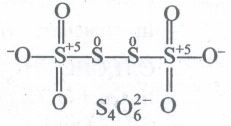
(ii) In \({ S }_{ 2 }{ O }_{ 6 }^{ 2- }\), two S-atoms have oxidation state +5 while another two S-atoms have 0 oxidation state.
15.
Cu + HNO3\(\rightarrow\)Cu(NO3)2 + NO2 + H2O
.png)
Equalise the increase / decrease in O N by multiplying Cu species by +1 and N species by +2
Cu + 2HNO3\(\rightarrow\)Cu(NO3)2 + 2NO2 + H2O
Balance all other atoms except H and O atoms
Cu + 2HNO3\(\rightarrow\)Cu(NO3)2 + 2NO2 + H2O
Balance O atom by adding H2O molecules on the side falling short of oxygen atoms.
Cu + 4HNO3\(\rightarrow\)Cu(NO3)2 + 2NO2 + H2O + H2O
The balanced equation is
Cu + 4HNO3\(\rightarrow\)Cu(NO3)2 + 2NO2 + 2H2O
16.
K2Cr2O7 + KCI + H2SO4 \(\rightarrow\) KHSO4 + CrO2CI2 + H2O
It is not a redox reaction.
17.
KMnO4 + Na2SO3\(\rightarrow\)MnO2 + Na2SO4 + KOH (Alkaline medium)
.png)
Equalise the increase/decrease in O N by multiplying Mn species by 2 and S species by 3
2KMnO4 + 3Na2SO3 \(\rightarrow\) 2MnO2 + 3Na2SO4 + KOH
Balance all other atoms except H and O
2KMnO4 + 3Na2SO3 \(\rightarrow\) 2MnO2 + 3Na2SO4 + 2KOH
Balance O atoms by adding H2O molecules on the side falling short of oxygen atom
2KMnO4 + 3Na2SO3 +H2O\(\rightarrow\) 2MnO2 + 3Na2SO4 + 2KOH
18.
K2Cr2O7 + KI + H2S04 \(\rightarrow\) K2SO 4 + Cr2(SO4)3 + I2 + H2O
.png)
Equalise the increase / decrease in O N by multiplying I species by 1
K2Cr2O7 + 3KI + H2S04 \(\rightarrow\) K2SO 4 + Cr2(SO4)3 + 3I2 + H2O
Balance all other atoms except H and O
K2Cr2O7 + 6KI + 7H2S04 \(\rightarrow\) 4K2SO 4 + Cr2(SO4)3 + 3I2 + H2O
Balance O atom by adding H2O on the side falling short of oxygen
K2Cr2O7 + 6KI + 7H2S04 \(\rightarrow\) 4K2SO 4 + Cr2(SO4)3 + 3I2 + H2O +6H2O
So the balanced equation is
K2Cr2O7 + 6KI + 7H2S04 \(\rightarrow\) 4K2SO 4 + Cr2(SO4)3 + 3I2 +7H2O
19.
Disproportionation reaction
20.
Non-metal displacement reaction
21.
Metal displacement reaction
22.
Decomposition reaction
23.
Displacement reaction
24.
Combination reaction
25.
| Element | Percentage | Atomic mass | Relative No. of moles | Simple Ratio Moles | Simplest whole numberRatio |
| K | 24.75 | 39 | \(\frac{24.75}{39}=0.63\) | \(\frac{0.63}{0.63}=1\) | 1 |
| Mn | 34.77 | 55 | \(\frac{34.77}{55}=0.63\) | \(\frac{0.63}{0.63}=1\) | 1 |
| O | 100-(24.75++34.77)=40.48 | 16 | \(\frac{40.48}{46}=2.53\) | \(\frac{2.53}{0.63}=4\) | 4 |
The empirical formula is KMn04
26.
| Element | Percentage | Atomic mass | Relative No. of moles | Simple Ratio Moles | Simplest whole numberRatio |
| X | 50 | 10 | \(\frac{50}{10}=5\) | \(\frac{5}{2.5}=2\) | 2 |
| Y | 50 | 20 | \(\frac{50}{20}=25\) | \(\frac{2.5}{2.5}=1\) | 1 |
Its simplest formula = X2Y
27.
Formula mass of boric acid H3BO3 = 61.834 amu
1 mole of H3BO3 = Molar mass of H3BO3
= 61.834 g
0.543 mole of H3BO3 = 61.834 x 0.543
= 33.57 g of H3BO3
28.
Equivalent mass of Ba(OH)2
Molar mass of Ba(OH)2 = 171.34 g/mol
Acidity of the Ba(OH)2 = 2
Equivalent mass of the Ba(OH)2 = \(\frac { Molar \ mass \ of \ the \ base }{Acidity \ of \ the \ base}\)
\(=\frac{171.34}{2}=85.5\)
29.
It is not a redox reaction because neither hydrogen or oxygen or electron is removed or added
30.
It is not a redox reaction, because neither hydrogen or oxygen or electron is removed or added
31.
Here, H in Li AlH4 gets oxidised because of the addition of oxygen atom that leads to the formation of OH-
32.
Mass of chloride = 0.606 - 0.456
= 0.146 g
0.146g of chlorine combines with 0.456 g of metal
∴ 35.5 g of chlorine will combine with
= \(\frac { 35.5\times 0.456 }{ 0.146 } \)
= 110.8 g of metal
∴ equivalent mass of metal = 110.8g equ-1
33.
Equivalent mass = \(\frac { Atomic\ mass }{ Valency } \)
Equivalent mass of sodium = \(\frac { 23 }{ 1 } \) = 23
34.
Equivalent mass of an ion = \(\frac { Formula\ mass }{ Change\ of\ ion } \)
Equivalent mass of NO3- = \(\frac { 62 }{ 1 } \) = 62
35.
Equivalent mass = \(\frac { Atomic\ mass }{ Valency } \)
= \(\frac { 65 }{ 2 } \) = 32.5 q eq-1
36.
6.023 1023 molecules = 1 mole
3.0115 \(\times\)1023 molecules = \(\frac { 1 }{ 6.023\times { 10 }^{ 23 } } \times 3.0115\times { 10 }^{ 23 }\)
= 0.5 moles
Molar volumes of 1 mole of SO2 = 2.24 \(\times\)10-2m3
Molar volumes of 0.5 moles of SO2 = 2.24 \(\times\) 10-2 \(\times\)0.5
= 1.12 \(\times\) 10-2 m3
37.
Molar mass of formic acid = 46 g
Molar volume of 46 g (1 mole) of formic acid = 2.24 \(\times\) 10-2 m3
Molar volume of 460 g of (10 moles) of formic acid = \(\frac { 2.24\times { 10 }^{ -2 }\times 460 }{ 46 } \)
= 2.24 \(\times\) 10-2 m3
38.
Molar mass of methane = 16 g
Molar volume of 16g (1 mole) of methane = 2.24 \(\times\) 10-2 m3
volume of 5 moles(80 g) of methane = \(\frac { 2.24\times { 10 }^{ -2 }\times 80 }{ 16 } \)
= 11.2 \(\times\) 10-2 m3
39.
Molar mass of CO2 = 44 g
Molar volume of 44 g (1 mole) of CO2
= 2.24 \(\times\) 10-2 m3
The volume of 88g (2 moles) = \(\frac { 2.24\times { 10 }^{ -2 }\times 88 }{ 44 } \)
= 4.48 \(\times\) 10-2 m3
40.
Bicarbonate ion HCO3-
Molar mass of HCO3-- = 61
Equivalent mass of ion = \(\frac{Molar \ Mass}{Charge \ of \ ion}\)
Equivalent mass of HCO3- = \(\frac{61}{1}=61\)
41.
No. of moles of Na2CO3 = 0.2 mole
Molar mass of Na2CO3 = 106g/mol
Mass = No of moles x molar mass of Na2CO3
= 0.2 x 106
= 21.2g
42.
Mass of glucose 720g
Molecular weight of glucose (C6H12O6) = 180
No. of moles = \(\frac {Mass}{Molar \ Mass}\)
\(=\frac{720}{180}=4 Moles\)
43.
Density of CO2 = 1.977 Kgm-3
PV = nRT
No of moles = \(\frac{Mass}{Molar \ Mass}\)
PV = \(\frac{Mass}{Molar \ Mass} \times R \times T\)
Density = \(\frac {Mass}{V}\)
Molar Mass of CO2 = \(\frac{D \times R \times T}{P}\)
Standard Temperature = 273 K
Standard Pressure = 760mm of Hg = 1 atm
=\(\frac {1.977 \times 0.0821 \times 273}{1}\)
= 44
44.
Atomic mass of potassium = 39
No. of moles = \(\frac { Mass }{ Molar\ mass } \)
No.of moles = \(\frac { 19.5 }{ 39 } \) = 0.5 moles
45.
Molar mass of MgO = 40
No .of moles = \(\frac { Mass }{ Molar\ mass } \)
No .of moles = \(\frac { 90 }{ 40 } \) = 2.25 moles
46.
Molar mass of ethanol = 46
No.of moles = \(\frac { Mass }{ Molar\ mass } \)
No.of moles (n) = \(\frac { 46 }{ 46 } \) = 1 mole
47.
Molar mass of sodium hydroxide = 40
No.of moles = \(\frac { Mass }{ Molar\ mass } \)
No.of moles (n) = \(\frac { 120 }{ 40 } \)
= 3 moles
48.
Molar mass of calcium chloride = 111
No. of moles = \(\frac { Mass }{ Molar\ mass } \)
No. of moles = \(\frac { 50 }{ 111 } \)
= 0.450 moles
49.
Molecular mass of FeSO47H2O
Atomic mass of Fe= 55.845
Atomic mass of S = 32.065
Atomic mass of O = 15.994 x 11 = 63.304
Atomic mass of H = 1.00794 x 14 = 5.076
Molecular of FeSO47H2O = 55.945 + 32.065 + (4 x 15.994) + 7 x (1.0079 x 2 + 15.9994)
= 278.014g/mol
50.
One mole C2H6 contains 2 moles of carbon atoms
∴ In 3 moles of C2H6
Number of moles of carbon atom = 2 x 3 = 6 moles
51.
Mass of Na2CO3= 424 x 106g
No of moles (n) = \(\frac{Mass \ of \ the \ substance}{Molar \ mass \ of \ the \ substance}\)
\(=\frac{425\times10^{6}}{106}\)
= \(4.009 moles \times 10^{6}\)
Mass o fCH30H = \(320\times10^{6}\)
No of moles = \(\frac{Mass \ of \ the \ substance}{Molar \ mass \ of \ the \ substance}\)
\(=\frac{320\times10^{6}}{32}\)
= 10\(\times 10^{6}\)
Methyl alcohol is produced more
52.
Molecular mass of acetic acid = 60
60g of acetic acid contains = 6.023 \(\times\) 1023
Molecules of acetic acid
∴ 1000g of acetic acid contains
= \(\frac { 100\times 6.023\times { 10 } }{ 60 } \)
= 100 \(\times\) 1023
Molecules of acetic acid
53.
| Content | Reactant | Product | ||
| x | y | l | m | |
| Stoichiometric coefficient | 2 | 3 | 4 | 1 |
| No. of moles allowed to react | 8 | 15 | - | - |
| No. of moles of reactant reacted and product formed | 8 | 12 | 16 | 4 |
| No. of moles of un-reacted reactants and the product formed | - | 3 | 16 | 4 |
Limiting reagent : x
Product formed : 16 moles of l & 4 moles of m
Amount of excess reactant : 3 moles of y
54.
| Element | Percentage Composition | \(\frac{Relative No.of atoms Percentage}{Atomic mass}\) | \(\frac{Atomic Mass Percentage}{Relative No.of atoms }\) | Simple Ratio |
| X | 32% | 2 | 16 | \(\frac{2}{0.5}=\) 4 |
| Y | 24% | 1 | 24 | \(\frac{1}{0.5}=\) 2 |
| Z | 44% | 0.5 | 88 | \(\frac{0.5}{0.5}=\) 1 |
| Empirical formula (X4 y2 Z) | ||||
Empirical formula mass = (16 x 4) + (24 x 2) + 88 = 64 + 48 + 88 = 200
n = \(\frac{Molar \quad mass}{calculated \ emphirical \ formula\ mass}\)
n = \(\frac{400}{200}\)
= 2
Molecular formula (X4 y2 Z)2 = X8 Y4 Z2

11th Standard Syllabus & Materials
11th Standard
TN 11th Tamil பீடு பெற நில் - செய்யுள் - காவடிச்சிந்து Important Questions And Answers Study Material - QB365 Set A
NEW11th Standard
TN 11th Tamil பீடு பெற நில் - உரைநடை - மலை இடப்பெயர்கள் : ஓர் ஆய்வு Important Questions And Answers Study Material - QB365 Set A
NEW11th Standard
TN 11th Tamil மாமழை போற்றுதும் - துணைப்பாடம் - யானை டாக்டர் Important Questions And Answers Study Material - QB365 Set A
NEW11th Standard
TN 11th Tamil மாமழை போற்றுதும் - செய்யுள் - ஐங்குறுநூறு Important Questions And Answers Study Material - QB365 Set A



Tamilnadu Stateboard 11th Standard Subjects

Maths

Commerce

Economics

Biology

Business Maths and Statistics

Accountancy

Computer Science

Physics
Chemistry
Maths
Biology
Economics
Physics
Chemistry

History
Business Maths and Statistics

Computer Science
Accountancy

Computer Applications
History
Computer Technology
Commerce
Computer Applications
Computer Technology

Tamil

English

French
Tamilnadu Stateboard Standards
