
 100% FREE ACCESS
11th Standard Syllabus & Materials
11th Standard
TN 11th Tamil இயற்கை வேளாண்மை,சுற்றுச்சூழல் -செய்யுள் - மனோன்மணீயம் Important Questions And Answers Study Material - QB365 Set A
NEW11th Standard
TN 11th Tamil என்னுயிர் என்பேன் -துணைப்பாடம் - இசைத்தமிழர் இருவர் Important Questions And Answers Study Material - QB365 Set A
NEW11th Standard
TN 11th Tamil மொழி கலை -செய்யுள் - ஒவ்வொரு புல்லையும் Important Questions And Answers Study Material - QB365 Set A
NEW11th Standard
TN 11th Tamil பீடு பெற நில் - இலக்கணம் - பகுபத உறுப்புகள் Important Questions And Answers Study Material - QB365 Set A
NEW11th Standard
TN 11th Tamil பீடு பெற நில் - துணைப்பாடம் - வாடிவாசல் Important Questions And Answers Study Material - QB365 Set A
NEW11th Standard
TN 11th Tamil பீடு பெற நில் - செய்யுள் - குறுந்தொகை Important Questions And Answers Study Material - QB365 Set A

Published on: 27/04/2019
Most important two mark questions in Quantum Mechanical Model of Atom
Download Tamil Nadu 11th Standard Chemistry question papers, model tests, one-mark questions, important questions, and public exam papers in PDF format. Free study materials and answer keys for TN State Board students.
Questions + Answers key
Take MCQ Chemistry Test
1.
A microscope using suitable photons is employed to locate an electron in an atom within a distance of 0.1\(\overset { o }{ A } \) What is the uncertainty involved in the measurement of its velocity.
2.
The kinetic energy of a subatomic particle is 5.58 x 10⁻²⁵ J. Calculate the frequency of the particle wave. (Planck's constant h = 6.626 x 10⁻³⁴ kg m2 s-1)
3.
Calculate the wave length of an electron (mass = 9.1 x 10⁻³¹ kg) moving with 'a velocity of 103 ms-1 (h = 6.6 x 10⁻³⁴ kg m2 sec-1).
4.
Chromium (Z = - 24) and copper (Z = 29), should have the configuration.
Cr = 1s2 2s2 2p6 3s2 3p6 3d4 4s2
Cu = 1s2 2s2 2p6 3s2 3p6 3d9 4s2
But their actual configuration are Cr = 1s2 2s2 2p6 3s2 3p6 3d5 4s1 and
Cu = 1s2 2s2 2p6 3s2 3p6 3d10 4s1 Explain the reason.
5.
Draw the shapes (boundary surfaces) for the following orbitals.
(i) 2px
(ii) 3dz2
(iii) 3dx2y2
6.
What is the angular momentum of an electron in
(i) 2s orbital
(ii) 4f orbital?
7.
The ground state electronic configurations listed below here are incorrect. Explain what mistakes have been made in each and correct the electronic configuration.
(i) Al = 1s2 2s2 2p4 3s2 3p6 .
(ii) B = 1s2 2s2 2p5
(iii) F = 1s2 2s2 2p5.
8.
How many electrons in sulphur (z = 16) can have n + 1 = 3?
9.
For each of the following pair of hydrogen orbitals indicate which is higher in energy?
(i) 1s, 2s
(ii) 2p, 3p
(iii) 3dxy 3dyz
(iv) 3s, 3d
(v) 4f, 5s.
10.
How many radial f spherical nodes will be present in 5f orbital?
11.
Bring out the similarities and dissimilarities between a 1s and 2s orbital.
12.
At what distance is the radial probability maximum for 1s orbital? What is this distance called?
13.
Why Pauli exclusion principle is called exclusion principle?
14.
How many electrons are present in all subshells (fully filled) with n + l = 5?
15.
Write the values of four quantum numbers present in the last electron in, an atom having the electronic configuration
(i) 1s2 2s2 2p1
(ii) 1s2 2s2 2p6 3s2 3p2.
16.
Write the values of all the four quantum numbers for all the electrons present in hydrogen and Helium atoms.
17.
After the execution of the \(\alpha\)-ray scattering experiment, what were the observations made by Rutherford? What did he conclude from his observations?
18.
How many neutrons and protons are there in the Following nuclei?
\(_{ 6 }^{ 13 }{ C }\),\(_{ 2 }^{ 18 }{ O }\).\(_{ 12}^{ 24}{ Mg }\),\(_{26 }^{ 56}{ Fe }\),\(_{ 88}^{ 38}{ Sr }\)
19.
Give the number of electrons in the following species. H2 , H2 , O2 and O2-
20.
What is the difference between atomic mass and mass number?
21.
What is the charge and mass of an electron?
22.
What are the defects of Rutherford's model?
23.
What did Rutherford's alpha ray scattering experiment prove
24.
Write a note on Thomson's plum pudding model of an atom.
25.
Energy of an electron in hydrogen atom in ground state is -13.6 eV. What is the energy of the electron in the second excited state?
1.
Given \(\Delta\)x = 0.1 or 0.1 x 10⁻¹⁰ m or 10-11 m.
h = 6.626 x 10⁻³⁴ kg m2 s-1, m = 9.11 x 10⁻³¹ kg
According to uncertainty principle,
\(\Delta x,m(\Delta v)=\frac{h}{4\pi}\)
i.e., \(\Delta v=\frac{h}{4\pi\times m\times \Delta x}\)
= \(\frac{6.626\times 10^{-34}kg m^2 s^{-1}}{4\times 3.14\times 9.11\times 10^{-31}kg \times 10^{-11}m}\)
= 5.79 x 10⁶ ms-1.
2.
KE = \(\frac{1}{2}\)mv2 = 5.85 x 10⁻²⁵ J
By de Broglie equation \(\lambda=\frac{h}{mv}\)
But \(\lambda=\frac{\nu}{V}=\frac{h}{mv}\)
v = \(\frac{mv^2}{h}=\frac{2\times 5.85\times 10^{-25}J}{6.026\times 10^{-34}J}\)
= 1.77 x 10⁹ s-1.
3.
Given m = 9.1 x 10⁻³¹ kg; v = 103 ms-1
h = 6.6 x 10⁻³⁴ kg m2 sec-1
\(\lambda=\frac{h}{mv}=\frac{6.6\times 10^{-34}kgm^2 sec^{-1}}{9.1\times 10^{-31}kg\times 10^3 ms^{-1}}\)
= 7.25 x 10⁻⁷ m.
4.
The reasons are:
(i) Symmetrical distribution: 3d5(half-filled) and 3d10 (completely filled) one more symmetrical and hence more stable.
(ii) Exchange energy: Electrons with parallel spins in degenerate orbitals tend to exchange their positions. As a result, energy is released. This energy is called exchange energy. Greater the exchange energy, greater is the stability.
5.
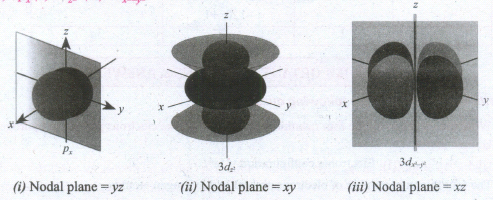
6.
Angular momentum of electron in any orbital = \(\sqrt{l(l+1)}\times\frac{h}{2\pi}\)
(i) for 2s orbital, l = 0
Therefore angular momentum = \(\sqrt{0(0+1)}\times\frac{h}{2\pi}=0\)
(ii) for 4f orbital, I = 3
Therefore angular momentum = \(\sqrt{3(3+1)}\times\frac{h}{2\pi}\)
= \(2\sqrt{3}\frac{h}{2\pi}\)
\(=\sqrt{3}\frac{h}{\pi}\)
7.
(i) In AI, 2p should be filled before filling 3s, orbital states.
\(\therefore\) correct electronic configuration is 1s2 2s2 2p6 3s2 2p1
(ii) In B, total electrons = 5. Electronic configuration is 1s2 2s2 2p1
(iii) In F, total electrons = 9. Electronic configuration is 1s2 2s2 2p5.
8.
The electronic configuration of sulphur is 1s2 2s2 2p6 3s2 3p4
For 1s2, n,+ l = 1+ 0 = 1 ; For 2p6, n + 1 = 2 + 1 = 3
2s2, n + I = 2 + 0 = 2; For 3s2, n + I = 3 + 0 = 3
3p4, n + 1 = 3 + 1 = 4
Thus n + 1 = 3 for 2p6 electron and 3s2 electron = 8 electrons.
9.
(i) 2s > 1s
(ii) 3p > 2p
(iii) 3dxy > 3dyz
(iv) 3s = 3d
(v) 5s > 4f.
10.
No. of radial nodes = n - I +1 = 5 - 3 - 1 = 1.
11.
Similarities:
(i) Both have similar shape.
(ii) Both have same angular momentum = \(\sqrt{l(l+1)} \frac{h}{2\pi}\)
Dissimilarities:
(i) Is orbital has no node while 2s orbital has one node.
(ii) Energy of 2s orbital is greater than Is orbital.
(iii) The size of the 2s orbital is larger than Is orbital.
12.
0.529 \(\overset { o }{ A } \), Bohr radius.
13.
This is because, according to this principle, if one electron of an atom has same particular values, for the four quantum numbers, then all the other electrons in that atom are excluded from having the same set of values.
14.
Subshells with n + 1 = 5 are 5s, 4p, 3d. Hence electrons present are 2 + 6 + 10 = 18.
15.
(i) The last electron is the 'one' electron present in 'p' sub level.
i.e., n = 2; l = 1; m = -1,0 or + 1,s = + 1/2 or - 1/2
(ii) If the first electron present in 'p' subshell has the-following quantum numbers.
n = 3, l = 1, m = -1,0 (or) + 1, s = + 1/2,
the last electron has n = 3, l = 1, m = -1, 0 (or) + 1, s = - 1/2.
16.
Hydrogen atom (H): Electronic configuration = IS1.
The four quantum number of electrons present in a hydrogen atom is
n = 1 l = 0; m = 0; s = +\(\frac{1}{2}\)
The four quantum number of two electrons present in a helium atom is
n = 1; l = 0; m = 0; s = + \(\frac{1}{2}\)
n = 1; l = 0; m = 0; s = + \(\frac{1}{2}\)
17.
| OBSERVATION | CONCLUSION | |
| 1 | Most of the \(\alpha\)-particles passed through the foil | Presence of large empty space in the atom |
| 2. | Few \(\alpha\)-particles were deflected by small angles | Positive charge is concentrated at a very small region and not uniformly distributed in whole atom |
| 3. | Very few \(\alpha\)-particles reflected completely at 180° | Positively charged core is known as nucleus |
18.
| Nucleus | Atomic Number (Z) | Mass Number (A) | Number of protons =Z | Number of Neutrons =A-Z |
| \(_{ 6 }^{ 13 }{ C }\) | 6 | 13 | 6 | 13 - 6 = 7 |
| \(_{ 2 }^{ 18 }{ O }\) | 8 | 16 | 8 | 16 - 8- = 8 |
| \(_{ 12}^{ 24}{ Mg }\) | 12 | 24 | 12 | 24 - 12 = 12 |
| \(_{26 }^{ 56}{ Fe }\) | 26 | 56 | 26 | 56 - 26 = 30 |
| \(_{ 88}^{ 38}{ Sr }\) | 38 | 88 | 38 | 88 - 38 = 50 |
19.
H2 = 1 + 1 = 2e-
H+2; = 2 - 1 = le-
\({O}_{2}\) = 8 + 8 = 16e-
\({O}_{2}^{-}\) = 8 + 8 + 1= 17e-
20.
(i) Mass number is a whole number because it is the sum of number of protons and number of neutrons.
(ii) Atomic mass is fractional because it is the average relative mass of its atom as compared with mass of an atom of C-12 isotope taken as 12.
21.
The charge of an electron is 1.602 x 10⁻¹⁹ coulomb
The mass of an electron is 9.11 x 10⁻³¹ kg
22.
According to J. C. Maxwell, whenever an electron is subjected to acceleration, it emits radiation and loses energy. As a result of this, its orbit should become smaller and smaller and finally it should drop into the nucleus by following a spiral path. This means that atom would collapse and thus Rutherford's model failed to explain stability of atoms. Another drawback of the Rutherford's model is that it gives no information about the electronic structure of an atom.
23.
(i) Atoms consist of huge positively charged centers called nuclei.
(ii) Most of the space inside the atom is empty.
24.
According to this theory, atom was assumed to consist of a sphere of uniform distribution of about 10-10 m positive charge with electrons embedded in it such that the number of electrons equal to the number of positive charges and the atom as a whole is electrically neutral.
25.
\(\mathrm{E}_{n}=\frac{-13.6}{\mathrm{n}^{2}} \mathrm{eV}\)
Second excited state
\(\therefore E_{3}=\frac{-13.6}{9} \mathrm{eV}\)
n = 3
E3 = -1.51 eV

11th Standard Syllabus & Materials
11th Standard
TN 11th Tamil பீடு பெற நில் - செய்யுள் - காவடிச்சிந்து Important Questions And Answers Study Material - QB365 Set A
NEW11th Standard
TN 11th Tamil பீடு பெற நில் - உரைநடை - மலை இடப்பெயர்கள் : ஓர் ஆய்வு Important Questions And Answers Study Material - QB365 Set A
NEW11th Standard
TN 11th Tamil மாமழை போற்றுதும் - துணைப்பாடம் - யானை டாக்டர் Important Questions And Answers Study Material - QB365 Set A
NEW11th Standard
TN 11th Tamil மாமழை போற்றுதும் - செய்யுள் - ஐங்குறுநூறு Important Questions And Answers Study Material - QB365 Set A



Tamilnadu Stateboard 11th Standard Subjects

Maths

Commerce

Economics

Biology

Business Maths and Statistics

Accountancy

Computer Science

Physics
Chemistry
Maths
Biology
Economics
Physics
Chemistry

History
Business Maths and Statistics

Computer Science
Accountancy

Computer Applications
History
Computer Technology
Commerce
Computer Applications
Computer Technology

Tamil

English

French
Tamilnadu Stateboard Standards
