
 100% FREE ACCESS
11th Standard Syllabus & Materials
11th Standard
TN 11th Tamil இயற்கை வேளாண்மை,சுற்றுச்சூழல் -செய்யுள் - மனோன்மணீயம் Important Questions And Answers Study Material - QB365 Set A
NEW11th Standard
TN 11th Tamil என்னுயிர் என்பேன் -துணைப்பாடம் - இசைத்தமிழர் இருவர் Important Questions And Answers Study Material - QB365 Set A
NEW11th Standard
TN 11th Tamil மொழி கலை -செய்யுள் - ஒவ்வொரு புல்லையும் Important Questions And Answers Study Material - QB365 Set A
NEW11th Standard
TN 11th Tamil பீடு பெற நில் - இலக்கணம் - பகுபத உறுப்புகள் Important Questions And Answers Study Material - QB365 Set A
NEW11th Standard
TN 11th Tamil பீடு பெற நில் - துணைப்பாடம் - வாடிவாசல் Important Questions And Answers Study Material - QB365 Set A
NEW11th Standard
TN 11th Tamil பீடு பெற நில் - செய்யுள் - குறுந்தொகை Important Questions And Answers Study Material - QB365 Set A

Published on: 06/12/2018
HSC Board Exams are fast approaching and students are getting anxious about how to prepare for their HSC Board Exams. This question paper exclusively designed for the chapter Environmental Chemistry from plus one Chemistry. The latest sample papers have been designed as per the latest syllabus and examination trends.
Now you can use this model question paper for practice on your own to score more on your board exams. By practicing with this important model question paper student can gain more knowledge and confidence to crack the exams. Our aim is to bring out the best scores on board exams. Creative questions were added in this question paper in order to enhance the student's knowledge and get the idea that how to answer strategic questions asked in the board exams.
By practicing repeatedly you will get the idea of answering the questions and this improves the speed of answering. This will save the time and you can complete all the questions without any last our tension. Get more model question papers and practice for the board examination.
It's the right time to grab the model question papers on chapter wise and practice for the board exams. This question paper is designed based on the academic syllabus. It will be more helpful for the Matriculation and state board students to prepare for their exams. The best way to prepare exams is to simply do one thing at a time. Using the model question papers, every student can get an idea about the exam questions in a subject wise and collect more information to score high marks on all exams
Download Tamil Nadu 11th Standard Chemistry question papers, model tests, one-mark questions, important questions, and public exam papers in PDF format. Free study materials and answer keys for TN State Board students.
Questions + Answers key
Take MCQ Chemistry Test
1.
Green house gases cause _____________
Increase in temperature of atmosphere
Prevents global warming
Trap UV rays
All the above
2.
High concentration of lead in human blood damages ______________
Brain
Liver
Both (a) & (b)
Neither (a) nor (b)
3.
Biochemical oxygen Demand value less than 5 ppm indicates a water sample to be ______.
highly polluted
poor in dissolved oxygen
rich in dissolved oxygen
low COD
4.
Which sequence for green house gases is based on GWP ?
CFC > N2O > CO2 > CH4
CFC > CO2 > N2O > CH4
CFC > N2O > CH4 > CO2
CFC > CH4 > N2O > CO2
5.
Assertion (A) : If BOD level of water in a reservoir is more than 5 ppm it is highly polluted
Reason(R) : High biological oxygen demand means high activity of bacteria in water
i) Both (A) and R are correct and (R) is the correct explanation of (A)
ii) Both (A) and R are correct and (R) is not the correct explanation of (A)
iii) Both (A) and R are not correct
iv) (A) is correct but( R) is not correct
Both (A) and R are correct and (R) is the correct explanation of (A)
Both (A) and R are correct and (R) is not the correct explanation of (A)
Both (A) and R are not correct
(A) is correct but( R) is not correct
6.
Write the impact of depletion of ozone layer on plants, human and aquatic life.
7.
Discuss the harmful effects of improper waste management in the city
8.
Bring out the differences between classical and photochemical smog
9.
A person was using water supplied by corporation. Due to shortage of water he started using underground water. He felt laxative effect. What could be the cause ?
10.
What would happen, if the greenhouse gases were totally missing in the earth’s atmosphere ?
11.
Name any four methods of waste management
12.
Write a short note on global warming.
13.
How does classical smog differ from photochemical smog ?
14.
From where does ozone come in the photo chemical smog ?
15.
Which is considered to be earth’s protective umbrella ? Why ?
16.
What is water pollution ? Give a detailed account on causes and harmful effects of water pollution.
17.
(i) How does pollutants vary from contaminants?
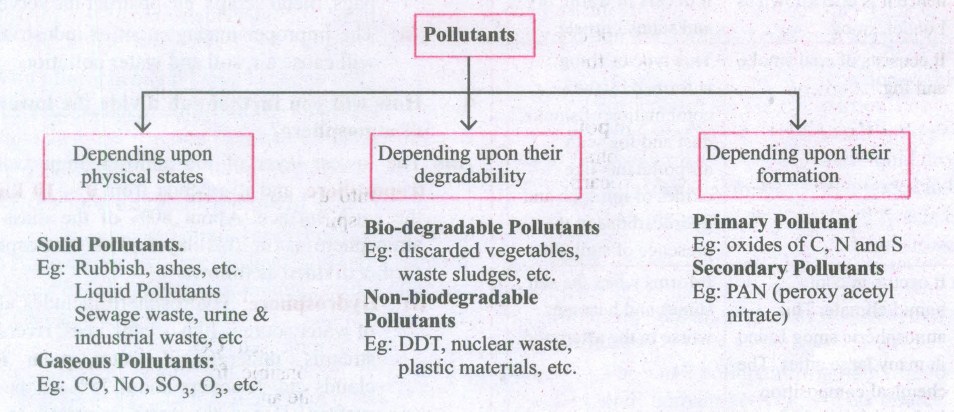
(ii) Classify the pollutants on the following basis & give examples.
Depending on their physical state
Depending upon their degradability.
Depending on their formation and existence in nature.
18.
Explain how oxygen deficiency is caused by carbon monoxide in our blood ? Give its effect
19.
How is acid rain formed ? Explain its effect
1.
(a)
Increase in temperature of atmosphere
2.
(c)
Both (a) & (b)
3.
(c)
rich in dissolved oxygen
4.
(c)
CFC > N2O > CH4 > CO2
5.
iv) (A) is correct but( R) is not correct
6.
(i) Impact on human:
Exposure to UV radiation lead to ageing of skin, cataract, sun bum and skin cancer.
(ii) Impact on aquatic life:
Many phytoplanktons are killed and the productivity of fishes are damaged.
(iii) Impact on plant life:
The plant proteins get easily affected by UV radiation.
It also increases evaporation of surface water through the stomata of the leaves and decrease the moisture content of the soil.
7.
(i) If the domestic waste is not managed properly. it might move down into severs or may be eaten up by the cattle.
(ii) The non-biodegradable waste like polythene bags, metal scraps. etc obstruct the servers.
(iii) The improper management of industrial waste will cause air, soil and water pollution
8.
| CLASSICAL SMOG | PHOTO CHEMICAL SMOG |
|---|---|
| (i) Classical smog was first observed in London in December 1952 and hence it is also known as London smog. | Photo Chemical smog was first observed in Los Angels in 1950. It occurs in warm, dry and sunny climate. |
| (ii) It consists of coal smoke and fog. | This type of smog is formed by the combination of smoke, dust and fog with air pollutants like oxides of nitrogen and hydrocarbons in the presence of sunlight. |
| (iii) It occurs in cool humid climate. This atmospheric smog found in many large cities. The chemical composition is the mixture of SO2, SO3 and humidity. It generally occurs in the morning and becomes worse when the sun rises | It forms when the sun shines and becomes worse in the afternoon. |
| (iv) Chemically it is reducing in nature because of high concentration of SO2 and so it is also called as reducing smog. | Chemically it is oxidizing in nature because of high concentration of oxidizing agents NO2 and O3, so it is also called as oxidizing smog. |
| (v) It causes bronchial irritation. | It causes irritation to eyes, skin and lungs throat infection, chest pain and difficulty in breathing. |
9.
There may be exercise concentration ( > 500 ppm) of sulphates in the ground water. So he could have felt laxative effect.
10.
Without the heating caused by the greenhouse effect, earth's average surface temperature would be only about -18 oC (0 oF). Although the greenhouse effect is a naturally occurring phenomenon, it is intensified by the continuous emission of greenhouse gases into the atmosphere.
During the past 100 years, the amount of carbon dioxide in the atmosphere increased by roughly 30 percent and the amount of methane more than doubled.If these trends continue, the average global temperature will increase which can lead to melting of polar ice caps and flooding of low areas. This will increase incidence of infectious diseases like dengu., malaria, etc.
11.
(i) Recycling
(ii) Burning and incineration
(iii) Sewage Treatment
(iv) Dumping
12.
The heating up of earth through the greenhouse effect is called global warming. Although the greenhouse effect is a naturally occurring phenomenon, it is intensified by the continuous emission of greenhouse gases into the atmosphere. During the past 100 years, the amount of carbon dioxide in the atmosphere increased by roughly 30 percent and the amount of methane more than doubled. If these trends continue, the average global temperature will increase which can lead to melting of polar ice caps and flooding of low lying areas. This will increase incidence of infectious diseases like dengue, malaria, etc
13.
| S.No | Classical somg (london smog) | Photochemical smog (Los Angels smog) |
|---|---|---|
| 1 | It was first observed in London in Dec. 1952 | It was first observed in Los Angels in 1950. |
| 2 | It occurs in cool, humid climate | It occurs in warm, dry and sunn climate |
| 3 | It consists of coal smoke and fog | It is formed by the combination of smoke dust and fog with air pollutants like N2 and hydrocarbons in presence of light. |
| 4 | It generally occurs in the morning and becomes worse when the sunshines | It forms when the sunshines and becomes worse in the afternoon. |
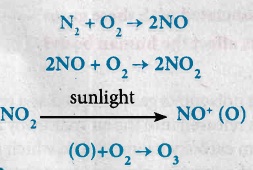
| 5 | This is mainly due to the induced oxidation of SO2 to SO3, which reacts with water yielding sulphuric acid aerosol. | This is mainly due to the induced oxidation of N2 to NO, NO2 and [O] + O2 to O3 NO and O3 are strong oxidising agents and can react with unburnt hydrocarbons in polluted air to form HCHO, Acrolein and PAN. |
| 6 | Chemically it is reducing in nature because of high concentration of SO2. | Chemically it is oxidising in nature because of high concentrations of oxidising agents like NO2 and O2 |
| 7 | It is called reducing smog | It is called oxidising smog |
| 8 | Responsible for acid rain, causes poor visibility, affects air and road transport and causes bronchial irritation. | Causes irritation to nose, throat, eyes, skin and lungs, increases asthma, causes chest pain, uncomfortable breathing, PAN attacks young leaves, causes corrosion of metals, stones painted surfaces, etc., |
14.
Ozone is formed by a series of reactions that occur from the sun shines
15.
At high altitudes to the atmosphere consists of a layer of ozone (O3) which acts as an umbrella or shield for harmful UV radiations. It protects us from harmful effect such as skin cancer. UV radiation can convert molecular oxygen into ozone as shown in the following reaction.
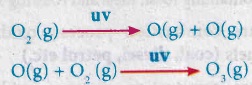
Ozone gas is thermodynamically unstable and readily decomposes to molecular oxygen.
16.
Water pollution is defined as "The addition of foreign substances or factors like heat which degrades the quality of water, so that it becomes health hazard or unfit to use."
(i) The water pollutants originate from both natural and human activities. The source of water pollution is classified as Point and Non-point source.
(ii) Easily identified source of place of pollution is called as point source.
Example: municipal and industrial discharge pipes.
(iii) Non-point source cannot be identified easily.
Example: agricultural runoff, mining wastes, acid rain, and storm-water drainage and construction sediments.
| POLLUTANT | SOURCES |
|---|---|
| (i) Micro-organisms | Domestic sewage, domestic waste water, dung heap |
| (ii) Organic wastes | Domestic sewage, animal excreta, food processing factory waste, detergents and decayed animals and plants. |
| (iii) Plant nutrients | Chemical fertilisers |
| (iv) Heavy metals | Heavy metal producing factories |
| (v) Sediments | Soil erosion by agriculture and strip-mining. |
| (vi) Pesticides | Chemicals used for killing insects, fungi and weeds. |
| (vii) Radioactive substances | Mining of uranium containing minerals. |
| (viii) Heat | Water used for cooling in industries. |
(a) Causes of water pollution:
(i) Microbiological (Pathogens) : Disease causing microorganisms like bacteria, viruses and protozoa are most serious water pollutants. They come from domestic sewage and animal excreta. Fish and shellfish can become contaminated and people who eat them can become ill. Some serious diseases like polio and cholera are water borne diseases. Human excreta contain bacteria such as Escherichia coli and Streptococcus faecalis which cause gastrointestinal diseases.
(ii) Organic wastes: Organic matter such as leaves, grass, trash etc can also pollute water. Water pollution is caused by excessive phytoplankton growth within water. Microorganisms present .in water decompose these organic matter and consume dissolved oxygen in water.
(iii) Eutrophication: Eutrophication is a process by which water bodies receive excess nutrients that stimulates excessive plant growth ( algae, other plant weeds).This enhanced plant growth in water bodies is called as algae bloom. The growth of algae in extreme abundance covers the water surface and reduces the oxygen concentration in water. Thus, bloom-infested
(b) Biochemical oxygen demand(BOD):
(i) The total amount of oxygen in milligrams consumed by microorganisms in decomposing the waste in one litre of water at 200C for a period of 5 days is called biochemical oxygen demand (BOD) and its value is expressed in ppm.
(ii) BOD is used as a measure of degree of water pollution. Clean water would have BOD value less than 5 ppm whereas highly polluted water has BOD value of 17 ppm or more
(c) Chemical wastes:
(i) A whole variety of chemicals from industries, such as metals and solvents are poisonous to fish and other aquatic life
(ii) Some toxic pesticides can accumulate in fish and shell fish and poison the people who eat them. Detergents and oils float and spoil the water bodies. Acids from mine drainage and salts from various sources can also contaminate water sources.
Harmful effcts of chemical water pollutants:
(i) Cadmium and mercury can cause kidney damage.
(ii) Lead poisoning can leads to the severe damage of kidneys, liver, brain etc. it also affects central nervous system
(iii) Polychlorinated biphenyls (PCBs) causes skin diseases and are carcinogenic in nature.
17.
| Pollutants | Contaminants |
|---|---|
| A substance which causes pollution are called pollutants. Eg: Fertilizers | The pollutants that do not occur in nature and are introduced into the environment by human activity are called contaminants. Eg: pyrosulphuric acid (H2S2O7). |
18.
It binds with haemoglobin and form carboxy haemoglobin which impairs normal oxygen transport by blood and hence the oxygen carrying capacity of blood is reduced. This oxygen deficiency results in headache, dizziness, tension, Loss of consciousness, blurring of eye sight and cardiac arrest.
19.
Rain water normally has a pH of 5.6 due to dissolution of atmospheric CO2 into it. Oxides of sulphur and nitrogen in the atmosphere may be absorbed by droplets of frater that make up clouds and get chemically converted into sulphuric acid and nitric acid respectively as a results of pH of rain water drops below the level 5.6, hence it is called acid rain. Acid rain is a by-product of a variety of sulphur and nitrogen oxides in the atmosphere. Burning of fossil fuels (coal and oil) in power stations, furnaces and petrol, diesel in motor engines produce sulphur dioxide and nitrogen oxides The main contributors of acid rain are SO2 and NO2.They are converted into sulphuric acid and nitric acid respectively by the reaction with oxygen and water.
2SO2 + O2 + 2H2O ⟶ 2H2SO4
4NO2 + O2 + 2H2O ⟶ 4HNO3
Harmful effects of acid rain
Some harmful effects are discussed below :
(i) Acid rain causes extensive damage to buildings and structural materials of marbles. This attack on marble is termed as Stone leprosy.
CaCO3 + H2SO4 ⟶ CaSO4 + H2O +CO2 ↑
(ii) Acid rain affects plants and animal life in aquatic ecosystem.
(iii) It is harmful for agriculture, trees and plants as it dissolves and removes the nutrients needed for their growth.
(iv) It corrodes water pipes resulting in the leaching of heavy metals such as iron, lead and copper into the drinking water which have toxic effects.
(v) It causes respiratory ailment in humans and animals.

11th Standard Syllabus & Materials
11th Standard
TN 11th Tamil பீடு பெற நில் - செய்யுள் - காவடிச்சிந்து Important Questions And Answers Study Material - QB365 Set A
NEW11th Standard
TN 11th Tamil பீடு பெற நில் - உரைநடை - மலை இடப்பெயர்கள் : ஓர் ஆய்வு Important Questions And Answers Study Material - QB365 Set A
NEW11th Standard
TN 11th Tamil மாமழை போற்றுதும் - துணைப்பாடம் - யானை டாக்டர் Important Questions And Answers Study Material - QB365 Set A
NEW11th Standard
TN 11th Tamil மாமழை போற்றுதும் - செய்யுள் - ஐங்குறுநூறு Important Questions And Answers Study Material - QB365 Set A



Tamilnadu Stateboard 11th Standard Subjects

Maths

Commerce

Economics

Biology

Business Maths and Statistics

Accountancy

Computer Science

Physics
Chemistry
Maths
Biology
Economics
Physics
Chemistry

History
Business Maths and Statistics

Computer Science
Accountancy

Computer Applications
History
Computer Technology
Commerce
Computer Applications
Computer Technology

Tamil

English

French
Tamilnadu Stateboard Standards
