
 100% FREE ACCESS
11th Standard Syllabus & Materials
11th Standard
TN 11th Tamil இயற்கை வேளாண்மை,சுற்றுச்சூழல் -செய்யுள் - மனோன்மணீயம் Important Questions And Answers Study Material - QB365 Set A
NEW11th Standard
TN 11th Tamil என்னுயிர் என்பேன் -துணைப்பாடம் - இசைத்தமிழர் இருவர் Important Questions And Answers Study Material - QB365 Set A
NEW11th Standard
TN 11th Tamil மொழி கலை -செய்யுள் - ஒவ்வொரு புல்லையும் Important Questions And Answers Study Material - QB365 Set A
NEW11th Standard
TN 11th Tamil பீடு பெற நில் - இலக்கணம் - பகுபத உறுப்புகள் Important Questions And Answers Study Material - QB365 Set A
NEW11th Standard
TN 11th Tamil பீடு பெற நில் - துணைப்பாடம் - வாடிவாசல் Important Questions And Answers Study Material - QB365 Set A
NEW11th Standard
TN 11th Tamil பீடு பெற நில் - செய்யுள் - குறுந்தொகை Important Questions And Answers Study Material - QB365 Set A

Published on: 14/02/2019
Download Tamil Nadu 11th Standard Business Maths and Statistics question papers, model tests, one-mark questions, important questions, and public exam papers in PDF format. Free study materials and answer keys for TN State Board students.
Questions + Answers key
Take MCQ Business Maths and Statistics Test1.
Evaluate: \(\underset { x\rightarrow a }{ lim } \frac { { x }^{ \frac { 3 }{ 5 } }-{ a }^{ \frac { 3 }{ 5 } } }{ { x }^{ \frac { 1 }{ 5 } }-{ a }^{ \frac { 1 }{ 5 } } } \)
2.
Find the value of \(\tan\left[ \frac { \pi }{ 4 } -{ \tan }^{ -1 }\left( \frac { 1 }{ 8 } \right) \right] \)
3.
If (n + 2)Cn = 45, find n
4.
Find the angle between the straight lines x2 + 4xy + y2 = 0
5.
If the lines 3x - 5y - 11 = 0, 5x + 3y - 7 = 0 and x + ky = 0 are concurrent, find the value of k.
6.
If \(A=\left| \begin{matrix} -2 & 6 \\ 3 & -9 \end{matrix} \right| \)then, find A-1
7.
A die is thrown. Find the probability of getting
(i) a prime number
(ii) a number greater than or equal to 3
8.
X speaks truth 4 out of 5 times. A die is thrown. He reports that there is a six. What is the chance that actually there was a six?
9.
Which is better investment? 7% of Rs. 100 shares at Rs. 120 (or) 8% of Rs. 100 shares at Rs. 135.
10.
How much will be required to buy 125 of Rs. 25 shares at a discount of Rs. 7
11.
A person brought at 12% stock for Rs. 54,000 at a discount of 17%. If he paid 1% brokerage, find the percentage of his income.
12.
If the production of a firm is given by p = 4LK - L2 + K2, L>0, K>0, prove that \(L\frac { \partial p }{ \partial L } +k\frac { \partial p }{ \partial k } =2p\)
13.
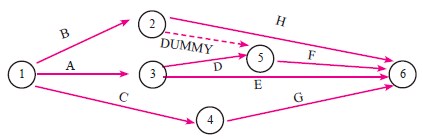
Construct a network diagram for the following situation:
A < D, E; B, D < F; C < G and B < H.
14.
Find the equilibrium price and equilibrium quantity for the following functions. Demand: x = 100 – 2p and supply: x = 3p – 50
15.
Find the values of x, when the marginal function of y = x3 + 10x2 - 48x + 8 is twice the x.
16.
Find the elasticity of supply for the supply function x = 2p2 +5 when p = 3
17.
Find the center and radius of the circle 5x2 + 5y2 + 4x - 8y - 16 = 0
18.
If \(f(x)=\frac { x+1 }{ x-1 } \) ,x ≠ 0 then prove that f(f(x)) = x
19.
Expand the following by using binomial theorem.\(\left( x+\frac { 1 }{ y } \right) ^{ 7 }\)
20.
There are 1000 students in a school out of which 450 are girls. It is known that out of 450, 20% of the girls studying in class XI. A student is randomly selected from 1000 students. What is the probability that the selected student is from class XI given that the selected student is a girl? rom a pack of 52 cards, two cards are drawn at random. Find the probability that one is a king and the other is a queen.
21.
If u = xy + sin(xy), then show that \(\frac { \partial ^{ 2 }u }{ \partial x\partial y } =\frac { \partial ^{ 2 }u }{ \partial y\partial x } \)
22.
Prove that \(\begin{vmatrix} {1\over a}&bc&b+c\\{1\over b}&ca&c+a\\{1\over c}&ab&a+b \end{vmatrix}=0\)
23.
Resolve into partial fractions for the following : \(\frac{1}{x^2-1}\)
24.
If y = A sin x + B cos x, then prove that, y2 + y = 0
25.
Differentiate the following functions with respect to x, x2 sin x
26.
If f(x) = 2x, then show that f(x).f(y) = f(x + y)
27.
The supply of a commodity is related to the price by the relation x = \(\sqrt{5p-15}\) . Show that the supply curve is a parabola.
28.
Find the parametric equations of the circle x2 + y2 = 25
29.
If nPr = 360, find n and r.
30.
Evaluate:\(\left| \begin{matrix} x & x+1 \\ x-1 & x \end{matrix} \right| \)
31.
A bag contains 5 white and 3 black balls. Two balls are drawn at random one after the other without replacement. Find the probability that both balls drawn are black.
32.
An unbiased die is thrown. If A is the event ‘the number appearing is a multiple of 3’ and B be the event ‘the number appearing is even’ number then find whether A and B are independent?
33.
A die is thrown twice and the sum of the number appearing is observed to be 6. What is the conditional probability that the number 4 has appeared at least once?
34.
A family has two children. What is the probability that both the children are girls given that at least one of them is a girl?
35.
Calculate the coefficient of correlation from the following data:
ΣX = 50, ΣY = –30, ΣX2 = 290, ΣY2 = 300, ΣXY = –115, N = 10
36.
If the dividend received from 10% of Rs. 25 shares is Rs. 2000. Find the number of shares.
37.
What is the amount of perpetual annuity of Rs. 50 at 5% compound interest per year?
38.
Find D2 and D6 for the following series 22, 4, 2, 12, 16, 6, 10, 18, 14, 20, 8
39.
From the following data calculate the correlation coefficient Σxy = 120, Σx2 = 90, Σy2 = 640
40.
41.
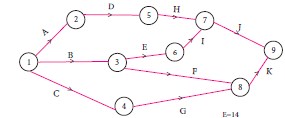
Construct the network for each the projects consisting of various activities and their precedence relationships are as given below:
| Activity | A | B | C | D | E | F | G | H | I | J | K |
| Immediate Predecessors | - | - | - | A | B | B | C | D | E | H,I | F,G |
42.
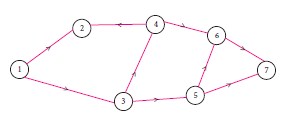
Draw the event oriented network for the following data:
| Events | 1 | 2 | 3 | 4 | 5 | 6 | 7 |
| Immediate Predecessors | - | 1 | 1 | 2,3 | 3 | 4,5 | 5,6 |
43.
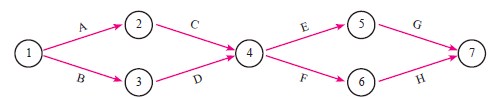
Develop a network based on the following information:
| Activity: | A | B | C | D | E | F | G | H |
| Immediate predecessor: | - | - | A | B | C, D | C, D | E | F |
44.
Evaluate: cos 20° + cos 100° + cos 140°
45.
Find the value of tan 15o
46.
Out of 7 consonants and 4 vowels, how many words of 3 consonants and 2 vowels can be formed?
47.
Find the values of each of the following trigonometric ratios. \(\tan { \left( { -855 }^{ o } \right) } \)
48.
Prove that \(2\tan^{-1}(x)=\sin^{-1}\left(\frac{2x}{1+x^2}\right)\)
49.
Find the minors and cofactors of all the elements of the following determinants \(\begin{vmatrix}5&20\\ 0&-1 \end{vmatrix}\)
50.
The technology matrix of an economic system of two industries is\(\begin{bmatrix} 0.6 & 0.9 \\ 0.20 & 0.80 \end{bmatrix}\). Test whether the system is viable as per Hawkins-Simon conditions.
1.
\(\underset { x\rightarrow a }{ lim } \cfrac { { x }^{ \frac { 3 }{ 5 } }-{ a }^{ \frac { 3 }{ 5 } } }{ { x }^{ \frac { 1 }{ 5 } }-{ a }^{ \frac { 1 }{ 5 } } } =\underset { x\rightarrow a }{ lim } \cfrac { { x }^{ \frac { 3 }{ 5 } }-{ a }^{ \frac { 3 }{ 5 } } }{ \frac { { x }^{ \frac { 4 }{ 5 } }-{ a }^{ \frac { 1 }{ 5 } } }{ x-a } } \)
= \(\cfrac { \frac { 3 }{ 5 } \left( a \right) ^{ -\frac { 2 }{ 5 } } }{ \frac { 1 }{ 5 } \left( a \right) ^{ -\frac { 4 }{ 5 } } } =3{ a }^{ \frac { -2 }{ 5 } +\frac { 4 }{ 5 } }=3a^{ \frac { 2 }{ 5 } }\)
2.
Let \({ \tan }^{ -1 }\left( \cfrac { 1 }{ 8 } \right) =\theta \)
Then \(\tan\theta =\cfrac { 1 }{ 8 } \)
\(\therefore \tan\left[ \cfrac { \pi }{ 4 } -{ \tan }^{ -1 }\left( \cfrac { 1 }{ 8 } \right) \right] =\tan\left( \cfrac { \pi }{ 4 } -\theta \right) \)
= \(\cfrac { \tan\frac { \pi }{ 4 } -\tan\theta }{ 1 + \tan\frac { \pi }{ 4 } \tan \theta } \)
= \(\cfrac { 1-\frac { 1 }{ 8 } }{ 1+\frac { 1 }{ 8 } } =\cfrac { 7 }{ 9 } \)
3.
\(\left( n+2 \right) { C }_{ n }=45\)
\(\left( n+2 \right) { C }_{ n+2-n }=45\)
\( \left( n+2 \right) { C }_{ 2 }=45\)
\(\cfrac { \left( n+2 \right) \left( n+1 \right) }{ 2 } =45\)
\({ n }^{ 2 }+3n-88=0\)
\(\left( n+11 \right) \left( n-8 \right) =0\)
\( n=-11,8\)
\(n=-11\) is not possible
\(\therefore n=8\)
4.
The given equation is \({ x }^{ 2 }+4xy+{ y }^{ 2 }=0\)
Here a = 1, b = 1 and h = 2
If \(\theta \) is the angle between the given straight lines, the
\(\theta ={ tan }^{ -1 }\left[ \left| \cfrac { 2\sqrt { { h }^{ 2 }-ab } }{ a+b } \right| \right] \)
\(={ \tan }^{ -1 }\left[ \left| \cfrac { 2+\sqrt { 4-1 } }{ 2 } \right| \right]\)
\(= { \tan }^{ -1 }\left( \sqrt { 3 } \right) \)
\(\theta =\cfrac { \pi }{ 3 } \)
5.
Given the lines are concurrent
Therefore \(\left| \begin{matrix} { a }_{ 1 } & { b }_{ 1 } & { c }_{ 1 } \\ { a }_{ 2 } & { b }_{ 2 } & { c }_{ 2 } \\ { a }_{ 3 } & { b }_{ 3 } & { c }_{ 3 } \end{matrix} \right| =0\)
\(\left| \begin{matrix} 3 & -5 & -11 \\ 5 & 3 & -7 \\ 1 & k & 0 \end{matrix} \right| =0\)
\(1(35+33)-k(-21+55)=0\)
\( \Rightarrow 34k=68\therefore k=2\)
6.
\(|A|=\left| \begin{matrix} -2 & 6 \\ 3 & -9 \end{matrix} \right| =0\)
Since A is a singular matrix, A -1 does not exist.
7.
(i) S = {1, 2, 3, 4, 5, 6}
n(S) = 6
(i) Let A be the event of getting a prime number
A = {2, 3, 5}
n(A) = 3
\(P(A)=\frac { 3 }{ 6 } =\frac { 1 }{ 2 } \)
(ii) Let B be the event that the number is greater than or equal to 3.
B = {3, 4, 5, 6}
n(B) = 4
\(P(B) =\frac { 4 }{ 6 } =\frac { 2 }{ 3 } \)
8.
Let us define the following events.
E1: X speaks truth
E2: X tells a lie
E: X reports a six
From the data given in the problem, we have
P(E1) = \(\frac{4}{5}\); P(E2) = \(\frac{1}{5}\);
P(E/E1) = \(\frac{1}{6}\); P(E/E2) = \(\frac{5}{6}\)
The required probability that actually there was six (by Bayes theorem) is
\(P(E_1/E)=\frac{P(E_1)P(E/E_2)}{P(E_1)P(E/E_1)+P(E_2)P(E/E_2)}\) = \(\frac{\frac{4}{5}\times \frac{1}{6}}{(\frac{4}{5}\times \frac{1}{6})+(\frac{1}{5}\times \frac{5}{6})}=\frac{4}{9}\)
9.
Let Investment in each stock be 120 x 135
At 7% stock
Investment = 120, Income = 7
Investment = 120 x 135
Income = \(\cfrac { 7\times120\times135 }{ 120 }=Rs.945\)
At 8% stock
Investment = 135, Income = 8
Investment = 120 x 135
Income =\(\cfrac { 8 \times 120 \times135 }{ 135 }=Rs.960\)
\(\therefore\) 8% of Rs.100 shares at Rs.135 is a better investment .
10.
Market value of one share = 25 - 7 = 18
Market value of 125 shares = 125 x 18
= Rs. 2250
11.
Face value = Rs. 100
Market value = Rs. (100 – 17 + 1) = Rs. 84
\(\therefore\) percentage of his income = \(\frac{(12\times 100)}{84}\)
= \(\frac{100}{7}=14\frac{2}{7}\)
\(\therefore\) % of Income = \(14\frac{2}{7}\%\)
12.
P = 4LK-L2+K2, L>0, k>0
\({\partial P\over \partial L}=4K-2L\)
\({\partial P\over \partial K}=4LK+2K\)
\(L{\partial P\over \partial L}+K{\partial P\over \partial K}=4KL-2L^2+4KL+2K^2\)
= 8KL-2L2+ 2K2 = 2(4LK-L2+ K2)
= 2p = RHS
Hence proved.
13.
Using the precedence relationships and following the rules of network construction, the required network is shown in following figure.
14.
At equilibrium, demand = Supply
\(\Rightarrow\) 100 - 2p = 3p - 50
\(\Rightarrow\) 150 = 5p
\(\Rightarrow\) p = 30
Equilibrium price is PE = 30
x = 100 - 2p
= 100 - 60 = 40
x = 40
\(\therefore\) Equilibrium quantity is xE = 40 units.
15.
Given \(\frac{d y}{d x}=2 x\)
\(y=x^3+10 x^2-48 x+8\)
\(\frac{d y}{d x}=3 x^2+20 x-48\)
\(2 x = 3x^2+20 x-48\)
\(3 x^2+18 x-48=0 \)
Dividing by 3 we get,
x2 + 6x - 16 = 0
\(\Rightarrow\)(x + 8)(x - 2) = 0
\(\Rightarrow\) x = -8,2
16.
x = 2p2 + 5
\({dx\over dp}=4p\)
Elasticity of supply \(\eta_s={p\over x}.{dx\over dp}\)
\(\eta_s={p\over 2p^2+5}(4p)={4p^2\over 2p^2+5}\)
when p = 3, \(\eta_s={36\over 18+5}\)\(={36\over23}\)
17.
5x2 + 5y2 +4x - 8y - 16 = 0
[Divide by 5]
x2 + y2 + \(\frac { 4 }{ 5 } x-\frac { 8 }{ 5 } y-\frac { 16 }{ 5 } =0\)
Here 2g = \(\frac { 4 }{ 5 } \) \(\Rightarrow\) \(g=+\frac { 2 }{ 5 } \)
2f = \(-\frac { 8 }{ 5 } \) \(\Rightarrow\) \(f=-\frac { 4 }{ 5 } \)
and c = \(-\frac { 16 }{ 5 } \)
Center of the circle is (-g, -f) \(\Rightarrow \) \(\left( -\frac { 2 }{ 5 } ,\frac { 4 }{ 5 } \right) \)
Radius of the circle is \(\sqrt { { g }^{ 2 }+{ f }^{ 2 }-c } \)
\(\Rightarrow\) r = \(\sqrt { \frac { 4 }{ 25 } +\frac { 16 }{ 25 } +\frac { 16 }{ 5 } } =\sqrt { \frac { 20 }{ 25 }+ { \frac { 16 }{ 5 }} } \)
\(\Rightarrow\) \(r=\sqrt { \frac { 20 }{ 5 } } \) = \(\sqrt { 4 } \) = 2 units
18.
f(x) = \(\frac { x+1 }{ x-1 } \)
\(\text { LHS }=f(f(x)) =f\left(\frac{x+1}{x-1}\right)=\frac{\frac{x+1}{x-1}+1}{\frac{x+1}{x-1}-1} \)
\(=\frac{x+1+x-1}{x+1-x+1}=\frac{2 x}{2}=x=R H S \)
19.
\(\left(x+\frac{1}{y}\right)^7 =7 C_0 x^7+7 C_1 x^6\left(\frac{1}{y}\right)+7 C_2 x^5\left(\frac{1}{y}\right)^2 +7 C_4 x^3\left(\frac{1}{y}\right)^4+7 C_5 x^2\left(\frac{1}{y}\right)^5 +7 C_6 x\left(\frac{1}{y}\right)^6+7 C_7\left(\frac{1}{y}\right)^7\)
\(=x^7+\frac{7 x^6}{y}+\frac{21 x^5}{y^2}+\frac{35 x^4}{y^3} +\frac{35 x^3}{y^4}+\frac{21 x^2}{y^5}+\frac{7 x}{y^6}+\frac{1}{y^7}\)
20.
n{S) = 1000
Let A be the event that the student selected is from XI std and B be the event that the selected student is a girl.
n(B) = 450
\(P(B)=\frac { 450 }{ 1000 } \)
n(A\(\cap \)B) = \(\frac { 20 }{ 100 } \times 450=90\)
P(A\(\cap \)B) \(=\frac { 90 }{ 1000 } \)
\(P(A/B)=\frac { P(A\cap B) }{ P(B) } =\frac { \frac { 90 }{ 1000 } }{ \frac {450 }{ 1000} } =\frac { 1 }{ 5 } =0.20\)
21.
u = xy+sin(xy)
\(\frac { \partial u }{ \partial x } \) = y+ycos(xy)
\(\frac { \partial u }{ \partial y } \) = x+x cos(xy)
\(\frac { \partial ^{ 2 }u }{ \partial y\partial y } =\frac { \partial }{ \partial x } \left( \frac { \partial u }{ \partial y } \right) \)
= 1 + x (−sin(xy) .y) + cos(xy)
= 1 – xy sin(xy) + cos(xy).... (1)
\(\frac { \partial ^{ 2 }u }{ \partial x\partial y } =\frac { \partial }{ \partial y } \) (y + cos(xy))
1+ cos(xy)+y (−sin(xy)x )
1−xy sin(xy)+ cos(xy) ... (2)
From (1) and (2), we get
\(\frac { \partial ^{ 2 }u }{ \partial x\partial y } =\frac { { \partial }^{ 2 }u }{ \partial y\partial x } \quad \)
22.
LHS = \(\begin{vmatrix} {1\over a}&bc&b+c\\{1\over b}&ca&c+a\\{1\over c}&ab&a+b \end{vmatrix}\)
Multiplying R1 by a, R2 by b, and R3 by c respectively and dividing the determinant by abc we get.
\(LHS={1\over abc}\begin{vmatrix} 1&abc&ab+ac\\1&abc&bc+ab\\{1}&abc&ac+bc \end{vmatrix}\)
\(={1\over abc}(abc)\begin{vmatrix} 1&1&ab+ac\\1&1&bc+ab\\{1}&1&ac+bc \end{vmatrix}\) = 0 \([\because C_1\equiv C_2]\) = RHS.
Hence proved.
23.
\(\frac { 1 }{ { x }^{ 2 }-1 } =\frac { 1 }{ (x+1)(x-1) } =\frac { A }{ x+1 } +\frac { B }{ x-1 } \)
⇒ \(\frac{1}{(x+1)(x-1)}=\frac{A(x-1)+B(x+1)}{(x+1)(x-1)}\)
⇒ 1 = A (x - 1) + B (x + 1) ...(1)
If x = -1 in (1) we get
1 = A(-2) + 0 ⇒ A = \(\frac { -1 }{ 2 } \)
If x = 1 in (1) we get,
1 = 0 + B(1 + 1) ⇒ 1 = 2B ⇒ B = \(\frac { 1 }{ 2 } \)
\(\frac{1}{x^2-1}=\frac{-1}{2(x+1)}+\frac{1}{2(x-1)}\).
24.
y = A sin x + B cos x
y1 = A cos x – B sin x
y2 = –A sin x –B cos x
y2 = –y
y2 + y = 0
25.
Differentiating y = x2 sin x with respect to x.
\(\cfrac { dy }{ dx } ={ x }^{ 2 }\cfrac { d }{ dx } \left( \sin x \right) +\sin x\cfrac { d }{ dx } \left( { x }^{ 2 } \right) \)
\(={ x }^{ 2 }\cos x+2x \sin x\)
\(=x\left( x \cos x+2\sin x \right) \)
26.
f(x) = 2x (Given)
\(\therefore \) f(x + y) = 2x+y
= 2x.2y
= f(x).f(y)
27.
The supply price relation is given by
\({ x }^{ 2 }=5p-15\)
= \(5(p-3)\)
\(\Rightarrow { X }^{ 2 }aP\) where X = x and \(P=p-3\)
\(\\ \therefore \) the supply curve is a parabola whose vertex is \(\left( X=0,\ P=0 \right) \)
i.e., The supply curve is a parabola whose vertex is (0, 3)
28.
Here \({ r }^{ 2 }=25\Rightarrow r=5\)
Parametric equations are \(x=rcos\theta ,y=rsin\theta \)
\(\Rightarrow x=5cos\theta ,y=5sin\theta ,0\le \theta \le 2\pi \)
29.
nP r= 360 = 36 \(\times\) 10
= 3 \(\times\) 3 \(\times\) 4 \(\times\) 5 \(\times\) 2
= 6 \(\times\) 5 \(\times\) 4 \(\times\) 3 = 6P4
Therefore n = 6 and r = 4
30.
\(\left| \begin{matrix} x & x+1 \\ x-1 & x \end{matrix} \right| \) = x2 - (x – 1)(x + 1)
= x2 – (x2 – 1)
= x2 – x2 + 1 = 1
31.
Let A, B be the events of getting a black ball in the first and second draw
Probability of drawing a black ball in the first attempt is
P(A) = \(\frac{3}{5+3}=\frac{3}{8}\)
Probability of drawing the second black ball given that the first ball drawn is black
P(B/A) = \(\frac{2}{5+2}=\frac{2}{7}\)
\(\therefore\) The probability that both balls drawn are black is given by
\(P\left( A\cap B \right) =P(A)P(B/A)=\frac { 3 }{ 8 } \times \frac { 2 }{ 7 } =\frac { 3 }{ 28 } \)
32.
We know that the sample space is S = {1,2,3,4,5,6}
Now, A = {3,6} ; B = { 2,4,6} then (A∩B) = {6}
P(A) = \(\frac { 2 }{ 6 } =\frac { 1 }{ 3 } \)
P(B) = \(\frac { 3 }{ 6 } =\frac { 1 }{ 2 } \) and P(A∩B) = \(\frac{1}{6}\)
Clearly P(A∩B) = P(A) P(B)
Hence A and B are independent events.
33.
S = {(1, 1) (1, 2) (1,3), ..... (6, 6)}
(2, 1), (2, 2) ...... (2, 6)
(6, 1), (6, 2) ..... (6, 6)}
n(S) = 36
Let B be the event that sum of numbers appearing is 6
B = {(1, 5), (2, 4), (3, 3), (4, 2), (5, 1)}
\(P(B)=\frac{5}{36}\)
Let A be the event that 4 has appeared atleast once
A = {(2, 4), (4, 2)}
\(A\cap B\) = {(2, 4),(4, 2)}
\(P(A\cap B)=\frac{2}{36}\)
\(P(A/B)=\frac { P(A\cap B) }{ P(B) } =\frac { 2/36 }{ 5/36 } =\frac { 2 }{ 5 } \)
34.
S {(G1, G2), (G1, B2), (B1, G2), (B1, B2)}
n(S) = 4
Let A be the event that both are girls
A= {(G1 G2)}
n(A) = 1
\(P(A)=\frac{1}{4}\)
Let B to the event that atleast one of the children is a girl.
B = {(G1 G2), (G1 B1), (G2 B2)}
\(P(B)=\frac{3}{4}\)
\( A\cap B=\{ ({ G }_{ 1 }{ G }_{ 2 })\}, P(A\cap B)=\frac{1}{4}\)
\(P(A / B)=\frac { P(A\cap B) }{ P(B) } =\frac{\frac{1}{4}}{\frac{3}{4}}=\frac { 1 }{ 3 } \)
35.
\(r =\frac{N \Sigma X Y-(\Sigma X)(\Sigma Y)}{\sqrt{N \Sigma X^2-(\Sigma X)^2} \sqrt{N \Sigma Y^2-(\Sigma Y)^2}} \)
\(=\frac{10(-115)-(50)(-30)}{\sqrt{10(290)-(50)^2} \sqrt{10(300)-(-30)^2}} \)
\(=\frac{-1150+1500}{\sqrt{400 \times 2100}}=\frac{350}{916.52}=0.382\)
36.
Let x be the number of shares.
Face value of ‘x’ shares = Rs. 25 x
Now \(\frac{10}{100}\times 25x=Rs. 2,000\)
\(\Rightarrow x=\frac{2000\times 100}{25\times 10}=800\)
Hence the number of shares = 800
37.
a = 50, i = \(\frac{5}{100}\) = .05
A = \(\cfrac { a }{ i } =\cfrac { 50 }{ 0.05 } \) Rs.1000
38.
Here n = 11 observations are arranged into ascending order
2, 4, 6, 8, 10, 12, 14, 16, 18, 20, 22
D2 = size of 2 \(\left( \frac { n+1 }{ 10 } \right) \)th value
D6 = size of 6 \(\left( \frac { n+1 }{ 10 } \right) \)th value
D2 = size of 2.4th value ≈ size of 2nd value = 4
D6 = size of 7.2th value ≈ size of 7th value = 14
39.
Given Σxy = 120, Σx2 = 90, Σy2 = 640
Then r = \(\frac { \Sigma xy }{ \sqrt { \Sigma { x }^{ 2 }\Sigma { y }^{ 2 } } } =\frac { 120 }{ \sqrt { 90(640) } } =\frac { 120 }{ \sqrt { 57600 } } =\frac { 120 }{ 240 } \) = 0.5
40.
41.
42.
Using the immediate precedence relationships and following the rules of network construction the required network is shown in the following figure
43.
Using the immediate precedence relationships and following the rules of network construction, the required network is shown in following figure.
44.
\(\cos 20^{\circ}+\cos 100^{\circ}+\cos 140^{\circ}\)
\(\cos 20^{\circ}+\left(\cos 100^{\circ}+\cos 140^{\circ}\right) =\cos 20^{\circ}+2 \cos \left(\frac{100^{\circ}+140^{\circ}}{2}\right) \cos \left(\frac{100^{\circ}-140^{\circ}}{2}\right) \)
\(=\cos 20^{\circ}+2 \cos 120^{\circ} \cos \left(-20^{\circ}\right)\)
\(=\cos 20^{\circ}+2 \cos \left(180^{\circ}-60\right) \cos 20^{\circ}\)
\(=\cos 20^{\circ}-2 \cos 60^{\circ} \cos 20^{\circ}\)
\(=\cos 20^{\circ}-2\left(\frac{1}{2}\right) \cos 20^{\circ}\)
\(=\cos 20^{\circ}-\cos 20^{\circ}=0\)
45.
\(\tan 15^o=\tan(45^o-30^o)\)
\(=\frac{\tan 45^{\circ}-\tan 30^{\circ}}{1+\tan 45^{\circ} \tan 30^{\circ}}=\frac{1-\frac{1}{\sqrt{3}}}{1+\frac{1}{\sqrt{3}}} \)
\(=\frac{\sqrt{3}-1}{\sqrt{3}+1} \times \frac{\sqrt{3}-1}{\sqrt{3}-1}=\frac{(\sqrt{3}-1)^2}{(\sqrt{3})^2-1^2} \)
\(=\frac{3-2 \sqrt{3}+1}{3-1}=\frac{4-2 \sqrt{3}}{2}=\frac{2(2-\sqrt{3})}{2} =2-\sqrt{3}\)
46.
Number of words \(=7 C_3 \times 4 C_2 \times 5 !\)
\(=\frac{7 \times 6 \times 5}{3 \times 2 \times 1} \times \frac{4 \times 3}{2 \times 1} \times 120\)
\(=25200\)
Since out of 7 consonants and 4 vowels 3 consonants and 2 vowels can be chosen in \(7 C_3 \times 4 C_2 \text { ways }\)
Thus there are \(7 C_3 \times 4 C_2\) each containing 3 consonants and 2 vowels. Since each group contains 5 letters which can be arranged among themselves in 5! ways.
47.
\(\tan \left(-855^{\circ}\right)=-\tan 855^{\circ}\)
\(=-\tan \left(2 \times 360^{\circ}+135^{\circ}\right)\)
\(=-\tan 135^{\circ}\)
\(=-\tan \left(180^{\circ}-45^{\circ}\right)(\text { II quad })\)
\(=\tan 45^{\circ}=1\)
48.
\(\mathrm{RHS}=\sin ^{-1}\left(\frac{2 x}{1+x^2}\right)\)
Let \(x=\tan \theta \Rightarrow \theta=\tan ^{-1} x\)
\(=\sin ^{-1}\left(\frac{2 \tan \theta}{1+\tan ^2 \theta}\right)=\sin ^{-1}(\sin 2 \theta)\)
\(=2 \theta=2 \tan ^{-1} x=\text { LHS }\)
Hence proved.
49.
Let A = \(\begin{vmatrix}5&20\\ 0&-1 \end{vmatrix}\)
Minor of 5 = M11 = -1
Minor of 20 = M12 = 0
Minor of 0 = M21 = 20
Minor of -1 = M22 = 5
Co-factor of 5 = A11 = -1
Co-factor of 20 = A12 = 0
Co-factor of 0 = A21 = -20
Co-factor of -1 = A22 = 5
50.
B = \(\begin{bmatrix} 0.6 & 0.9 \\ 0.20 & 0.80 \end{bmatrix}\)
I - B = \(\begin{bmatrix} 1 & 0 \\ 0 & 1 \end{bmatrix}-\begin{bmatrix} 0.6 & 0.9 \\ 0.20 & 0.80 \end{bmatrix}=\begin{bmatrix} 0.4 & -0.9 \\ -0.20 & 0.20 \end{bmatrix}\)
|I - B| =\(\begin{bmatrix} 0.4 & -0.9 \\ -0.20 & 0.20 \end{bmatrix}\)
= 0.08 - 0.18 = - 0.1 < 0
Since |I - B| is negative, Hawkins-Simon conditions are not satisfied.
Therefore the given system is not viable.

11th Standard Syllabus & Materials
11th Standard
TN 11th Tamil பீடு பெற நில் - செய்யுள் - காவடிச்சிந்து Important Questions And Answers Study Material - QB365 Set A
NEW11th Standard
TN 11th Tamil பீடு பெற நில் - உரைநடை - மலை இடப்பெயர்கள் : ஓர் ஆய்வு Important Questions And Answers Study Material - QB365 Set A
NEW11th Standard
TN 11th Tamil மாமழை போற்றுதும் - துணைப்பாடம் - யானை டாக்டர் Important Questions And Answers Study Material - QB365 Set A
NEW11th Standard
TN 11th Tamil மாமழை போற்றுதும் - செய்யுள் - ஐங்குறுநூறு Important Questions And Answers Study Material - QB365 Set A



Tamilnadu Stateboard 11th Standard Subjects

Maths

Commerce

Economics

Biology
Business Maths and Statistics

Accountancy

Computer Science

Physics

Chemistry
Maths
Biology
Economics
Physics
Chemistry

History
Business Maths and Statistics

Computer Science
Accountancy

Computer Applications
History
Computer Technology
Commerce
Computer Applications
Computer Technology

Tamil

English

French
Tamilnadu Stateboard Standards

