
 100% FREE ACCESS
11th Standard Syllabus & Materials
11th Standard
TN 11th Tamil இயற்கை வேளாண்மை,சுற்றுச்சூழல் -செய்யுள் - மனோன்மணீயம் Important Questions And Answers Study Material - QB365 Set A
NEW11th Standard
TN 11th Tamil என்னுயிர் என்பேன் -துணைப்பாடம் - இசைத்தமிழர் இருவர் Important Questions And Answers Study Material - QB365 Set A
NEW11th Standard
TN 11th Tamil மொழி கலை -செய்யுள் - ஒவ்வொரு புல்லையும் Important Questions And Answers Study Material - QB365 Set A
NEW11th Standard
TN 11th Tamil பீடு பெற நில் - இலக்கணம் - பகுபத உறுப்புகள் Important Questions And Answers Study Material - QB365 Set A
NEW11th Standard
TN 11th Tamil பீடு பெற நில் - துணைப்பாடம் - வாடிவாசல் Important Questions And Answers Study Material - QB365 Set A
NEW11th Standard
TN 11th Tamil பீடு பெற நில் - செய்யுள் - குறுந்தொகை Important Questions And Answers Study Material - QB365 Set A

Published on: 18/07/2019
Download Tamil Nadu 11th Standard Maths question papers, model tests, one-mark questions, important questions, and public exam papers in PDF format. Free study materials and answer keys for TN State Board students.
Questions + Answers key
Take MCQ Maths Test1.
If A = {1, 2, 3, 4} and B = {3, 4, 5, 6}, find \(n((A\cup B)\times(A\cap B)\times(A \triangle B))\)
2.
Solve the equation \(\frac { x+2 }{ x+3 } =\frac { x+4 }{ 2x+3 } \)
3.
Prove that the relation "friendship" is not an equivalence relation on the set of all people in Chennai.
4.
If A\(\times\) A has 16 elements, S = {(a, b) \(\in \) A\(\times\) A:a < b}; (−1, 2) and (0, 1) are two elements of S, then find the remaining elements of S.
5.
Find the radius of the spherical tank whose volume is \(\frac { 32\pi }{ 3 } \) units
6.
Write the set {-1, 1} in set builder form.
7.
Evaluate \(\left( \left[ (256)^{ \frac { -1 }{ 2 } } \right] ^{ \frac { -1 }{ 4 } } \right) ^{ 3 }\)
8.
Solve \(\frac { x-2 }{ x+4 } \ge \frac { 5 }{ x+3 } \)
9.
If \(f:R\rightarrow R\) is defined by f(x) = 2x- 3, prove that f is a bijection and find its inverse
10.
Find all values of x for which \({{x^3(x-1)}\over{x-2}}>0.\)
11.
Factorize: x4 + 1
12.
A manufacturer has 600 litres of a 12 percent solution of acid. How many litres of a 30 percent acid solution must be added to it so that the acid content in the resulting mixture will be more than 15 percent but less than 18 percent?
13.
Solve: \(\frac { 1 }{ 5 } \left| 10x-2 \right| <1\)
14.
A salesperson whose annual earnings can be represented by the function A(x) = 30,000 + 0.04x, where x is the rupee value of the merchandise he sells. His son also in sales and his earnings are represented by the function S(x) = 25,000 + 0.05x. Find (A+S) (x) and determine the total family income if they each sell Rs. 1,50,00,000 worth of merchandise.
15.
Resolve into partial fractions: \(\frac{x}{(x+3)(x-4)}\)
16.
If A = {x : x = 3n, n ∈ Z} and B = {x : x = 4n, n ∈ Z} then find A ∩ B.
17.
Find the domain of \(\frac { 1 }{ 1-2sinx } \)
18.
Prove \(log\frac { { a }^{ 2 } }{ bc } +log\frac { b^{ 2 } }{ ca } +log\frac { c^{ 2 } }{ ab } =0\)
19.
If a2+b2 = 7ab. Show that log \(\ \frac { a+b }{ 3 } =\frac { 1 }{ 2 } \) (log a + log b)
20.
Solve the quadratic equation 52x- 5x + 3+ 125 = 5x.
21.
The formula for converting from Fahrenheit to Celsius temperatures is \(y={5x\over 9}-{160\over 9}\). Find the inverse of this function and determine whether the inverse is also a function.
22.
The number of roots of (x + 3)4+ (x + 5)4 = 16 is
4
2
3
0
23.
The value of \({ log }_{ \sqrt { 2 } }512\) is
16
18
9
12
24.
If n((A \(\times\) B) ∩(A \(\times\) C)) = 8 and n(B ∩ C) = 2, then n(A) is
6
4
8
16
25.
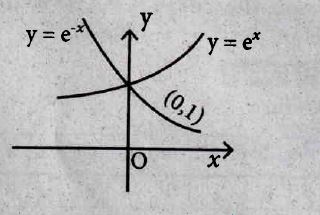
If A = {(x,y) : y = ex, x∈R} and B = {(x,y) : y = e-x, x ∈ R} then n(A∩B) is
Infinity
0
1
2
26.
The function f:[0,2π]➝[-1,1] defined by f(x) = sin x is
one-to-one
onto
bijection
cannot be defined
1.
We have \(n(A \cup B)=6,n(A\cap B)=2\) and \(n(A \triangle B)=4.\)
So, \(n((A\cup B)\times(A\cap B)\times(A \triangle B))=n(A \cup B)\times n(A\cap B)\times n(A\triangle B)= 6 \times 2 \times 4 = 48.\)
2.
Given \(\frac { x+2 }{ x+3 } =\frac { x+4 }{ 2x+3 } \)
⇒ (x + 2)(2x + 3) = (x + 4) (x + 3)
⇒ 2x2 + 3x + 4x + 6 = x2 + 3x + 4x +12

⇒ x2 = 6
⇒ x = ± \(\sqrt { 6 } \)
The roots are \(\sqrt { 6 } \) and -\(\sqrt { 6 } \)
3.
Let a, b, c are people in Chennai
Reflexivity: "a" is a friend of "a" \(\Rightarrow\) a R a \(\Rightarrow\) R is not reflexive.
Symmetric: a is friend of b \(\Rightarrow\) b is the friend of a.
\(\therefore\) aRb \(\Rightarrow\) bRa \(\Rightarrow\) R is symmetric
Transitive: a is the friend of b and b is the friend of c \(\Rightarrow\) a need not be the friend of c.
\(\therefore\) aRb \(\Rightarrow\) bRc \(\neq \) aRc \(\Rightarrow\) R is not transitive
Hence, the relation "friendship" is not equivalent.
4.
n(A\(\times\) A) = 16. \(\Rightarrow\) n(A) = 4
Given S = {a,b) \(\in \) A\(\times\)A : a
\(\therefore\) A = {0, 1, 2, -1}
(A\(\times\)A) = {(0, 0)(0, 1)(0, 2)(0, -1),(1, 1) (1, 2)(1, -1)(2, 0)(2, 1)(2, 2)(2, -1)(-1, 0)(-1, 1)(-1, 2)(-1, -1)}
Now, S = {(0, 1)(0, 2)(-1, 0)(-1, 1)(-1, 2)}
\(\therefore\) The remaining elements of S are (0, 2)(-1, 0)(-1, 1)(1, 2)(0, 1) (1, 2)(0, 2)
5.
Let r be the radius of the spherical tank
Then, Volume of the spherical tank = \(\frac { 32\pi }{ 3 } \)
⇒ \(\frac { 4 }{ 3 } { \pi r }^{ 3 }=\frac { 32\pi }{ 3 } \)
⇒ 4r3 = 32
⇒ r3 = \(\frac { 32 }{ 4 } \) = 8
⇒ r3 = 23
⇒ r = 2
∴ Radius of the spherical tank is 2 unit
6.
Let p = {-1, 1}
\(\Rightarrow\) P = {x \(\in \) R : x is a root of the equation x2-1 = 0}
7.
\(\left( \left[ (256)^{ \frac { -1 }{ 2 } } \right] ^{ \frac { -1 }{ 4 } } \right) ^{ 3 }\) = \((256)^{ \frac { -1 }{ 2 } \times \frac { -1 }{ 4 } \times 3 }\) \([\because \frac { { a }^{ m } }{ { a }^{ n } } ={ a }^{ m-n }]\)
= \((256)^{ \frac { 3 }{ 8 } }=({ 2 }^{ 8 })^{ \frac { 3 }{ 8 } }={ 2 }^{ 8\times \frac { 3 }{ 8 } }={ 2 }^{ 3 }=8\)
8.
\(\frac { (x-2) }{ (x+4) } -\frac { 5 }{ x+3 } \ge 0\)
\(\frac { (x-2)(x+3)-5(x+4) }{ (x+4)(x+3) } \ge 0\)
\(\frac { { x }^{ 2 }+x-6-5x-20 }{ (x+4)(x+3) } \ge 0\)
(i.e)\(\frac { { x }^{ 2 }-4x-26 }{ (x+4)(x+3) } \ge 0\)
x+4 = 0 ⇒ x = -4 ; x + 3 = 0 ⇒ x = -3
Plotting the points -4, -3 on number line and taking limits \((-∞,-4)(-4,-3),(-3,∞)\)

| Intervals | x2-4x-26 | (x+4) | (x+3) | \(\frac { { x }^{ 2 }-4x-26 }{ (x+4)(x+3) } \) |
| (-∞, 0) say x = -5 | + | - | - | \(\frac { x }{ (-)(-) } -ve\) |
| (-4, -3) say x = -3.5 | + | - | - | \(\frac { x }{ (-)(-) } +ve\) |
| (-3, ∞) | - | + | + | -ve |
The solution for the inequality\(\frac { x-2 }{ x+4 } \ge \frac { 5 }{ x+3 } \)are the intervals \((-∞,-4)\) and (-4, -3)
9.
Method 1:
One-to-one: Let f(x) = f(y). Then 2x - 3 = 2y - 3; this implies that x = y. That is, f(x) = f(y) implies that x = y. Thus f is one-to-one.
Onto: Let y \(\in\) R. Let x \(={y+3 \over 2}.\) Then \(f(x)=2\left( {y+3\over2} \right)-3=y.\) Thus f is onto. This also can be proved by saying the following statement. The range of f is R (how?) which is equal to the co-domain and hence f is onto.
Inverse: Let y = 2x - 3. Then y + 3 = 2x and hence \(x={y+3\over 2}.\) Thus \({f}^{-1}(y)={y+3\over2}\). By replacing y as x, we get \({f}^{-1}(x)={x+3\over 2}.\)
Method 2:
Let y = 2x − 3. Then \(x=\frac{y+3}{2}\). Let \(g(y)=\frac{y+3}{2}\)
Now
\((g \circ f)(x)=g(f(x))=g(2 x-3)=\frac{(2 x-3)+3}{2}=x .\)
\((f \circ g)(y)=f(g(y))=f\left(\frac{y+3}{2}\right)=2\left(\frac{y+3}{2}\right)-3=y\)
Thus, \(g \circ f=I_{X} \text { and } f \circ g=I_{Y}\)
This implies that f and g are bijections and inverses to each other. Hence f is a bijection and \(f^{-1}(y)=\frac{y+3}{2}\). Replacing y by x we get \(f^{-1}(x)=\frac{x+3}{2}\)
10.
Given inequality is \({x^3(x-1)\over x-2}>0\)
The critical numbers are 0, 1, 2
The possible intervals are (-∞, 0) (0, 1) (1, 2) (2, ∞)

| Intervals | Sign of x3 | Sign of (x - 1) | Sign of (x - 2) | Sign of \({x^3(x-1)\over x-2}\) |
|---|---|---|---|---|
| (- ∞, 0) Say x = -1 | - | - | - | - |
| (0, 1) Say x = \(\frac{1}{2}\) | + | - | - | + |
| \((1,2)={1\over 2}\) Say x = 1 | + | + | - | - |
| (2, ∞) Say x = 3 | + | + | + | + |
The given inequality \({x^2(x-1)\over x-2}>0\) is satisfied by the intervals (0, 1) and (2, ∞)
∴ Solution set is (0, 1)∪(2, ∞)
∴ Solution set is \((0,1)\bigcup(2, \infty)\)
11.
Given equation is x4+ 1
x4+1 = (x2)2+12 [ \(\because\) a2 + b2 = (a + b)2-2b where a = x2, b = 1 ]
= (x2 + 1)2- 2x2(1)
= (x2 + 1)2-\((-\sqrt{2}x)^2\)
= (x2 + 1 + \(\sqrt{2}\) x) (x2+ 1 -\(\sqrt{2}\)x) [ \(\because\) a2- b2 = (a + b) (a - b)]
12.
Let x be the number of litres of 30% acid solution
∴ Total mixture = (600 + x) litres
30% of x + 12% of 600 > 5% of (600 + x)
\(⇒\ {30x\over 100}+{12\over 100}\times600>{15\over 100}(600+x)\)
⇒30x + 7200 > 9000 + 15x [Multiplying by 100]
⇒ 30x + 7200 - 15x > 9000 [Subtracting 15x]
⇒ 15x + 7200 > 900
⇒ 15x > 1800
⇒ x > 120 ....(1)
Also, 30% of x + 12% of 600 < \(18\over 100\)(600 + x)
\({30x\over 100}+{12\over 100}\times600<{18\over 100}(600 +x)\)
⇒ 30x + 7200 < 18 (600 + x) [Multiplying by 100]
⇒ 30x + 7200 < 10, 800 + 18x
⇒ 12x + 7200 < 10, 800 [Subtracting 18x]
⇒ 12x < 10, 800 - 7200 [Subtracting 7200]
⇒ 2x < 3600
⇒ \(x<{3600\over12}\)
⇒ x < 300 ....(2)
From (1) and (2), 120 < x < 300
The number of litres of the 30% acid solution will have to be greater than 120 litres and less than 300 litres.
13.
Given inequality is \({1\over 5}|10x-2|<1\)
⇒ |10x - 2| < 5
This means, -5 < 10x - 2 < 5.
⇒ -5 + 2 < 10x < 5 + 2
⇒ -3 < 10x <7
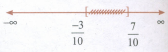
\(⇒\ -{3\over 10}< x < {7\over 10}\)
∴Solution set is \(\left[ \frac { -3 }{ 10 } ,\frac { 7 }{ 10 } \right] \)
14.
Given A(x) = 30,000 + 0.04x
S(x) = 25,000 + 0.05x
∴ (A + S)(x) = 30,000 + 0.04x + 25,000 + 0.05x
= 55,000+0.09x
Given x = Rs. 1,50,00,000
Then (A+S)(x) = 55000 + 0.09(1,50,00,000)
= 55000 + 1,350,000
= 1,405,000
Hence total family income = Rs. 14,05,000
15.
Let \(\frac{x}{(x+3)(x-4)}=\frac{A}{x+3}+\frac{B}{x-4}\) where A and B are constants.
Then, \(\frac{x}{(x+3)(x-4)}=\frac{A(x-4)+B(x+3)}{(x+3)(x-4)}\) which gives x = A(x - 4) + B(x + 3)
When x = 4, we have B = \(\frac{4}{7}\)
When x = -3 we have A = \(\frac{3}{7}\)
Hence, \(\frac{x}{(x+3)(x-4)}=\frac{3}{7(x+3)}+\frac{4}{7(x-4)}\)
16.
Clearly x ∈ A ∩ B
⇒ x ∈ A and x ∈ B
⇒ x = 3n and x = 4n, n ∈ Z
⇒ x is a multiple of 3 and x is a multiple of 4
⇒ x is a multiple of 3 and 4 both
⇒ x is a multiple of 12
⇒ x = 12n, n ∈ Z
Hence A ∩ B= {x : x = 12n, n∈Z}
17.
Let f(x) = \(\frac { 1 }{ 1-2sinx } \)
When the denominator is 0,
1-2 sin x = 0
\(\Rightarrow\) 1 = 2 sin x
\(\Rightarrow sin\quad x=\frac { 1 }{ 2 } \)
\(\Rightarrow sin\quad x=sin\frac { \pi }{ 6 } \)
\(\Rightarrow x=n\pi +{ (-1) }^{ n }\frac { \pi }{ 6 } n\in Z\) \(\left[ \because sin\quad x=sin\alpha \Rightarrow x=n\pi +{ (-1) }^{ n }\alpha \quad n\in Z \right] \)
Domain of f(x) is R - \(\left( n\pi +{ (-1) }^{ n }\frac { \pi }{ 6 } \right) ,n\in Z\)
18.
LHS = \(log\frac { { a }^{ 2 } }{ bc } +log\frac { b^{ 2 } }{ ca } +log\frac { c^{ 2 } }{ ab } \)
= \(log\left( \frac { { a }^{ 2 } }{ bc } .\frac { b^{ 2 } }{ ca } .\frac { c^{ 2 } }{ ab } \right) \)
= \(log\left( \frac { { a }^{ 2 }b^{ 2 }c^{ 2 } }{ { a }^{ 2 }b^{ 2 }c^{ 2 } } \right) \)
= log 1 = 0 =RHS
Hence proved
19.
Given a2+ b2 = 7ab
Adding 2ab both sides we get,
a2+b2+2ab = 7ab + 2ab
⇒ (a+b)2 = 9ab
⇒ \(\frac { (a+b)^{ 2 } }{ 9 } \) = ab
⇒ \(\left( \frac { a+b^{ 2 } }{ 9 } \right) ^{ 2 }\) = ab
Taking square root,we get
\(\frac { a+b }{ 3 } \) = ab
\(log\left( \frac { a+b }{ 3 } \right) =log(ab)^{ \frac { 1 }{ 2 } }\)
= \(\frac { 1 }{ 2 } \) log (ab)
log \(\left( \frac { a+b }{ 3 } \right) \) = \(\frac { 1 }{ 2 } \) [log a + log b]
Hence proved.
20.
Given quadratic equation is
52x-5x+3 + 125 = 5x
\(\Rightarrow\) (5x)2-5x 53- 5x + 125 = 0
\(\Rightarrow\) (5x)2-125 5x- 5x + 125 = 0
\(\Rightarrow\) (5x)2-126.5x+125=0
Let 5x=y
\(\Rightarrow\)y2-126y + 125 = 0
\(\Rightarrow\)(y-1)(y-125) = 0
\(\Rightarrow\) y = 1 or 125
\(\Rightarrow\) 5x = 1 or 125
Case (i) When 5x = 1 \(\Rightarrow\) 50 \(\Rightarrow\) x = 0
Case (ii) When 5x = 125 \(\Rightarrow\) 5x = 53\(\Rightarrow\) x = 3
\(\therefore\) The roots are 0, 3.
21.
Let \(f(x)={5x-160\over 9}\)
Given \(y={5x\over 9}-{160\over 9}\)
\(⇒\ \ y={5x-160\over 9}\)
Then 9y = 5x - 160 ⇒ 5x = 9y + 160 ⇒ \(x={9y+160\over5}\)
Let \(g(y)={9y+160\over 5}\)
Now gof(x) = \(g[f(x)=g\left(5x-160\over 6\right)\)
\(={9\left(5x-160\over 9\right)+160\over 5}={5x-160+160\over 5}={5x\over 5}=x\)
and fog(y) = f(g(y)) =\(f\left(9y+160\over 5\right)={5\left(9y+160\over5\right)-160\over 5}={9y+160-160\over 9}=y\)
Thus gof = Ix and fog = Iy
This implies that f and g are bijections and inverses to each other
\(f^{-1}(y)={9y+160\over5}\)
Replacing y by x, we get f-1 (x) = \(\frac { 9x+160 }{ 5 } \)
22.
(a)
4
23.
\(\text { Let } \log _{\sqrt{2}} 512=x\)
\(\text { Then }(\sqrt{2})^{x}=2^{9}\)
\(\Rightarrow 2^{\frac{x}{2}}=2^{9} \Rightarrow x / 2=9 \Rightarrow x=18\)
24.
\((A \times B) \cap(A \times C) =A \times(B \cap C) \)
\(n[(A \times B) \cap(A \times C)] =n(A) \times n(B \cap C) \)
\(\Rightarrow 8 =n(A) \times 2 \Rightarrow n(A)=4 \)
25.
\(n(A \cap B)=1\)
26.
It is onto not one-one
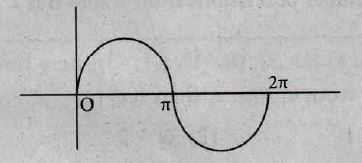
\(\text { Since } \sin 30^{\circ}=\frac{1}{2}\)
\(\sin 150^{\circ}=\frac{1}{2}\)

11th Standard Syllabus & Materials
11th Standard
TN 11th Tamil பீடு பெற நில் - செய்யுள் - காவடிச்சிந்து Important Questions And Answers Study Material - QB365 Set A
NEW11th Standard
TN 11th Tamil பீடு பெற நில் - உரைநடை - மலை இடப்பெயர்கள் : ஓர் ஆய்வு Important Questions And Answers Study Material - QB365 Set A
NEW11th Standard
TN 11th Tamil மாமழை போற்றுதும் - துணைப்பாடம் - யானை டாக்டர் Important Questions And Answers Study Material - QB365 Set A
NEW11th Standard
TN 11th Tamil மாமழை போற்றுதும் - செய்யுள் - ஐங்குறுநூறு Important Questions And Answers Study Material - QB365 Set A



Tamilnadu Stateboard 11th Standard Subjects
Maths

Commerce

Economics

Biology

Business Maths and Statistics

Accountancy

Computer Science

Physics

Chemistry
Maths
Biology
Economics
Physics
Chemistry

History
Business Maths and Statistics

Computer Science
Accountancy

Computer Applications
History
Computer Technology
Commerce
Computer Applications
Computer Technology

Tamil

English

French
Tamilnadu Stateboard Standards

