
 100% FREE ACCESS
11th Standard Syllabus & Materials
11th Standard
TN 11th Tamil இயற்கை வேளாண்மை,சுற்றுச்சூழல் -செய்யுள் - மனோன்மணீயம் Important Questions And Answers Study Material - QB365 Set A
NEW11th Standard
TN 11th Tamil என்னுயிர் என்பேன் -துணைப்பாடம் - இசைத்தமிழர் இருவர் Important Questions And Answers Study Material - QB365 Set A
NEW11th Standard
TN 11th Tamil மொழி கலை -செய்யுள் - ஒவ்வொரு புல்லையும் Important Questions And Answers Study Material - QB365 Set A
NEW11th Standard
TN 11th Tamil பீடு பெற நில் - இலக்கணம் - பகுபத உறுப்புகள் Important Questions And Answers Study Material - QB365 Set A
NEW11th Standard
TN 11th Tamil பீடு பெற நில் - துணைப்பாடம் - வாடிவாசல் Important Questions And Answers Study Material - QB365 Set A
NEW11th Standard
TN 11th Tamil பீடு பெற நில் - செய்யுள் - குறுந்தொகை Important Questions And Answers Study Material - QB365 Set A

Published on: 27/04/2019
Frequently asked five mark questions Basic Concepts of Chemistry and Chemical Calculations
Download Tamil Nadu 11th Standard Chemistry question papers, model tests, one-mark questions, important questions, and public exam papers in PDF format. Free study materials and answer keys for TN State Board students.
Questions + Answers key
Take MCQ Chemistry Test
1.
\({ 2NH }_{ 3 }\left( g \right) +{ CO }_{ 2 }\left( g \right) \rightarrow \underset{Urea}{H_2N}-\overset { \underset { || }{ O } }{ C } -{ NH }_{ 2 }\left( aq \right) +{ H }_{ 2 }O(I)\)
In a process, 646 g of ammonia is allowed to react with 1.144 kg of CO2 to form urea.
(i) If the entire quantity of all the reactants is not consumed in the reaction which is the limiting reagent ?
(ii) Calculate the quantity of urea formed and unreacted quantity of the excess reagent. The balanced equation is
\(\overset { { 2NH }_{ 3 }+{ CO }_{ 2 } }{ \underset { { H }_{ 2 }NCON{ H }_{ 2 }+{ H }_{ 2 }O }{ \downarrow } } \)
2.
Chlorine is used to purify drinking water. Excess of chlorine is harmful. The excess chlorine is removed by treating with sulphur dioxide. Present a balanced equation for the reaction for this redox change taking place in water.
3.
The Mn3+ ion is unstable in solution and undergoes disproportionation to give Mn2+, MnO2 and H+ ion. Write a balanced ionic equation for the reaction.
4.
(a) Formulate possible compounds of 'CI' in its oxidation state is: 0, -1, +1, +3, +5, +7
(b) H2O2 act as an oxidising agent as well as reducing agent where as O3 act as only oxidizing agent. Prove it.
5.
A flask A contains 0.5 mole of oxygen gas. Another flask B contains 0.4 mole of ozone gas. Which of the two flasks contains greater number of oxygen atoms.
6.
Write balanced equation for the oxidation of Ferrous ions to Ferric ions by permanganate ions in acid solution. The permanganate ion forms Mn2+ ions under these conditions.
7.
Balancing of the molecular equation in alkaline medium.
MnO2 + O2 + KOH\(\rightarrow\)K2MnO4 + H2O
8.
Balance the following equation by oxidation number method.
KMnO4 + FeSO4 + H2SO4 \(\rightarrow\)K2SO4 + MnSO4 + Fe2(SO4)3 + H2O
9.
Define the following
(a) equivalent mass of an acid
(b) equivalent mass of a base
(c) equivalent mass of an oxidising agent
(d) equivalent mass of a reducing agent.
10.
Explain the steps involved in ion-electron method for balancing redox reaction.
11.
Balance the following equation by oxidation number method.
KMnO4 + HCI \(\rightarrow\) KCl + MnCl2 + H2O + Cl2
12.
Balance the following equation by oxidation number method.
C6H6 + O2\(\rightarrow\)CO2 + H2O
13.
(a) Define oxidation number.
(b) What are the rules used to assign oxidation number ?
14.
Urea is prepared by the reaction between ammonia and carbon dioxide.
2NH3(g) + CO2(g) → (NH4)2CO(ag) + H2O(I)
In one process, 637.2 g of NH3 are allowed to react with 1142 g of CO2
(a) Which of the two reactants is the limiting reagent?
(b) Calculate the mass of (NH4)2CO formed.
(c) How much of the excess reagent in grams is left at the end of the reaction?
15.
Calculate the percentage composition of the elements present in magnesium carbonate. How many Kg of CO2 can be obtained from 100 Kg of is 90% pure magnesium carbonate.
16.
An insecticide has the following percentage composition by mass: 47.5% C, 2.54% H, and 50.0% Cl. Determine its empirical formula and molecular formulae. Molar mass of the substance is 354.5g mol-1
17.
A laboratory analysis of an organic compound gives the following mass percentage composition: C = 60%, H = 4.48% and remaining oxygen.
18.
A compound on analysis gave the following percentage composition: C = 24.47%, H = 4.07 %, CI = 71.65%. Find out its empirical formula.
19.
(a) Define equivalent mass of an reducing agent.
(b) How would you determine the equivalent mass of Ferrous sulphate?
20.
(a) Define equivalent mass of an oxidising agent.
(b) How would you calculate the equivalent mass of potassium permanganate?
21.
Balance the following equation by ion-electron method In acidic medium.
\(Cr{(OH)}_4^-+H_2O_2\rightarrow Cr{O}_4^{2-}\)
22.
Balance the following equation by ion-electron method In acidic medium.
\(Mn{O}_4^-+Fe^{2+}\rightarrow Mn^{2+}+Fe^{3+}\)
23.
Balance the following equation by ion-electron method In acidic medium.
\(Mn{O}_4^-+I^-\rightarrow MnO_2+I_2\)
1.
(i) The entire quantity of ammonia is consumed in the reaction. So ammonia is the Iimiting reagent. Some quantity of CO2 remains unreacted, so CO2 is the excess reagent.
(ii) Quantity of urea formed = number of moles of urea formed x molar mass of urea
= 19 moles x 60 g mol-1
= 1140 g = 1.14 kg
Excess reagent leftover at the end of the reaction is carbon dioxide.
Amount of carbon dioxide leftover
= number of moles of CO2 left over x molar mass of CO2
= 7 moles x 44 g mol-1
= 308 g
| Reactants | Products | |||
| NH3 | CO2 | Urea | H2O | |
| Stoichiometric coefficients | 2 | 1 | 1 | 1 |
| Number of moles of reactants allowed to react \(N=\frac { Mass }{ Molar\quad mass } \) | \(\frac { 646 }{ 17 } =38\) moles | \(\frac { 1144 }{ 44 } =26\)moles | - | - |
| Actual number of moles consumed during reaction Ratio (2:1) | 38 moles | 19 moles | - | - |
| No.of moles of product thus formed | - | - | 19 moles | 19 moles |
| No.of moles of reactant left at the end of the reaction | - | 7 moles | - | - |
2.
The skeletal equation is:
\(Cl_{ 2{ (aq) } }+SO_{ 2(aq) }+H_{ 2 }O_{ (1) }\rightarrow { Cl }^{ - }_{ (aq) }+\)\({{SO}^{2}_{4}}_{(aq)}\)
Reduction half equation:
\(Cl_{2(aq)}\rightarrow {Cl}^-_{(aq)}\)
Balance CI atoms,
\(\overset{0}Cl_{2(aq)}\rightarrow \overset{-1}2Cl^{-1}_{(aq)}\)
Balance O.N. by adding electrons
\(Cl_{2(aq)}+2e^-\rightarrow 2Cl^-_{(aq)}\)
Oxidation half equation:
\(\overset{+4}{{{SO}_{{2}_{(aq)}}}}\rightarrow{SO}_{{4}^{2-}_{(aq)}}+2e^{-}\)
Balance O.N. by adding electrons
SO2 (aq) \(\rightarrow\)SO42-(aq) + 2e-
Balance charge by adding 4H+ ions:
SO2 (aq) \(\rightarrow\)SO42-(aq) + 4H+ (aq) + 2e-
Balance O atoms by adding 2H2O,
SO2 (aq) + 2H2O(l) \(\rightarrow\)SO42-(aq) + 4H+ (aq) + 2e-
Adding equation (1) and (2), we have,
CI2 (aq)+ SO2 (aq)+ 2H2O(I) \(\rightarrow\)2CI-(aq) + SO42-(aq) + 4H+ (aq)
This represents the balanced redox reaction.
3.
The skeletal equation is:
\(Mn^{3+}_{aq} \rightarrow Mn_{aq}^{2+}+MnO_{2(s)}+H^+_{(aq)}\)
Oxidation half equation:
\(\overset{+3}Mn^{3+}_{(aq)}\rightarrow \overset{+4}MnO_2{s}\)
Balance O.N. by adding electrons,
\(Mn^{3+}_{(aq)}\rightarrow Mn{O}_{2{(s)}}+e^-\)
Balance charge by adding 4H+ ions,
\(\overset{3+}Mn_{(aq)}\rightarrow MnO_{2{(s)}}+4H^+_{(aq)}+e^-\)
Balance O atoms by adding 2H2O
\(\overset{ 3+}Mn_{(aq)}+2H_2O_{(1)}\rightarrow MnO_{2{(s)}}+4H^+_{(aq)}+e^-\)....(1)
Reduction half equation:
\(\overset{3+}Mn^{3+}\rightarrow\overset{2+} Mn^{2+}\)
Balance O.N. by adding electrons:
\(Mn^{3+}_{(aq)}+e^-\rightarrow Mn^{2+}_{(aq)}\).....(2)
Adding Equation (1) and (2), the balanced equation for the disproportionation reaction is
\(2M{n}^{3+}_{(aq)}+2{H}_{2}{O}_{(1)}\rightarrow Mn{O}_{2(s)}+M{n}^{2+}_{(aq)}+{4H}^{+}_{(aq)}\)
4.
(a) (i) CI oxidation number 0 in Cl2.
(ii) CI oxidation number -1 in HCI.
(iii) Cl oxidation number +3 in HCIO2.
(iv) Cl oxidation number +5 in KClO3.
(v) CI oxidation number +7 in Cl2O7.
(b) In H2O2, oxidation number of oxygen is -1 and it can vary from 0 to -2 (+2 is possible in OF2).
The oxidation number can decrease or increase, because of this H2O2 can act both oxidising and reducing agent.
Ozone (O3) only acts as oxidising agent since it decomposes to give nascent oxygen.
5.
Flask A:
1 mole of oxygen gas = 6.023 x 10²³ molecules
\(\therefore\) 0.5 mole of oxygen gas = 6.023 x 1023 x 0.5 molecules
The number of atoms in flask A = 6.023 x 1023 x 0.5 x 2
= 6.023 x 10²³ atoms.
Flask B:
1 mole of ozone gas = 6.023 x 10²³ molecules
\(\therefore\) 0.4 mole of ozone gas = 6.023 x 1023 x 0.4 molecules
The number of atoms in flask B = 6.023 x 1023 x 0.4 x 3
= 7.227 x 10²³atoms.
\(\therefore\) Flask B contains a great number of oxygen atoms as compared to flask A.
6.
Net ionic reaction:
\(Mn{O}_4^-+Fe^{2+}+H^+\rightarrow Mn^{2+}+Fe^{3+}\)
Oxidation half reaction:
\(Fe^{2+}\rightarrow Fe^{3+}+e^-\) ....(1)
Reduction half reaction:
\(Mn{O}_4^-+5e^-\rightarrow Mn^{2+}\)...(2)
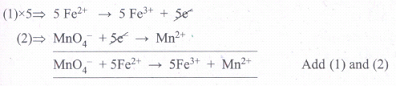
To balance O and H, H+ and H2O are added.
\(Mn{O}_4^-+5Fe^{2+}+8H^{+}\rightarrow Mn^{2+}+5Fe^{3+}+4H_2O\)
7.
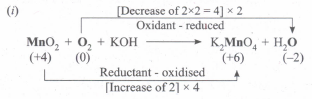
(ii) Balance the changes in O, N, by multiplying the oxidant and reductant by suitable numbers.
4MnO2 + 2O2 + KOH\(\rightarrow\)K2MnO4 + H2O
(iii) Balance the equation atomically (except O and H).
4MnO2 + 2O2 + KOH\(\rightarrow\) 4K2MnO4 + H2O
(iv) Balance oxygen and hydrogen atoms by multiplying H2O by 4.
4MnO2 + 2O2 + 8KOH \(\rightarrow\) 4K2MnO4 + 4H2O
8.
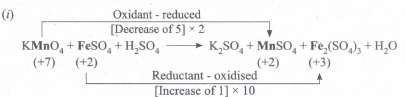
(ii) 2KMnO4 +10 FeSO4 + H2SO4 \(\rightarrow\)K2SO4 + MnSO4 + Fe2(SO4)3 + H2O
(iii) Balance the equation atomically (except O and H) and sulphate ions.
2KMnO4 + 10 FeSO4 + 8 H2SO4 \(\rightarrow\)K2SO4 + 2MnSO4 + 5 Fe2(SO4)3 + H2O
(iv) BalanceO atoms by multiplying H2O by 8.
2KMnO4 + 10 FeSO4 + 8 H2SO4 \(\rightarrow\)K2SO4 + 2MnSO4 + 5 Fe2(SO4)3 + 8 H2O
9.
(a) Equivalent mass of an acid:
Equivalent mass of an acid is the number of parts by mass of the acid which contains 1.008 part by mass of replaceable hydrogen atom.
Equivalent mass of an acid = \(\frac { Molar\ mass\ of\ the\ acid }{ Basicity\ of\ the\ acid } \)
(b) Equivalent mass of a base:
It is defined as the number of parts by mass of the base which contains one replaceable hydroxyl ion or which completely neutralizes one gram equivalent of an acid.
Equivalent mass of a base = \(\frac { Molar\ mass\ of\ the\ base }{ Acidity\ of\ the\ base } \)
(c) Equivalent mass of an oxidising agent :
It is defined as the number of parts by mass of an oxidising agent which can furnish 8 parts by mass of oxygen for oxidation.
(d) Equivalent mass of a reducing agent:
It is defined as the number of parts by mass of the reducing agent which is completely oxidised by 8 parts by mass of oxygen or with one equivalent of any oxidising agent.
10.
Ion-electron method makes use of the Half reactions. Steps involved in this method are,
1. Write the equation in the net ionic form without attempting to balance it.
2. Write and locate the oxidation number of atoms undergoing oxidation and reduction from the knowledge of calculation of oxidation number.
3. Write two half reactions showing oxidation and reduction separately.
4. Balance oxygen atoms by adding required number of water molecules to the side deficient in oxygen atoms.
5. Add required number of H+ ions to the side deficient in hydrogen atom if the reaction is in acidic medium
6. Add electrons to whichever side is necessary to make up the difference in oxidation number.
7. Add the two half reactions. The resulting equation is a net balanced equation.
8. For reactions in basic medium, add H2O and hydrogen ion to balance H and O.
9. Finally, balance the equation by cancelling common species present on both sides of the equation.
11.
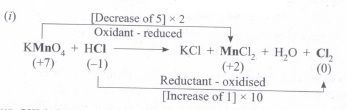
(ii) 2KMnO4 + 10 HCI \(\rightarrow\) KCl + MnCl2 + H2O + Cl2
(iii) Balance the equation atomically (except O and H).
2KMnO4 + 10 HCI \(\rightarrow\) 2KCl + 2MnCl2 + H2O + Cl2
(iv) Balance chlorine atoms by adding HCI and multiplying Cl2 by 5.
2KMnO4 + 16HCI \(\rightarrow\) 2KCl + 2MnCl2 + H2O + 5Cl2
(v) To balance O and H, H2O is multiplied by 8.
2KMnO4 + 16HCI \(\rightarrow\) 2KCl + 2MnCl2 + 8 H2O + 5Cl2
12.
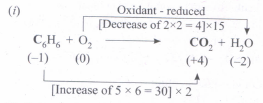
(ii) Balance the changes in O.N. by multiplying the oxidant and reductant by suitable numbers
2 C6H6 + 15 O2\(\rightarrow\)CO2 + H2O
(iii) Balance the equation atomically (except O and H).
2 C6H6 + 15 O2\(\rightarrow\)12 CO2 + H2O
(iv) Balance O atoms by adding one H2O molecule to the RHS for making the number of molecules of H2O to be 6.
2 C6H6 + 15 O2\(\rightarrow\)12 CO2 + 6 H2O
13.
(a) Oxidation number refers to the number of charges an atom would have in a molecule or an ionic compound, if electrons were transferred completely.
(b) Rules to assign oxidation number:
1. Oxidation number of a substance in its elementary state is equal to zero (H2, Br2, Na)
2. Oxidation number of a mono-atomic ion is equal to the charge on the ion (Na+= + 1,S2- = -2).
3. Oxidation number of hydrogen in a compound is + 1 (except hydrides).
4. Oxidation number of hydrogen in metal hydrides is -1 (NaH, CaH2).
5. Oxidation number of oxygen in a compound is -2 (except OF2 and peroxides).
6. Oxidation number of oxygen in peroxides is -1 (H2O2, Na2O2) = - 1.
7. Oxidation number of oxygen in fluorinated compounds is either + 1 or +2.
(OF2 = +2, O2F2 = + 1).
8. Fluorine has an oxidation number -1 in all its compounds.
9. The sum of the oxidation number of all the atoms in neutral molecules is equal to Zero.
10. For all ions, the sum of the oxidation number of all atoms is equal to the charge of the ion.
14.
(a)2NH3(g) + CO2(g) \(\rightarrow\) (NH4)2CO(ag) + H2O(I)
2 moles 1 mole 1 mole
No. of moles of ammonia =\({637.2\over 17}=37.45\) mole
No. of moles of CO2 \(={1142\over 44}=25.95\) moles
As per the balanced equation, one mole of CO2 requires 2 moles of ammonia.
\(\therefore\) No. of moles of NH3 required to react with 25.95 moles of CO2 is
\(={2\over 1}\times 25.95=51.90\) moles
\(\therefore\) 37.45 moles of NH3 is not enough to completely react with CO2 (25.95 moles).
Hence, NH3 must be the limiting reagent, and CO2 is excess reagent.
(b) 2 moles of ammonia produce 1 mole of urea.
\(\therefore\) Limiting reagent 37.45 moles of NH3 can produce \({1\over 2}\times 37.45\)moles of urea.
= 18.725 moles of urea.
\(\therefore\) The mass of 18.725 moles of urea = No. of moles x Molar mass
= 18.725 x 60
= 1123.5g of urea.
(c) 2 moles of ammonia requires 1 mole of CO2,
\(\therefore\)Limiting reagent 37.45 moles of NH3 will require \({1\over 2}\times 37.45\) moles of CO2.
= 18.725 moles of CO2
\(\therefore\) No. of moles of the excess reagent (CO2) left = 25.95 - 18.725 = 7.225
The mass of the excess reagent (CO2) left = 7.225 x 44
= 317.9g of CO2·
15.
Molar mass of Mg CO3 = 84.32 g mol-1
Percentage of Mg =\({24\over 84.32}\times 100=28.46\%\)
Percentage of C=\({12\over 84.32}\times 100=14.23\%\)
Percentage of O3=\({48\over 84.32}\times 100=57.0\%\)
\(\underset{84.32\ g}{MgCO_3}\rightarrow MgO+\underset{44\ g}{CO_2 }\)
84.32 g of 100% pure MgCO3 gives 44g of CO2.
\(\therefore\) 100 x 103 g of 100 % pure MgCO3 gives =\({44\over 84.32}\times 100\times 10^3\)
= 52.182 x 10³g CO2
100% pure MgCO3 gives 52.182 x 10³ g CO2
\(\therefore\) 90% pure MgCO3 will give \({52.182\times 10^3\over 100}\times 90\) = 46963.8 g CO2
= 46.96 Kg CO2.
16.
| Element | Percentage | Atomic mass | Relative No. of moles | Simple ratio of atoms | Simplest whole number ratio |
| C | 47.5% | 12 | \(\frac{47.5}{12}=3.96\) | \(\frac{3.96}{1.41}=2.8\times 5\) | 14 |
| H | 2.54% | 1 | \(\frac{2.54}{1}=2.54\) | \(\frac{2.54}{1.41}=1.8\times 5\) | 9 |
| Cl | 50% | 35.5 | \(\frac{50}{35.5}=1.41\) | \(\frac{1.41}{1.41}=1\times 5\) | 5 |
\(\therefore\) The empirical formula is C14H9Cl5.
Calculation of Molecular formula:
The empirical formula mass(C14H9Cl5) = \((14\times 12)+(9\times1)+(5\times 35.5)\)
= 168 + 9 + 177.5 = 354.5
\(n=\frac{Molecular\ mass}{Empirical\ formula\ mass}=\frac{354.5}{354.5}=1\)
Molecular formula = (Empirical formula)n
= (C14H9Cl5)l
\(\therefore\) Molecular formula = C14H9Cl5
17.
| Element | Percentage | Atomic mass | Relative No. of atoms | Simple ratio of atoms | Simplest whole number ratio |
|---|---|---|---|---|---|
| C | 60% | 12 | \(\frac{60}{12}=4.99\) | \(\frac{4.99}{2.22}=2.25\times\frac{9}{4}\) | 9 |
| H | 4.48% | 1 | \(\frac{4.48}{1}=4.48\) | \(\frac{4.48}{2.22}=2.02\times 4\) | 8 |
| O | 35.53% | 16 | \(\frac{35.53}{16}=2.22\) | \(\frac{2.22}{2.22}=1\times 4\) | 4 |
\(\therefore\) The empirical formula is C9H8O4.
18.
| Element | Percentage | Atomic mass | Relative No. of atoms | Simple ratio of atoms | Simplest whole number ratio |
|---|---|---|---|---|---|
| C | 24.47% | 12 | \(\frac{24.27}{12}=2.02\) | \(\frac{2.02}{2.02}=1\) | 1 |
| H | 4.07% | 1 | \(\frac{4.07}{1}=4.07\) | \(\frac{4.07}{2.02}=2.01\) | 2 |
| Cl | 71.65% | 35.45 | \(\frac{71.65}{35.45}=2.02\) | \(\frac{2.02}{2.02}=1\) | 1 |
\(\therefore\) The empirical formula = CH2Cl
19.
(a) The equivalent mass of a reducing agent is the number of parts by mass of the reducing agent which is completely oxidised by 8 parts by mass of oxygen or one equivalent of any oxidising agent.
(b) Ferrous sulphate is a reducing agent
\(\underset{2\times 152g}{2FeSO_4}+H_2SO_4+\underset{16g}{[O]}\rightarrow Fe_2{(SO_4)}_3+H_2O\)
16 parts by mass of oxygen oxidised 304 parts by mass of FeSO4.
\(\therefore\) 8 parts by mass of oxygen will oxidise \(\frac{316}{80}\times8\) parts by mass of ferrous sulphate = 152
The equivalent mass of ferrous sulphate (anhydrous) = 152.
The equivalent mass of crystalline ferrous sulphate is (FeSO4.7H2O) = 152 + 126 = 278
The equivalent mass of crystalline ferrous sulphate = 278.
20.
(a) The equivalent mass of an oxidizing agent is the number of parts by mass which can furnish 8 parts by mass of oxygen for oxidation.
(b) Potassium permanganate is an oxidizing agent
\(\underset { \overset { 2\times 158 }{ 316\ g } }{ 2\ KMn{ O }_{ 4 } } +3H_2SO_4\rightarrow K_2SO_4+2MnSO_4+3H_2O+\underset { \overset { 5\times 16 }{ 80g } }{ 5\left[ O \right] } \)
\(\therefore\) 8 parts by mass of oxygen will be furnished by \(\frac{316}{80}\times=31.6\)
Equivalent mass of KMnO4 = 31.6g eq-1.
21.
\(Cr{(OH)}_4^-+H_2O_2\rightarrow Cr{O}_4^{2-}\)
Oxidation half reaction:
\(\underset{(+3)}{Cr{(OH)}_4^-}\rightarrow\underset{(+6)} {Cr{O}_4^{2-}}+3e^-\).... (1)
Reduction half reaction:
\(H_2O_2+e^-\rightarrow H_2O\)....(2)
(+2) (+1)

To balance oxygen and hydrogen atoms, OH- and H2O are added.
\(2Cr{(OH)}_4^-+3H_2O_2+2OH^-\rightarrow 2Cr{O}_4^{2-}+8H_2O\)
22.
\(Mn{O}_4^-+Fe^{2+}\rightarrow Mn^{2+}+Fe^{3+}\)
Oxidation half reaction:
\(Fe^{2+}\rightarrow Fe^{3+}+e^-\).....(1)
Reduction half reaction:
\(Mn{O}_4^-+5e^-\rightarrow Mn^{2+}\).......(2)
(+7)

To balance oxygen, H+ is added on RHS and H2O is added on LHS.
\(Mn{O}_4^-+5Fe^{2+}+8H^+\rightarrow Mn^{2+}+5Fe^{3+}+4H_2O\)
23.
\(Mn{O}_4^-+I^-\rightarrow MnO_2+I_2\)
Oxidation half reaction:
\(2I^-+2e^-\rightarrow I_2\).......(1)
Reduction half reaction:
\(Mn{O}_4^-\rightarrow MnO^2+3e^-\).......(2)
Equation (1) is multiplied by 3
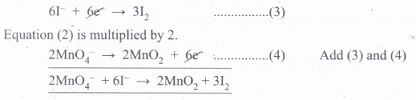
To balance oxygen and hydrogen atoms, H+ is added on RHS and H2O is added on LHS.
\(2Mn{O}_4^-+6I^-+4H^+\rightarrow 2MnO_2+2I_2+2H_2O\)
In acidic medium

11th Standard Syllabus & Materials
11th Standard
TN 11th Tamil பீடு பெற நில் - செய்யுள் - காவடிச்சிந்து Important Questions And Answers Study Material - QB365 Set A
NEW11th Standard
TN 11th Tamil பீடு பெற நில் - உரைநடை - மலை இடப்பெயர்கள் : ஓர் ஆய்வு Important Questions And Answers Study Material - QB365 Set A
NEW11th Standard
TN 11th Tamil மாமழை போற்றுதும் - துணைப்பாடம் - யானை டாக்டர் Important Questions And Answers Study Material - QB365 Set A
NEW11th Standard
TN 11th Tamil மாமழை போற்றுதும் - செய்யுள் - ஐங்குறுநூறு Important Questions And Answers Study Material - QB365 Set A



Tamilnadu Stateboard 11th Standard Subjects

Maths

Commerce

Economics

Biology

Business Maths and Statistics

Accountancy

Computer Science

Physics
Chemistry
Maths
Biology
Economics
Physics
Chemistry

History
Business Maths and Statistics

Computer Science
Accountancy

Computer Applications
History
Computer Technology
Commerce
Computer Applications
Computer Technology

Tamil

English

French
Tamilnadu Stateboard Standards
