100% FREE ACCESS
9th Standard CBSE Syllabus & Materials
9th Standard CBSE
CBSE 9th Science Is matter around us pure? - New Model Questions Papers Study Material - QB365 Set A
NEW9th Standard CBSE
CBSE 9th Science Matter in our surroundings - New Model Questions Papers Study Material - QB365 Set A
NEW9th Standard CBSE
CBSE 9th Mathematics Heron's Formula Sample Question Papers Study Material - QB365 Set A
NEW9th Standard CBSE
CBSE 9th Mathematics Circles Sample Question Papers Study Material - QB365 Set A
NEW9th Standard CBSE
CBSE 9th Mathematics Quadrilaterals Sample Question Papers Study Material - QB365 Set A
NEW9th Standard CBSE
CBSE 9th Mathematics Triangles Sample Question Papers Study Material - QB365 Set A

Published on: 31/12/2018
Grade 9 unit Test
Download CBSE Class 9th Standard CBSE Mathematics question papers, sample papers, important questions, and previous year solved papers in PDF format. Get free study materials, NCERT solutions, and exam preparation resources for Class 9th Standard CBSE Mathematics
Questions + Answers key
Take MCQ Mathematics Test
1.
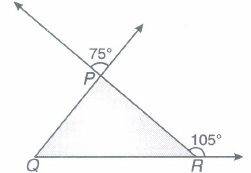
In the given figure, calculate the value of \(\angle PQR\)
2.
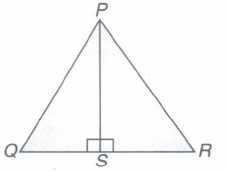
PS is an altitude of an isosceles triangle PQR in which PQ = PR. Show that PS bisects \(\angle\)P.
3.
The mean of 100 observations is 60. If one observation of 50 is replaced by 110, then what will be the new mean?
4.
What is the volume of a cube whose total surface area is 864 m2?
5.
Find the area of a triangle whose sides are 6.5 cm. 7 cm and 7.5 cm.
6.
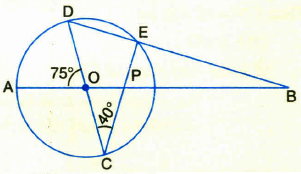
In the figure, straight lines AB and CD pass through the centre O of the circle. If \(\angle OCE=40°\) and \(\angle AOD=75°\), find \(\angle CDE\) and \(\angle OBE\).
7.
Solve for x: \(3x+11+{x\over2}=-{7\over2}+18.\)What will be the graph of this equation?
8.
(a) Plot the following points in the coordinate plane.
A(-4,4), B(-6,0), C(-4,-4), D(-2,0)
(b) Name the figure formed by joining the points A, B, C and D is also find its area.
9.
Write the coefficient of x3 of the following polynomials:
\(\frac { 2 }{ 3 } -\frac { 5 }{ 4 } x+{ x }^{ 3 }+\frac { 1 }{ 2 } { x }^{ 2 }\)
10.
Simplify: 73.93
11.
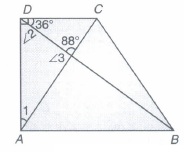
In the given figure, on a quadrilateral, ABCD shaped land is a village the panchayat has constructed a school specially for girls. What value are they exhibiting by doing so? How many triangles can be seen in the given figure? Find the measure of \(\angle 1\)
12.
The diameter of roller 1.5 m long is 84 cm. If it takes 100 revolutions to level a playground, find the cost of levelling this ground at the rate of 50 paise per square metre.
13.
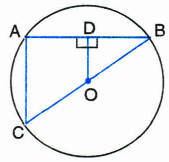
OD is perpendicular to chord AB of a circle whose centre is O. If BC is a diameter, prove that CA = 20D.
14.
Show that each angle of a rectangle is a right angle.
15.
Factorise: \((x^2-4x)(x^2-4x-1) -20\)
16.
Find two irrational numbers between \(\frac { 1 }{ 3 } \)and \(\frac { 1 }{ 2 } \)
17.
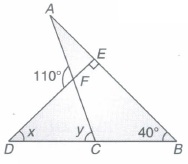
In the given figure \(DE\bot AB.\) Find the value of x and y.
18.
Find the surface area of a sphere of diameter:
(i) 14 cm
(ii) 21 cm
(iii) 3.5 m.
19.
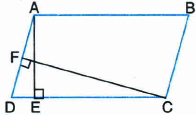
In figure, ABCD is a parallelogram, \(AE\bot DC\)and \(CF\bot AD\). If AB = 16cm, AE = 8 cm and CF = 10 cm, find AD.
20.
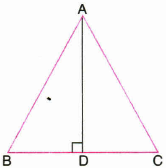
In \(\triangle ABC\) , AD is the perpendicular bisector of BC (see figure).Show that \(\triangle ABC\) is isosceles triangle in which AB = AC.
21.
A rectangle field has to be cut out and its boundary marked with fencing with a given wire of length 100m.
(a)Represent the above situation using a linear equation
(b)Also plot its graph
22.
Find the value of \((x-a)^3+(x-b)^3+(x-c)^3-3(x-a)(x-b)(x-c)\) where a+b+c=0
23.
The radii of two right circular cylinders are in the ratio 2:3 and their heights are in the ratio 5:4, then the ratio of their volumes will be _______________
24.
For the given data: 11,15, 17, y+1, 19, y-2, 3; if the mean is 14, find the value of y.
25.
If a 60o angle is bisected twice,what will be measure of each that is constructed?
26.
Is it possible to construct a triangle, when its sides are 5.4 cm, 2.3 cm, 3.1 cm?
27.
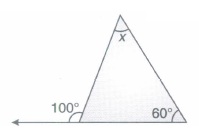
What is the value of x in the figure given below?
28.
If in quadrilateral ABCD; ∠A=90° and AB=BC=CD=DA, then ABCD is a square.
29.
Explain when a system of axioms is called consistent.
30.
Factorize: 6-x+x2.
31.
Write the sum of \(0.\bar{3}\) and \(0.\bar{4}\)
32.
If \(\sqrt { 3 } x=\sqrt { 2 } x+1\) , then x is equal to _____
33.
In \(\triangle\)ABC, if AB is the greatest side, then prove that LC > 60°.
34.
Prove that: \({ \left( \frac { { x }^{ { a }^{ 2 } } }{ { x }^{ { b }^{ 2 } } } \right) }^{ \frac { 1 }{ a+b } }.{ \left( \frac { { x }^{ { b }^{ 2 } } }{ { x }^{ { c }^{ 2 } } } \right) }^{ \frac { 1 }{ b+c } }.{ \left( \frac { { x }^{ { c }^{ 2 } } }{ { x }^{ { a }^{ 2 } } } \right) }^{ \frac { 1 }{ c+a } }=1\)
1.
\(\angle QPR=75^o\) (Vertically opposite angles)
Again, \(\angle PQR+\angle QPR=105^o\) (Exterior angle)
\(\Rightarrow \angle PQR+75^o=105^o\)
\(\Rightarrow PQR=30^o\)
2.
In \(\triangle\)PQS and \(\triangle\)PRS,
PQ = PR (Given)
PS = PS (Common)
\(\angle\)PSQ = \(\angle\)PSR = 90°
(PS is altitude)
By R.H.S. rule,
\(\triangle PQS\cong \triangle PRS\)
\(\angle\)QPS = \(\angle\)RPS (By c.p.c.t.)
Hence, PS bisects \(\angle\)P.
3.
60.6
4.
1728 m3
5.
21 cm2
6.
\(\angle\)AOD + \(\angle\)BOD = 180° (linear pair)
\(\angle\)BOD = 180°- \(\angle\)AOD
\(\angle\)BOD = 180°- 75° = 105°
\(\angle\)CED =90° (angle in semi-circle)
\(\angle\)CDE =90° - \(\angle\)OCE \(\Rightarrow\) 90° - 40° = 50°
\(\angle\)OBE = \(\angle\)OBD
\(\angle\)OBD = 180°- (105° + 50°)
(In \(\Delta\)DBO, Angle sum property of \(\Delta\))
\(\angle\)OBE = \(\angle\)OBD = 25°
7.
x=1
8.
(a)
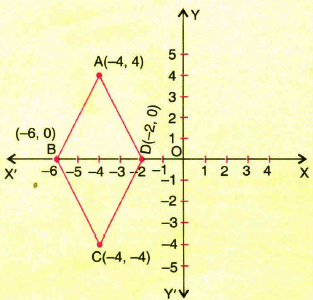
(b) Rhombus, 16 sq.units
9.
1
10.
633
11.
Caring, gender equality, concern 8 triangles
Now \(\angle 2=90^o-36^o\)
=54o
\(\angle 2=180^o-88^o\)
=92o (Linear pair)
\(\angle AOD, \angle 1+\angle2+\angle3=180^o\)[Angle sum property of triangle]
\(\Rightarrow\angle1= \angle 180^o-54^o-92^o\)
\(\Rightarrow \angle 1=34^o\)
12.
For roller
\(r=\frac { 1.5 }{ 2 } m=0.75m\)
\(\\ h=84cm=0.84m\)
\(\therefore \) Curved surface area = \(2\pi rh\)
\(=2\times \frac { 22 }{ 7 } \times 0.75\times 0.84\)
\(\\ =3.96{ m }^{ 2 }\)
\(\therefore \) Area of the ground levelled in 1 revolution
= 3.96 m2
\(\therefore \) Area of the ground levelled in 100 revolutions
= 3.96 100 m2 = 396 m2
\(\therefore \) Cost of levelling
= Rs \(396\times \frac { 50 }{ 100 } =\) Rs 198
13.
Given: OD is perpendicular to chord AB of a circle where centre is O. BC is a diameter of the circle.
To Prove: CA=20D
Proof: OD丄AB
∴ D is the mid-point of AB
|The perpendicular drawn from the centre of a circle to a chord bisects the chord.
In \(\Delta BAC\),
∵ \(OD\parallel AC\) I By mid-point theorem
and \(OD=\frac { 1 }{ 2 } AC\)
⇒ CA=2 OD
14.
Let us recall what a rectangle is.
A rectangle is a parallelogram in which one angle is a right angle.
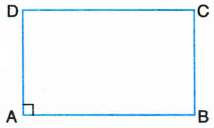
Let ABCD be a rectangle in which \(\angle\) A = 90°.
We have to show that \(\angle\) B = Ð C = \(\angle\) D = 90°
We have, AD || BC and AB is a transversal
(see Fig.).
So, \(\angle\) A + \(\angle\) B = 180° (Interior angles on the same
side of the transversal)
But, \(\angle\) A = 90°
So, \(\angle\) B = 180° – \(\angle\) A = 180° – 90° = 90°
Now, \(\angle\) C = Ð A and \(\angle\) D = \(\angle\) B
(Opposite angles of the parallellogram)
So, \(\angle\) C = 90° and \(\angle\) D = 90°.
Therefore, each of the angles of a rectangle is a right angle.
15.
\((x^2-4x)(x^2-4x-1)-20\)
\(=y(y-1)-20\quad\quad y=x^2-4x\)
\(=y^2-y-20\)
\(=y^2-5y+4y-20\)
\(=y(y-5)+4(y-5)\)
\(=(y-5)(y+5)\)
\(=(x^2-5x+x-5)(x-2)^2\)
Using Identity II
\(=\left\{ x(x-5)+1(x-5) \right\} { (x-2) }^{ 2 }\)
\(=(x-5)(x+1){ (x-2) }^{ 2 }\)
16.
\(\frac { 1 }{ 3 } \)=0.3333...
\(\frac { 1 }{ 2 } \)=0.5
Hence two irrational numbers between \(\frac { 1 }{ 3 } \) and \(\frac { 1 }{ 2 } \) can be taken as 0.343443444... and 0.353553555...
17.
In \(\triangle BDE,\)
\(\angle B+\angle D+\angle DEB=180^o\)( Angle sum property of a triangle)
\(\Rightarrow\) 40o+x+90o=180o
\(\Rightarrow\)x=50o
In \(\triangle DCF,\)
\(\angle D+\angle FCD=\angle AFD\) (Exterior angle is the sum of the two interior opposite angles)
\(\Rightarrow \)50o+y=110o
y=60o
18.
(i) Diameter = 14 cm
Radius (r) = \(\frac { 14 }{ 2 } cm=7cm\)
\(\therefore\) Surface area = \(4\pi { r }^{ 2 }\)
\(=4\times \frac { 22 }{ 7 } \times { \left( 7 \right) }^{ 2 }=616{ cm }^{ 2 }.\)
(ii) Diameter = 21 cm
Radius (r) = \(\frac { 21 }{ 2 } cm\)
\(\therefore\) Surface area = \(4\pi { r }^{ 2 }\)
\(=4\times \frac { 22 }{ 7 } \times { \left( \frac { 21 }{ 2 } \right) }^{ 2 }=1386{ cm }^{ 2 }.\)
(iii) Diameter = 3.5 m
Radius (r) = \(\frac { 3.5 }{ 2 } m=1.75m\)
\(\therefore\) Surface area = \(4\pi { r }^{ 2 }\)
\(=4\times \frac { 22 }{ 7 } \times { \left( 1.75 \right) }^{ 2 }\)
\(\\ =38.5{ m }^{ 2 }.\)
19.
ar(parallelogram ABCD) = AB x AE
= 16 x 8 cm2
= 128 cm2 ...(1)
ar(parallelogram ABCD) = AD x CF
= AD x 10 cm2 .......(2)
From (1) and (2), we get
AD x 10 = 128
AD = \(\frac { 128 }{ 10 } \)
AD = 12.8 cm.
20.
Given: In \(\triangle ABC\) , AD is the perpendicular bisector of BC
To Prove: \(\triangle ABC\) is isosceles triangle in which AB = AC.
Proof: In \(\angle ADB=\angle ADC\)
DB = DC | AD is the perpendicular bisector of BC
AD = AD
\(\triangle ADB\cong \triangle ADC\) |By SAS rule
AB = AC | C.P.C.T
\(\triangle ABC\) is an isosceles triangle in which
AB = AC
21.
(a)x+y=50
22.
0
23.
()
Let radii of cylinders be 2x and 3x and heights be 5y and 3y respectively.
\(\therefore\) Ratio of volumes = \(\frac { \pi { (2x) }^{ 2 }\times 5y }{ \pi { (3x) }^{ 2 }\times 3y } \)
\(=\frac { { 4x }^{ 2 }\times 5 }{ { 9x }^{ 2 }\times 3 } \)
= 20:27.
24.
()
\(14=\frac{11+15+17+y+1+19+y-2+3}{7}\)
⇒ 98 = 64+2y
⇒ 2y = 34
⇒ y = 17
25.
()
Since bisector of an angle divides it in two equal parts,so,when it is bisected twice,measure of each angle is 15o
26.
()
No, Because, 2.3 + 3.1 = 5.4 cm (third side)
\(\therefore\) Not possible to construct a triangle.
27.
()
We know that x+60o=100o (Exterior angle os the sum of the two interior opposite angles)
x=40o
28.
()
True
29.
()
A system of axioms is called consistent, when it is impossible to deduce from these axioms, a statement that contradicts any axiom or previously proved statement.
30.
()
6x-x-x2 = 6-3x+2x-x2
= 3(2-x)+x(2-x)
= (2-x)(3+x)
31.
()
\(0.\bar{3}+0.\bar{4}\)=(0.333...) + (0.444...)
= 0.777...
Let x = 0.777...
10x = 7.777...
⇒ 10x - x = (7.777...) - (0.777...)
⇒ 9x = 7.0
⇒ x = \(\frac{7}{9}\)
32.
()
Given, \(\sqrt { 3 } x=\sqrt { 2 } x+1\)
\(\therefore \ x(\sqrt { 3 } -\sqrt { 2 } )=1\)
\(\therefore \ x=\frac { 1 }{ \sqrt { 3 } -\sqrt { 2 } } \).
33.
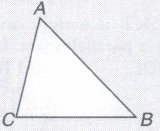
In \(\triangle\)ABC, as AB is the greatest side
\(\Rightarrow\) AB > BC \(\Rightarrow\) \(\angle\)C > \(\angle\)A
AB > AC \(\Rightarrow\) \(\angle\)C > \(\angle\)B
On adding (1) and (2), we get
2\(\angle\)C > \(\angle\)A + \(\angle\)B
\(\Rightarrow\) 2\(\angle\)C + \(\angle\)C > \(\angle\)A + \(\angle\)B + \(\angle\)C
\(\Rightarrow\) 3\(\angle\)C > 180°
\(\therefore\) \(\angle\)C > 60°.
34.
\(={ \left( { x }^{ { a }^{ 2 }-{ b }^{ 2 } } \right) }^{ \frac { 1 }{ a+b } }.{ \left( { x }^{ { b }^{ 2 }-{ c }^{ 2 } } \right) }^{ \frac { 1 }{ b+c } }.{ \left( { x }^{ { c }^{ 2 }-{ a }^{ 2 } } \right) }^{ \frac { 1 }{ c+a } }\)
\(={ x }^{ \frac { { a }^{ 2 }-{ b }^{ 2 } }{ a+b } }.{ x }^{ \frac { { b }^{ 2 }-{ c }^{ 2 } }{ a+b } }.{ x }^{ \frac { { c }^{ 2 }-{ a }^{ 2 } }{ c+a } }\)
\(={ x }^{ a-b }.{ x }^{ b-c }.{ x }^{ c-a }\)
\(={ x }^{ 0 }\)

9th Standard CBSE Syllabus & Materials
9th Standard CBSE
CBSE 9th Mathematics Lines and Angles Sample Question Papers Study Material - QB365 Set A
NEW9th Standard CBSE
CBSE 9th Mathematics Introduction to Euclid's Geometry Sample Question Papers Study Material - QB365 Set A
NEW9th Standard CBSE
CBSE 9th Mathematics Linear Equations in Two Variables Sample Question Papers Study Material - QB365 Set A
NEW9th Standard CBSE
CBSE 9th Mathematics Coordinate Geometry Sample Question Papers Study Material - QB365 Set A



CBSE 9th Standard CBSE Subjects
CBSE Standards