
 100% FREE ACCESS
11th Standard Syllabus & Materials
11th Standard
TN 11th Tamil இயற்கை வேளாண்மை,சுற்றுச்சூழல் -செய்யுள் - மனோன்மணீயம் Important Questions And Answers Study Material - QB365 Set A
NEW11th Standard
TN 11th Tamil என்னுயிர் என்பேன் -துணைப்பாடம் - இசைத்தமிழர் இருவர் Important Questions And Answers Study Material - QB365 Set A
NEW11th Standard
TN 11th Tamil மொழி கலை -செய்யுள் - ஒவ்வொரு புல்லையும் Important Questions And Answers Study Material - QB365 Set A
NEW11th Standard
TN 11th Tamil பீடு பெற நில் - இலக்கணம் - பகுபத உறுப்புகள் Important Questions And Answers Study Material - QB365 Set A
NEW11th Standard
TN 11th Tamil பீடு பெற நில் - துணைப்பாடம் - வாடிவாசல் Important Questions And Answers Study Material - QB365 Set A
NEW11th Standard
TN 11th Tamil பீடு பெற நில் - செய்யுள் - குறுந்தொகை Important Questions And Answers Study Material - QB365 Set A

Published on: 29/11/2018
Here is the most important model question paper for 11th state board chemistry. In this question paper, questions are created based on the reference of the public pattern. Now you can use this model question paper for practice on your own to score more on your board exams. This question paper is prepared by most experienced teachers.
Important questions were added from the chapters Basic concepts of chemistry and chemical calculations, Quantum mechanical model of atom, Elements and periodic classification, Hydrogen and water, Alkaline and alkaline earth metals, Chemical Bonding, Thermodynamics, Gaseous state, Solutions, Chemical equilibrium, Organic Chemistry – Basic principles and technique, Organic reactions and their mechanism, Hydrocarbons, Halo-alkanes and haloarenes, and Environmental Chemistry.
Now you can use this model question paper for practice on your own to score more on your board exams. By practicing with this important model question paper student can gain more knowledge and confidence to crack the exams. The question paper is designed based on the half-yearly syllabus.
The question paper includes book back questions, creative questions, and previous year questions.
Download Tamil Nadu 11th Standard Chemistry question papers, model tests, one-mark questions, important questions, and public exam papers in PDF format. Free study materials and answer keys for TN State Board students.
Questions + Answers key
Take MCQ Chemistry Test
1.
An alkyl bromide (A) reacts with sodium in ether to form 4, 5– diethyloctane, the compound (A) is _________
CH3 (CH2)3 Br
CH3(CH2)5 Br
CH3(CH2)3 CH(Br)CH3
\({ CH }_{ 3 }-{ \left( { CH }_{ 2 } \right) }_{ 2 }-CH\left( Br \right) -\underset { \overset { { | } }{ { CH }_{ 3 } } }{ { CH }_{ 2 } } \)
2.
Structure of the compound whose IUPAC name is 5,6 - dimethylhept - 2 - ene is ___________

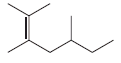
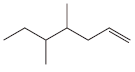
None of these
3.
At 100o C the vapour pressure of a solution containing 6.5g a solute in 100g water is 732mm. If Kb = 0.52, the boiling point of this solution will be __________
102oC
100oC
101oC
100.52oC
4.
For the formation of Two moles of SO3(g) from SO2 and O2, the equilibrium constant is K1. The equilibrium constant for the dissociation of one mole of SO3 into SO2 and O2 is __________
\(1/K_1\)
\(K_1^2\)
\(({1\over K_1})^{1/2}\)
\({K_1\over 2}\)
5.
Solubility of carbon dioxide gas in cold water can be increased by ____________
increase in pressure
decrease in pressure
increase in volume
none of these
6.
The highest ionization energy is exhibited by_________
halogens
alkaline earth metals
transition metals
noble gases
7.
Two similar reactions are given below:
H2(g)+\(\frac { 1 }{ 2 } \)O2(g) \(\rightarrow\)H2O(g); \(\Delta\)H = \(\Delta\)H1
H2(g)+\(\frac { 1 }{ 2 } \)O2(g)\(\rightarrow\)H2O(l); \(\Delta\)H = \(\Delta\)H2
In terms of magnitude, of \(\Delta\)H
\(\Delta\)H1 > \(\Delta\)H2
\(\Delta\)H1 < \(\Delta\)H2
\(\Delta\)H1 = \(\Delta\)H2
cannot be predicted
8.
The value of Bohr radius for hydrogen atom is ___________
0.529 \(\times\) 10-8 cm
0.529 \(\times\) 10-10 cm
0.529 \(\times\) 10-12 cm
0.529 \(\times\) 10-12 cm
9.
The amount of heat exchanged with surrounding at constant temperature pressure is given by the quantity ______________
ΔE
ΔH
ΔS
ΔG
10.
Among the following the least thermally stable is ___________
K2CO3
Na2CO3
BaCO3
Li2CO3
11.
Which of the following is the correct expression for the equation of state of van der Waals gas?
\(\left( P+\frac { a }{ { n }^{ 2 }{ V }^{ 2 } } \right) (V-nb)=nRT\)
\(\left( P+\frac { na }{ { n }^{ 2 }{ V }^{ 2 } } \right) (V-nb)=nRT\)
\(\left( P+\frac { { an }^{ 2 } }{ { V }^{ 2 } } \right) (V-nb)=nRT\)
\(\left( \frac { P+{ n }^{ 2 }{ a }^{ 2 } }{ { V }^{ 2 } } \right) (V-ab)=nRT\)
12.
Hot concentrated sulphuric acid is a moderately strong oxidizing agent. Which of the following reactions does not show oxidising behaviour ?
Cu + 2H2 SO4 \(\longrightarrow \) CuSO4 +SO2 + 2H2O
C + 2H2 + SO4 \(\longrightarrow \) CO2 + 2SO2 + 2H2O
BaCl2 + H2SO4 \(\longrightarrow \) BaSO4 + 2HCl
None of the above
13.
Which of the following pairs of d-orbitals will have electron density along the axes ?
dz2, dxz
dxz, dyZ
dz2, dx2-y2
dxy ,dx2-y2
14.
Zeolite used to soften hardness of water is hydrated _____________
Sodium aluminium silicate
Calcium aluminium silicate
Zinc aluminium borate
Lithium aluminium hydride
15.
In which of the following options the order of arrangement does not agree with the variation of property indicated against it?
I< Br < CI < F (increasing electron gain enthalpy)
Li < Na < K < Rb (increasing metallic radius)
Al3+< Mg2+ < Na+
B < C < O < N (increasing first ionisation enthalpy)
16.
Give IUPAC names for the following compounds
CH3 – CH = CH – CH = CH – C ≡ C – CH3
17.
Write structural formula for the following compounds
m - dinitrobenzene
18.
A sample of 12 M Concentrated hydrochloric acid has a density 1.2 gL–1 Calculate the molality.
19.
The atmospheric oxidation of NO
2NO(g) + O2(g) ⇌ 2NO2(g)
was studied with initial pressure of 1 atm of NO and 1 atm of O2. At equilibrium, partial pressure of oxygen is 0.52 atm calculate Kp of the reaction.
20.
At 0°C, ice and water are in equilibrium and the enthalpy change for the process, H2O(s) \(\rightleftharpoons \) H2O(l) is 6 KJ mol-1 Calculate the entropy change for the conversion ice into water.
21.
State charles law and give an example.
22.
How many orbitals are possible for n = 4?
23.
Discuss the three types of Covalent hydrides.
24.
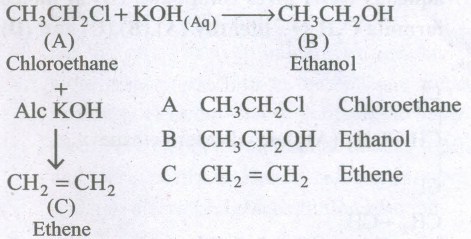
An organic compound (A) with molecular formula C2H5Cl reacts with KOH gives compounds (B) and with alcoholic KOH gives compound (C). Identify (A),(B), and (C)
25.
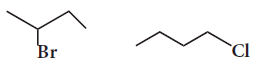
Which alkyl halide from the following pair is
i) chiral
ii) undergoes faster SN2 reaction?
26.
Describe the mechanism of Nitration of benzene.
27.
28.
What volume of 4M HCl and 2M HCl should be mixed to get 500 mL of 2.5 M HCl ?
29.
For the reaction,
A2(g) + B2(g) ⇌ 2AB(g) ; ΔH is –ve.
the following molecular scenes represent different reaction mixture (A – green, B – blue)
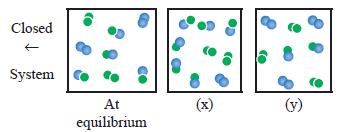
i) Calculate the equilibrium constant KP and (KC).
ii) For the reaction mixture represented by scene (x), (y) the reaction proceed in which directions?
iii) What is the effect of increase in pressure for the mixture at equilibrium.
30.
What is the relation between KP and KC. Give one example for which KP is equal to KC.
31.
Give a brief account of the shapes of atomic orbitals?
32.
The second electron affinity of O is positive, whereas first is negative. Give reason.
33.
What mass of N2 will be required to produce 34g of NH3 by the reaction, N2 + 3H2 \(\longrightarrow\) 2NH3·
34.
Calculate the energy required for the process.
\({ He }_{ (g) }^{ + }\longrightarrow { He }_{ (g) }^{ 2+ }+{ e }^{ - }\)
The ionisation energy for the H atom in its ground state is -13.6 ev atom-1
35.
Determine the values of all the four quantum numbers of the 8th electron in O- atom and 15th electron in Cl atom.
36.
Would it be easier to drink water with a straw on the top of Mount Everest?
37.
Explain inductive effect with suitable example.
38.
Write a note on homologous series.
39.
A 10 L cylinder consist of mixture of helium, oxygen, and nitrogen of masses 0.4 g, 1.6 g and 1.4 g at 27°C. Calculate the partial pressures of He, O and N and finally arrive at the total pressure. Assume the gases to behave ideally.
40.
List out and compare the chemical properties of metals and non-metals.
41.
Write down the Born-Haber cycle for the formation of CaCl2
42.
What is screening effect? Briefly give the basis for pauling's scale of electronegativity.
43.
Compare the structures of H2O and H2O2 .
1.
(d)
\({ CH }_{ 3 }-{ \left( { CH }_{ 2 } \right) }_{ 2 }-CH\left( Br \right) -\underset { \overset { { | } }{ { CH }_{ 3 } } }{ { CH }_{ 2 } } \)
2.
(a)
3.
(c)
101oC
4.
(c)
\(({1\over K_1})^{1/2}\)
5.
(a)
increase in pressure
6.
(b)
alkaline earth metals
7.
(b)
\(\Delta\)H1 < \(\Delta\)H2
8.
(a)
0.529 \(\times\) 10-8 cm
9.
(b)
ΔH
10.
(d)
Li2CO3
11.
(c)
\(\left( P+\frac { { an }^{ 2 } }{ { V }^{ 2 } } \right) (V-nb)=nRT\)
12.
(c)
BaCl2 + H2SO4 \(\longrightarrow \) BaSO4 + 2HCl
13.
(c)
dz2, dx2-y2
14.
(a)
Sodium aluminium silicate
15.
(a)
I< Br < CI < F (increasing electron gain enthalpy)
16.

17.
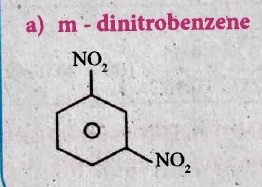
18.
Given: M = 12 M;
d = 1.2 gL-1
In 12 M - HCI means 12 mole of HCI in 1 litre of the solution (i.e)
n = 12 mole
Calculation of mass of 1L of HCI solution:
Mass of 1 L of HCl solution = d x v
= 1.2 x 1000 = 1200 g
Mass of HCI (m) = No. of moles of HCl x Molar mass of HCl
= nm
= 12 x 36.5
= 438 g
.'. Mass of water (solvent) = 1200 - 438
= 762 g = 762 x 10-3 kg
\(\therefore \text { Molality }=\frac{\text { No.of moles of solute }}{\text { Mass of solvent }(\mathrm{kg})}\)
\(=\frac{12}{762 \times 10^{-3}}\)
= 15.75 m.
19.
2 NO(g) + O2 (g) ⇌ 2NO2(g)
| NO2 | O2 | NO2 | |
| Initila Partial Pressure | 1 | 1 | - |
| Reacted | 0.96 | 0.96 | - |
| Equilibrium Partial Pressure | 0.04 | 0.52 | 0.96 |
\(K_p={P^2_{NO_2}\over P^2_{NO_2}.Po_2}\)
\(={0.96\times 0.96\over 0.04\times 0.04\times 0.52}\)
= 11.07 x 10² (atm)-1
Keq = 41.6 x 10² M-1.
20.
For the process, H2O(s) \(\rightleftharpoons \) H2O(l)
\(\triangle\)S(fusion) = \(\frac { \Delta H(fusion) }{ Freezingtemperature } \)
= \(\frac { 6\times 1000 }{ 273 } =21.98\) JK-1 mol-1
21.
For a fixed mass of a gas at constant pressure, the volume is directly proportional to its temperature (K). Mathematically it can be represented as (at constant P and n)
or V = kT
or \(\frac { V }{ T } =Constant\)
Use of hot air balloon in meteorological observation is based on Charles law.
22.
| n | l | m | orbitals | Total no of orbitals |
| 0 | 0 | 1 | (1- 4s +3 - 4P orbital +5 - 4d orbital +7 - 4f orbital) =16 |
|
| 4 | 1 | -1 0 +1 |
3 | |
| 2 |
-2 |
5 | ||
| 3 |
-3 |
7 |
23.
a) Electron-precise hydrides:
These have required number of electron to represent their conventional d lewis structure. All the elements of carbon group (14) form such hydrides.
Eg CH4, C2H6, SiH4, GeH4
b) Electron - deficient hydrides:
There act as Lewis acids (ie) electron acceptors. The elements from group (13) form such hydrides.
Eg: B2H6
c) Electron - rich hydrides:
There have excess electron, which are present as lone pairs. Elements of group 15-17 form such hydrides. They behave as Lewis bases (ie) electron donors.
Eg: NH3 ,H2O, HF
24.
25.
i) chiral molecule:
The chiral molecule is 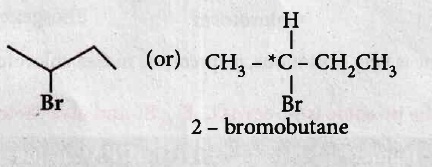
ii) SN2 reaction:
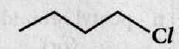 undergoes SN2 reaction faster as it is a primary alkyl halide.
\( \text { (or) } \mathrm{CH}_3-\mathrm{CH}_2-\mathrm{CH}_2-\mathrm{CH}_2-\mathrm{Cl}\\ 1 - chlorobutane\)
26.
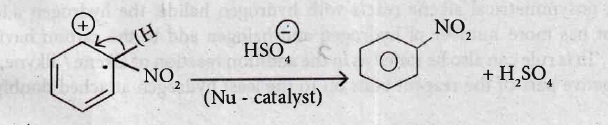
Benzene undergoes nitration reaction becasuse it is an elecron - rich system due to delocalised \(\pi\) electron. So it is easily attacked by electrophiles and gives substituted products.

Mechanism:
Step - I : Formafion of the electrophile:

Step - II : Formation of carbocation intermediate:
The electrophile attacks the aromatic ring to form a carbocation intermediate which is stabilised by resonance.

Step - III: Formation of nitro benzene:
The electrophile attacks the artomatic ring to fo
27.
28.
Let the volume of 4M HCl required to prepare 500 mL of 2.5 MHCl = x mL
Therefore, the required volume of 2M HCl = (500 - x) mL
We know from the equation
C1V1+ C2V2 = C3V3
(4x) + 2(500 - x) = 2.5 x 500
4x + 1000 - 2x = 1250
2x = 1250 - 1000
\(x={250\over 2}\)
= 125 ml
Hence, volume of 4M HCl required = 125 mL
Volume of 2M HCl required = (500 - 125) mL = 375 mL.
29.
\(K_c={[AB]^2\over [A_2][B_2]}\)
A - green
B - blue
Given that 'V' is constant (closed system)
At equilibrium
\(K_c={({4\over V})^2\over ({2\over V})({2\over V})}={16\over 4}=4\)
KP = KC (RT)Δn
KP = 4(RT)o = 4
At Stage 'x'
\(Q={({6\over V})^2\over ({2\over V})({1\over V})}={36\over 2}=18\)
Q > KC ie., reverse reaction is favoured
At Stage 'y'
\(Q={({3\over V})^2\over ({3\over V})({3\over V})}={9\over 3\times 3}=1\)
KC > Q ie., forward reaction is favoured.
30.
i) \(K_{p}=K_{c}(R T)^{\Delta n_{g}}\)
Kp = Equilibrium constant in term of partial Pressures.
Kc = Equilibrium constant in term of concentration.
R = Gas constant; T = Temperature
\(\Delta \mathrm{n}_{\mathrm{g}}\) = Difference between the sum of number of moles of products and the sum of number of moles of reactants in gas phases.
ii) Synthesis of HI:
\( \mathrm{H}_{2(\mathrm{~g})}+\mathrm{I}_{2(\mathrm{~g})} \rightleftharpoons 2 \mathrm{HI}_{(\mathrm{g})} \)
\(\Delta n_{g}=0 \therefore K_{p}=K_{c}(R T) \Delta n_{g}\)
\(K_{p}=K_{c}(R T)^{\circ} \)
\(K_{p}=K_{c} \text {. }\)
31.
The shape of an atomic orbital is found by finding the probability (\({ \Psi }^{ 2 }\) ) of the electron at different points around the nucleus and representing the density of the nucleus. Same orbitals are found to have a region of space where the probability of finding electron is zero. This is called a node.
(i) All 's' orbitals are spherical in shape.
(ii) All 'p' orbitals are dumb-bell in shape.
The three 'p' orbitals differ in orientation. They lie along the axes and called Px, Py and Pz orbitals.
(iii) All 'd' orbitals have clover- leaf shaped with four lobes. Three have lobes between axes and are called dxy, dyz, dxz orbitals.
The fourth lobe is along the axes and is called \({ d }_{ { x }^{ 2 }-{ y }^{ 2 } }\) the fifth has two lobes along 'z' axis and dough-nut shape in the centre and is called \({ d }_{ { z }^{ 2 } }\)
32.
\({ O }_{ (g) }+{ e }^{ - }\longrightarrow { O }^{ - }_{ (g) };{ \Delta }_{ eg }H=-141\quad kj\quad { mol }^{ -1 }\)
\({ O }_{ (g) }+{ e }^{ - }\longrightarrow { O }^{ 2- }_{ (g) };{ \Delta }_{ eg }H=+780\quad kj\quad { mol }^{ -1 }\)
When an electron is added to oxygen atom to form ion, energy is released. Hence, first electron gain enthalpy of oxygen is negative.
But when another electron is added to O- ion to form O2- ion, it feels stronger electrostatic repulsion. Hence, addition of second electron takes place with absorption of energy. That's why the second electron gain enthalpy of oxygen is positive.
33.
The reaction is
N2 + 3H2 \(\longrightarrow\) 2NH3
1mol 3mol 2 mol
2 x 14 = 2(1 x 14 + 3 x 1)
28 g = 34 g
Thus, to produce 34.0 g ammonia, 28 g of N2 is required
34.
\({ He }^{ + }\longrightarrow { He }^{ 2+ }+{ e }^{ - }\)
\({ E }_{ n }=\frac{-13.6(2)^2}{n^2}\)
\({ E }_{ 1 }=\frac{-13.6(2)^2}{(1)^2}=-54.4\)
\({ E }_{ \infty }=\frac{-13.6(2)^2}{(\infty)^2}=0\)
\(\therefore\) Required Energy for the given process
= E\(\infty\) - EI = 0 - (- 54.4) = 56.4 ev.
35.
Electronic configuration of oxygen
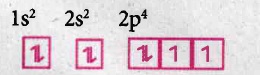
ஃ 8th electron present in 2px orbital and the quantum numbers are
n = 2,l = 1,m1 = either + 1 or -1 and s = -1/2
Electronic configuration of chlorine
.png)
15th electron present in 3Pz orbital and the quantum numbers are n = 3, l = 1, m1 = either +1 or -1 and ms = +1/2
36.
It will be more difficult to drink water with a straw on the top of a Mount Everest. This is because the reduced atmospheric pressure is less effective in pushing water up into the straw, below the water surface.
The force that propels water through a straw is atmospheric pressure, which is less at high altitude.
37.
Inductive effect (I):
(i) Inductive effect is defined as the change in the polarisation of a covalent bond due to the presence of adjacent bonds, atoms or groups in the molecule. This is a permanent phenomenon.
(ii) Let us explain the inductive effect by considering ethylchloride as example. The C-C bond in ethyl chloride is polar.
We know that chlorine is more electronegative than carbon, and hence it attracts the shared pair of electron between C-Cl in ethyl chloride towards itself. is develops a slight negative charge on Chlorine and a slight positive charge on carbon to which chlorine is attached.
To compensate it, the C1 draws the shared pair of electron between itself and. C2 . This polarisation effect is called inductive effect.
(iii) The magnitude of the charge separation decreases rapidly, as we move away from C1 and is observed maximum for 2 carbons and almost insignicant after 4 bonds from the active group.
\(\overset { \delta }{ C } \overset { \delta + }{ { H }_{ 3 } } \longrightarrow \underset { 1 }{ C\overset { \delta + }{ { H }_{ 2 } } } \twoheadrightarrow \overset { \delta - }{ C } { l }_{ 2 }\)
It is important to note that the inductive effect does not transfer electrons from one atom to another but the displacement effect is permanent. The inductive effect represents the ability of a particular atom or a group to either withdraw or donate electron density to the attached carbon. Based on this ability the substituents are classified as +I groups and -I groups. Their ability to release or withdraw the electron through sigma covalent bond is called +I effect and -I effect respectively.
Highly electronegative atoms and atoms of groups which are carry a positive charge are electron withdrawing or -I group
Example : -F, -CI, -COOH, -NO2, NH2,
Higher the electronegativity of the substitutent, greater is the -I effect.
The order of the -I effect of some groups are given below :
NH3+ > NO2 > CN > SO3H > CHO > CO > COOH > COCI > CONH2 > F > Cl > Br > I > OH > OR, NH2 > C6H5 > H
Highly electropositive atoms and atoms are groups which carry a negative charge are electron donating or +I groups.
Example. Alkali metals, alkyl groups such as methyl, ethyl, negatively charged groups such as CH3O-, C2H5O-, COO- etc.
Lesser the electronegativity of the elements, greater is the +I effect. The relative order of +I effect of some alkyl groups is given below
\(-\mathrm{C}\left(\mathrm{CH}_3\right)_3>-\mathrm{CH}\left(\mathrm{CH}_3\right)_2>-\mathrm{CH}_2 \mathrm{CH}_3>-\mathrm{CH}_3\)
Let us understand the influence of inductive effect on some properties of organic compounds.
Reactivity :
When a highly electronegative atom such as halogen is attached to a carbon then it makes the C-X bond polar. In such cases the -I effect of halogen facilitates the attack of an incoming nucleophile at the polarised carbon, and hence increases the reactivity.
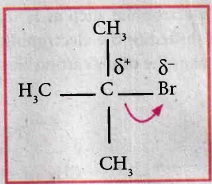
If a - I group is attached nearer to a carbonyl carbon, it decreases the availability of electron density-on the carbonyl carbon, and hence increases the rate of the nucelophilic addition reaction.
Aciditv of carborvlic acids :
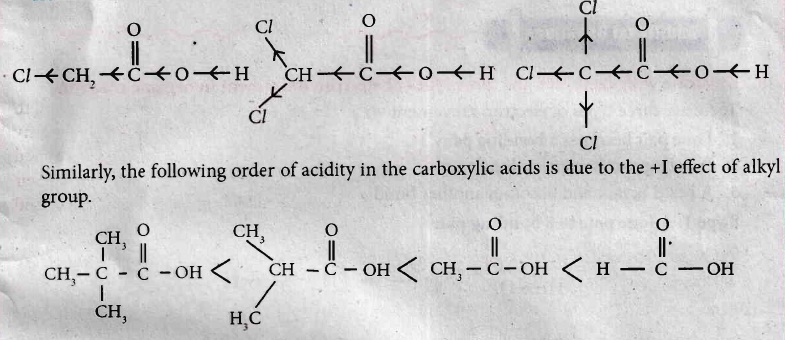
When a halogen atom is attached to the carbon which is nearer to the carboxylic acid group, its -I effect withdraws the bonded electrons towards itself and makes the ionisation of H+ easy. The acidity of various chloro acetic acid is in the following order. The strength of the acid increases with increase in the -I effect of the group attached to the carboxyl group.
Tiichloro acetic acid > Dichloro acetic acid > Chloro acetic acid > acetic acid
38.
Homologous series: A series of organic compounds each containing a characteric functional group and the successive' members differ from each other in molecular formula by a CH2 group is called homologous series. Eg.
Alkanes : Methane (CH4), Ethane (C2H6), Propane (C3Hg) etc .
Alcohols: Methanol (CH3OH), Ethanol (C2H5OH) Propanol (C3H7OH) etc ..)
Compounds of the homologous series are represented by a general formula Alkanes CnH2n+2' Alkenes CnH2n, Alkynes CnH2n-2 and can be prepared by general methods. They show regular gradation in physical properties but have almost similar chemical property.
39.
Mass of He = 0.4 g; V = 10 Litres
Mass of O = 1.6 g; T = 27oC + 273 = 300K
Mass of N = 1.4g
R = 0.0821 dm3 atm K-1 mol-1
Sol:
Calculate of no.of moles:
\(\left[ No.of\ moles=\frac { mass }{ molecular\ mass } \right] \)
No.of moles of He (nHe) = \(\frac { 0.4 }{ 4 } =0.1\)
No.of moles O2 (\({ n }_{ { o }_{ 2 } }\)) = \(\frac { 1.6 }{ 32 } =0.05\)
No. of moles of N2 (\({ n }_{ { N }_{ 2 } }\)) =\(\frac { 1.4 }{ 28 } =0.05\)
Total no.of moles (n) = nHe + \({ n }_{ { o }_{ 2 } }\) + \({ n }_{ { N }_{ 2 } }\)
= 0.1 + 0.05 + 0.05
n = 0.2
Calculate of mole fraction:
Mole fraction of He (XHe) = \(\frac { 0.1 }{ 0.2 } =0.5\)
Mole fraction of O2 (\({ X }_{ { o }_{ 2 } }\)) = \(\frac { 0.05 }{ 0.2 } =0.25\)
Mole fraction of N2 ( \({ X }_{ { N }_{ 2 } }\)) = \(\frac { 0.05 }{ 0.2 } =0.25\)
Calculate of Total pressure of an ideal gas:
PV = nRT
\(P=\frac { nRT }{ V } \)
\(=\frac { 0.2\times 0.082\times 300 }{ 10 } =0.4926\)
P = 0.4926 atm
Calculation of Partial pressure:
Partial pressure of He (PHe) = 0.5 x 0.4926
= 0.2463 atm
[\(\therefore\) Partial pressure = mole fraction x Total pressure]
Partial pressure of O2 (\({ P }_{ { o }_{ 2 } }\)) = 0.25 x 0.4926 = 0.1231 atm
Partial pressure of N2 (\({ P }_{ { N }_{ 2 } }\)) = 0.25 x 0.4926 = 0.1231 atm
Calculation of Total pressure in the cylinder:
\(\therefore\) Total pressure PTotal = PHe + \({ P }_{ { o }_{ 2 } }\) + \({ P }_{ { N }_{ 2 } }\)
= 0.2463 + 0.1231 + 0.1231
= 0.4925
PTotal = 0.4925 atm
40.
| Chemical Properties | Metals | Non-Metals |
|---|---|---|
| Oxidising and Reducing Action | Generally good reducing agents | Generally good oxidising agents |
| Nature of oxides | Metallic oxides are basic in nature | Non-metallic oxides are acidic in nature |
| Nature of Hydrides | Form unstable hydride | Form stable hydrides |
| Action with acid | Dissolve in mineral acid to form salt. | Do not react with mineral acids |
| Arrangement of valence electrons | They have one, two or three valence electrons. | They have 4,5,6, 7 valence electrons |
41.
Born - Haber cycle for the formation of CaCl2
Born - Haber cycle is used to calculate the lattice enthalpy of CaCl2
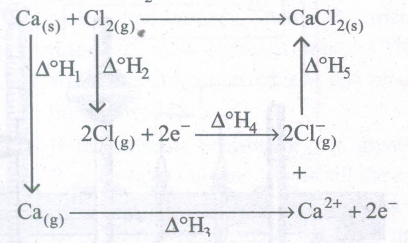
ΔoH1 - Enthalpy change for the sublimation of Ca(s) to Ca(g)
ΔoH2 - Enthalpy change for dissociation of Cl2(g) to 2Cl(g)
ΔoH3 - Ionisation energy for Ca(g) to Ca2+(g)
ΔoH4 - Electron affinity for the conversion of 2Cl(g) to 2Cl-(g)
ΔoH5 - Lattice enthalpy for the formation of solid CaCl2·
ΔoHf =ΔoH1+ΔoH2+ΔoH3+ΔoH4+ΔoH5
42.
Screening effect: The repulsive force between the inner shell electrons and the valence electrons leads to a decrease in the electrostatic attractive forces acting on the valence electrons by the nucleus. Thus, the inner shell electrons act as a shield between the nucleus and the valence electrons. This effect is called shielding effect.
Pauling's scale: Pauling, he assigned arbitrary value of electronegativities for hydrogen and fluorine as 2.2 and 4.0 respectively. Based on this the electronegativity values for other elements can be calculated using the following expression.
\(({ X }_{ A }-{ X }_{ B })=0.182\sqrt { E_{ AB } } -({ E }_{ AA }*{ E }_{ BB })^{ 1/2 }\)
Where EAB' EAA and EBB are the bond dissociation energies of AB, A2 and B2 molecules respectively. The electronegativity of any given element is not a constant and its value depends on the element to which it is covalently bound. The electronegativity values play an important role in predicting the nature of the bond.
43.
| H2O | H2O2 | |
|---|---|---|
| Hybridisation of oxygen |
SP3 | Sp3 (each 0 - atom) |
| Structure | .jpg) |
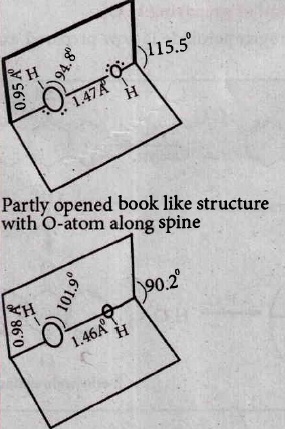 |

11th Standard Syllabus & Materials
11th Standard
TN 11th Tamil பீடு பெற நில் - செய்யுள் - காவடிச்சிந்து Important Questions And Answers Study Material - QB365 Set A
NEW11th Standard
TN 11th Tamil பீடு பெற நில் - உரைநடை - மலை இடப்பெயர்கள் : ஓர் ஆய்வு Important Questions And Answers Study Material - QB365 Set A
NEW11th Standard
TN 11th Tamil மாமழை போற்றுதும் - துணைப்பாடம் - யானை டாக்டர் Important Questions And Answers Study Material - QB365 Set A
NEW11th Standard
TN 11th Tamil மாமழை போற்றுதும் - செய்யுள் - ஐங்குறுநூறு Important Questions And Answers Study Material - QB365 Set A



Tamilnadu Stateboard 11th Standard Subjects

Maths

Commerce

Economics

Biology

Business Maths and Statistics

Accountancy

Computer Science

Physics
Chemistry
Maths
Biology
Economics
Physics
Chemistry

History
Business Maths and Statistics

Computer Science
Accountancy

Computer Applications
History
Computer Technology
Commerce
Computer Applications
Computer Technology

Tamil

English

French
Tamilnadu Stateboard Standards
