100% FREE ACCESS
9th Standard CBSE Syllabus & Materials
9th Standard CBSE
CBSE 9th Science Is matter around us pure? - New Model Questions Papers Study Material - QB365 Set A
NEW9th Standard CBSE
CBSE 9th Science Matter in our surroundings - New Model Questions Papers Study Material - QB365 Set A
NEW9th Standard CBSE
CBSE 9th Mathematics Heron's Formula Sample Question Papers Study Material - QB365 Set A
NEW9th Standard CBSE
CBSE 9th Mathematics Circles Sample Question Papers Study Material - QB365 Set A
NEW9th Standard CBSE
CBSE 9th Mathematics Quadrilaterals Sample Question Papers Study Material - QB365 Set A
NEW9th Standard CBSE
CBSE 9th Mathematics Triangles Sample Question Papers Study Material - QB365 Set A

Published on: 02/08/2018
Based on the current academic syllabus, some of the important questions are prepared from the chapter Heron's Formula.
Students, subscribe and get plenty of question paper with answer key. For subscription please click here.
Download CBSE Class 9th Standard CBSE Mathematics question papers, sample papers, important questions, and previous year solved papers in PDF format. Get free study materials, NCERT solutions, and exam preparation resources for Class 9th Standard CBSE Mathematics
Questions + Answers key
Take MCQ Mathematics Test
1.
Students of a school staged a rally for cleanliness campaigp. They walked through the lanes in two groups. One group walked through the lanes AB, BC and CA; while the other through AC, CD and DA. Then they cleaned the area enclosed within their lanes. If AB = 9 m, BC = 40 m, CD = 15 m, DA = 28 m and \(\angle B=90°\) , which group cleaned more area and by how much? Find the total area cleaned by the students.
2.
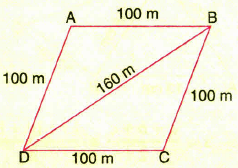
Sanya has a piece of land which is in the shape of a rhombus. She wants her one daughter and one son to work on the land and produce different crops to suffice the needs of their family. She divided the land in two equal parts. If the perimeter of the land is 400 m and one of the diagonals is 160 m, how much area each of them will get?
3.
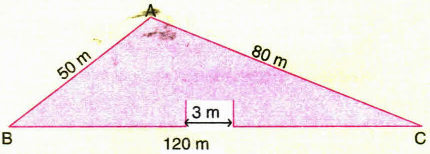
A triangular park ABC has sides 120 m, 80 m and 50 m. A gardener Dhania has to put a fence all around it and also plant grass inside. How much area does she need to plant? Find the cost of fencing it with barbed wire at the rate of Rs. 20 per metre leaving a space 3 m wide for a gate on one side.
4.
The sides of a triangular plot are in the ratio 3: 5: 7 and its perimeter is 300 m. Find its area
5.
The perimeter of a triangular ground is 900 m and its sides are in the ratio 3: 5 : 4. Using Heron's formula, find the area of the ground.
6.
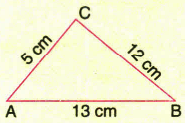
The sides of a right triangle ABC are 5 cm, 12 cm and 13 cm. Find the area of the triangle.
7.
\(\triangle \)ABC is an isosceles triangle with AB = AC.The perimeter of the triangle is 36 cm and AB = 10 cm. What is the area of the triangle?
8.
(a) Find the area of the triangle.
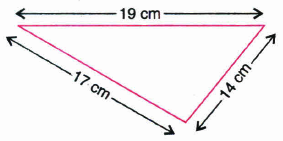
(b) Find the area of a triangle whose sides are 16 cm, 14 cm, nd 10 cm.
(c) The sides of a triangle are 7 cm, 12 cm, and 13 cm. Find its area.
d) Find the area of a triangle whose sides are 11 m, 60 m and 61 m.
9.
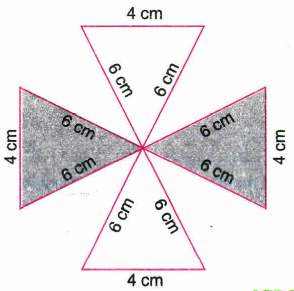
Black and white coloured triangular sheets are used to make a toy as shown in figure. Find the total area of black and white colour sheets used for making the toy.
10.
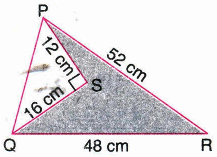
In the following figure, calculate the area of the shaded portion:
11.
The perimeter of a right triangle is 24 cm. If its hypotenuse is 10 cm, find its area.
12.
A square and an equilateral triangle have equal perimeters.If the diagonal of the square is \(12\sqrt { 2 } \) cm then area of the triangle is
\(24\sqrt { 2 } \) cm2
\(24\sqrt { 3 } \) cm2
\(48\sqrt { 3 } \) cm2
\(64\sqrt { 3 } \) cm2
13.
A regular hexagon has a side 8 cm. Find its area.
\(=8\sqrt { 3 } \) cm2
\(=96\sqrt { 3 } \) cm2
\(=4\sqrt { 3 } \) cm2
\(=12\sqrt { 3 } \) cm2
14.
The parallel sides of a trapezium are 45.8 cm and 81.2 cm and the distance between then is 22 cm.Find the area of the trapezium.
1397 cm2
1937 cm2
3197 cm2
139.7 cm2
15.
Area of a rhombus is 90 cm2 .One of its diagonals measures 10 cm.Length of the other diagonal is
18 cm
36 cm
80 cm
9 cm
16.
1 are =
10 m2
100 m2
1000 m2
10000 m2
17.
Find the area of an isosceles triangle whose equal sides are 6 cm each and the third side is 8 cm.
\(8\sqrt { 5 } \) cm2
\(5\sqrt { 8 } \) cm2
\(3\sqrt { 55 } \) cm2
\(3\sqrt { 8 } \) cm2
18.
Heron's formula is
\(\Delta =\sqrt { s(s+a)(s+b)(s+c) } \)
\(\Delta =\sqrt { s(s-a)(s-b)(s-c) } \)
\(\Delta =\sqrt { s(s-a)(s-b)(s-c) } \), s=a+b+c
\(\Delta =\sqrt { s(s-a)(s-b)(s-c) } \), 2s=a+b+c
19.
The diagonals of a rhombus are 10 cm and 8 cm.Its area is
80 cm2
40 cm2
9 cm2
36 cm2
20.
The perimeter of an equilateral triangle is 60 m.Its area is
\(10\sqrt { 3 } \) m2
\(100\sqrt { 3 } \)m2
\(15\sqrt { 3 } \)m2
\(20\sqrt { 3 } \)m2
21.
The side of an equilateral triangle is 6 cm.The area of the triangle is
\(6\sqrt { 3 } \) cm2
\(9\sqrt { 3 } \) cm2
\(16\sqrt { 3 } \) cm2
\(3\sqrt { 3 } \) cm2
22.
The base of a right triangle is 15 cm and its hypotenuse is 25 cm.Then its area is
187.5 cm2
375 cm2
150 cm2
300 cm2
23.
Area of a triangle is 60 cm2.Its base is 15 cm.Its altitude is
30 cm
4 cm
8 cm
10 cm
24.
The area of \(\triangle \)ABC in which AB = BC = 4 cm and \(\angle B=90°\) is
16 cm2
8 cm2
4 cm2
12 cm2
25.
Base of a triangle =
\(\frac { 2\times Area }{ Height } \)
\(\frac { Area }{ Height } \)
\(\frac { Area }{ 2\quad Height } \)
\(\frac { Area }{ 4\quad Height } \)
26.
Area of a triangle =
\(\frac { 1 }{ 2 } \times\) Base \( \times\) Height
Base \( \times\) Height
\(\frac { 1 }{ 3} \times\) Base \( \times\) Height
\(\frac { 1 }{ 4 } \times\) Base \( \times\) Height
1.
Since AB = 9 m and BC = 40 m, Ð B = 90°, we have
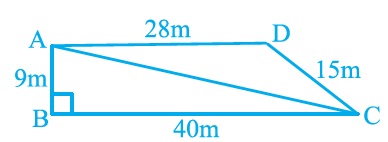
\( \mathrm{AC} =\sqrt{9^{2}+40^{2}} \mathrm{~m} \)
\(=\sqrt{81+1600} \mathrm{~m} \)
\(=\sqrt{1681} \mathrm{~m}=41 \mathrm{~m} \)
Therefore, the first group has to clean the area of triangle ABC, which is right angled.
\(Area of \Delta \mathrm{ABC}=\frac{1}{2} \times base \times height \)
\(=\frac{1}{2} \times 40 \times 9 \mathrm{~m}^{2}=180 \mathrm{~m}^{2} \)
The second group has to clean the area of triangle ACD, which is scalene having sides 41 m, 15 m and 28 m.
Here, \(s=\frac{41+15+28}{2} \mathrm{~m}=42 \mathrm{~m}\)
Therefore, area of \(\Delta \mathrm{ACD}=\sqrt{s(s-a)(s-b)(s-c)}\)
\(=\sqrt{42(42-41)(42-15)(42-28)} \mathrm{m}^{2} \)
\( =\sqrt{42 \times 1 \times 27 \times 14} \mathrm{~m}^{2}=126 \mathrm{~m}^{2} \)
So first group cleaned 180 m2 which is (180 – 126) m2, i.e., 54 m2 more than the area cleaned by the second group.
Total area cleaned by all the students = (180 + 126) m2 = 306 m2.
2.
Let ABCD be the field.
Perimeter = 400 m
So, each side = 400 m ÷ 4 = 100 m.
i.e. AB = AD = 100 m.
Let diagonal BD = 160 m.
Then semi-perimeter s of D ABD is given by
\(s=\frac{100+100+160}{2} \mathrm{~m}=180 \mathrm{~m}\)
Therefore, area of \(\Delta \mathrm{ABD}=\sqrt{180(180-100)(180-100)(180-160)}\)
\(=\sqrt{180 \times 80 \times 80 \times 20} \mathrm{~m}^{2}=4800 \mathrm{~m}^{2}\)
Therefore, each of them will get an area of 4800 m2.
3.
For finding area of the park, we have
2s = 50 m + 80 m + 120 m = 250 m.
i.e., s = 125 m
Now, s – a = (125 – 120) m = 5 m,
s – b = (125 – 80) m = 45 m,
s – c = (125 – 50) m = 75 m.
Therefore, area of the park = \(\sqrt{s(s-a)(s-b)(s-c)}\)
\(=\sqrt{125 \times 5 \times 45 \times 75} \mathrm{~m}^{2}\)
\(=375 \sqrt{15} \mathrm{~m}^{2}\)
Also, perimeter of the park = AB + BC + CA = 250 m
Therefore, length of the wire needed for fencing = 250 m – 3 m (to be left for gate)
= 247 m
And so the cost of fencing = Rs.20 x 247 = RS. 4940
4.
Suppose that the sides, in metres, are 3x, 5x and 7x (see Fig.).
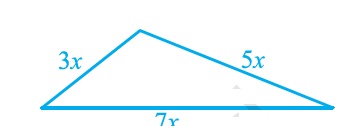
Then, we know that 3x + 5x + 7x = 300 (perimeter of the triangle)
Therefore, 15x = 300, which gives x = 20.
So the sides of the triangle are 3 x 20 m, 5 x 20 m and 7 x 20 m
i.e., 60 m, 100 m and 140 m.
We have s \(=\frac{60+100+140}{2} \mathrm{~m}=150 \mathrm{~m}\)
and area will be \(\sqrt{150(150-60)(150-100)(150-140)} \mathrm{m}^{2}\)
\(=\sqrt{150 \times 90 \times 50 \times 10} \mathrm{~m}^{2}\)
\(=1500 \sqrt{3} \mathrm{~m}^{2}\)
5.
33750 cm2
6.
30 cm2.
7.
48 cm2
8.
(a) 114.89 cm2
(b) \(40\sqrt { 3 } \)cm2
(c) \(24\sqrt { 3 } \)cm2
(d) 330 m2
9.
For one black colour sheet a= 4 cm, b = 6 cm
\(\therefore \) Area \(=\frac { a }{ 4 } \sqrt { 4{ b }^{ 2 }-{ a }^{ 2 } } \) | Sheet is an isosceles triangle
\(=\frac { 4 }{ 4 } \sqrt { 4{ (6) }^{ 2 }-4^{ 2 } } \) \(=\sqrt { 128 } =8\sqrt { 2 } \) cm2
\(\therefore \) Area of 2 black colour sheets = 2\(\times 8\sqrt { 2 } \) = \( 16\sqrt { 2 } \) cm2
Similarly, area of 2 white colour sheets = \( 16\sqrt { 2 } \) cm2
\(\therefore \) Total area of black and white colour sheets = \( 16\sqrt { 2 } \) + \( 16\sqrt { 2 } \) = \( 32\sqrt { 2 } \) cm2
10.
In right triangle PSQ, PQ\(\frac { 1 }{ 2 } \)2 = PS2 + QS2 |By Pythagoras Theorem
= (12)2 + (16)2
= 144 + 256 =400
\(\Rightarrow \) PQ = \(\sqrt { 400 } \) = 20 cm
Now, for \(\Delta \)PQR
a = 20cm, b = 48cm, c = 52cm
\(\therefore s=\frac { a+b+c }{ 2 } =\frac { 20+48+52 }{ 2 } =60\) cm
\(\therefore \) Area of \(\Delta \)PQR \(=\sqrt { s(s-a)(s-b)(s-c) } \)
\(=\sqrt { 60(60-20)(60-48)(60-52) }\)
\( \\ =\sqrt { (60)(40)(12)(8) } \)
\(=\sqrt { \left( 6\times 10 \right) \left( 4\times 10 \right) \left( 6\times 2 \right) \left( 8 \right) } \)
\(=6\times 10\times 8=480\) cm2
Area of \(\Delta \) PSQ = \(\frac { 1 }{ 2 } \)\(\times \)Base\(\times \)Altitude
=\(\frac { 1 }{ 2 } \)\(\times \)16\(\times \)12=96 cm2
\(\therefore \) Area of the shaded portion =Area of \(\Delta \)PQR - Area of \(\Delta \)PSQ
= 480 - 96 = 384 cm2
11.
Let the sides forming the right angle be a cm and b cm. Then,
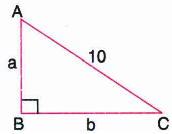
a + b + 10 = 24
\(\Rightarrow \) a + b = 14 ....(1)
Also, a2 + b2 = (10)2 |By Pythagoras Theorem
\(\Rightarrow \) a2 + b2 = 100 ...(2)
We know that (a + b)2 = a2 + b2 + 2ab
\(\Rightarrow \) (14)2 = 100+2ab
\(\Rightarrow \) 2ab = 96
\(\Rightarrow \) ab=48 ...(3)
Also, (a - b)2 = a2 + b2- 2ab
= 100 - 2\(\times \)48
= 100 - 96 = 4 | if a>b
\(\Rightarrow \) a- b = 2
Solving (1) and (4), we get a=8cm, b=6cm
\(\therefore \) Area = \(\frac { 1 }{ 2 } \)ab = \(\frac { 1 }{ 2 } \).8.6 = 24 cm2
12.
(d)
\(64\sqrt { 3 } \) cm2
13.
Area = 6\(\left\{ \frac { \sqrt { 3 } }{ 4 } { (8) }^{ 2 } \right\} \) = \(96\sqrt { 3 } \) cm2
14.
Area = \(\frac { (45.8+81.2)\times 22 }{ 2 } \)
= 127\(\times \)11 = 1397 cm2
15.
(a)
18 cm
16.
Formula
17.
(a)
\(8\sqrt { 5 } \) cm2
18.
See Hero's formula.
19.
Area = \(\frac { 1 }{ 2 } \times 10\times 8=40\)cm2
20.
Side (a) = \(\frac { 60 }{ 3 } =20\)m
\(\therefore \) Area =\(\quad =\frac { \sqrt { 3 } }{ 4 } { a }^{ 2 }=\frac { \sqrt { 3 } }{ 4 } { (20) }^{ 2 }=100\sqrt { 3 } \) m2
21.
\(\frac { \sqrt { 3 } }{ 4 } { (6) }^{ 2 }=9\sqrt { 3 }\) cm2.
22.
(c)
150 cm2
23.
(c)
8 cm
24.
Area = \(\frac { AB\times BC }{ 2 } =\frac { 4\times 4 }{ 2 } \)= 8 cm2
25.
Formula
26.
Formula

9th Standard CBSE Syllabus & Materials
9th Standard CBSE
CBSE 9th Mathematics Lines and Angles Sample Question Papers Study Material - QB365 Set A
NEW9th Standard CBSE
CBSE 9th Mathematics Introduction to Euclid's Geometry Sample Question Papers Study Material - QB365 Set A
NEW9th Standard CBSE
CBSE 9th Mathematics Linear Equations in Two Variables Sample Question Papers Study Material - QB365 Set A
NEW9th Standard CBSE
CBSE 9th Mathematics Coordinate Geometry Sample Question Papers Study Material - QB365 Set A



CBSE 9th Standard CBSE Subjects
CBSE Standards