
 100% FREE ACCESS
11th Standard Syllabus & Materials
11th Standard
TN 11th Tamil இயற்கை வேளாண்மை,சுற்றுச்சூழல் -செய்யுள் - மனோன்மணீயம் Important Questions And Answers Study Material - QB365 Set A
NEW11th Standard
TN 11th Tamil என்னுயிர் என்பேன் -துணைப்பாடம் - இசைத்தமிழர் இருவர் Important Questions And Answers Study Material - QB365 Set A
NEW11th Standard
TN 11th Tamil மொழி கலை -செய்யுள் - ஒவ்வொரு புல்லையும் Important Questions And Answers Study Material - QB365 Set A
NEW11th Standard
TN 11th Tamil பீடு பெற நில் - இலக்கணம் - பகுபத உறுப்புகள் Important Questions And Answers Study Material - QB365 Set A
NEW11th Standard
TN 11th Tamil பீடு பெற நில் - துணைப்பாடம் - வாடிவாசல் Important Questions And Answers Study Material - QB365 Set A
NEW11th Standard
TN 11th Tamil பீடு பெற நில் - செய்யுள் - குறுந்தொகை Important Questions And Answers Study Material - QB365 Set A

Published on: 26/02/2019
HSC +1 Third Revision Test 2019
Download Tamil Nadu 11th Standard Physics question papers, model tests, one-mark questions, important questions, and public exam papers in PDF format. Free study materials and answer keys for TN State Board students.
Questions + Answers key
Take MCQ Physics Test1.
A body of mass 1 kg is executing SHM given by, x = 4 Cos\(\left( 100t+\frac { \pi }{ 2 } \right) \)cm. Whatis the velocity?
200 sin t(100 t+\(\frac{\pi}{2}\))
-200 sin t(100 t+\(\frac{\pi}{2}\))
400 sin t(100 t+\(\frac{\pi}{2}\))
-400 sin t(100 t+\(\frac{\pi}{2}\))
2.
When the distance between the two atoms becomes '\(\gamma_{0}\)' then the inter atomic force will be____________.
Zero
Infinity
Negative constant
Positive constant
3.
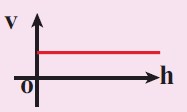
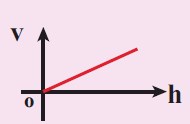
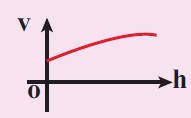
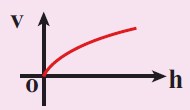
A uniform rope having mass m hangs vertically from a rigid support. A transverse wave pulse is produced at the lower end. Which of the following plots shows the correct variation of speed v with height h from the lower end?
4.
A simple pendulum is suspended from the roof of a school bus which moves in a horizontal direction with an acceleration a, then the time period is
\(T\propto \frac { 1 }{ { g }^{ 2 }+{ a }^{ 2 } } \)
\(T\propto \frac { 1 }{ \sqrt { { g }^{ 2 }+{ a }^{ 2 } } } \)
\(T\propto \sqrt { { g }^{ 2 }+{ a }^{ 2 } } \)
\(T\propto \left( { g }^{ 2 }+{ a }^{ 2 } \right) \)
5.
A particle of mass m is moving with speed u in a direction which makes 60° with respect to x axis. It undergoes elastic collision with the wall. What is the change in momentum in x and y direction?
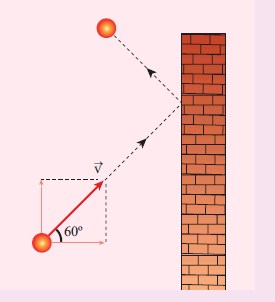
Δpx = −mu, Δpy = 0
Δpx = −2mu, Δpy = 0
Δpx = 0, Δpy = mu
Δpx = mu, Δpy = 0
6.
7.
For a given material, the rigidity modulus is \(\left( \frac { 1 }{ 3 } \right) \)rd of Young’s modulus. Its Poisson’s ratio is
0
0.25
0.3
0.5
8.
The magnitude of the Sun’s gravitational field as experienced by Earth is
same over the year
decreases in the month of January and increases in the month of July
decreases in the month of July and increases in the month of January
increases during day time and decreases during night time
9.
The distance travelled by a particle starting from rest and moving with an acceleration \({4\over3}ms^{-2}\), in the third second is _____________.
\({10\over 3}m\)
\({19\over3}m\)
6m
4m
10.
A mass M is moving with a constant velocity along a line parallel to the z-axis away from the origin. Its angular momentum with respect to the origin _____________.
Zero
remains constant
goes on increasing
goes on decreasing
11.
What is the minimum velocity with which a body of mass m must enter a vertical loop of radius R so that it can complete the loop?
\(\sqrt{2gR}\)
\(\sqrt{3gR}\)
\(\sqrt{5gR}\)
\(\sqrt{gR}\)
12.
A particle is moving with a constant velocity along a line parallel to positive X-axis. The magnitude of its angular momentum with respect to the origin is
zero
increasing with x
decreasing with x
remaining constant
13.
Force acting on the particle moving with constant speed is
always zero
need not be zero
always non zero
cannot be concluded
14.
Two objects of masses m1 and m2 fall from the heights h1 and h2 respectively. The ratio of the magnitude of their momenta when they hit the ground is
\(\sqrt { \frac { { h }_{ 1 } }{ { h }_{ 2 } } } \)
\(\sqrt { \frac { { { m }_{ 1 }h }_{ 1 } }{ { { m }_{ 2 }h }_{ 2 } } } \)
\(\frac { { m }_{ 1 } }{ { m }_{ 2 } } \sqrt { \frac { { h }_{ 1 } }{ { h }_{ 2 } } } \)
\(\frac { { m }_{ 1 } }{ { m }_{ 2 } } \)
15.
Which of the following pairs of physical quantities have same dimension?
force and power
torque and energy
torque and power
force and torque
16.
17.
Draw graphs showing the variation of acceleration due to gravity with
(i) height above the earth's surface
(ii) depth below the earth's surface.
18.
Estimate the total number of molecules inclusive of oxygen, nitrogen, water vapour and other consituents in a room of capacity 30 m3 at a temperature of 30°C and 1 atmosphere pressure.
19.
How is skating possible on snow?
20.
An observer observes two moving trains, one reaching the station and other leaving the station with equal speeds of 8 m s−1. If each train sounds its whistles with frequency 240 Hz, then calculate the number of beats heard by the observer.
21.
To maintain a rotor at a uniform angular speed of 200 rad s-1, an engine needs to transmit a torque of 180 Nm. What is the power required by the engine? Assume that the engine is 100% efficient.
22.
Give an example in which a force does work on a body but fails to change its K.E.
23.
Write the role of physics in technology.
24.
25.
Define angular displacement and angular velocity.
26.
How can we distinguish experimentally between longitudinal and transverse waves?
27.
Show that for a particle executing simple harmonic motion
a. the average value of kinetic energy is equal to the average value of potential energy.
b. average potential energy = average kinetic energy = \(\frac{1}{2}\) (total energy)
Hint: average kinetic energy =< kinetic energy > = \(\frac{1}{T} \int_{0}^{T}\)(Kineticenergy) dt and
average Potential energy = < Potential energy > = \(\frac{1}{T} \int_{0}^{T}\) (Potential energy) dt
28.
Define frequency of simple harmonic motion.
29.
State the second law of thermodynamics in terms of entropy.
30.
Give some examples of irreversible processes.
31.
State Pascal’s law in fluids.
32.
A wooden box is lying on an inclined plane. What is the coefficient of friction if the box starts sliding when the angle of inclination is 45°.
33.
Consider a horse attached to the cart which is initially at rest. If the horse starts walking forward, the cart also accelerates in the forward direction. If the horse pulls the cart with force Fh in forward direction, then according to Newton's third law, the cart also pulls the horse by equivalent opposite force Fc = Fh in backward direction. Then total force on 'cart+horse' is zero. Why is it then the 'cart+horse' accelerates and moves forward?
34.
Give an example to show that the following statement is false. 'any two forces acting on a body can be combined into single force that would have same effect'.
35.
Which unit is used to measure electrical energy?
36.
A water fountain on the ground sprinkles water all around it. If the speed of the water coming out of the fountain is v, calculate the total area around the fountain that gets wet.
37.
What is 1 light year?
38.
0.014 kg of nitrogen is enclosed in a vessel at a temperature of 27°C. How much heat has to be transferred to double the rms speed of its molecules.
39.
Obtain an equation of continuity for a flow of fluid on the basis of conservation of mass.
40.
The force F acting on a body moving in a circular path depends on mass of the body (m), velocity (v) and radius (r) of the circular path. Obtain the expression for the force by dimensional analysis method. (Take the value of k = 1)
41.
Explain in details the subtraction of two vectors.
42.
A solid cylinder of mass 20 kg rotates about its axis with angular speed 100 rad/s. The radius of the cylinder is 0.25m. Calculate the kinetic energy associated with the rotation of the cylinder.
43.
Find the work done and power of a car engine which can maintain a speed of 40 ms-1 for a mass of a car 2\(\times\)103 kg on a rough level road to 2 km. The coefficient of friction is 0.05.
1.
(d)
-400 sin t(100 t+\(\frac{\pi}{2}\))
2.
(a)
Zero
3.
Speed varies exponentially with height 'h'.
4.
\(T=2 \pi \sqrt{\frac{\ell}{g}}\)
\(\text { when a bus is moving } g^{\prime} \sqrt{g^{2}+a^{2}}\)
\(\therefore T \propto \frac{1}{\sqrt{g^{2}+a^{2}}}\)
5.
As it moves with respect to x axis
\(\Delta p_{x}=-m u, \Delta p_{y}=0\)
6.
(c)
7.
\(\text { Rigidity modulus }=\frac{1}{3} \times \text { Young's modulus }\)
\(\text { Poisson ratio }=\frac{\text { lateral strain }}{\text { longitudinal strain }}\)
8.
(c)
decreases in the month of July and increases in the month of January
9.
(a)
\({10\over 3}m\)
10.
(b)
remains constant
11.
Radius =R
\(v_{1}^{2}-v_{2}^{2}=4 g R\)
\(\text { Tension } T_{2}=\frac{m v_{2}^{2}}{R_{2}}-m g\)
\(\text {To find minimum speed, let } T_{2}=0\)
\(0 =\frac{m v_{2}^{2}}{R}-m g \)
\(\frac{m v^{2}}{R} =m g \)
\(v_{2}^{2}=R g \ v_{2} =\sqrt{g R} \)
\(\text { sub (2) in the eqn (1) we get }\)
\(v_{1}^{2}-(\sqrt{g R})^{2} =4 g R \)
\(v_{1}^{2}-g R =4 g R \)
\(v_{1}^{2} =4 g R+g R \)
\(=5 g R \)
\(v_{1} =\sqrt{5 g R} \)
12.
(d)
remaining constant
13.
(b)
need not be zero
14.
For freely falling body, velocity while the body, hit the ground \(v=\sqrt{2 g h}\)
\(v_{1}=\sqrt{2 g h_{1}} \text { and } v_{2}=\sqrt{2 g h_{2}} \)
\(\therefore \frac{m_{1} v_{1}}{m_{2} v_{2}}=\frac{m_{1} \sqrt{h_{1}}}{m_{2} \sqrt{h_{2}}}=\frac{m_{1}}{m_{2}} \sqrt{\frac{h_{1}}{h_{2}}}\)
15.
\(\text { Torque }=\text { Force } \times \mathrm{r}\)
\(\text { Dimension of torque }\)
\(=\left[\mathrm{MLT}^{-2}\right][\mathrm{L}]=\left[\mathrm{ML}^{2} \mathrm{~T}^{-2}\right]\)
\(\text { Energy }=\text { Force } \times \text { displacement }\)
\(\text { Dimension of Energy }\)
\(=\left[\mathrm{MLT}^{-2}\right][\mathrm{L}]=\left[\mathrm{ML}^{2} \mathrm{~T}^{-2}\right]\)
16.
17.
(i) The value of g varies with height has
g a\(\frac { 1 }{ { \left( R+h \right) }^{ 2 } } \ or\ g\ a\ \frac { 1 }{ { r }^{ 2 } } \)
Thus the graph of g versus V is the parabolic curve AB
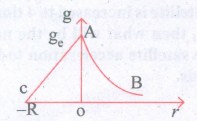
(ii) The value of g varies with depth d as
\(g=g\left( 1-\frac { d }{ R } \right) \)i.e g\(\alpha \)(R-d)
Thus the graph of g versus depth d is the straight line AB.
18.
As Boltzmann's constant,
\({ K }_{ B }=\frac { R }{ N } \therefore R={ K }_{ B }N\)
Now, PV = nRT = nKBNT
The number of molecules in the room
\(=nN=\frac { PV }{ { TK }_{ B } } \)
\(=\frac { 1.013\times { 10 }^{ 5 }\times 30 }{ 303\times 1.38\times { 10 }^{ -23 } } \)
\(=\frac { 1.013\times 30\times { 10 }^{ 5 }\times { 10 }^{ 23 } }{ 303\times 1.38 } \)
\(=\frac { 1.013\times 30\times \times { 10 }^{ 28 } }{ 418.14 } \)
\(=\frac { 30.39\times { 10 }^{ 28 } }{ 418.4 } \)
= 0.0726\(\times\)1028
= 7.26\(\times\)1026
19.
(i) While skating a person presses the snow down ward with his weight i.e increases pressure on snow below the skates.
(ii) Due to it, the melting point of ice becomes lower & ice melts into water, which acts as lubricant for skates.
(iii) As the skater crosses the & now, the pressure on water is released & it is again converted into ice.
20.
Observer is stationary
(i) Source (train) is moving towards an observer:
Apparent frequency due to train arriving station is
\({ f }_{ in }=\frac { f }{ \left( 1-\frac { { v }_{ s } }{ v } \right) } =\frac { 240 }{ \left( 1-\frac { 8 }{ 330 } \right) } =246Hz\)
(ii) Source (train) is moving away form an observer:
Apparent frequency due to train leaving station is
\({ f }_{ out }=\frac { f }{ \left( 1-\frac { { v }_{ s } }{ v } \right) } =\frac { 240 }{ \left( 1-\frac { 8 }{ 330 } \right) } =234Hz\)
So the number of beats = | fin -fout| = (246-234) = 12
21.
Here \(\omega=200\)rad s-1, \(\tau\)-=180 Nm
∵ Power P = \(\tau \omega=180 \times 200\) = 36,000 W = 36 kW.
22.
When a body is pulled on a rough, horizontal surface with constant velocity. Work is done on the body but K.E. remains unchanged.
23.
(i) Basic laws of electricity and magnetism led to the discovery of wireless communication technology which has shrunk the world with effective communication over large distances.
(ii) The launching of satellite into space has revolutionized the concept of communication.
(iii) Microelectronics, lasers, computers, superconductivity and nuclear energy have comprehensively changed the thinking and living style of human beings.
24.
25.
Angular displacement: While a particle is revolving around a point in a circular path, the angle described by the particle about the axis of rotation (or at the centre of the circle) in a given time is called angular displacement. Its unit is radian.
Angular velocity: The rate of change of angular displacement is called angular velocity. Its unit is rad s-1
\(\omega =\frac { d\theta }{ dt } \)
26.
We can distinguish between longitudinal and transverse ways by performing polarization experiments. Transverse waves can be polorised while longitudinal waves cannot be poloriused.
27.
(a) Suppose a particle of mass m executes SHM of time period T. The displacement of the particle of any instant A is given by
\(\mathrm{y} =\mathrm{A} \sin \omega t \) .....(1)
\(\text {Velocity } \mathrm{v} =\frac{d y}{d t}=\frac{d}{d t}\)
\((\mathrm{A} \sin \omega t) =\omega A \cos \omega t\)
\( \therefore \text {Kinetic energy } E_{k} =\frac{1}{2} m v^{2}=\frac{1}{2} m \omega^{2} \cdot A^{2} \cos ^{2} \omega t \) ......(2)
Potential energy \(\mathrm{E}_{\mathrm{p}}=\frac{1}{2} m \omega^{2} y^{2}\)
\(\mathrm{E}_{p}=\frac{1}{2} m \omega^{2} A^{2} \sin ^{2} \omega t\) .....(3)
Average K.E for one period of oscillation is
\(E_{k_{\alpha v}}=\frac{1}{T} \int_{0}^{T} E_{k} d t \)
\(=\frac{1}{T} \int \frac{1}{2} m \omega^{2} A^{2} \cos ^{2} \omega t d t \)
\(=\frac{1}{2 T} m \omega^{2} A^{2} \int_{0}^{T} \frac{(1+\cos 2 \omega t)}{2} d t \)
\(E_{k_{o v}}=\frac{1}{4 T} m \omega^{2} A^{2}\left[t+\frac{\sin 2 \omega t}{2 \omega}\right]_{0}^{T}=\frac{1}{4 T} m \omega^{2} A^{2}(T) \)
\(E_{k_{\alpha v}}=\frac{1}{4 T} m \omega^{2} A^{2}\) .....(4)
Average potential energy over a period of oscillation is
\(E_{p_{\omega}} =\frac{1}{T} \int_{0}^{T} E_{p} d t=\frac{1}{T} \int_{0}^{T} \frac{1}{2} m \omega^{2} A^{2} \sin ^{2} \omega t d t \)
\(=\frac{1}{2 T} m \omega^{2} A^{2} \int_{0}^{T}\left(\frac{1-\cos 2 \omega t}{2}\right) d t \)
\(=\frac{1}{4 T} m \omega^{2} A^{2}\left[t-\frac{\sin 2 \omega t}{2 \omega}\right]_{0}^{T}=\frac{1}{4 T} m \omega^{2} A^{2} C_{1} \)
\(E_{p_{a v}} =\frac{1}{4 T} m \omega^{2} A^{2} \) .....(5)
clearly from equation (4) and (5)
\(E_{k_{\mathrm{ow}}}=E_{p_{\mathrm{wo}}}\)
Average value of K.E = Average value of P.E
(b) Total energy
\(\text {T.E } =\frac{1}{2} m \omega^{2} y^{2}+\frac{1}{2} m \omega^{2}\left(A^{2}-y^{2}\right) \)
\(\text {But y } =\mathrm{A} \sin \omega t \)
\(\text {T.E } =\frac{1}{2} m \omega^{2} A^{2} \sin ^{2} \omega t+\frac{1}{2} m \omega^{2} A^{2} \cos ^{2} \omega t \)
\(=\frac{1}{2} m \omega^{2} A^{2}\left(\sin ^{2} \omega t+\cos ^{2} \omega t\right)\)
\(But \sin ^{2} \omega t+\cos ^{2} \omega t=1\)
Equation (6) becomes
\(\text {T.E }=\frac{1}{2} m \omega^{2} A^{2}(1)=\frac{1}{2} m \omega^{2} A^{2}\)
Average potential energy = Average kinetic energy
\(=\frac{1}{2} \text { (Total energy) }\)
28.
Frequency of simple harmonic motion is defined as the number of oscillations produced by the Particle.
29.
For all the processes that occur in nature (irreversible process), the entropy always increases. For reversible process entropy will not change.
30.
All naturally occuring processes are irreversible. Here we give some interesting examples.
(a) When we open a gas bottle, the gas molecules slowly spread into the entire room. These gas molecules can never get back in to the bottle.
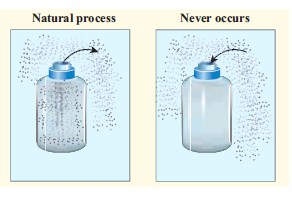
(b) Suppose one drop of an ink is dropped in water, the ink droplet slowly spreads in the water. It is impossible to get the ink droplet back.
(c) When an object falls from some height, as soon as it hits the earth it comes to rest. All the kinetic energy of the object is converted to kinetic energy of molecules of the earth surface, molecules of the object and small amount goes as sound energy. The spreaded kinetic energy to the molecules never collected back and object never goes up by itself.
Note that according to first law of thermodynamics all the above processes are possible in both directions. But second law of thermodynamics forbids The processes to occur in the reverse direction. The second law of thermodynamics is one of the very important laws of nature. It controls the way the natural processes occur.
31.
Pascal's law states that, if the pressure in a liquid is changed at a particular point, the change is transmitted to the entire liquid without being diminished in magnitude.
32.
Angle of inclination θ = 450
∴ Coefficient of friction μ= tan θ = tan450=1
33.
This paradox arises due to wrong application of Newton's second and third laws. Before applying Newton's laws, we should decide 'what is the system?'. Once we identify the 'system', then it is possible to identify all the forces acting on the system. We should not consider the force exerted by the system. If there is an unbalanced force acting on the system, then it should have acceleration in the direction of the resultant force. By following these steps we will analyse the horse and cart motion.
If we decide on the cart+horse as a 'system', then we should not consider the force exerted by the horse on the cart or the force exerted by cart on the horse. Both are internal forces acting on each other. According to Newton's third law, total internal force acting on the system is zero and it cannot accelerate the system. The acceleration of the system is caused by some external force. In this case, the force exerted by the road on the system is the external force acting on the system. It is wrong to conclude that the total force acting on the system (cart+horse) is zero without including all the forces acting on the system. The road is pushing the horse and cart forward with acceleration. As there is an external- force acting on the system, Newton's second law has to be applied and not Newton's third law. The following figures illustrates this.
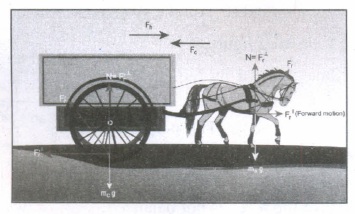
If we consider the horse as the 'system', then there are three forces acting on the horse.
(i) Downward gravitational force (mhg)
(ii) Force exerted by the road (Fr)
(iii) Backward force exerted by the cart (Fc)
It is shown in the following figure.
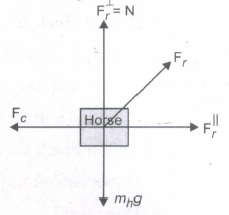
Fr - Force exerted by the road on the horse
Fc - Force exerted by the cart on the horse
F丄r-Perpendicular component of Fr=N
F||r-Parallel component of Fr which is reason for forward movement.
The force exerted by the road can be resolved into parallel and perpendicular components. The perpendicular component balances the downward gravitational force. There is parallel component along the forward direction. It is greater than the backward force (Fc). So there is net force along the forward direction which causes the forward movement of the horse.
If we take the cart as the system, then there are three forces acting on the cart.
(i) Downward gravitational force (mcg)
(ii) Force exerted by the road (Fr)
(iii) Force exerted by the horse (Fh)
It is shown in the figure.
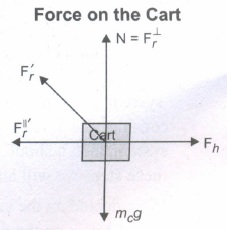
The force exerted by the road (\(\vec { { F }_{ r } } \) ) can be resolved into parallel and perpendicular components. The perpendicular component cancels the downward gravity (mcg). Parallel component acts backwards and the force exerted by the horse (\(\vec { { F }_{ h } } \) ) acts forward. Force (\(\vec { { F }_{ h } } \) ) is greater than the parallel component acting in the opposite direction. So there is an overall unbalanced force in the forward direction which causes the cart to accelerate forward.
If we take the cart+horse as a system, then there are two forces acting on the system.
(i) Downward gravitational force (mh + mc)g
(ii) The force exerted by the road (Fr) on the system.
It is shown in the following figure.
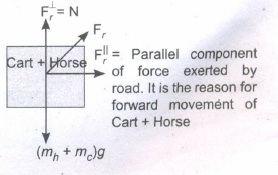
(iii) In this case the force exerted by the road (Fr) on the system (cart+horse) is resolved in to parallel and perpendicular components. The perpendicular component is the normal force which cancels the downward gravitational force (mh + mc)g. The parallel component of the force is not balanced, hence the system (cart+horse) accelerates and moves forward due to this force.
34.
Lifting a table from the floor by two persons. Pushing the car by two persons.
35.
Electrical energy is measured in the unit called kilowatt hour (kWh).
1 electrical unit = 1 kWh = 1\(\times\)(103 W)\(\times\)(3600 s)
1 electrical unit = 3600\(\times\)103 Ws
1 electrical unit = 3.6\(\times\)106J
1 kWh =3.6\(\times\)106J
36.
Sprinkled water takes circular motion.
The centripetal acceleration \(=\frac{v^2}{r}\). The centripetal acceleration is provided by the acceleration due to gravity.
\(\therefore g=\frac { v^2 }{ r } \ or \ r=\frac { { v }^{ 2 } }{ g } \)
∴ Area around the fountain that gets wet = πr2
\(=\pi { \left( \frac { { r }^{ 2 } }{ g } \right) }^{ 2 }=\frac { { \pi r }^{ 4 } }{ { g }^{ 2 } } \)
37.
1 light year is distance travelled by light in vacuum in one year. 1 Light Year = 9.467\(\times\)1015 m.
38.
Number of molecule in 0.014 kg of nitrogen
\(n=\frac { 0.014\times { 10 }^{ 3 } }{ 27 } \)=0.0005\(\times\)103
\(=0.5=\frac { 1 }{ 2 } \)mole.
Molecular specific heat
\({ C }_{ V }=\frac { 5 }{ 2 } \times R\)
\({ C }_{ V }=\frac { 5 }{ 2 } R=\frac { 5 }{ 2 } \times 2\)
\(=\frac { 10 }{ 2 } =5\)cal / molecule k
[\(\therefore\) Nitrogen diatom molecule So=\(\frac{5}{2}\)]
Ratio of volume \(\frac { { V }_{ 2 } }{ { V }_{ 1 } } =\sqrt { \frac { { T }_{ 2 } }{ { T }_{ 1 } } , } { T }_{ 2 }=4{ T }_{ 1 }\)
\(\Delta\) T=T2-T1=4T1-T1=3T1
= 3\(\times\)300=900K
\(\Delta\)Q = nCV\(\Delta\)T= \(\frac{1}{2}\)\(\times\)5\(\times\)900
\(\therefore\)Heat transfer \(\Delta\)Q = 2250 cal
39.
Consider a pipe AB of varying cross sectional area a1 and a2 such that a1 > a2. A non-viscous and incompressible liquid flows steadily through the pipe, with velocities v1 and v2 in area a1 and a2, respectively as shown in Figure.
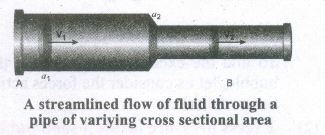
Let m1 be the mass of fluid flowing through section A in time Δt, m1 = (a1v1Δt) p
Let m2 be the mass of fluid flowing through section B in time Δt, m2= (a2v2Δt) p
For an incompressible liquid, mass is conserved m1 =m2
a1v1Δtρ = a2v2Δtρ
a1v1 = a2v2 ⇒ av = constant
which is called the equation of continuity and it is a statement of conservation of mass in the flow of fluids.
In general, a v = constant, which means that the volume flux or flow rate remains constant throughout the pipe. In other words, the smaller the cross section, greater will be the velocity of the fluid.
40.
F ∝ ma vb rc ;
F = k ma vb rc
where k is a dimensionless constant of proportionality. Rewriting above equation in terms of dimensions and taking k= 1, we have
[MLT-2] = [M]a [LT-1]b [L]c
= [MaLbT-bLc]
[MLT-2] = [MaLb+cT-b]
Comparing the powers of M, L and T on both sides
a = 1 ; b + c = 1; -b =-2
2 + c = 1 ; b = 2;
a = 1 b = 2 and c = -1
From the above equation we get
F = mavbrc
F =m1v2r-1
or F = \(\frac { m{ v }^{ 2 } }{ r } \)
41.
For two non-zero vectors \(\vec A\) and \(\vec B\) which are inclined to each other at an angle θ, the difference \(\vec A-\vec B\) is obtained as follows. First obtain \(-\vec B\) as in figure (Subtraction of vectors). The angle between \(\vec A\) and \(-\vec B\) is 180-θ.The difference \(\vec A-\vec B\) is the same as the resultant of \(\vec A\)and \(-\vec B\).
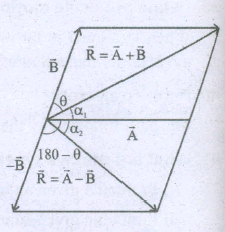
We can write \(\vec A-\vec B=\vec A+(-\vec B)\) and using the equation, we have \(\left| \vec { A } -\vec { B } \right| =\sqrt { { A }^{ 2 }+{ B }^{ 2 }+2ABcos\left( 180-\theta \right) } \)
Since, cos(180 -θ ) = -cosθ, we get \(\Rightarrow \left| \vec { A } -\vec { B } \right| =\sqrt { { A }^{ 2 }+{ B }^{ 2 }-2ABcos\theta } \)
Again from the figure, and using an equation similar to the equation
\(tan\ { \alpha }_{ 2 }=\frac { Bsin\left( 180^{ 0 }-\theta \right) }{ A+Bcos\left( 180^{ 0 }-\theta \right) } \)
But sin(180°- θ ) = sine hence we get
\(\Rightarrow tan\ { \alpha }_{ 2 }=\frac { Bsin\theta }{ A-Bcos\theta } \)
42.
Kinetic energy of rotation = \(\frac { 1 }{ 2 } I{ \omega }^{ 2 }\)
=\(\frac { 1 }{ 2 } \left( \frac { 1 }{ 2 } { mr }^{ 3 } \right) { \omega }^{ 2 }\)
=\(\frac { 1 }{ 4 } \times 20\times (0.25)^{ 2 }\times 100\times 100\)
=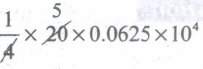
= 3125 J
43.
Mass of a car (m) = 2\(\times\)103 kg
The coefficient of friction (μ)= 0.05
Speed (v) = 40 ms-1
Displacement (s) = 2 km = 2000 m
Power, p = ?
Watt, w = ?
F = before of friction = umg
Power = F v = μmg\(\times\)v
= 0.05\(\times\)2\(\times\)103\(\times\)10\(\times\)40
= 4\(\times\)104 Watt
= 40 kW
Workdone, W = F.S = μmgs
= 0.05\(\times\)2\(\times\)103 \(\times\)10\(\times\)2\(\times\)103
= 2\(\times\)106 J

11th Standard Syllabus & Materials
11th Standard
TN 11th Tamil பீடு பெற நில் - செய்யுள் - காவடிச்சிந்து Important Questions And Answers Study Material - QB365 Set A
NEW11th Standard
TN 11th Tamil பீடு பெற நில் - உரைநடை - மலை இடப்பெயர்கள் : ஓர் ஆய்வு Important Questions And Answers Study Material - QB365 Set A
NEW11th Standard
TN 11th Tamil மாமழை போற்றுதும் - துணைப்பாடம் - யானை டாக்டர் Important Questions And Answers Study Material - QB365 Set A
NEW11th Standard
TN 11th Tamil மாமழை போற்றுதும் - செய்யுள் - ஐங்குறுநூறு Important Questions And Answers Study Material - QB365 Set A



Tamilnadu Stateboard 11th Standard Subjects

Maths

Commerce

Economics

Biology

Business Maths and Statistics

Accountancy

Computer Science
Physics

Chemistry
Maths
Biology
Economics
Physics
Chemistry

History
Business Maths and Statistics

Computer Science
Accountancy

Computer Applications
History
Computer Technology
Commerce
Computer Applications
Computer Technology

Tamil

English

French
Tamilnadu Stateboard Standards

