
 100% FREE ACCESS
11th Standard Syllabus & Materials
11th Standard
TN 11th Tamil இயற்கை வேளாண்மை,சுற்றுச்சூழல் -செய்யுள் - மனோன்மணீயம் Important Questions And Answers Study Material - QB365 Set A
NEW11th Standard
TN 11th Tamil என்னுயிர் என்பேன் -துணைப்பாடம் - இசைத்தமிழர் இருவர் Important Questions And Answers Study Material - QB365 Set A
NEW11th Standard
TN 11th Tamil மொழி கலை -செய்யுள் - ஒவ்வொரு புல்லையும் Important Questions And Answers Study Material - QB365 Set A
NEW11th Standard
TN 11th Tamil பீடு பெற நில் - இலக்கணம் - பகுபத உறுப்புகள் Important Questions And Answers Study Material - QB365 Set A
NEW11th Standard
TN 11th Tamil பீடு பெற நில் - துணைப்பாடம் - வாடிவாசல் Important Questions And Answers Study Material - QB365 Set A
NEW11th Standard
TN 11th Tamil பீடு பெற நில் - செய்யுள் - குறுந்தொகை Important Questions And Answers Study Material - QB365 Set A

Published on: 30/09/2018
Important 2mark -chapter 7,8
Download Tamil Nadu 11th Standard Chemistry question papers, model tests, one-mark questions, important questions, and public exam papers in PDF format. Free study materials and answer keys for TN State Board students.
Questions + Answers key
Take MCQ Chemistry Test
1.
State law of mass action.
2.
Consider the following reactions,
H2(g) + I2(g) ⇌ 2 HI(g)
In each of the above reaction find out whether you have to increase (or) decrease the volume to increase the yield of the product.
3.
If there is no change in concentration, why is the equilibrium state considered dynamic?
4.
What is meant by open system? Give example.
5.
Predict in which of the following, entropy increases or decreases.
(I) A liquid crystallizes into a solid
(ii) Temperature of a crystallized solid is raised from 0 K to 115 K
(iii) 2NaHCO3 (s) \(\longrightarrow\) Na2CO3 (s) + CO2 (g) + H2O (g)
(iv) H2 (g) \(\longrightarrow\) 2H(g)
6.
What are spontaneous reaction? Give three examples for spontaneous reaction.
7.
Define Zeroth law of thermodynamics (or) Law of thermal equilibrium.
8.
Calculate the entropy change in surroundings when 1 mol of H20(I) is formed under standard conditions. Given \(\Delta { H }^{ \ominus }\) = - 286 kJ mol-1.
9.
For the equilibrium PCI5(s) ⇌ PCl3(g) + CI2(g) at 25°C kc = 1.8 x 10⁻⁷ R = 8.314 Jk-1 mol-1 Calculate ΔGo for the reaction.
10.
Identify the state and path function out of the following:
a) Enthalpy
b) Entropy
c) Heat
d) Temperature
e) Work
f) Free energy.
11.
State the third law of thermodynamics.
12.
Define enthalpy of combustion.
13.
Define Gibbs' free energy.
14.
Predict the feasibility of a reaction when
(i) both ΔH and ΔS positive
(ii) both ΔH and ΔS negative
(iii) ΔH decreases but ΔS increases
15.
What is the usual definition of entropy? What is the unit of entropy?
16.
Explain intensive properties with two examples
17.
Define Hess's law of constant heat summation.
18.
State the first law of thermodynamics.
19.
Deduce the Vant Hoff equation.
20.
Explain how will you predict the direction of a equilibrium reaction.
21.
When the numerical value of the reaction quotient (Q) is greater than the equilibrium constant (K), in which direction does the reaction proceed to reach equilibrium?
22.
For a gaseous homogeneous reaction at equilibrium, number of moles of products are greater than the number of moles of reactants. Is KC is larger or smaller than KP.
23.
Derive the relation between KP and KC.
24.
Write a balanced chemical equation for equilibrium reaction for which the equilibrium constant is given by expression
\(K_c={[NH_3]^4[O_2]^5\over [NO]^4[H_2O]^6}\)
25.
Derive a general expression for the equilibrium constant KP and KC for the reaction
3H2(g) + N2(g) ⇌ 2NH3(g).
1.
At any instant, the rate of a chemical reaction, at a given temperature is directly proportional to the product of the active masses of the reactants at that instant.
Rate of the reaction \(\alpha \) [Reactant]x
2.
\( \mathrm{H}_{2(\mathrm{~g})}+\mathrm{I}_{2(\mathrm{~g})} \rightleftharpoons 2 \mathrm{HI}_{(\mathrm{g})} \)
\(\mathrm{K}_{\mathrm{c}}=\frac{4 x^{2}}{(a-x)(b-x)}\)
This expression doesn't involve, V. So, increase or decrease of volume will not affect the equilibrium and hence the yield of the product.
3.
This condition is not static and is dynamic, because both the forward and reverse reactions are still occurring with the same rate. No macroscopic change is observed.
4.
(i) A system which can exchange both matter and energy with its surroundings is called an open system.
(ii) Hot water contained in an open beaker is an example for open system.
(iii) In this system, both water vapour and heat is transferred to the surroundings through the imaginary boundary.
(iv) All living things are open systems because they continuously exchange matter and energy with the surroundings.
5.
(i) After freezing, the molecules attain an ordered state and therefore, entropy decreases.
(ii) At 0 K the constituent particles are in static form therefore, entropy is minimum. If the temperature.is raised to 115 K particles begin to move and entropy increases.
(iii) Reactant, NaHCO3 is solid. Thus, its entropy is less in comparison to product which has high entropy.
(iv) Here, one molecule gives two atoms. Thus, number of particles increases and this leads to more disordered form.
6.
A reaction that does occur under the given set of conditions is called a spontaneous reaction.
Example:
1. A waterfall runs downhill, but never up, spontaneously.
2. Heat flows from hotter object to a colder one.
3. Ageing process.
7.
Zeroth law of thermodynamics states that 'If two systems at different temperatures are separately in thermal equilibrium with a third one, then they tend to be in thermal equilibrium with themselves'.
8.
\(q_{rev}= (-\Delta_f H^{\ominus})=-286 kJ\ mol^{-1}=286000\ J\ mol^{-1}\)
\(\Delta{S}{_{(Surroundmgs)}}=\frac{q_{rev}}{T}=\frac{286000\ J\ mol^{-1}}{298\ K}\) = 959 J K-1 mol-1.
9.
ΔG0 = - 2.303 RT log kc
= - 2.303 x 8.314 x 298 log (1.8 x 10⁻⁷)
= - 38484 J mol-1
= - 38.484 kJ mol-1
10.
State Function: Enthalpy, entropy, temperature, free energy
Path Function: Heat, work.
11.
(i) The third law of thermodynamics states that the entropy of pure crystalline substance at absolute zero is zero.
(ii) It can also be stated as it is impossible to lower the temperature of an object to absolute zero in a finite number of steps
(iii) Mathematically, \(\lim _{ T\rightarrow 0 }{ S=0 } \) for a perfectly ordered crystalline state.
12.
The heat of combustion of a substance is defined as "The change in enthalpy of a system when one mole of the substance is completely burnt in excess of air or oxygen". It is denoted by ΔHC
13.
Gibbs free energy is defined as G = H - TS
14.
(i) non-spontaneous
(ii) non-spontaneous
(iii) spontaneous
15.
(i) Entropy is a measure of the molecular disorderliness (randomness) of a system. dS = dqrev/T
(ii) The entropy (S) is equal to heat energy exchanged (q) divided by the temperature (T) at which the exchange takes place. Therefore, The SI unit of entropy is JK-1
16.
The property that is independent of the mass or the size of the system is called an intensive property.
Examples: Refractive index, Surface tension, density, temperature, Boiling point, Freezing point, molar volume, etc.,
17.
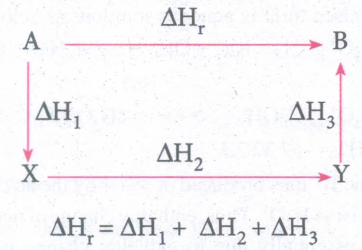
The enthalpy change of a reaction either at constant volume or constant pressure is the same whether it takes place in a single or multiple steps provided the initial and final states are same.
18.
The first law of thermodynamics, also known as the law of conservation of energy, states that "The total energy of an isolated system remains constant though it may change from one form to another."
The mathematical statement of the First Law is: ΔU=q+w
Where q - the amount of heat supplied to the system; w - work done on the system
19.
This equation gives the quantitative temperature dependence of equilibrium constant (K). The relation between standard free energy change (\(\triangle\)GO) and equilibrium constant is
\(\Delta { G }^{ 0 }=-RTln\ K\) ...(1)
We know that
\(\Delta { G }^{ 0 }=\Delta { H }^{ 0 }-T\Delta { S }^{ 0 }\)
Substituting (1) in equation (2)
\(-RTln\ K\ =\Delta { H }^{ 0 }-T\Delta { s }^{ 0 }\)
Rearranging
In \(K=\cfrac { -\Delta H^{ 0 } }{ RT } +\cfrac { { \Delta S }^{ 0 } }{ R } \) ...(3)
Differentiating equation (3) with respect to temperature
\(\cfrac { d\left( In\quad K \right) }{ dT } =\cfrac { \Delta { H }^{ 0 } }{ { RT }^{ 2 } } \) ...(4)
Equation 4 is known as differential form of Van't Hoff equation.
On integrating the equation 4, between T1 and T2 with their respective equilibrium constants K1 and K2.
\(\int _{ { k }_{ 1 } }^{ { K }_{ 2 } }{ d\left( In\ K \right) =\cfrac { \Delta { H }^{ 0 } }{ R } \int _{ { T }_{ 2 } }^{ { { T }_{ 2 } } }{ \cfrac { dT }{ { T }^{ 2 } } } } \)
\(\left[ In\quad K \right] _{ { K }_{ 1 } }^{ { K }_{ 2 } }=\cfrac { \Delta { H }^{ 0 } }{ R } \left[ -\cfrac { 1 }{ T } \right] ^{ { T }_{ 2 } }_{ { T }_{ 1 } }\)
\(In\quad { K }_{ 2 }-In\quad { K }_{ 1 }=\cfrac { \Delta { H }^{ 0 } }{ R } -\left[ \cfrac { 1 }{ { T }_{ 2 } } +\cfrac { 1 }{ { T }_{ 2 } } \right] \)
\(In\quad \cfrac { { K }_{ 2 } }{ { K }_{ 1 } } =\cfrac { \Delta { H }^{ 0 } }{ R } \left[ \cfrac { { T }_{ 2 }-{ T }_{ 1 } }{ { T }_{ 2 }{ T }_{ 1 } } \right] \)
\(log\quad \cfrac { { K }_{ 2 } }{ { K }_{ 1 } } =\cfrac { \Delta { H }^{ 0 } }{ 2.303R } \left[ \cfrac { { T }_{ 2 }-{ T }_{ 1 } }{ { T }_{ 2 }{ T }_{ 1 } } \right] \) ...(5)
Equation (5) is known as integrated form of Van't Hoff equation.
20.
If we know the value of kc and Q, the reaction quotient, we can predict the direction of a reaction
If Q = Kc; the reaction is in equilibrium state.
If Q > Kc: the reaction will proceed in the reverse direction i.e., formation of reactants.
If Q < Kc: the reaction will proceed in the forward direction i.e., formation of products.
21.
If Q > Kc; the reaction will proceed in the reverse direction (ie) formation of reactants to proceed to reach equilibrium.
22.
\(\Delta n_{g}=\sum n p_{(g)}-\sum n R_{(g)}\)
As \(\Delta n_{p}(g)\) is greater \(\Delta n_{g}=+v e\)
\( \therefore K_{p}=K_{c}(R T)^{+v e} \)
\(\therefore K_{p}>K_{c} \)
So K is smaller than Kp.
23.
Let us consider the general reaction in which all reactants and products are ideal gases
\(xA+yB\rightleftharpoons IC+mD\)
The equilibrium constant, Kc is
\({ K }_{ c }=\cfrac { \left[ C \right] ^{ I }\left[ D \right] ^{ m } }{ \left[ A \right] ^{ x }\left[ B \right] ^{ y } } \) .......(1)
and Kp is
\({ K }_{ p }=\cfrac { { p }_{ c }^{ I }\times { p }_{ D }^{ m } }{ { p }_{ a }^{ x }\times { p }_{ B }^{ y } } \) ..........(2)
The ideal gas equation is
PY = nRT
or
\(P=\cfrac { n }{ V } RT\)
Since Active mass = molar concentration = n/V
p = active mass\(\times\)RT
Based on the above expression the partial pressure of the reactants and products can be expressed as,
\({ p }_{ A }^{ x }=\left[ A \right] ^{ x }\left[ RT \right] ^{ x }\)
\({ p }_{ B }^{ y }=\left[ B \right] ^{ y }\left[ RT \right] ^{ y }\)
\({ p }_{ C }^{ 1 }=\left[ C \right] ^{ I }\left[ RT \right] ^{ 1 }\)
\({ p }_{ D }^{ m }=\left[ D \right] ^{ m }\left[ RT \right] ^{ m }\)
On substitution in eqn. 2,
\({ K }_{ p }=\cfrac { { \left[ C \right] }^{ 1 }{ \left[ RT \right] }^{ 1 }{ \left[ D \right] }^{ m }{ \left[ RT \right] }^{ m } }{ { \left[ A \right] }^{ x }{ \left[ RT \right] }^{ x }{ \left[ B \right] }^{ y }{ \left[ RT \right] }^{ y } } \) .........(3)
\({ K }_{ p }=\cfrac { { \left[ C \right] }^{ 1 }{ \left[ D \right] }^{ m }{ \left[ RT \right] }^{ I+m } }{ { \left[ A\quad \right] }^{ x }{ \left[ B \right] }^{ y }{ \left[ RT \right] }^{ x+y } } \)
\({ K }_{ p }=\cfrac { { \left[ C \right] }^{ I }{ \left[ D \right] }^{ m } }{ { \left[ A \right] }^{ x }{ \left[ B \right] }^{ y } } \left[ RT \right] ^{ \left( 1+m \right) -\left( x+y \right) }\) ...........(4)
Sub (1) in (4)
\({ K }_{ p }={ K }_{ C }\left( RT \right) ^{ \left( \Delta { n }_{ g } \right) }\)
where,
\({ \Delta n }_{ g }\) is the difference between the sum of number of moles of products and the sum of number of moles of reactants in the gas phase.
24.
\(K_c={[NH_3]^4[O_2]^5\over [NO]^4[H_2O]^6}\)
\(4 \mathrm{NO}_{(\mathrm{g})}+6 \mathrm{H}_{2} \mathrm{O}_{(\mathrm{g})} \rightleftharpoons 4 \mathrm{NH}_{3(\mathrm{~g})}+5 \mathrm{O}_{2(\mathrm{~g})}\)
25.
Let us consider the formation of ammonia in which, 'a' moles nitrogen and 'b' moles hydrogen gas are allowed to react in a container of volume V. Let 'x' moles of nitrogen react with 3x moles of hydrogen to give 2x moles of ammonia.
\({ N }_{ 2 }\left( g \right) +3{ H }_{ 2 }\left( g \right) \rightleftharpoons { 2NH }_{ 3 }\left( g \right) \)
| N2 | H2 | NH3 | |
| Initial number of moles | a | b | 0 |
| number of moles reacted | x | 3x | 0 |
| Number of moles at equilibrium | a - x | b - 3x | 2x |
| Active mass or molaroncentration at equilibrium | \(\cfrac { a-x }{ V } \) | \(\cfrac { b-3x }{ V } \) | \(\cfrac { 2x }{ V } \) |
Applying law of mass action
\({ K }_{ C }=\cfrac { \left[ { NH }_{ 3 } \right] ^{ 2 } }{ \left[ { N }_{ 2 } \right] \left[ { H }_{ 2 } \right] ^{ 3 } } \)
= \(\cfrac { \left( \cfrac { 2x }{ V } \right) ^{ 2 } }{ \left( \cfrac { a-x }{ V } \right) \left( \cfrac { b-3x }{ V } \right) ^{ 3 } } \)
= \(\cfrac { \left( \cfrac { 4x }{ V } \right) ^{ 2 } }{ \left( \cfrac { a-x }{ V } \right) \left( \cfrac { b-3x }{ V } \right) ^{ 3 } } \)
\({ K }_{ C }=\cfrac { 4{ x }^{ 2 }{ V }^{ 2 } }{ \left( a-x \right) \left( b-3x \right) ^{ 2 } } \)
The equilibrium constant Kp can also be calculated as follows:
\({ K }_{ p }={ K }_{ C }\left( RT \right) ^{ \left( \Delta { n }_{ g } \right) }\)
\(\Delta \)ng =np - nr = 2 - 4 = -2
\({ K }_{ p }=\cfrac { { 4x }^{ 2 }{ V }^{ 2 } }{ \left( a-x \right) \left( b-3x \right) ^{ 3 } } \left( RT \right) ^{ -2 }\)
Total number of moles at equilibrium,
n = a - x + b - 3x + 2x = a + b - 2x
\({ K }_{ p }=\cfrac { { 4x }^{ 2 }{ V }^{ 2 } }{ \left( a-x \right) \left( b-3x \right) ^{ 3 } } \times \left[ \cfrac { PV }{ n } \right] ^{ -2 }\)
\({ K }_{ p }=\cfrac { { 4x }^{ 2 }{ V }^{ 2 } }{ \left( a-x \right) \left( b-3x \right) ^{ 3 } } \times \left[ \cfrac { n }{ PV } \right] ^{ 2 }\)
\({ K }_{ p }=\cfrac { { 4x }^{ 2 }{ V }^{ 2 } }{ \left( a-x \right) \left( b-3x \right) ^{ 3 } } \times \left[ \cfrac { a+b-2x }{ PV } \right] ^{ 2 }\)
\({ K }_{ p }=\cfrac { 4{ x }^{ 2 }\left( a+b\quad -2x \right) ^{ 2 } }{ { P }^{ 2 }\left( a-x \right) \left( b-3x \right) ^{ 3 } } \)

11th Standard Syllabus & Materials
11th Standard
TN 11th Tamil பீடு பெற நில் - செய்யுள் - காவடிச்சிந்து Important Questions And Answers Study Material - QB365 Set A
NEW11th Standard
TN 11th Tamil பீடு பெற நில் - உரைநடை - மலை இடப்பெயர்கள் : ஓர் ஆய்வு Important Questions And Answers Study Material - QB365 Set A
NEW11th Standard
TN 11th Tamil மாமழை போற்றுதும் - துணைப்பாடம் - யானை டாக்டர் Important Questions And Answers Study Material - QB365 Set A
NEW11th Standard
TN 11th Tamil மாமழை போற்றுதும் - செய்யுள் - ஐங்குறுநூறு Important Questions And Answers Study Material - QB365 Set A



Tamilnadu Stateboard 11th Standard Subjects

Maths

Commerce

Economics

Biology

Business Maths and Statistics

Accountancy

Computer Science

Physics
Chemistry
Maths
Biology
Economics
Physics
Chemistry

History
Business Maths and Statistics

Computer Science
Accountancy

Computer Applications
History
Computer Technology
Commerce
Computer Applications
Computer Technology

Tamil

English

French
Tamilnadu Stateboard Standards
